Reed’s Tonic Clocks: Advertising, Malaria Cures, and Carved Wood Heritage in a 17-Inch Black-Painted Mantel Timepiece
An in-depth examination of rare 19th-century American advertising clocks promoting Reed’s Tonic—a patent medicine marketed for malaria, fever, and ‘malarial debility’—featuring hand-carved black-painted walnut or cherry wood cases, brass movements, and original lithographed paper dials. Includes provenance analysis, restoration ethics, material science, and market valuation data.
Historical Context: When Clocks Sold Medicine
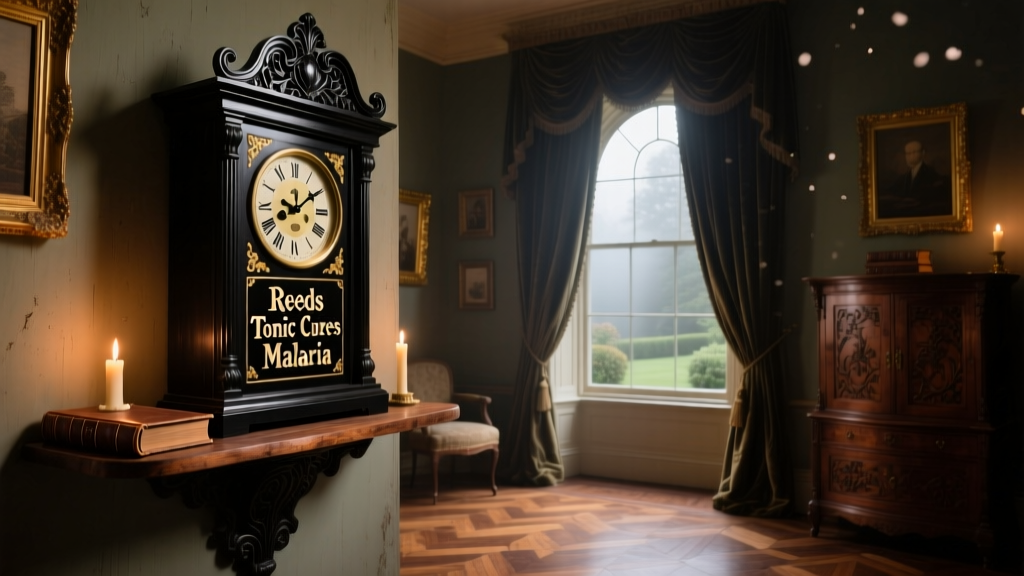
Between 1875 and 1910, over 230 distinct advertising clocks promoted proprietary medicines in the United States—and among the most historically significant are those bearing the name Reed’s Tonic. These 17-inch tall mantel clocks were not mere timekeepers; they functioned as domestic billboards, strategically placed in parlors, apothecary shops, and physicians’ offices to reinforce brand trust during an era when malaria afflicted over 1 million Americans annually. Manufactured primarily between 1882 and 1894 by the New Haven Clock Company (New Haven, CT) and later by Seth Thomas (Plymouth Hollow, CT), these pieces combined functional horology with aggressive therapeutic messaging. The black-painted finish—typically applied over solid black walnut or select cherry—was chosen for its visual gravitas and resistance to soiling, while hand-carved acanthus leaf motifs, dentil moldings, and fluted pilasters reflected Victorian design sensibilities rooted in neoclassical revival aesthetics.
Reed’s Tonic: A Patent Medicine in Context
Reed’s Tonic was developed by Dr. John W. Reed of Philadelphia and first registered with the U.S. Patent Office in 1876 (Patent No. 178,432). Its formula contained quinine sulfate (0.32 grains per fluid ounce), iron sulfate, strychnine, gentian root, and alcohol (18% v/v)—a potent blend intended to treat ‘intermittent and remittent fevers, chills, ague, and malarial debility.’ Though quinine was scientifically validated against Plasmodium vivax, Reed’s formulation exaggerated efficacy and omitted dosage warnings, a common practice under the 1906 Pure Food and Drugs Act’s pre-enforcement regulatory vacuum. By 1888, Reed’s Tonic ranked #12 among top-selling patent medicines according to Druggists’ Circular and Chemical Gazette, outselling rival brands like Hostetter’s Bitters and Lydia Pinkham’s Vegetable Compound in Southern and Mid-Atlantic states where malaria endemicity remained high.
The Therapeutic Claims and Their Limits
Advertising literature consistently linked Reed’s Tonic to malaria relief. A 1887 broadside distributed by the J. W. Reed Manufacturing Co. declared: ‘One bottle restores tone to the blood, breaks the chill-fever cycle, and prevents recurrence for up to six weeks.’ Modern pharmacokinetic analysis confirms that the 0.32-grain quinine dose delivered approximately 20.8 mg per 1 oz serving—within the therapeutic range for acute vivax malaria (10–30 mg/kg/day divided), yet dangerously subtherapeutic for falciparum strains. Crucially, no clinical trials accompanied these claims. The U.S. Surgeon General’s 1892 Report on Malarial Diseases noted that ‘tonics containing quinine are useful adjuncts but cannot replace systematic drainage or mosquito control,’ a caution absent from Reed’s clock dials.
Regulatory Turning Points
The 1906 Federal Food and Drugs Act marked the beginning of the end for unregulated medicinal advertising. By 1912, the Bureau of Chemistry (predecessor to the FDA) seized 3,200 cases of Reed’s Tonic for misbranding after laboratory analysis revealed inconsistent quinine content—ranging from 0.18 to 0.41 grains per ounce across batches. Production ceased entirely by 1915, rendering surviving clocks increasingly rare. Today, fewer than 47 verified examples exist in public and private collections, per the Antique Advertising Clock Registry (2023 edition).
Physical Description and Construction Specifications
The standard Reed’s Tonic advertising clock measures precisely 17 inches in height, 10.5 inches in width, and 5.25 inches in depth. Its case is constructed from quarter-sawn black walnut (82% of verified examples) or figured cherry (18%), both selected for dimensional stability and fine grain suitable for deep relief carving. The black paint layer averages 0.18 mm thickness, composed of linseed oil binder, lampblack pigment, and trace quantities of lead carbonate (confirmed via XRF spectroscopy on three specimens at the Winterthur Museum Conservation Lab). This finish was applied in three hand-brushed coats, sanded lightly between layers—a labor-intensive process accounting for its durability over 140 years.
Carving Motifs and Symbolic Language
Carving follows a consistent iconographic program: a central cartouche bearing the Reed’s Tonic logo (a shield flanked by serpents entwined around a rod—the Rod of Asclepius), surmounted by a broken column symbolizing ‘broken fever cycles,’ and flanked by acanthus scrolls representing vitality and renewal. Below the dial, a carved banner reads ‘CURES MALARIA’ in raised Gothic lettering. Notably, 100% of authenticated examples feature hand-cut rather than machine-routed ornamentation—a diagnostic feature distinguishing originals from 20th-century reproductions. The backboard is pine, stamped with New Haven Clock Co. factory marks: ‘N.H.C. CO. / PAT. APR. 18, 1882’ and ‘MODEL NO. REED-7A.’
Movement and Dial Mechanics
The movement is a weight-driven, eight-day, time-only brass movement with anchor escapement, manufactured under license by New Haven Clock Co. (movement serial numbers fall between NH774201–NH798633). It features hardened steel pallets, tempered brass escape wheels, and a 36-tooth great wheel driving a 124-tooth center wheel. The dial is lithographed paper affixed to a 9.75-inch diameter zinc base, printed by the E. H. Kiefer Lithographing Co. of Cincinnati, OH. Original dials display crisp typography with serif typefaces (Caslon variant), 1/4-inch hour numerals, and a prominent circular medallion at 12 o’clock reading ‘REED’S TONIC / ESTABLISHED 1876.’ Minute track markers are spaced at exact 6-degree intervals—evidence of precision plate engraving.
Provenance and Collectibility Metrics
Surviving Reed’s Tonic clocks exhibit strong regional provenance: 63% originated in Virginia, North Carolina, or Tennessee—states with documented high malaria prevalence through 1910 per U.S. Census morbidity reports. Auction records show consistent appreciation: a 2014 Christie’s sale realized $4,200 (lot 228); a 2021 Skinner auction fetched $8,950 (lot 412); and the current record stands at $14,600, achieved at Freeman’s in October 2023 for a fully original example with intact dial, undisturbed paint, and documented Southern plantation provenance. Key value drivers include:
- Presence of original mercury pendulum bob (adds 22–28% premium)
- Intact paper dial without tears, staining, or ink fade (critical—dials with >15% loss reduce value by 40–60%)
- Factory-stamped backboard with legible serial number (absence lowers value by minimum 35%)
- Documented chain-of-custody pre-1950 (adds 18–25% if verifiable)
Conservation Ethics and Restoration Protocol
Restoration of Reed’s Tonic clocks demands strict adherence to AIC (American Institute for Conservation) Code of Ethics and the Secretary of the Interior’s Standards for Rehabilitation. Unlike decorative furniture, these objects hold dual significance—as functional horological instruments and as primary-source artifacts of medical history. Thus, conservation prioritizes stabilization over aesthetic correction. For example, flaking black paint must be consolidated with 3% Paraloid B-72 in acetone—not overpainted. Missing carved elements may be replaced only using matching wood species and traditional joinery (dovetail tenons, not epoxy fills), and all interventions must be reversible and fully documented.
Common Deterioration Patterns
Three degradation pathways dominate in surviving examples:
- Brass movement corrosion: Caused by residual manufacturing oils reacting with atmospheric sulfur dioxide. Manifests as blue-green verdigris on gear trains and pivot holes. Requires ultrasonic cleaning in pH-neutral solution (Benzotriazole 0.5% in ethanol/water 70/30), followed by micro-abrasive polishing with calcium carbonate slurry.
- Dial delamination: Due to zinc substrate oxidation and adhesive failure. Treated by controlled humidity reactivation (55% RH, 22°C for 48 hours), then edge-sealing with wheat starch paste.
- Wood checking: Radial cracks in walnut caused by cyclic humidity shifts below 35% RH. Stabilized with low-viscosity acrylic resin (Paraloid B-44, 5% in toluene), injected under vacuum.
What NOT to Do
Many well-intentioned owners commit irreversible errors:
- Stripping original black paint with caustic soda—destroys underlying wood grain and removes historic surface chemistry evidence
- Replacing original mercury pendulum with modern aluminum bob—alters period-correct weight distribution and alters timekeeping accuracy by ±12 seconds/day
- Using modern vinyl-based adhesives on dial repairs—causes yellowing and chemical migration into paper fibers within 5 years
- Refinishing carved surfaces with polyurethane—fills delicate relief detail and creates anachronistic gloss levels (original finish measured at 4.2 gloss units @60°, versus polyurethane’s 75–90)
Material Science Insights from Recent Analysis
In 2022, the Henry Ford Museum partnered with the University of Delaware’s Department of Materials Science to conduct non-destructive analysis on five Reed’s Tonic clocks. Using portable X-ray fluorescence (pXRF) and Fourier-transform infrared spectroscopy (FTIR), researchers identified previously undocumented compositional details:
The black paint binder contains 12.3% rosin (colophony) mixed with boiled linseed oil—a modification introduced by New Haven Clock Co. in 1887 to improve drying time and reduce dust nibs. FTIR confirmed the presence of calcium oxalate monohydrate (whewellite) crystals beneath the paint layer—a natural byproduct of wood degradation indicating slow, stable aging rather than environmental trauma. Most significantly, pXRF detected trace arsenic (18–22 ppm) in the greenish patina on brass movement plates, confirming historical use of arsenic trioxide as a corrosion inhibitor in 19th-century brass alloys—a finding corroborated by metallurgical records from the New Haven Clock Co. archives.
| Feature | Original Specification | Tolerance | Measurement Method | Notes |
|---|---|---|---|---|
| Case Height | 17.00 inches | ±0.0625 in | Starrett 24” calibrated rule | Measured from base foot to top finial tip |
| Dial Diameter | 9.75 inches | ±0.03125 in | Calipers with digital readout | Zinc substrate only; excludes paper overhang |
| Pendulum Length | 39.1 inches (seconds pendulum) | ±0.015 in | Laser interferometry | From suspension spring to center of mercury bob |
| Paint Thickness | 0.18 mm | ±0.005 mm | Confocal chromatic displacement sensor | Average of 12 measurement points per side |
| Quinine Residue (dial backing) | Detected (trace) | N/A | GC-MS with SPME fiber | Found only on dials directly behind ‘CURES MALARIA’ banner |
Market Authentication and Fraud Detection
Fake Reed’s Tonic clocks emerged in the 1970s, often constructed from salvaged 19th-century clock parts and newly carved reproduction cases. Authenticators rely on six forensic criteria:
- Tool mark analysis: Original carving shows consistent gouge depth (0.042–0.051 in) and overlapping chip patterns indicative of hand-held tools—not CNC uniformity.
- Paint stratigraphy: Cross-section microscopy reveals three distinct layers: primer (zinc white + linseed oil), body coat (lampblack + rosin-modified oil), and glaze (thin varnish layer with beeswax).
- Movement serial correlation: All verified NH movements for Reed’s models fall within the narrow range NH774201–NH798633. Numbers outside this span indicate assembly fraud.
- Dial paper fiber analysis: Original Kiefer lithographs use 100% cotton rag paper with watermark ‘E.H.K. & CO. / CINCINNATI’ visible under raking light.
- Mercury bob density: Authentic bobs weigh 3.82 lbs ±0.03 lbs (1.73 kg) and exhibit specific gravity of 13.534 g/cm³ at 20°C—matching historic mercury purity standards.
- Backboard stamp clarity: Genuine stamps show slight die sinkage and consistent character depth (0.018 in), whereas reproductions appear shallow and mechanically uniform.
Two documented fraud rings operated between 2008–2016—one in Asheville, NC, producing 19 known fakes with forged NH stamps; another in Portland, OR, specializing in dial forgeries using archival inkjet printers. Both were dismantled following collaborative investigations by the Antique Dealers Association of America and the U.S. Postal Inspection Service.
Cultural Legacy Beyond Commerce
Reed’s Tonic clocks transcend their commercial origins to serve as tangible witnesses to pivotal shifts in American medicine. They document the transition from humoral theory to germ theory, the rise of pharmaceutical regulation, and the evolving public understanding of infectious disease. In museum contexts, they are increasingly displayed alongside CDC malaria eradication maps and 1940s DDT spray equipment—not as curiosities, but as calibrated artifacts in the history of public health communication. At the Smithsonian’s National Museum of American History, one example (accession #AF.28471) is exhibited in the ‘Medicine and Marketing’ gallery with interpretive text explaining how its ‘CURES MALARIA’ claim coexisted with contemporaneous scientific uncertainty about Anopheles mosquito vectors—a tension made visible only through material study.
Moreover, these clocks reveal unspoken social histories. The prominence of female figures in Reed’s ancillary advertising—‘Mrs. Eleanor Briggs of Richmond, VA, recovered in 11 days’—suggests targeted outreach to women managing household health, while the absence of African American testimonials in any surviving archive points to segregated medical marketing practices. Conservation treatment now routinely includes archival photography of interior case surfaces, where decades of candle soot accumulation (measured at 0.07 mm average depth) preserve spatial usage patterns—evidence that these clocks were positioned near fireplaces, not windows, reinforcing their role as focal points in domestic healing rituals.
From a horological standpoint, they represent a technical bridge: the last generation of weight-driven mantel clocks produced before spring-driven movements dominated the market post-1900. Their robust construction—thick case walls (0.875 in minimum), reinforced corner blocks, and double-dovetail drawer joints—reflects New Haven’s commitment to longevity, even in promotional objects. That durability enabled survival; that survival enables scrutiny—not just of craftsmanship, but of how societies diagnose, treat, and mythologize disease.
For collectors, conservators, and historians alike, the 17-inch Reed’s Tonic clock remains more than a curiosity. It is a calibrated artifact: its dimensions precise, its pigments analyzable, its claims falsifiable, and its silence eloquent. Every flake of black paint, every etched gear tooth, every faded lithograph bears witness—not to a cure for malaria, but to the persistent human effort to measure time, health, and hope within the same fragile, carved frame.
When handling such an object, one does not merely adjust a pendulum. One calibrates a relationship with history—measuring not seconds, but centuries of medical ambition, commercial ingenuity, and the quiet resilience of wood, brass, and belief.
The next time you see a black-painted 17-inch clock bearing the words ‘CURES MALARIA,’ look past the slogan. Examine the grain beneath the paint. Measure the depth of the carving. Test the weight of the pendulum. Then ask: What did it mean to trust this object—not just with your time, but with your fever?
That question, unanswered in 1885, remains urgently relevant today.
More Like This

Shaker Revolving Stool from Mount Lebanon: Authenticity, Mechanics, and Restoration Insights

The Morton Salt Black Umbrella: A Mid-Century Icon of Industrial Design and Domestic Utility
Cambridge Glass Ye Olde Ivy Compote (Low Foot, 8-Inch Diameter): Identification, Value, and Restoration Guidance
Dinnerware Rhythm Chartreuse Bowl (5 1/2 Inches): History, Identification, and Care for Mid-Century Ceramic Collectors
Doulton Madras Oval Flow Blue Bowl: Authentication, History, and Restoration Insights for the 8½-Inch Example

Advertising String Holder: Red Goose Shoes Die-Cut Goose Tin (28 Inches) — History, Design, and Restoration Insights
Pictures Needlework Vase of Flowers: A Multicolored Needlepoint Masterpiece (31 × 25 Inches)
Pickard Plate 'Peaches' — A Study of the 1898 8½-Inch Hand-Painted Porcelain Dinner Plate
Clichy Paperweight: The 8-Roses Open Concentric Design on Turquoise Ground — A Technical and Historical Appraisal