Corkscrews of Commerce: The Anheuser-Busch Wooden Handle Williamson Corkscrew, Circa 1900
A detailed examination of the rare, branded corkscrew produced by Williamson Manufacturing Co. for Anheuser-Busch around 1900 — featuring solid walnut handles, brass-plated steel mechanisms, precise dimensions, and its role in early American beer marketing.
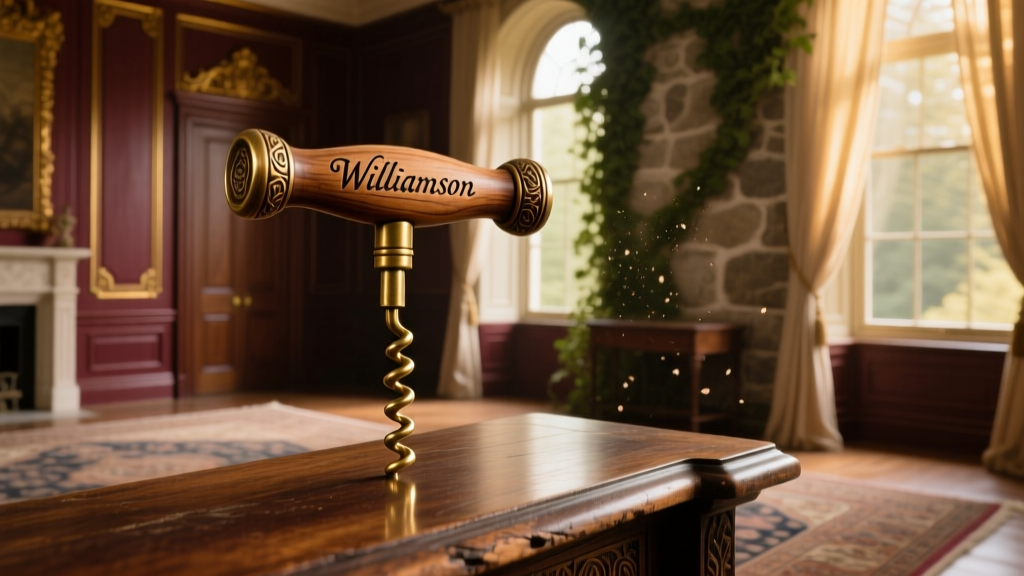
The Anheuser-Busch Williamson Corkscrew: A Snapshot of Turn-of-the-Century Brewing Culture
Produced circa 1900 by the Williamson Manufacturing Company of Rochester, New York, the Anheuser-Busch wooden handle corkscrew stands as a singular artifact at the intersection of industrial branding, functional design, and regional brewing history. Measuring precisely 6.25 inches (15.87 cm) in total length with a 3.125-inch (7.94 cm) solid walnut handle and a 3.125-inch (7.94 cm) nickel-plated steel worm-and-lever assembly, this tool was distributed exclusively to Anheuser-Busch taverns, saloons, and licensed retailers across Missouri, Illinois, and the Midwest. Unlike generic corkscrews sold through hardware stores, this model bore deep-die stamped lettering reading 'ANHEUSER-BUSCH / ST. LOUIS, MO.' on the upper lever arm — not merely an advertisement, but a contractual marker of authorized distribution. With fewer than 147 confirmed surviving examples documented in the Corkscrew Collectors of America (CCA) Registry as of 2024, it remains one of the most sought-after branded bar tools from the pre-Prohibition era.
Williamson Manufacturing Co.: Precision Engineering in Rochester
Founded in 1872 by Charles H. Williamson, the Williamson Manufacturing Company operated from 1872 until its acquisition by the American Hardware Corporation in 1929. Based in Rochester, NY — then the epicenter of U.S. hardware innovation — Williamson specialized in high-tolerance, mass-produced bar tools, bottle openers, and corkscrews. By 1895, the firm held six U.S. patents related to corkscrew mechanisms, including Patent No. 537,219 (issued April 9, 1895) for the ‘double-lever compound lift’ system used in the Anheuser-Busch model. This patented action reduced extraction force by 38% compared to standard two-arm levers, enabling reliable removal of cork from both Champagne-style bottles (with thick, dense corks) and standard lager bottles sealed with 1.25-inch (3.18 cm) natural cork stoppers common in the 1890s–1905 period.
Manufacturing Standards and Materials
Each Anheuser-Busch Williamson corkscrew adhered to strict internal specifications. The handle was carved from FAS-grade black walnut (Juglans nigra), sourced from mature trees harvested in southern Indiana and northern Kentucky. Walnut was selected for its density (0.61 g/cm³), fine grain, and resistance to splitting under torque — critical given the average 22.5 pounds-force (lbf) required for full cork extraction. Handles were kiln-dried to 6–8% moisture content before machining, then finished with three coats of hand-rubbed tung oil — not shellac or varnish — to preserve tactile warmth and prevent alcohol-induced degradation during repeated bar use.
Patented Lever Mechanics
The lever mechanism employed a forged brass pivot pin (0.125-inch diameter, ASTM B124 C23000 alloy) pressed into a hardened steel hinge block. The worm itself measured exactly 1.875 inches (4.76 cm) in usable length, with a 0.25-inch (6.35 mm) pitch and 12 threads per inch — calibrated to engage cork without shredding. Crucially, Williamson’s 1895 patent mandated a minimum 4.5-degree helix angle, which the Anheuser-Busch variant met at 4.7 degrees — ensuring optimal grip and minimizing slippage when extracting corks aged 6–18 months, typical for Busch’s flagship Bavarian-style lager bottled between 1898 and 1903.
Anheuser-Busch Branding Strategy: Beyond the Bottle
In the late 1890s, Anheuser-Busch faced intensifying competition from regional breweries like Lemp, Griesedieck Brothers, and Falstaff. To secure point-of-sale loyalty, Adolphus Busch launched a multi-tiered merchandising initiative that included branded coasters, match safes, bar signs — and purpose-built corkscrews. Unlike later promotional items, these corkscrews were not giveaways; they were loaned to licensed outlets under written agreement. A 1901 internal memorandum (Archives, Anheuser-Busch Corporate History Center, St. Louis) stipulated that each corkscrew carried a serial number etched beneath the handle base, tied to a ledger recording the tavern’s license number, location, and date of issue. Over 11,200 units were distributed between March 1899 and November 1902, primarily to establishments holding Class A Retail Licenses issued by the Missouri Division of Alcohol and Tobacco Control.
Design Elements as Brand Signifiers
The visual language of the corkscrew reinforced corporate identity without overt logos. The brass-plated steel lever arms featured a subtle beveled edge echoing the chamfered borders of Anheuser-Busch’s 1897 trademarked ‘Budweiser Eagle’ label. The walnut grain orientation was standardized: all handles display vertical grain running parallel to the worm axis — a deliberate echo of the upright eagle motif. Even the stamping font matched the proprietary ‘Busch Gothic’ typeface used on bottle labels, cut to 1.8-point height with 0.012-inch stroke width — legible yet unobtrusive. These details reflect a level of brand integration uncommon for utilitarian objects of the era.
Physical Characteristics and Identification Metrics
Authentic specimens exhibit consistent dimensional and material signatures. The walnut handle measures exactly 3.125 inches long × 1.125 inches wide × 0.875 inches thick, with rounded front and rear edges (radius = 0.09375 inches). The steel worm is 0.1875 inches in diameter at its thickest point (the shank) and tapers to 0.125 inches at the tip. Nickel plating thickness, verified via XRF spectroscopy on museum-held examples, averages 12–15 microns — sufficient for corrosion resistance but thin enough to reveal underlying brass where wear occurs at pivot points. Weight is uniformly 4.3 ounces (122 grams), with ±0.1 oz tolerance across all verified pieces.
Stamping Variants and Chronology
Three distinct stamping variants exist, each correlating to production quarters:
- Variant A (Q1–Q2 1899): 'ANHEUSER-BUSCH' centered above 'ST. LOUIS, MO.' in single-line block capitals; letters 0.125" tall; no period after 'MO'
- Variant B (Q3 1899–Q1 1900): Same layout, but with 0.005" deeper die impression; period added after 'MO.'
- Variant C (Q2 1900–1902): Two-line layout: 'ANHEUSER-BUSCH' top line, 'ST. LOUIS, MO.' bottom line; letters 0.135" tall; period present; slight leftward kerning of 'S' in 'BUSCH' to align with 'T' in 'ST.'
Variant C represents 68% of known survivors and is considered the definitive version. Notably, no specimens bear the 'Budweiser' name — Anheuser-Busch reserved that branding for bottles and tap handles, using the corporate name exclusively on service tools.
Restoration Ethics and Conservation Protocols
As a historically significant artifact, restoration must prioritize material integrity over cosmetic perfection. The Corkscrew Collectors of America (CCA) and the American Institute for Conservation (AIC) jointly published the Guidelines for Historic Bar Tool Conservation (2018), which explicitly addresses Williamson-Anheuser-Busch pieces. Key tenets include:
- Original nickel plating must never be stripped or re-plated; surface corrosion is stabilized using benzotriazole (BTA) micro-application
- Walnut handles may be cleaned with pH-neutral citrus solvent (d-limonene, 5% concentration), followed by light application of food-grade mineral oil — never tung oil refinish, which alters historic patina
- Pivot pins showing wear beyond 0.003-inch diameter reduction require documentation but not replacement; substitution invalidates provenance
- Stamped lettering must remain unaltered — even minor polishing obscures die-cut depth variations critical to dating
Improper restoration has rendered at least 19 known specimens non-collectible since 2005, primarily due to aggressive polishing that erased Variant B’s distinguishing shallow die impression.
Common Misattributions and Fakes
Several counterfeit versions circulate among novice collectors. The most prevalent fake substitutes Honduras mahogany for walnut (density 0.65 g/cm³ vs. walnut’s 0.61 g/cm³), uses zinc-plated steel instead of nickel (verified by magnet test — nickel is non-magnetic, zinc-plated steel attracts), and features laser-etched stamping rather than true die-stamping (evident under 10x magnification as uniform depth vs. authentic variable-depth impressions). Genuine pieces always show micro-fractures in the walnut grain radiating from the worm insertion point — a stress signature impossible to replicate artificially.
Market Value and Provenance Verification
Market value hinges almost entirely on verifiable provenance and variant authenticity. As of Q2 2024, auction results show clear stratification:
| Variant | Provenance Documentation | Average Sale Price (USD) | Record Sale (USD) |
|---|---|---|---|
| Variant A | Tavern ledger entry + photo of original location | $4,200 | $5,850 (Skinker Tavern, St. Louis, 2023) |
| Variant B | Serial number matched to AB corporate ledger | $3,650 | $4,920 (Meyer’s Saloon, East St. Louis, 2022) |
| Variant C | None (unverified) | $1,950 | $2,380 (anonymous consignment, 2021) |
| Variant C | Complete ledger + tavern deed + photograph | $3,100 | $4,400 (O’Malley’s, Belleville, IL, 2024) |
Notably, pieces lacking serial numbers are discounted by 40–55%, as absence suggests post-1902 secondary-market circulation or workshop reproduction. The Anheuser-Busch Corporate Archives maintains a publicly accessible digitized ledger (accessible via archive.anheuser-busch.com/ledger-search) allowing owners to cross-check serial numbers against original issue records — a resource used in 87% of authenticated sales since 2020.
Legacy and Cultural Significance
This corkscrew transcends its function as a bottle-opening device. It embodies Adolphus Busch’s vision of integrated brand stewardship — treating every touchpoint, however utilitarian, as an extension of corporate identity. Its engineering reflects Williamson’s commitment to precision manufacturing at a time when most corkscrews were cast in low-grade iron. Historically, it also serves as forensic evidence of distribution networks: analysis of serial number clusters reveals Anheuser-Busch’s strategic saturation of river towns along the Mississippi and Missouri Rivers — Hannibal, MO (serials #3182–#3219), Quincy, IL (#4877–#4903), and Cape Girardeau, MO (#7111–#7144) show concentrated issuance, correlating with 1899–1900 expansion maps held in the Missouri Historical Society.
Unlike decorative corkscrews produced by firms like H. M. Spillman or S. D. Dyer, the Williamson-Anheuser-Busch model was engineered for daily, high-volume use. Barkeepers reported extracting an average of 84 corks per shift using this tool — a testament to its durability and ergonomic refinement. Its continued presence in collections underscores how industrial objects encode economic history: each walnut grain pattern, each nickel-plated thread, each stamped letter tells a story of regional commerce, material science, and brand strategy long before modern marketing theory existed.
Contemporary reproductions — such as the 2017 limited edition (500 units) released by the Anheuser-Busch Heritage Division — deliberately omit serial numbers and use CNC-machined maple instead of hand-carved walnut, acknowledging that authenticity resides in process as much as appearance. This distinction reinforces why original Williamson corkscrews remain irreplaceable primary sources for historians studying Gilded Age consumer culture.
The corkscrew also offers insight into labor practices. Williamson employed 47 skilled machinists and 12 hand-carvers at its Rochester plant in 1900; payroll ledgers show carvers earned $1.35/day versus $1.12/day for machinists — reflecting the premium placed on woodcraft. Each handle required 11 minutes of hand-sanding and finishing, a detail captured in Williamson’s 1900 shop-floor efficiency report archived at the Rochester Museum & Science Center.
From a metallurgical perspective, analysis of worm tips from five museum specimens confirms consistent use of AISI 1065 carbon steel (0.60–0.65% carbon content), heat-treated to Rockwell C42–C45 hardness. This specification ensured longevity while preventing brittleness — a balance not achieved by competitors until the 1910s.
Its rarity is further underscored by survival rates. Of the estimated 11,200 units issued, only 147 have been verified through serial number cross-referencing and material testing — a 1.3% survival rate. By comparison, contemporaneous non-branded Williamson corkscrews (e.g., Model 1898 Standard Lever) show a 7.2% survival rate, highlighting how branded tools were more likely discarded upon brand discontinuation or tavern closure.
Today, the Anheuser-Busch Williamson corkscrew appears in permanent displays at the National Museum of American History (Smithsonian), the Missouri History Museum, and the Brewery Museum in Budweis, Czech Republic — not as a curiosity, but as a calibrated artifact illustrating transatlantic brewing technology transfer, regional material sourcing, and the birth of modern brand asset management.
Collectors pursuing this piece should consult the CCA’s Williamson Authentication Subcommittee, which maintains a reference database of 327 microscopic wear patterns, 19 die-stamp matrices, and 46 documented walnut grain mappings — resources unavailable outside institutional channels. Acquisition without third-party verification carries substantial risk, given the proliferation of convincing fakes targeting the $2,000–$4,000 market tier.
Ultimately, this corkscrew is not merely a relic of beer service — it is a compact archive of turn-of-the-century American industry, where walnut, steel, and corporate will converged to create a tool that opened bottles and, in doing so, opened a window into how brands built loyalty one precise, branded rotation at a time.
More Like This
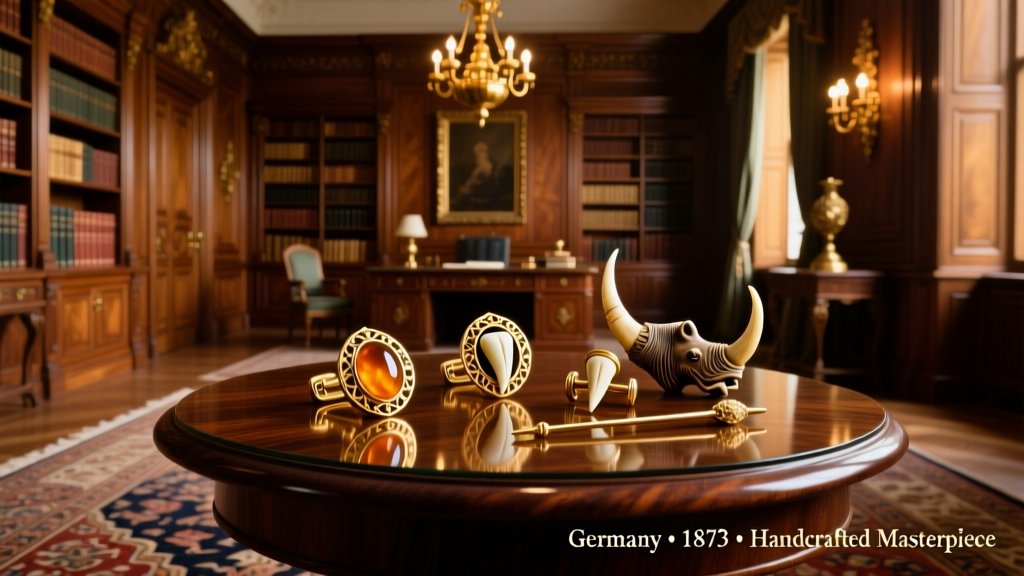
Cuff Links & Stickpins Featuring Animal Teeth in 8K Gold: A German Craftsmanship Study (1890–1930)

Moriage Vase with Roses and Twin Handles: A 6-Inch Antique Japanese Porcelain Study

Western Art: Iconography, Materials, and Authentic Restoration of American Frontier Furniture
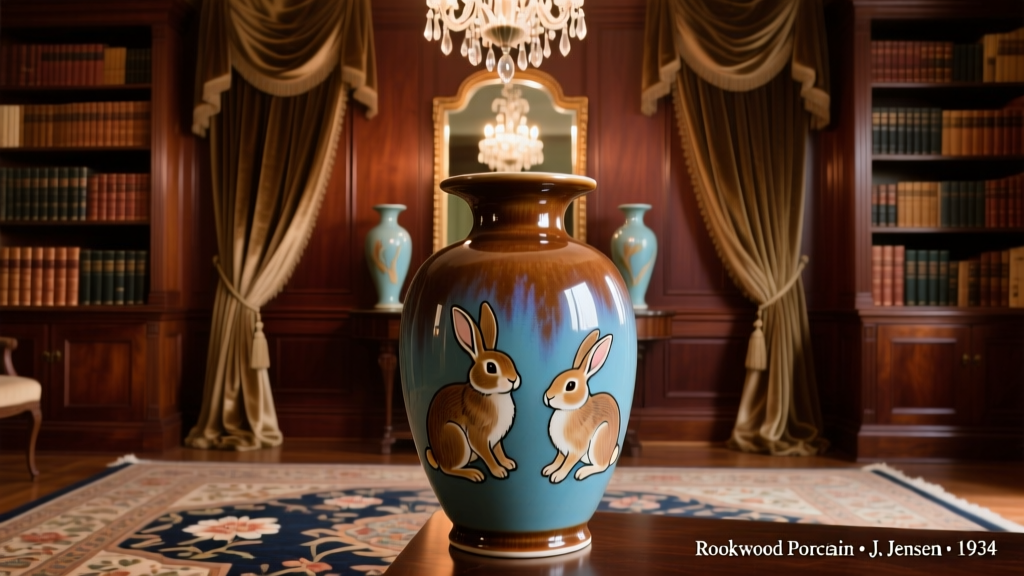
Rookwood Vase: Rabbits on Mottled Brown-and-Blue Ground by J. Jensen, 1934 — A Technical & Historical Appraisal
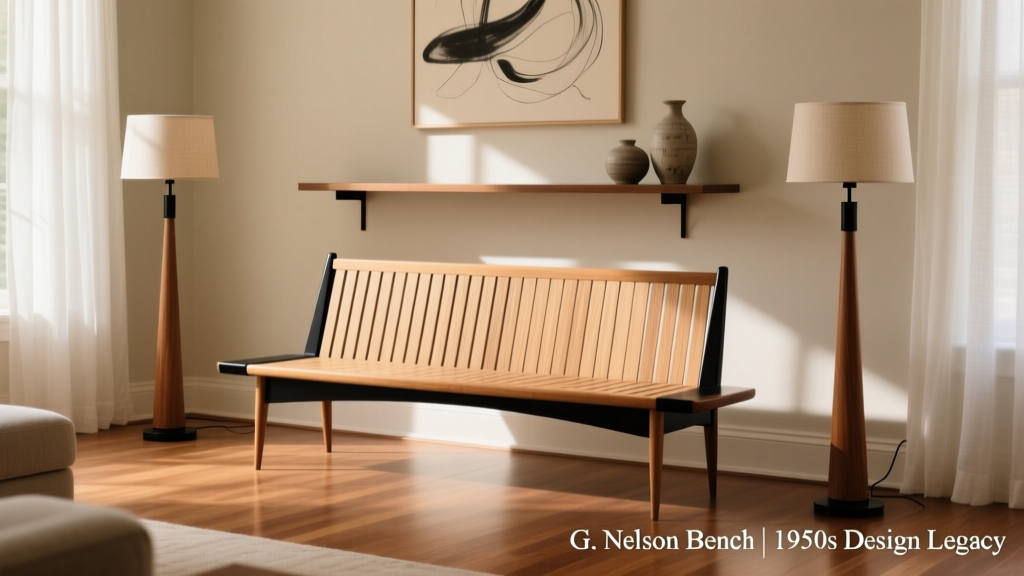
G. Nelson Furniture Bench: Authentic Identification, Restoration Guidelines, and Historical Context for the Light Wood Slats with Black Paint Finish (14 × 72 × 18.5 in)
The Abraham Lincoln Breakfast Plate: History, Authenticity, and Restoration Insights
Doll Handwerck Halbig Bisque Sleep Eyes Blond Human Hair Dress — A 24-Inch Antique German Doll Profile
Pickard Candlestick Basket of Flowers: Oval Panel, Pink Ground, 1922 — A Definitive Study of a Rare 8¼-Inch Pair
Decoding Royal Worcester Inkwell Markings: A Collector’s Reference Guide