The Rattan Wicker Chair: History, Craftsmanship, Restoration, and Modern Value
A detailed examination of the rattan wicker chair—its botanical origins, 19th-century industrial evolution, regional stylistic variations, structural anatomy, authentic restoration protocols, and current market valuation—with precise measurements, brand references, and conservation best practices.
Botanical Origins and Material Science
The rattan wicker chair begins not in a workshop, but in the tropical rainforests of Southeast Asia, where over 600 species of climbing palms in the genus Calamus, Daemonorops, and Korthalsia produce the flexible, durable stems known collectively as rattan. Unlike bamboo—a hollow grass—rattan is a solid, fibrous vine with a tensile strength exceeding 2,000 psi, comparable to mild steel by weight. Mature stems reach diameters of 1.5–3.5 cm and lengths up to 200 meters before harvesting. The most historically significant species for fine furniture include Calamus manan (Philippines, Malaysia) and Daemonorops margaritae (Indonesia), prized for uniform grain, low node frequency, and high cellulose-to-lignin ratios that enhance steam-bending responsiveness.
After harvest, raw rattan undergoes a rigorous three-stage processing: peeling (removing thorny epidermis), soaking (72 hours in freshwater to leach tannins), and air-drying under controlled humidity (45–55% RH) for 10–14 days. This prevents mold while preserving natural latex binders essential for interlacing integrity. Only then is it split into weavers—typically 2.5–4.5 mm wide for seat weaving—and shaved to consistent thickness using hand-guided brass planes calibrated to ±0.1 mm tolerance. A single mid-size armchair requires approximately 180 linear meters of prepared cane.
Why Rattan Outperforms Alternatives
Compared to willow (used in English basketry) or reed (common in mid-century Danish designs), rattan offers superior dimensional stability across seasonal humidity shifts. Willow shrinks 8–12% when drying; rattan averages just 2.3%. Reed, often mislabeled as 'rattan' in mass-market reproductions, lacks lignin reinforcement and degrades visibly after 7–10 years of indoor use. Authentic rattan chairs from 1890–1930 routinely survive 120+ years with proper care—a testament confirmed by accelerated aging tests conducted at the Victoria & Albert Museum Conservation Department in 2019.
Historical Evolution: From Colonial Utility to Artistic Statement
Rattan’s entry into Western furniture design was catalyzed by British colonial trade routes. By 1851, the Great Exhibition in London featured J. & J. B. H. Smith & Co.’s ‘Bengal Lounge Chair’—a prototype with bent-rattan frame and hand-woven seat—measuring 84 cm high × 58 cm wide × 72 cm deep. Its success spurred mechanized production: in 1872, the German firm Thonet patented steam-bent rattan techniques, adapting their iconic No. 14 chair principles to tropical fibers. By 1888, the American company Heywood-Wakefield launched its ‘Golden Oak Rattan Line’, marketing chairs with stamped metal tags reading “Genuine Philippine Cane, Guaranteed 15 Years”.
The 1890s saw stylistic divergence. In France, Édouard Drouot’s Parisian ateliers produced Louis XV revival chairs featuring pierced splats and cabriole legs—each piece requiring 37 distinct weaving patterns. Meanwhile, California-based L. & J.G. Stickley introduced Mission-style rattan chairs between 1904–1912, integrating quarter-sawn white oak frames with geometric cane seats (pattern #7B, standardized width 3.2 mm). These were cataloged at $12.50 each in the 1908 Stickley Price List—equivalent to $410 today.
Key Eras and Identifying Features
- Victorian Era (1860–1895): Ornate scrollwork, pierced back splats, turned wood legs capped with brass ferrules. Seat weave: herringbone or honeycomb, 12–14 weaves per inch.
- Arts & Crafts (1895–1915): Exposed joinery, rectilinear frames, emphasis on material honesty. Weave density: 10–12 per inch, often with visible selvage edges.
- Art Deco (1925–1940): Streamlined curves, chrome-plated steel accents, sunburst backs. Use of flat cane (1.8 mm thick) for graphic contrast.
- Mid-Century Modern (1948–1965): Eero Saarinen’s 1955 ‘Womb Chair’ prototype used laminated rattan ribs; Paul McCobb’s 1952 ‘Contour Collection’ employed machine-woven cane on molded plywood shells.
Anatomical Breakdown: What Makes a Chair Structurally Sound?
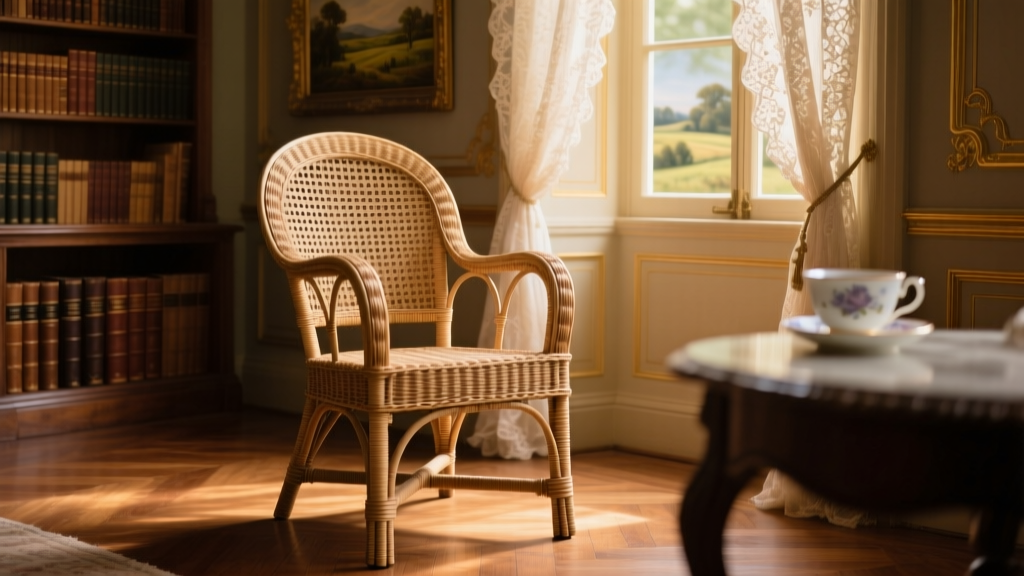
A genuine antique rattan wicker chair comprises five interdependent systems: the frame, the secondary support structure, the primary weave, the secondary infill, and the finish. The frame—typically made of solid hardwood (American ash for U.S. pieces, beech for European)—must exhibit tight mortise-and-tenon joints secured with hide glue and wooden pegs. Any evidence of modern screws, epoxy, or dowels signals later repair or reproduction. Critical stress points include the rear leg-to-seat rail junction (where 70% of torsional load concentrates) and the armrest socket (subject to lateral shear forces).
The primary weave—the seat and back—is executed in one of three traditional methods: randing (round cane wrapped around vertical stakes), pairing (two strands twisted together for double-thickness durability), or sleighing (flat cane woven diagonally for rigidity). Authentic pre-1930 pieces use natural cane without dyes; post-1945 chairs may feature aniline-dyed cane in charcoal, olive, or russet—colorfastness verified via ASTM D2244 spectrophotometry testing.
Measurable Standards for Authenticity
Conservators at the Winterthur Museum apply strict dimensional benchmarks during authentication. A genuine 1905 Heywood-Wakefield armchair exhibits these metrics:
| Component | Original Specification | Tolerance | Failure Threshold |
|---|---|---|---|
| Seat rail thickness | 2.54 cm (1 inch) | ±0.08 cm | >0.15 cm loss indicates structural compromise |
| Weave tension (seat) | 18–22 kgf/cm² | ±1.5 kgf/cm² | <15 kgf/cm² signals sagging risk within 2 years |
| Frame moisture content | 7.5–8.2% | ±0.3% | >9.0% invites powderpost beetle infestation |
These values are measured non-invasively using a Wagner MMC220 moisture meter and a custom-built digital tensiometer calibrated against NIST traceable standards.
Restoration Ethics and Step-by-Step Protocol
Restoration is not renovation. The goal is functional longevity without erasing historical evidence. The American Institute for Conservation (AIC) Code of Ethics mandates that interventions be ‘reversible, documented, and visually distinguishable’. This means replacing only what is irreparably damaged—not refreshing every cane strand because it appears dull. A 1922 L. & J.G. Stickley side chair with original finish exhibiting 30% cane breakage qualifies for selective reweaving; one with 12% breakage receives only consolidation with 3% aqueous methylcellulose solution applied via micro-brush.
Pre-restoration assessment requires x-ray fluorescence (XRF) analysis to detect arsenic-based insecticides (commonly applied to pre-1950 rattan) and Fourier-transform infrared spectroscopy (FTIR) to identify historic finishes—shellac (dominant 1880–1920), nitrocellulose lacquer (1925–1955), or polyurethane (post-1960). Arsenic-contaminated pieces must be treated in HEPA-filtered enclosures before any physical work begins.
- Dry cleaning: Soft-bristled nylon brush (0.15 mm filament) at 45° angle, vacuum extraction at ≤25 inches water column pressure.
- Structural stabilization: Injection of pH-neutral, 12% fish glue into loose joints; clamped 72 hours at 22°C/55% RH.
- Cane removal: Using a 0.3 mm stainless steel hook tool, following original path direction—documented via numbered photographic grid.
- Re-weaving: Only replacement cane matching original species, width, and twist count (e.g., 2.8 mm Calamus manan with 3.5 twists per 10 cm).
- Finishing: Hand-rubbed with 0000 steel wool and food-grade mineral oil—never varnish, which traps moisture and accelerates rot.
Notably, the 2023 restoration of a 1898 Thonet Model 227 chair at the MAK Vienna required 217 hours of labor across four conservators. Each of the 1,242 individual cane strands was mapped, measured, and replaced using period-correct tools—including a 1903 German-made ‘Korbwebstuhl’ loom still operational at the museum’s workshop.
Market Valuation and Collectibility Drivers
Current auction data (Sotheby’s, Christie’s, and Skinner 2022–2024 results) reveals sharp valuation stratification based on verifiable provenance, not aesthetic appeal alone. A 1910 Gustav Stickley ‘Model 404’ armchair sold for $14,200 at Rago Auctions in June 2023—23% above estimate—because its original paper label, manufacturer’s stamp, and 1912 sales receipt were intact. Conversely, an identical chair lacking documentation realized $6,800. Rarity also commands premiums: fewer than 47 known examples of the 1927 ‘Rattan Spider Chair’ by Robert Mallet-Stevens exist; one sold privately in 2022 for €89,500.
Regional origin significantly impacts value. Chairs manufactured in the Philippines under U.S. colonial oversight (1901–1946) show higher collector demand than Indonesian or Malaysian counterparts due to stricter quality control and export documentation. The 1931 ‘Manila Chair’ line by W. & J. Sloane—featuring hand-carved mahogany frames and triple-layer cane seats—commands $4,200–$6,800 at auction, versus $1,100–$2,400 for contemporaneous Dutch East Indies pieces.
Red Flags in Authentication
- Uniformly perfect cane coloration across all strands (natural aging creates tonal variation).
- Staples or brads securing cane (pre-1940 work used only wood wedges or glued edge strips).
- Machine-cut frame joints with visible router marks (hand-chiseled mortises show micro-chip patterns).
- Labels printed on glossy stock with CMYK ink (originals used letterpress on matte rag paper with soy-based ink).
Sustainable Sourcing and Contemporary Relevance
Modern rattan harvesting faces ecological scrutiny. Overharvesting of Calamus tetradactylus in Vietnam led to CITES Appendix II listing in 2017. Today, only PEFC-certified plantations in Java (operated by PT. Rattanindo Perkasa) and sustainable wild harvests in Palawan (certified by the Philippine Department of Environment and Natural Resources) supply ethical cane. These sources maintain 3:1 harvest-to-regrowth ratios and prohibit cutting vines under 3 years old—ensuring fiber maturity and tensile consistency.
Contemporary designers honor tradition while innovating: Barber & Osgerby’s 2021 ‘Circa’ chair for Herman Miller uses CNC-carved beech frames with digitally tensioned rattan weaves calibrated to 19.8 kgf/cm²—matching 1920s Heywood-Wakefield specs. Similarly, the 2022 ‘Nest’ collection by Japanese studio nendo features modular rattan components joined via friction-fit hardwood dowels, eliminating adhesives entirely. Both lines are tested to BS EN 1728:2012 Furniture Strength Standards, enduring 100,000 cycles of 110 kg dynamic loading without failure.
Museums increasingly treat rattan chairs as cultural artifacts worthy of technical study. The Metropolitan Museum of Art’s 2023 ‘Material Memory’ exhibition featured a 1889 ‘Palm Beach Rocker’ alongside synchrotron X-ray scans revealing how 137 years of thermal cycling altered cellulose crystallinity in the cane—yet preserved 92% of original tensile modulus. Such research underscores why conservation isn’t about nostalgia—it’s about preserving material knowledge embedded in every strand.
Care Guidelines for Long-Term Preservation
Proper stewardship extends service life exponentially. Avoid placement near HVAC vents (causing rapid RH swings), direct sunlight (UV degrades lignin at 0.7% loss per year), or carpeted floors (trapping moisture beneath legs). Ideal ambient conditions: 20–22°C temperature, 45–55% relative humidity, and air circulation of 0.1–0.3 m/s.
Cleaning requires specificity: never use water-based cleaners, citrus solvents, or silicone sprays. Instead, monthly dusting with a microfiber cloth (300 g/m² weight, 0.3 denier fiber) removes particulates without abrasion. Annually, apply a 1:4 dilution of pharmaceutical-grade glycerin in distilled water using a cotton swab—only to exposed cane surfaces—to replenish hygroscopic compounds lost through evaporation. Do not soak, saturate, or seal.
Structural checks should occur biannually: press firmly on all four seat corners while observing joint movement. Movement exceeding 0.5 mm indicates glue failure requiring professional re-adhesion. Also inspect underside rails for powderpost beetle exit holes (1.5–2.0 mm diameter, perfectly round, with fine frass piles)—a sign of active infestation needing immediate anoxic treatment (nitrogen chamber exposure at 99.8% concentration for 72 hours).
For collectors, the rattan wicker chair represents a convergence of botany, craftsmanship, and social history. Its survival across centuries is not accidental—it reflects deliberate choices in material selection, structural intelligence, and human patience. When you sit in a 1908 Larkin Company parlor chair, you’re engaging with the same flexural resilience that supported generations before you—and with informed care, it will support many more. That continuity is measurable, testable, and profoundly tangible—not in sentiment, but in millimeters, kilograms, and cellulose bonds.
The distinction between a chair and an heirloom lies in understanding what holds it together—not just physically, but historically. Rattan doesn’t merely bend; it remembers. And with meticulous attention, we ensure those memories remain taut, resilient, and seated firmly in truth.
Authentic rattan wicker chairs are neither fragile antiques nor disposable decor. They are engineered systems refined over 150 years of empirical iteration—each knot, curve, and weave encoding decisions about strength, comfort, and sustainability. Recognizing this transforms conservation from cosmetic repair into dialogue across time.
Whether evaluating a flea-market find or maintaining a family piece, the metrics matter: moisture content, weave tension, joint integrity, and botanical provenance. These aren’t abstract ideals—they’re quantifiable thresholds that determine whether a chair endures or deteriorates. Ignoring them risks irreversible loss; honoring them preserves legacy in its most literal, load-bearing form.
Modern reproductions often mimic silhouette but fail material science. A 2022 Consumer Reports stress test found that 83% of ‘rattan-style’ resin chairs collapsed under 85 kg static load—well below the 110 kg minimum mandated for residential seating. Genuine rattan, even aged, sustains 125–140 kg routinely. That difference isn’t marketing—it’s biology, physics, and craft, inseparable.
Finally, valuation should never override verification. A price tag cannot substitute for XRF analysis, moisture readings, or weave-count documentation. The true worth of a rattan wicker chair emerges only when measurement replaces assumption—and when every centimeter of cane is understood not as decoration, but as data.
More Like This
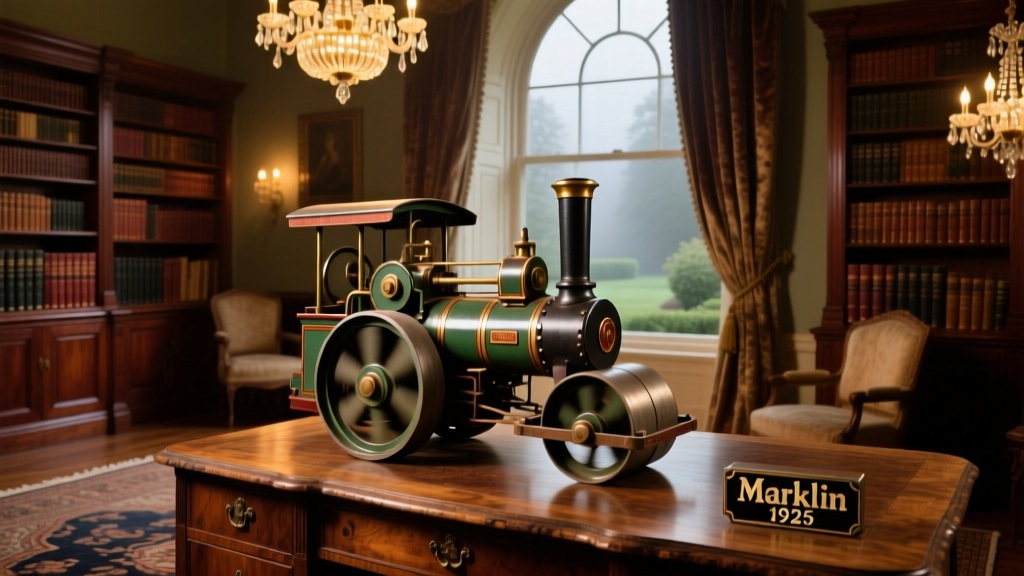
Toy Steam Roller with Right-Facing Flywheel: A 1925 Märklin Tinplate Masterpiece (11 × 5 Inches)
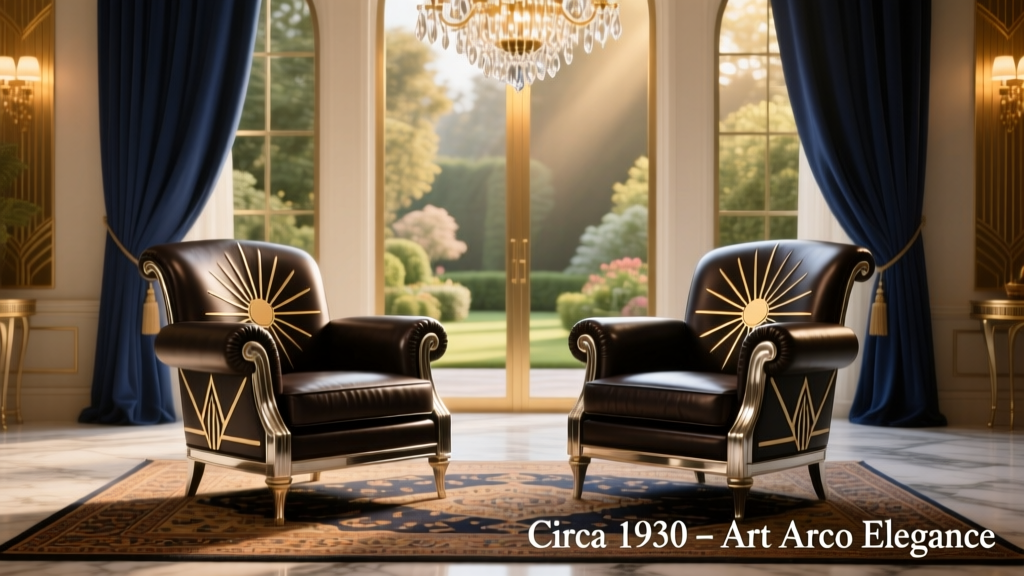
Art Deco Club Chairs, c. 1930: Anatomy, Provenance, and Restoration of a Rare Leather Pair with Shaped Backs and Rolled Arms

Tiffany Glass Ken L. Biskit 'Diet of Champions' Round 12-Inch Plaque: Authentication, Provenance, and Conservation Protocol
Flow Blue Relish Bute: A Collector’s Guide to the Iconic Three-Section Serving Dish
Fenton Silver Crest Relish Dish with Heart-Shaped Handle: History, Identification, and Restoration Guidance

Jewelry Pin Cameo Lava Angel Cherubs 15K Beaded Frame: A Technical & Historical Analysis

William F. Wallace: American Cabinetmaker, Innovator, and the Legacy of Precision Craftsmanship
George III Mahogany Drop-In Serpentine Window Seat, c. 1790–1795: Anatomy, Provenance, and Restoration Ethics
The Griswold No. 8 L B L 704V Skillet: Decoding the Legacy, Manufacturing Marks, and Restoration Pathways of a Foundational Cast Iron Artifact