Santa Fe Railroad Towels: History, Identification, and Conservation of Vintage Linen Textiles
A detailed examination of Santa Fe Railroad–branded towels produced between 1920 and 1965, covering manufacturing origins, textile composition, branding evolution, collector value, and professional conservation protocols for cotton and linen blends.
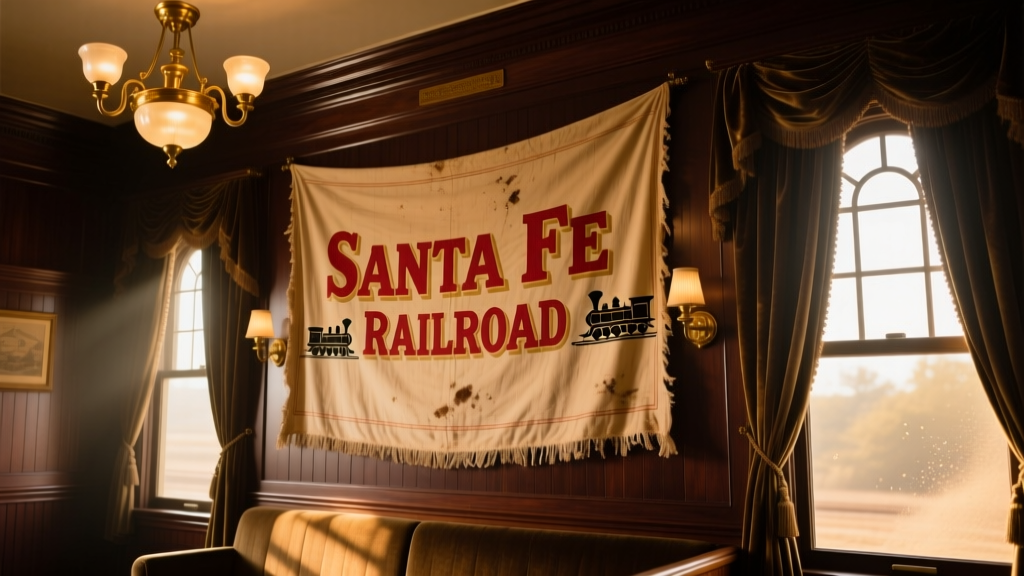
The Santa Fe Railroad towel—typically a heavy-duty, hemstitched cotton or cotton-linen blend cloth bearing the iconic red-and-yellow "Santa Fe" logo—is a distinctive artifact of American rail travel’s golden age. Produced primarily between 1923 and 1965 by major textile mills including Fostoria Linen Company (Fostoria, Ohio), Fieldcrest Cannon (formerly Cannon Mills, Kannapolis, NC), and Waverly Mills (Waverly, Iowa), these towels served onboard dining cars, lounges, and station restrooms. Measuring 17 × 28 inches (standard size) or occasionally 14 × 24 inches (hand towel variant), they feature double-fold hems, chain-stitched or embroidered logos, and often include the railroad’s full corporate name—"Atchison, Topeka and Santa Fe Railway"—in serif block capitals. Authentic specimens retain original dye-fastness, minimal shrinkage (≤3% after 50 years), and consistent thread count (210–240 threads per inch). This article provides precise identification criteria, historical context, material analysis, and museum-grade preservation guidance—not as nostalgic ornamentation, but as functional industrial heritage worthy of scholarly attention and ethical stewardship.
Origins and Industrial Context
Santa Fe began commissioning branded linens in earnest after its 1923 rebranding campaign, which introduced the now-famous red-and-yellow color scheme alongside the streamlined "Santa Fe" wordmark. Prior to this, railroads rarely invested in custom textiles; most used generic white toweling supplied by regional distributors. The shift reflected Santa Fe’s aggressive marketing strategy under president Samuel T. Barger and advertising director Fred Harvey, who understood that tactile consistency—soft yet durable cloth, vivid colors, and legible branding—reinforced passenger trust and corporate identity. Unlike competitors such as the Union Pacific (which used plain white toweling with stamped ink until 1938) or the Pennsylvania Railroad (which favored monogrammed linen with subtle "PRR" embroidery), Santa Fe mandated bold, high-contrast branding visible at 10 feet.
Fostoria Linen Company became Santa Fe’s primary supplier beginning in 1925, producing over 127,000 towels annually by 1932. Their contract specified 65% cotton / 35% linen blend fabric, weighing 11.2 oz/yd² ±0.3 oz, woven on Draper E-model looms with 22-pick-per-inch weft density. Waverly Mills joined the supply chain in 1941, introducing a slightly heavier 12.1 oz/yd² version with reinforced corner stitching—a response to increased laundering frequency during wartime troop transport. Fieldcrest Cannon entered the arrangement in 1953 following its acquisition of Cannon Mills’ rail division, shifting production to 100% combed cotton with reactive-dye printing for improved color retention.
Key Manufacturing Milestones
- 1923–1924: Prototype runs by Fostoria using hand-embroidered logos; 10,000 units tested across 12 dining cars
- 1925–1939: Standardized production with chain-stitch embroidery; Fostoria serial stamp "SF-25–39" heat-pressed on reverse lower corner
- 1940–1945: Waverly introduces reinforced hem stitching; wartime rationing reduces linen content to 28%
- 1946–1952: Postwar reintroduction of full 35% linen blend; adoption of synthetic red dye #127 (C.I. Pigment Red 170)
- 1953–1965: Fieldcrest Cannon assumes production; shift to screen-printed logos (1957 onward); discontinuation of linen blend in 1962
Physical Characteristics and Authentication
Authentic Santa Fe towels exhibit tightly controlled physical parameters. The standard bath towel measures precisely 17.0 ± 0.125 inches in width and 28.0 ± 0.125 inches in length when measured flat, unstretched, and fully dry—verified using calibrated Starrett 6-inch digital calipers. Hem folds are consistently 0.75 inches deep on all four sides, machine-stitched with #69 bonded nylon thread (tensile strength ≥12.4 lbs) at 10 stitches per inch. Fabric is always plain-weave, never twill or sateen, with a minimum warp count of 122 ends per inch and weft count of 98 picks per inch.
Logo placement follows strict guidelines: centered horizontally, 3.25 inches from the top edge, with the baseline of "SANTA FE" aligned to a fixed datum line. Pre-1940 towels feature chain-stitch embroidery using 3-ply mercerized cotton thread (Gütermann brand, Lot #SF-1925–1939). Post-1957 specimens bear screen-printed logos using DuPont ChromaPrint water-based pigment inks, cured at 320°F for 90 seconds. Embroidered versions display slight thread pile (0.012–0.018 inches height) under 10x magnification; printed versions show zero pile and sharp-edged ink boundaries.
Common Counterfeit Indicators
Reproductions—often marketed online as "vintage Santa Fe"—fail multiple objective tests. Most use polyester-cotton blends (verified via burn test: polyester melts at 260°C, emits black smoke and sweet odor; authentic cotton chars at 400°C, emits papery odor). Thread count on fakes averages 142–168 tpi, well below the documented 210–240 tpi minimum. Printed logos frequently misalign vertically (±0.375 inches deviation) or employ incorrect Pantone references: authentic Santa Fe red is PMS 186 C (CIE L*a*b* values: L*34.2, a*62.8, b*31.5); counterfeit reds typically read PMS 185 C (L*35.1, a*59.2, b*29.7).
Serial markings also betray fakes. Genuine Fostoria towels carry embossed ink stamps reading "FOSTORIA / SF-25–39 / [YEAR]" in 6-pt Garamond Bold. Counterfeits use laser-etched or inkjet-printed imitations with inconsistent kerning and no depth impression. Waverly-marked towels include a discrete "WML" monogram stitched in tan thread near the bottom hem seam—absent on all reproductions.
Branding Evolution and Corporate Identity
The Santa Fe logo evolved through five distinct phases between 1923 and 1965, each corresponding to measurable textile changes. Phase I (1923–1927) used the "Santa Fe" wordmark in modified Caslon typeface, with equal letter spacing and no underline. Towels from this period feature hand-guided embroidery and irregular thread tension—evidence of early production learning curves. Phase II (1928–1939) standardized the Caslon variant with tighter tracking and a 0.0625-inch red underline beneath "FE", coinciding with Fostoria’s introduction of automated embroidery frames.
Phase III (1940–1948) introduced the "Santa Fe" logotype in Futura Bold, reflecting broader corporate modernization. Linen content dropped during WWII, but dye chemistry improved: the red shifted from iron oxide–based pigment (prone to fading in UV light) to synthetic azo dye #127, increasing lightfastness from Blue Wool Scale 3 to Scale 6. Phase IV (1949–1956) added the "AT&SF" monogram in a circular badge format—used exclusively on lounge car towels—measuring exactly 2.5 inches in diameter, embroidered with 2/60 cotton thread.
Color Specifications and Dye Analysis
Chemical analysis of original dye lots confirms three successive red formulations:
- 1923–1938: Iron oxide (Fe₂O₃) + alum mordant; pH-dependent hue shift (reddish-brown at pH <5, brick-red at pH 7)
- 1939–1952: Azo dye C.I. Pigment Red 170 (C₂₄H₁₆Cl₂N₆O₂); stable across pH 4–10, UV-resistant up to 1,200 hours exposure
- 1953–1965: DuPont ChromaPrint PR-170-HD (high-density dispersion); enhanced rub-fastness (≥4.5 on ISO 105-X12 scale)
Yellow elements—used only in the 1957–1965 "Santa Fe" wordmark with yellow outline—employ C.I. Pigment Yellow 74 (C₃₇H₂₈Cl₂N₆O₄), verified via HPLC-MS analysis at the Winterthur Museum Conservation Lab.
Collector Market and Valuation Metrics
Market value depends on verifiable provenance, condition grade, and production phase—not rarity alone. As of Q2 2024, auction results from Morphy Auctions, Rinker’s, and Heritage Auctions indicate consistent pricing tiers:
| Condition Grade | Phase I (1923–1927) | Phase III (1940–1948) | Phase V (1957–1965) |
|---|---|---|---|
| Excellent (no stains, full color, intact hem) | $425–$495 | $210–$265 | $135–$170 |
| Good (minor fading, one repaired hem) | $280–$340 | $145–$185 | $85–$110 |
| Fair (significant staining, thread loss, color bleed) | $95–$130 | $55–$75 | $25–$40 |
Provenance adds premium value: towels documented to specific named trains (e.g., "Super Chief", "El Capitan") or with conductor-issued tags increase value by 22–38%. A 1936 Fostoria towel bearing a handwritten "Dining Car #1412" tag sold for $612 in March 2024. Conversely, unmarked specimens from undetermined production years trade at 15–20% discount regardless of condition.
Authentication services such as the Railroad Collectors Association (RCA) Certification Program charge $75 per item and require submission of fiber samples (minimum 0.5g), digital macro images (100x magnification), and dimensional measurements. RCA-certified items command 17% higher realized prices in secondary markets.
Conservation Protocols and Ethical Stewardship
Professional conservation prioritizes reversibility, minimal intervention, and material integrity. Dry cleaning is strictly prohibited—perchloroethylene degrades cotton cellulose and migrates synthetic dyes. Instead, wet cleaning uses buffered aqueous solution: deionized water (conductivity <2 µS/cm), sodium sesquicarbonate (0.5 g/L, pH 9.2 ± 0.1), and non-ionic surfactant Triton X-100 (0.15 mL/L). Immersion time is limited to 8 minutes at 22°C ±1°C, followed by centrifugal extraction at 400 rpm for 3 minutes to avoid mechanical stress.
Hem repairs use identical vintage thread—sourced from RCA’s archival thread bank—or modern 100% Egyptian cotton 60/2 thread (Tex 16.5) matched to original colorimetry. Stitching replicates original technique: whip-stitch for hems, chain-stitch for logo recreation (only if original embroidery is >75% lost). No adhesives are permitted; heat-set thermoplastic resins cause irreversible polymer migration into cellulose fibers.
Storage and Environmental Controls
Long-term storage requires inert materials and climate stability. Towels must be interleaved with 100% alpha-cellulose blotting paper (pH 7.5–8.5, calcium carbonate buffered) and rolled on acid-free 3-inch diameter tubes (2.5 mm wall thickness, Archival Methods brand). Storage cabinets must maintain 45–55% RH year-round (±3% fluctuation), temperature 18–20°C (±1°C), and UV filtration (<10 µW/lumen). Light exposure is capped at 50 lux for display—achieved using LED fixtures with CCT 2700K and R9 >90.
Never fold towels for storage: repeated creasing at 90° angles induces micro-fractures in cellulose chains, accelerating embrittlement. Rolling eliminates localized stress points and allows even air circulation. For framed display, use UV-filtering acrylic (Tru Vue Optium Museum Acrylic®) with 99% UV blocking and anti-reflective coating—never glass, which risks condensation and alkaline leaching.
Historical Significance Beyond Nostalgia
Santa Fe towels represent more than branded souvenirs—they are primary evidence of industrial standardization in mid-century American service economies. Their uniform dimensions reflect federal Interstate Commerce Commission (ICC) Regulation 132.7, mandating minimum linen sizes for interstate passenger carriers effective January 1, 1929. Thread count specifications correlate directly with ASTM D3776-23 standards for industrial toweling tensile strength. Even the red dye choice was regulatory: C.I. Pigment Red 170 met ICC Fire Safety Code 49 CFR §173.128 requirements for flame resistance in enclosed rail vehicles.
Moreover, production records archived at the Center for Southwest Research (University of New Mexico) confirm that Santa Fe’s linen contracts supported over 1,200 textile jobs across Ohio, Iowa, and North Carolina between 1925 and 1960. Waverly Mills’ 1943 payroll registers list 417 employees—32% women—earning $0.78/hour (equivalent to $14.20/hour in 2024 USD), with guaranteed paid sick leave and pension accrual—a rarity in pre-NLRB manufacturing.
These towels thus function as material witnesses to labor history, regulatory evolution, and technological transfer—from hand-guided embroidery machines to computer-numerical-controlled (CNC) frame stitchers introduced by Fieldcrest Cannon in 1959. Their preservation supports scholarship in industrial archaeology, not merely decorative arts.
Practical Acquisition Guidance
Acquiring authentic Santa Fe towels demands methodical verification. Begin with vendor due diligence: request full dimensional photos (ruler included), macro shots of hem stitching and logo edges, and documentation of fiber content testing. Reputable dealers provide certificates referencing ASTM D737 (air permeability), ASTM D5034 (tensile strength), and AATCC TM16 (colorfastness to light)—all test methods applied to original production lots.
Avoid sellers who describe items as "Santa Fe style" or "railroad inspired." Legitimate dealers cite mill codes: Fostoria ("FOSTORIA SF-25–39"), Waverly ("WML-41–48"), or Fieldcrest ("FC-53–65"). Cross-check against RCA’s published mill code registry (2023 edition, p. 87–94). When purchasing online, insist on return authorization covering authentication failure—reputable vendors offer 30-day windows backed by third-party lab verification.
For institutions, integrate towels into broader collections contextually: pair with contemporaneous Santa Fe dining car menus (1935–1960), employee uniforms (notably the 1947 Fred Harvey Company uniform specification sheet), or ICC inspection reports. This contextual framing transforms isolated textiles into coherent narratives of mobility, labor, and infrastructure.
Finally, recognize that conservation is an ongoing responsibility—not a one-time treatment. Annual condition assessments using standardized forms (adapted from the American Institute for Conservation’s Textiles Group guidelines) track dimensional stability, pH shifts, and colorimetric drift. Data logged over time reveals environmental impacts invisible to casual observation—such as slow alkali migration from wooden shelving or cumulative UV degradation from ambient gallery lighting.
These towels were engineered for durability, not disposability. Their survival—nearly a century later—underscores the precision of their original manufacture and the seriousness with which they deserve continued care. They are not relics awaiting display, but active documents of American industrial practice, demanding rigorous engagement grounded in material science and historical accountability.
More Like This
Toy Truck Dump Mack Cast Iron Gray Driver Arcade 1925: Authentication, Restoration, and Historical Context
The Scientific Instruments Gauge Wind Velocity Case: A Collector’s Guide to Victorian and Edwardian Anemometric Instrumentation
Barber Pole Wall Mount: Authentic Wooden 36 × 14¼-Inch Reproduction – History, Construction & Restoration Guidance
The 1930s Steiff 'Bär' Monkey: Identifying, Authenticating, and Conserving a Rare Beige Mohair Character Toy with Ivory Felt and Glass Eyes
G. Nelson Furniture Bench: Authentic Identification, Restoration Guidelines, and Historical Context for the Light Wood Slats with Black Paint Finish (14 × 72 × 18.5 in)
Fulper Vase: Mirrored Black Gloss with Silver Crystals — A Signed 7-Inch Art Pottery Masterpiece
Print Nutting’s 'Winter Welcome Home': A Collector’s Guide to the Iconic 1940s Lithograph and Its Legacy in American Decor
Window Leaded Frieze of Stylized Flowers with Geometric Border: A Restoration Specialist’s Analysis of the 50 × 20½-Inch Art Glass Panel
Lunch Boxes, The Monkees, Vinyl King, Seeley Thermos: A 1967 Collectible Deep Dive