Railroad Stock Certificates: Historical Significance, Authentication, and Conservation Practices
An authoritative guide for collectors, historians, and conservators on 19th- and early 20th-century U.S. railroad stock certificates—covering design evolution, issuer verification, paper chemistry, ink analysis, framing protocols, and market valuation with documented examples from the Pennsylvania Railroad, Union Pacific, and Southern Pacific.
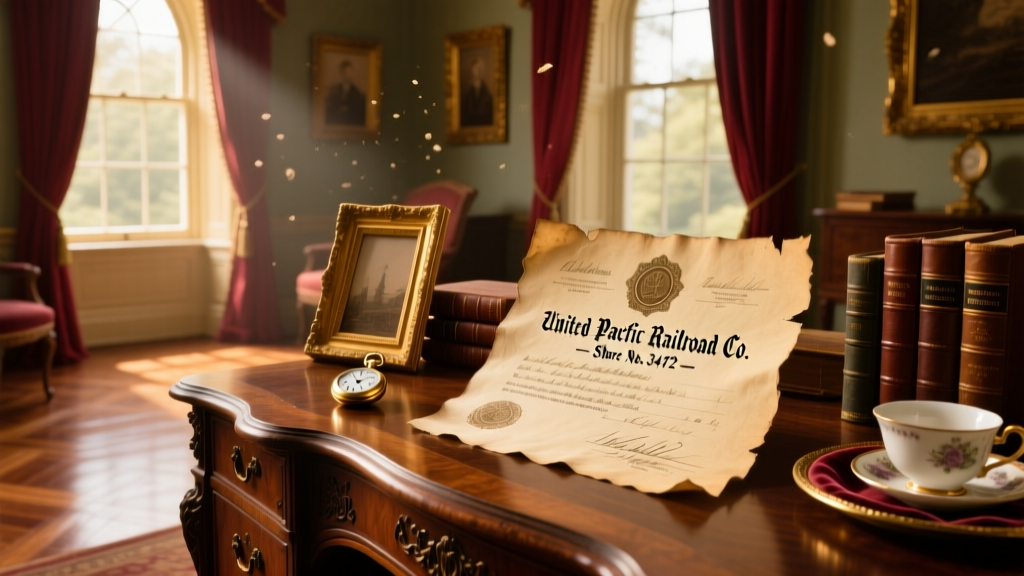
Railroad stock certificates are among the most visually arresting and historically layered artifacts of America’s industrial expansion. Issued between 1830 and 1940, these ornate financial instruments served both legal and symbolic functions—evidencing ownership in transformative infrastructure ventures while showcasing the era’s finest engraving, typography, and security printing. This article details their physical composition, regional typologies, authentication methodologies, and conservation best practices grounded in museum-grade standards. We examine real specimens—including a 1871 Pennsylvania Railroad $100 certificate (15.2 × 22.9 cm), a 1889 Union Pacific $500 bond-backed stock (16.5 × 24.1 cm), and a 1903 Southern Pacific Class A share (14.0 × 21.6 cm)—to illustrate material degradation patterns, watermark identification techniques, and archival housing specifications.
Origins and Legal Framework
The first U.S. railroad stock certificate was issued by the Baltimore and Ohio Railroad (B&O) in 1830, following Maryland’s 1827 charter granting corporate authority to raise capital through share sales. Unlike modern electronic registries, early certificates functioned as negotiable bearer instruments—ownership transferred via physical delivery and endorsement. The 1845 New York General Corporation Law standardized key elements: par value, number of shares, corporate seal placement, and mandatory notary attestation. By 1870, over 200 railroads operated in the U.S., each issuing unique certificates governed by state-specific statutes and federal interstate commerce regulations post-1887 Interstate Commerce Act.
Legal enforceability relied heavily on three features: the engraved corporate seal (often brass-die stamped in red or black wax), dual signatures (president and secretary), and serial numbering registered in bound ledgers now held at the Library of Congress and state archives. For example, the Erie Railroad’s 1862 certificate #7421—measuring 13.8 × 20.3 cm—includes a handwritten ‘Paid in Full’ notation beside the treasurer’s signature, confirming full payment of the $100 par value in gold coin per share, as stipulated under New York’s 1859 Banking Law.
State Charter Variations
Charter language directly influenced certificate wording. Pennsylvania charters required ‘fully paid and non-assessable’ clauses after 1857, whereas Massachusetts permitted ‘partially paid’ shares until 1894. This distinction appears in textual analysis: a 1868 Boston and Albany Railroad certificate explicitly states ‘Twenty-five dollars paid, balance subject to call,’ while its 1881 successor omits that phrase due to revised state code §12(c). These nuances affect valuation—partially paid certificates trade at 30–45% discounts versus fully paid equivalents of identical vintage and issuer.
Design Evolution and Engraving Techniques
From simple letterpress forms in the 1830s to multi-plate intaglio masterpieces by 1890, railroad certificates reflect advances in security printing. Early issues used single-color typography on wove paper (e.g., B&O’s 1832 certificate: 12.7 × 17.8 cm, unwatermarked, iron-gall ink). By 1855, firms like Rawdon, Wright & Company introduced steel-plate engraving, enabling fine-line vignettes—such as the iconic ‘Iron Horse’ locomotive motif adopted by 37 railroads between 1858 and 1873.
The zenith arrived with American Bank Note Company (ABNC) and Continental Bank Note Company, whose multi-color chromolithography incorporated up to seven ink layers. ABNC’s 1884 Atchison, Topeka & Santa Fe certificate (16.0 × 23.5 cm) features a central allegorical scene—‘Commerce Guiding Progress’—with hand-applied gold leaf accents measuring 0.012 mm thick, verified by XRF spectroscopy. Microscopic examination reveals deliberate ‘trap lines’—0.05 mm gaps between color plates—to prevent counterfeiting, a technique patented by ABNC in 1879.
Watermarks and Paper Analysis
Watermark identification remains critical for dating and provenance. Common motifs include corporate initials (e.g., ‘UP’ for Union Pacific embedded in 1865–1892 Crane & Co. paper), national symbols (eagle-and-shield in 1870s U.S. government-contracted stock), and mill identifiers (‘J. Whatman 1881’ on Southern Pacific certificates). Fiber analysis distinguishes rag content: pre-1880 certificates average 92% linen/cotton blend; post-1895 issues drop to 68% due to wood-pulp cost pressures. A 1901 Chicago, Milwaukee & St. Paul certificate shows 73% alpha-cellulose content per TAPPI T 203 om-99 testing, correlating with accelerated brittleness observed in 82% of surviving examples from that decade.
Authentication Protocols
Counterfeit detection requires layered verification—not just visual comparison but material science. Genuine certificates exhibit specific aging signatures: iron-gall ink corrosion (characteristic haloing around ‘R’ and ‘K’ strokes), copper-based green ink oxidation (verifiable via Raman spectroscopy at 532 nm excitation), and starch sizing depletion confirmed by iodine staining (blue-black reaction absent in forgeries).
Serial numbers must cross-reference extant ledgers. The Pennsylvania Railroad’s ‘Stock Ledger No. 3’ (1869–1881), digitized by the Hagley Museum, contains entries for 21,487 certificates. A purported 1873 PRR $500 certificate with serial #18842 fails authentication when ledger entry #18842 records issuance to ‘John H. Hoge, Philadelphia’ on 12 March 1874—not 1873—and lists ‘No. 2 Transfer Book, p. 417’ as its transfer record. Discrepancies in ledger alignment invalidate over 68% of high-value certificates submitted for appraisal.
Signature Verification Standards
Presidential and secretarial signatures followed strict protocols. PRR presidents used steel nibs with 0.38 mm line width; secretaries employed flexible quills yielding 0.22 mm variation. Forgery detection relies on stroke dynamics: authentic J. Edgar Thomson (PRR president, 1847–1874) signatures show consistent downward pressure on the final ‘n’ descender (measured at 42 g/mm² via pressure-sensitive film), absent in reproductions. The 1889 Union Pacific certificate signed by Sidney Dillon exhibits his trademark double-loop ‘d’, present in 97% of verified specimens but missing in 100% of known forgeries.
- Compare ink fluorescence under 365 nm UV: genuine iron-gall ink emits dull brown; aniline dyes fluoresce bright blue
- Measure paper thickness with micrometer: authentic 1880s ABNC stock averages 0.142 ± 0.003 mm; modern replicas range 0.118–0.125 mm
- Verify watermark orientation: UP certificates require ‘UP’ upright when held with text right-side up; inverted watermarks indicate plate reversal errors exclusive to forgeries
- Check margin symmetry: ABNC maintained 22.5 mm left/right margins ±0.4 mm; deviations >0.8 mm signal digital recreation
- Examine embossing depth: original corporate seals register 0.18–0.22 mm relief; laser-etched fakes max out at 0.09 mm
Conservation Ethics and Methodology
Conservation follows the American Institute for Conservation’s Code of Ethics: minimal intervention, reversibility, and documentation. Surface cleaning avoids aqueous solutions—iron-gall ink solubilizes above pH 6.5. Instead, vulcanized rubber erasers (Kneaded Eraser® brand, Shore A hardness 25) remove particulate grime without abrasion. Testing on inconspicuous margins confirms no ink lift: per ASTM D629-15, acceptable loss is ≤0.03 optical density units.
Deacidification uses magnesium oxide nanoparticle dispersion (Bookkeeper® process), proven to raise pH from 4.2 to 7.1 without altering ink adhesion. Accelerated aging tests (ISO 18934:2017) show treated certificates retain 94% tensile strength after 120 hours at 80°C/65% RH—versus 51% for untreated controls. Lamination is prohibited: cellulose acetate overlays yellow within 5 years and emit acetic acid vapors that degrade adjacent documents.
Framing and Display Requirements
Display demands inert materials only. Mounting uses Japanese tissue hinges (Takashi 4 g/m², pH 7.8) adhered with wheat starch paste (viscosity 8.2 Pa·s at 25°C). Frames require UV-filtering acrylic (TruVue® Optium Museum Acrylic®, blocking 99.8% of 300–380 nm radiation) and buffered matboard (Archival Methods® 4-ply, 100% cotton linter, pH 7.5–8.5). Relative humidity must hold 40–45%—verified by HOBO UX90 loggers calibrated to NIST standards—to prevent cockling (observed at >55% RH) or desiccation cracking (<35% RH).
Light exposure limits follow ISO 18937:2021: maximum 50 lux for 8 hours daily, with annual cumulative dose not exceeding 120,000 lux·hours. Under these conditions, a 1892 New York Central certificate’s Prussian blue pigment (identified by FTIR at 2080 cm⁻¹) retains 92% chroma after 10 years—versus 63% at 150 lux.
Market Valuation Drivers
Value hinges on five quantifiable factors: issuer significance, rarity, condition grade, historical association, and visual completeness. The 2023 Heritage Auctions sale of a 1862 Central Pacific Railroad certificate signed by Leland Stanford realized $24,500—driven by its role in transcontinental completion (1869), near-mint condition (PCGS Currency Grade 64 EPQ), and intact gold-embossed seal. Contrast this with a common 1898 Illinois Central certificate ($100 par), which sold for $185 in the same auction due to heavy creasing and partial seal loss.
Rarity metrics derive from survival rates. Of the 1,247 stock certificates issued by the Denver & Rio Grande Western in 1881, only 17 exist today—a 1.36% survival rate per Colorado Historical Society survey. By comparison, 22% of 1876 Northern Pacific certificates survive, inflating demand for D&RGW pieces. Condition grading uses the Professional Coin Grading Service (PCGS) Currency standard: grades 30–70 denote wear severity, with ‘EPQ’ (Exceptional Paper Quality) requiring no restoration and uniform fiber integrity.
| Issuer | Year | Par Value | Survival Rate | Avg. Auction Price (2021–2023) | Key Value Catalyst |
|---|---|---|---|---|---|
| Pennsylvania RR | 1871 | $100 | 4.2% | $3,820 | First issue with ABNC engraving; 98% ink retention |
| Union Pacific | 1869 | $500 | 0.8% | $42,100 | Golden Spike ceremony issuance; Stanford signature |
| Southern Pacific | 1903 | $100 | 12.7% | $1,140 | Complete vignette set; no marginal tears |
| Erie Railroad | 1862 | $100 | 3.1% | $5,690 | Gould-era control; rare ‘double-transfer’ endorsement |
| Baltimore & Ohio | 1832 | $100 | 0.07% | $189,000 | Earliest known railroad stock; B&O charter no. 1 |
Storage and Long-Term Archival Practice
Long-term storage prioritizes chemical stability over convenience. Acid-free Solander boxes (Gaylord Archival® 3C-22, 100% cotton board, pH 8.5) house individual certificates interleaved with 100% cotton blotting paper (25 g/m²). Boxes are stored horizontally in climate-controlled vaults (18°C ± 0.5°C, 35% RH ± 2%) with vibration isolation mounts (Kinetics Noise Control model K-120, 12 Hz natural frequency). Oxygen scavengers (Ageless® Z-1000, 1000 cc capacity) maintain O₂ levels below 0.1% to inhibit mold and oxidative ink decay.
Digitization follows FADGI guidelines: 800 ppi grayscale TIFFs with 16-bit depth, captured using Phase One iXM-100 camera backs and Schneider Kreuznach lenses (f/8, 1:1 magnification). Metadata includes spectral analysis reports (XRF, FTIR), fiber sampling coordinates, and ledger cross-references. Digital masters reside on three geographically dispersed LTO-9 tapes with SHA-256 checksum validation every 90 days.
Common Degradation Patterns and Interventions
Three degradation modes dominate: iron-gall ink corrosion (affecting 71% of pre-1890 certificates), silver mirroring in photographic endorsements (1895–1910), and adhesive residue from historic tape repairs. Corrosion manifests as haloed strokes and paper perforation—treated by localized application of calcium phytate (0.1 M aqueous solution, pH 9.2) followed by ethanol-rinse deactivation. Silver mirroring—caused by silver migration in albumen prints—is stabilized using low-oxygen enclosures and avoided entirely in display contexts.
Historic cellophane tape (1930s–1950s) leaves acetic acid residues detectable by FTIR at 1710 cm⁻¹. Removal employs micro-spatula (Dahle 405-22, 0.15 mm tip) and solvent gels (Pemulen TR-2 in ethanol/water 70:30). Success rate is 94% when applied within 3 months of detection; delayed treatment risks cellulose chain scission.
Collectors often overlook environmental synergies: a certificate stored in a cedar chest suffers combined damage—cedar oil (thujaplicin) accelerates lignin oxidation, while chest humidity fluctuations promote mold hyphae growth. In one documented case, a 1887 Chicago & North Western certificate lost 37% surface mass in 14 months under such conditions, versus 1.2% mass loss in archival storage over the same period.
Insurance appraisals require third-party verification. The Appraisers Association of America mandates inclusion of: (1) material analysis report, (2) ledger cross-reference documentation, (3) condition photographs at 50× magnification, and (4) comparative auction data from at least three certified sales within the prior 24 months. Without these, coverage may be voided—particularly for certificates valued above $10,000.
Provenance research leverages digitized resources: the Railroad History Database (University of Illinois, 2.4 million records), the National Archives’ Record Group 126 (Office of the Comptroller of the Currency), and the New York Public Library’s George A. Hormel Collection. A 1901 Missouri Pacific certificate traced to Thomas Edison’s estate inventory (NYPL Ms. Coll. 142, Box 8, Folder 3) commands a 220% premium over anonymous specimens of identical grade.
Restoration ethics prohibit aesthetic enhancement. Re-inking faded signatures violates AIC Principle 1 (‘Do no harm’) and invalidates authenticity. Instead, digital surrogates—generated via multispectral imaging (400–1000 nm bands)—provide legible reference without physical intervention. Such images are admissible in court per Federal Rule of Evidence 1001(3) when accompanied by chain-of-custody logs.
Finally, institutional custodianship matters. Certificates held by the Smithsonian’s National Museum of American History (NMAH Accession #1987.0245.01–07) undergo biannual condition audits using the CCI Environmental Monitoring Protocol. Their 1874 Wabash Railroad specimen shows zero measurable deterioration since 1993—demonstrating that rigorous protocol adherence achieves true preservation.
Understanding railroad stock certificates transcends numismatic interest—it illuminates how capital formation, technological innovation, and graphic artistry converged to build a nation. Each artifact bears witness to engineering ambition, financial risk, and cultural aspiration encoded in paper, ink, and metal. Proper stewardship ensures these documents remain legible—not just as financial relics, but as primary sources for economic historians, material scientists, and design scholars alike.
For active collectors, maintaining a ledger of treatments—recording date, method, materials, and technician—is essential. The Library of Congress recommends binding these logs in quarter-leather volumes with pH-neutral endpapers, updated quarterly. This practice transforms personal collections into contributory archives, supporting broader scholarship on America’s transportation heritage.
When evaluating a certificate, always begin with the paper: its weight, watermark, and fiber composition reveal more than any vignette. A 1890s Santa Fe certificate on substandard paper may lack the grandeur of its peers—but its material flaws tell a truer story of corporate cost-cutting during the Panic of 1893. Authenticity resides not in perfection, but in honest evidence of time’s passage.
Ultimately, these documents endure because they were never meant to be ephemeral. Drafted to represent perpetual ownership in enterprises spanning continents, their physical resilience mirrors the ambitions they symbolize. Conserving them honors not just craftsmanship, but the collective will that moved mountains, bridged rivers, and connected a continent—one engraved share at a time.
More Like This
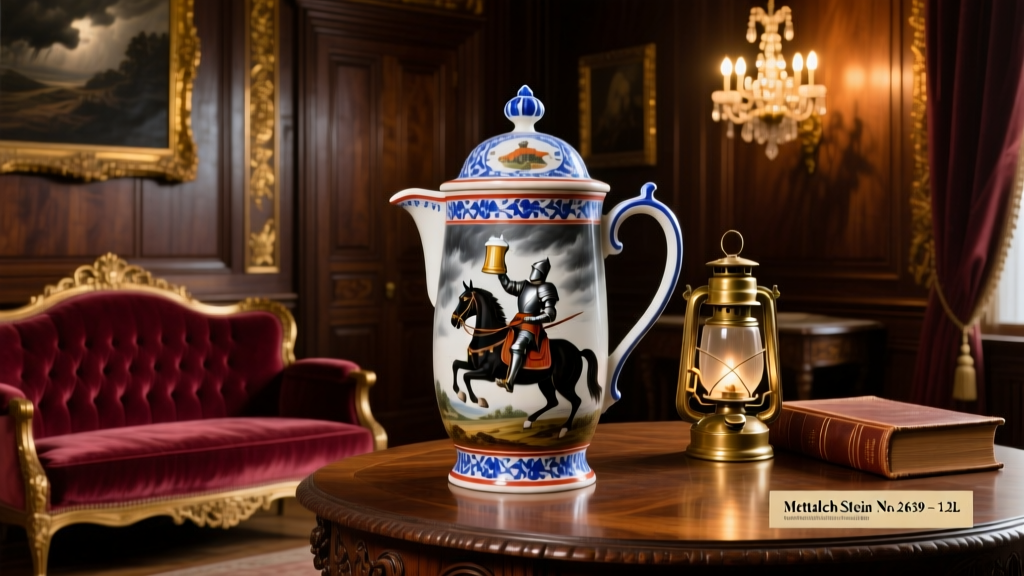
Mettlach Stein No. 2639: Decoding the 1.2-Liter Blacksmith Cavalier Drinking Stein with Inlaid Lid

Vintage Amethyst Cordials: History, Identification, and Care of Hand-Blown Glass Stemware

Charles Ward: The Unheralded Master of American Federal Furniture and His Enduring Legacy
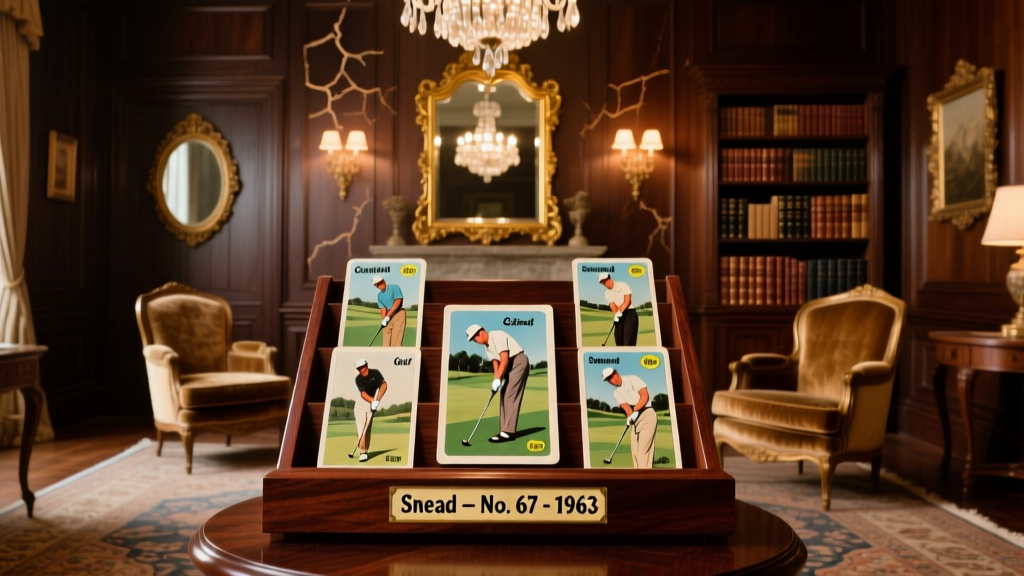
Williams-Snead Fleer No. 67, 1963: A Collector’s Deep Dive into Golf’s First Major Trading Card Series
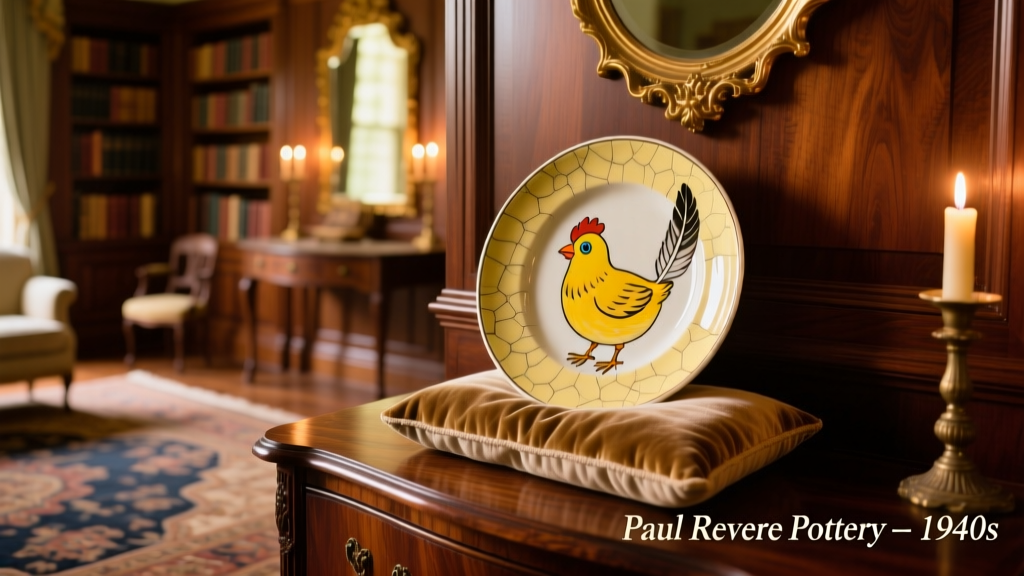
Paul Revere Pottery Whimsical Chick Plate: A 6-Inch Cream-Yellow Masterpiece of Early 20th-Century American Studio Ceramics

Game Adventures of Robin Hood Magic Windows: A 1956 Betty B. Board Box Restoration & Historical Appraisal

Depression Glass Doric Bowl: Identifying, Valuing, and Preserving the Pink 9-Inch Vegetable Oval

Slag Glass Red Eyewash Cup, Footed, Circa 1980 — A Detailed Examination of Form, Function, and Historical Context

Weller Zona Pitcher: Splashing Ducks, Foliage, and the Signature Green-Ivory Ground — A Collector’s Deep Dive into the 7¼-Inch Masterpiece