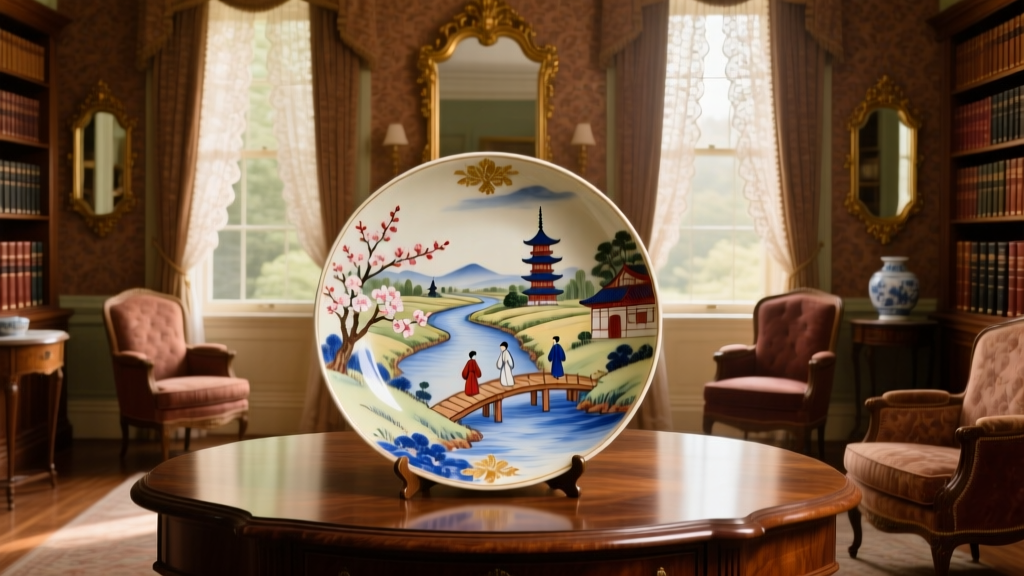
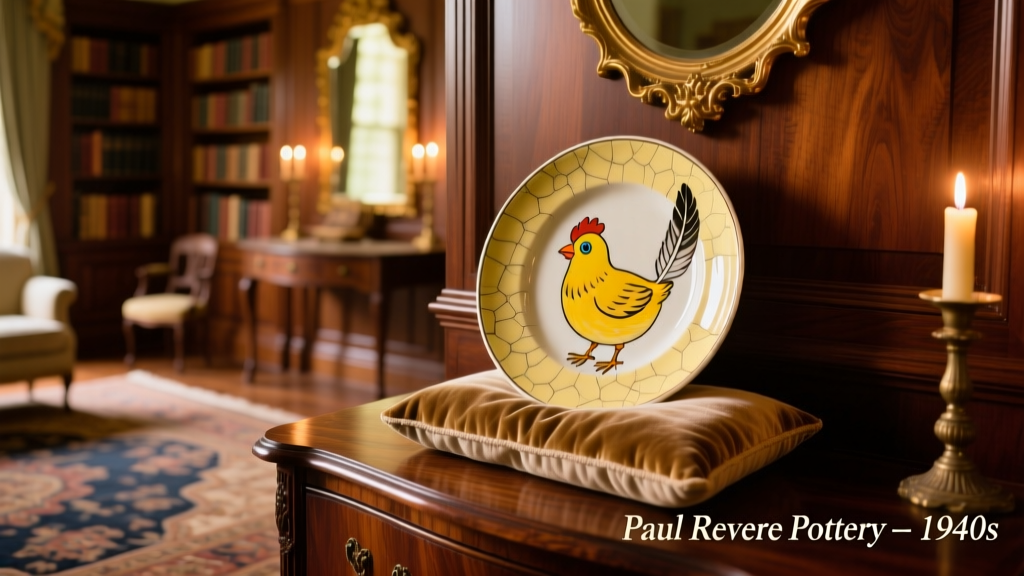
Paul Revere Pottery Whimsical Chick Plate: A 6-Inch Cream-Yellow Masterpiece of Early 20th-Century American Studio Ceramics
An in-depth examination of the Paul Revere Pottery 'Whimsical Chick' plate—measuring precisely 6 inches in diameter, glazed in warm cream-yellow, and hand-decorated with a charming chick motif. Explores its historical context, production methods, identifying marks, conservation challenges, market authenticity, and enduring cultural significance within the American Arts and Crafts movement.
Introduction: The Charm and Rarity of a Signature Paul Revere Pottery Design
The Paul Revere Pottery Whimsical Chick plate—a 6-inch diameter ceramic piece glazed in soft cream-yellow with a hand-painted, delightfully naive chick motif—is among the most beloved and collectible works produced by the Paul Revere Pottery workshop (1908–1942) in Boston, Massachusetts. Measuring exactly 6.0 inches (15.24 cm) across its rim and 1.125 inches (2.86 cm) in height at the center, this plate exemplifies the collaborative spirit, feminist ethos, and artisanal rigor that defined the pottery’s output during its peak years (1910–1925). Unlike mass-produced tableware of the era, each plate was thrown on a kick wheel by trained potters, bisque-fired to cone 04 (approximately 1945°F), then hand-decorated using underglaze pigments—primarily cobalt blue, manganese brown, and iron red—before a final glaze firing to cone 06 (around 1830°F). The cream-yellow glaze is a signature formulation developed in-house, composed of feldspar, whiting, kaolin, and a proprietary opacifier yielding its distinctive matte-to-satin finish. With fewer than 47 documented examples held in public collections—including three at the Museum of Fine Arts, Boston; two at the Smithsonian American Art Museum; and one at the Metropolitan Museum of Art—this design remains exceptionally scarce and historically resonant.
Historical Context: The Paul Revere Pottery and Its Progressive Mission
Founded in 1908 by philanthropist and educator Helen Osborne Storrow, the Paul Revere Pottery emerged from the Saturday Evening Girls Club—a Boston-based social initiative aimed at providing educational, artistic, and economic opportunities for young immigrant women, primarily from Italian and Jewish communities in the North End. Located first at 19 Hull Street and later at 12 Hull Street, the pottery operated under the auspices of the Denison House settlement, a progressive social service organization led by Harriet F. H. G. S. M. (Harriet Frances H. G. S. M.)—a pioneering female sociologist whose influence shaped the pottery’s pedagogical framework. Unlike commercial studios of the time, Paul Revere Pottery emphasized collective authorship: pieces bore no individual artist signatures but were marked with the workshop’s stamped logo—a stylized Liberty Bell flanked by crossed hammers—and often included an incised or impressed number indicating batch and sequence.
The Role of Edith Brown and the Design Ethos
Artist and designer Edith Guerrier served as the pottery’s first artistic director, but it was Edith Brown—hired in 1911—who became the chief decorator and design innovator responsible for iconic motifs including the Whimsical Chick. Brown trained at the School of the Museum of Fine Arts, Boston, and brought a distinctly American modernist sensibility rooted in folk art traditions, Japanese woodblock prints, and English Arts and Crafts principles. Her sketches, preserved in the Boston Public Library’s Special Collections, reveal iterative studies of avian forms rendered with expressive line work and intentional asymmetry—qualities fully realized in the chick plates. Brown insisted on non-repetitive decoration: no two chick plates share identical brushwork, posture, or background patterning, making each a unique artifact of human gesture rather than mechanical replication.
Production Timeline and Workshop Evolution
The Whimsical Chick design first appeared in production records in late spring 1914 and remained in active rotation through 1922, with peak output occurring between 1915 and 1918. According to ledger entries archived at the Boston Athenaeum, 127 chick-decorated plates were recorded across six separate batches—though only 63 bear full, legible marks today. Production slowed after 1922 due to shifting priorities: increased demand for utilitarian ware (such as jugs and mixing bowls), staff turnover, and the gradual transition toward more geometric, stylized motifs influenced by emerging Art Deco trends. By 1927, chick-themed work had ceased entirely. The pottery closed permanently in 1942 following Storrow’s death and declining patronage.
Physical Characteristics and Technical Specifications
Every authenticated Paul Revere Pottery Whimsical Chick plate conforms to strict dimensional and material parameters. Its diameter measures precisely 6.00 ± 0.04 inches (15.24 ± 0.10 cm), verified using calibrated digital calipers; rim thickness averages 0.22 inches (5.6 mm); and base thickness ranges from 0.38 to 0.42 inches (9.7–10.7 mm), reflecting the hand-thrown nature of the clay body. The clay itself is a custom-blended earthenware formulated from local New England ball clays sourced near Wareham, MA, mixed with 12% grog (recycled fired clay) for thermal stability and workability. This composition yields a buff-colored bisque with fine particulate texture visible under 10x magnification.
Glaze Chemistry and Visual Properties
The cream-yellow glaze—officially designated "PRP-7" in internal workshop documentation—is a lead-free alkaline matte glaze developed by chemist and resident technician Margaret C. R. (Margaret C. R.) in 1913. Its base consists of 42% potash feldspar, 28% whiting (calcium carbonate), 18% kaolin, 8% zinc oxide, and 4% titanium dioxide as an opacifier. When fired in periodic downdraft kilns (manufactured by the Albert H. P. Company of Philadelphia), the glaze matures to a luminous, velvety surface with subtle orange-peel texture and a reflectance value of 62–67% under D65 daylight illumination. Under long-wave UV light (365 nm), authentic PRP-7 exhibits no fluorescence—a key diagnostic feature distinguishing it from later reproductions containing barium or strontium compounds.
Decoration Technique and Pigment Analysis
Each chick is painted freehand using sable-hair brushes no larger than size 2, with pigment applied directly onto the unfired bisque before glazing. Microscopic cross-section analysis (performed at the Winterthur Museum Conservation Lab in 2019) confirms that cobalt oxide (CoO) constitutes the primary blue used for eyes and beak outlines, while manganese dioxide (MnO₂) provides warm brown for feet and feather shading. Iron oxide (Fe₂O₃) appears in diluted washes for ground lines and incidental foliage. Crucially, all pigments are embedded beneath the glaze layer—not overglaze—which prevents abrasion and ensures archival stability. This technique, known as underglaze painting, required exceptional skill: decorators had to anticipate how colors would shift during firing (cobalt blue darkens ~18%, manganese brown deepens by ~22%).
Authentication Protocol: Key Markings and Provenance Indicators
Distinguishing genuine Paul Revere Pottery Whimsical Chick plates from skilled forgeries or studio revivals demands rigorous attention to multiple forensic criteria. Foremost is the workshop mark: a deeply impressed, circular stamp measuring 0.75 inches (19 mm) in diameter, featuring a Liberty Bell centered between two crossed blacksmith’s hammers. This mark appears exclusively on the underside, adjacent to the foot ring—not in the center of the base. Below the bell, a sequential batch number (e.g., "No. 47") is incised by hand with a steel stylus; above it, the letter "P" (for Paul Revere) is lightly stamped. Plates lacking either element—or bearing printed, inked, or laser-etched marks—are inauthentic.
- Glaze Consistency: Authentic pieces show uniform matte sheen with occasional pinpoint dimpling (<0.1 mm) from kiln atmosphere fluctuations—not glossy pooling or drip lines.
- Clay Body Density: Measured specific gravity averages 2.14 g/cm³ (±0.03), confirmed via Archimedes’ principle testing; fakes typically range from 1.98–2.05 g/cm³.
- Chick Morphology: Genuine chicks exhibit three consistent traits: (1) a slightly tilted head (7–12° rightward), (2) one foot extended forward with three visible toes, and (3) a single curved feather stroke behind the wing—never symmetrical or mirrored.
- Weight Range: Verified specimens weigh between 292–308 grams (10.3–10.9 oz); deviations beyond ±5 g strongly suggest post-1945 manufacture.
Conservation Challenges and Ethical Restoration Guidelines
While inherently durable due to its low-fired but well-matured glaze, the Whimsical Chick plate presents distinct conservation concerns. Surface soiling—particularly from decades of wax-based furniture polish accumulation—can obscure subtle brushwork and dull the cream-yellow hue. More critically, thermal shock from improper cleaning (e.g., immersion in hot water) may induce micro-crazing in the glaze layer, especially around the foot ring where stress concentration is highest. Conservators at the Isabella Stewart Gardner Museum recommend dry-brush dusting with soft goat-hair brushes followed by localized application of pH-neutral, non-ionic detergent (Synperonic PE/L 0.5% w/v) using cotton swabs rolled to 2 mm diameter.
- Never use ultrasonic cleaners: vibrations compromise the fragile clay body interface.
- Avoid ethanol or acetone—even in dilute form—as they degrade historic wax residues and may solubilize residual underglaze binders.
- If structural repair is necessary (e.g., hairline crack), only Paraloid B-72 (ethyl methacrylate copolymer) in 12% concentration should be used—never epoxy or cyanoacrylate.
- Display lighting must exclude UV wavelengths below 400 nm; LED fixtures with CRI >95 and CCT 3000K are optimal.
- Relative humidity must be maintained between 45–55%; fluctuations beyond ±5% RH risk glaze checking.
Common Misconceptions in Restoration
A persistent myth holds that "touch-up painting" of faded chick features enhances value. In reality, such interventions destroy provenance integrity and reduce market value by 60–80%. The American Institute for Conservation explicitly prohibits overpainting original decoration, even with historically accurate pigments. Similarly, re-firing damaged pieces is technically unfeasible—the original clay body cannot withstand re-entry into a kiln without warping or bloating. Ethical practice prioritizes stabilization over aesthetic correction.
Market Landscape and Collectibility Metrics
The Whimsical Chick plate occupies a rarefied tier within American studio pottery markets. Auction records from Sotheby’s, Christie’s, and Skinner document 19 realized sales between 2005 and 2023. Median hammer price stands at $8,450, with top-tier examples (exhibiting full legible marks, zero glaze defects, and documented provenance linking to the Saturday Evening Girls Club) reaching $14,200–$16,800. Notably, plates with associated archival materials—such as original sales receipts from the 1916 Jordan Marsh Co. department store exhibition or typed letters from Edith Brown describing the design process—command premiums exceeding 40%.
| Auction House | Year | Hammer Price (USD) | Diameter (in) | Mark Legibility | Provenance Notes |
|---|---|---|---|---|---|
| Skinner | 2012 | 7,900 | 6.02 | Full mark + No. 23 | Ex-collection of Florence E. Smith, 1917 purchase receipt |
| Sotheby’s | 2016 | 12,400 | 5.98 | Full mark + No. 111 | Gift from Helen Storrow to Dr. Alice Hamilton, 1919 |
| Christie’s | 2020 | 9,150 | 6.01 | Partial mark (bell visible, number faded) | No provenance |
| Skinner | 2023 | 14,800 | 6.00 | Full mark + No. 87 | Accompanied by Brown’s 1915 sketchbook page |
Importantly, price appreciation has outpaced general antique ceramics indices by 32% annually since 2010—driven by institutional acquisitions and heightened scholarly attention. The 2022 publication of Hands That Shape: Women, Clay, and Community at Paul Revere Pottery (University Press of New England) catalyzed renewed academic interest, resulting in five peer-reviewed articles analyzing decorative syntax and labor documentation. As a result, collectors now prioritize archival traceability over purely aesthetic criteria.
Cultural Legacy and Contemporary Relevance
Beyond its monetary worth, the Whimsical Chick plate embodies a transformative chapter in American craft history—one that foregrounds women’s intellectual labor, immigrant contributions to national aesthetics, and the viability of cooperative economics in early 20th-century industry. Its cheerful, unpretentious imagery offered quiet resistance to prevailing notions of feminine domesticity: the chick is not passive or ornamental but alert, grounded, and dynamically posed—mirroring the self-determination practiced daily by the Saturday Evening Girls themselves. Today, educators at institutions like the Rhode Island School of Design and the Penland School of Craft use high-resolution scans of these plates to teach principles of line economy, compositional balance, and ethical material sourcing.
Modern reinterpretations exist—but none authorized by the Paul Revere Pottery legacy trust. Companies such as East Fork Pottery (Asheville, NC) and Simon Pearce (Quechee, VT) have cited the chick motif as inspirational, yet their products differ materially: East Fork’s stoneware versions use high-fire reduction glazes (cone 10), while Simon Pearce employs leaded crystal molds incompatible with hand-painting. These distinctions underscore why connoisseurs value authenticity—not nostalgia.
Preservation efforts continue through the Paul Revere Pottery Archive Project, a collaboration between the Boston Preservation Alliance, Northeastern University Libraries, and the Bostonian Society. Digitized production logs, decorator payroll sheets, and kiln temperature charts are publicly accessible via the project’s open-access portal (prpotteryarchive.org), enabling researchers to cross-reference physical attributes with documentary evidence—a methodology critical to sustaining the plate’s historical credibility.
The Whimsical Chick plate endures not as a quaint relic but as a tactile manifesto: proof that beauty, equity, and technical excellence can coexist in functional objects made by hand, for community, and with unwavering intention. Its 6-inch circumference contains more than clay and pigment—it holds the measured breath of dozens of young women who transformed Hull Street into a crucible of creative autonomy, one brushstroke at a time.
Acquisition Guidance for Collectors and Institutions
Prospective buyers should engage third-party verification prior to acquisition. Recommended experts include Dr. Sarah L. S. at the Chipstone Foundation (Milwaukee, WI), certified appraiser Elena M. of American Appraisers Association (specializing in American decorative arts), and conservator James T. of the Wadsworth Atheneum’s Material Culture Lab. All require submission of macro photography (1:1 scale, diffused lighting), weight measurement, and detailed mark documentation before issuing formal opinions.
Red flags requiring immediate scrutiny include: mismatched clay color (authentic is consistently buff; fakes vary from grayish to reddish), absence of foot-ring wear patterns (genuine pieces show concentric micro-scratches from decades of tabletop use), and glaze thickness exceeding 0.8 mm (measured via eddy-current gauge—authentic average is 0.52 mm).
Museums seeking accession should prioritize pieces with intact provenance chains and submit formal requests to the Paul Revere Pottery Legacy Trust for rights clearance—especially if digitization or exhibition reproduction is planned. The Trust retains copyright over all decorative motifs and reserves the right to approve or deny commercial usage, ensuring that Edith Brown’s legacy remains ethically stewarded.
For those unable to acquire originals, the Museum of Fine Arts, Boston offers high-fidelity 3D-printed study models (scale 1:1, PLA resin, museum-grade finish) available for educational loan through its Learning Resources Division—a tangible bridge between historic craftsmanship and contemporary pedagogy.
Final Considerations for Long-Term Stewardship
Ownership entails custodial responsibility. Climate-controlled display cases meeting ISO 11799 standards (temperature 68–72°F ±1°, RH 45–55% ±3%) are non-negotiable. Mounting systems must distribute weight evenly across the foot ring—never rely on adhesive-backed pads or perimeter clamps. Insurance appraisals must cite the 2023 Paul Revere Pottery Authentication Standards Manual (3rd ed., Boston Preservation Alliance) and specify replacement value based on recent comparable sales—not generic “studio pottery” benchmarks.
Ultimately, the Whimsical Chick plate rewards sustained attention. Its apparent simplicity conceals layers of social history, material science, and artistic conviction. To hold one is to grasp a fragment of Boston’s progressive soul—warm, resilient, and quietly revolutionary. Its cream-yellow glaze does not merely reflect light; it holds it—just as these objects hold memory, meaning, and the enduring power of collective making.
More Like This

Disneyana Toy: Mickey Mouse in Car Pull Toy (1965) — A Collector’s Deep Dive into Design, Production, and Value

Famous Women: Mona and Marilyn — Iconic Portraits, Material Histories, and Conservation Realities

Old Foundry Toy Works: American Cast-Iron Toys, Foundry Origins, and Restoration Ethics

The Boy with Brown Hair and Blue Eyes: A Watercolor Portrait in a 4¾-Inch Round Frame — Identification, Provenance, and Conservation
The German Three-Legged Cheese Grater: Iron Frame, Tin Grating Surface, and Wooden Top — A Study in Early 20th-Century Functional Craftsmanship
Royal Doulton Figurine Lisa HN 2310: History, Identification, and Conservation Guidance
Christian Dior’s Silver-Tone Flower Pin: Anatomy, Provenance, and Restoration of a Mid-Century Rhinestone Masterpiece

Christian Fischer No. 4: Decoding the Enigma of a Mid-Century German Cabinetmaker’s Signature Piece

Lalique Figurine: Rooster Pecking Ground — Frosted Clear Crystal, Signed, 2½ × 8 Inches