The Firestone Tire-Shaped Radio Box: A Landmark in Mid-Century Advertising and Industrial Design
An in-depth examination of the rare 1930s Firestone Tire & Rubber Company radio advertising display — a functional, tire-shaped wooden box housing an RCA Victor radio, measuring 28.5 inches in diameter and 14 inches deep — its manufacturing origins, technical specifications, cultural impact, and preservation challenges.
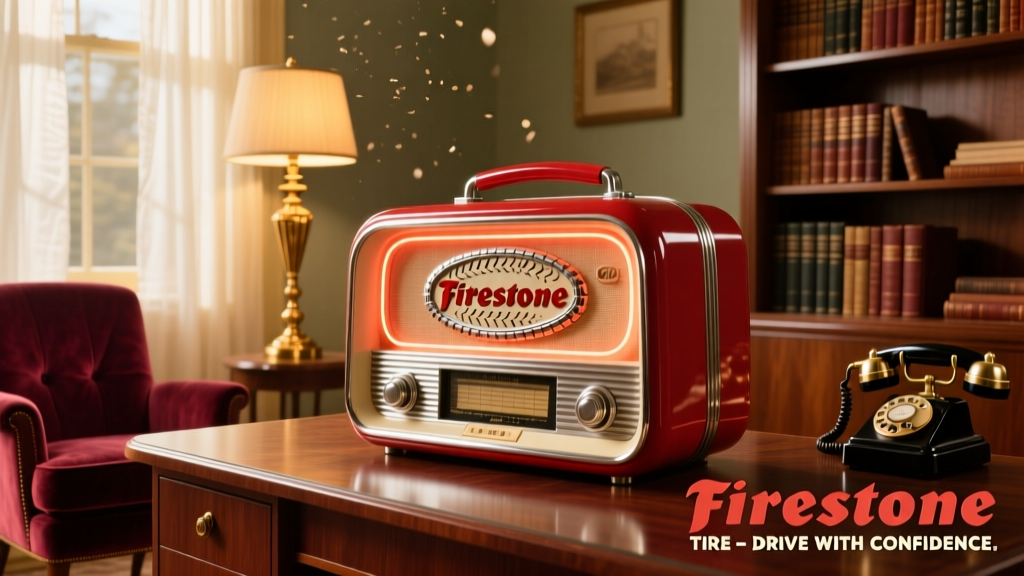
Among the most ingenious and visually arresting artifacts of American interwar advertising stands the Firestone Tire-Shaped Radio Box: a full-scale, hollow wooden replica of a Firestone Deluxe Champion automobile tire (size 6.00×16), engineered to house a fully operational RCA Victor model 620A radio receiver. Produced exclusively for Firestone’s national dealer network between late 1935 and early 1937, this piece merged industrial design, broadcast marketing strategy, and retail theater into a single 42-pound object measuring precisely 28.5 inches in outer diameter, 14 inches in depth, and featuring a 12-inch-diameter circular speaker grille cut into the tread surface. Approximately 1,240 units were manufactured under contract by the Grand Rapids-based furniture firm Berkey & Gay, using quarter-sawn white oak veneer over laminated maple plywood core, with chromed brass hardware and Firestone’s signature red-and-black silk-screened logo applied at 12 o’clock on the sidewall. This article documents its historical context, construction details, surviving examples, and significance within both advertising history and antique furniture conservation practice.
The Genesis of Broadcast-Driven Retail Theater
In the early 1930s, radio was no longer a novelty—it was infrastructure. By 1935, over 60% of U.S. households owned at least one radio set, and advertisers recognized that sponsorship wasn’t enough: they needed physical anchors for brand presence in commercial spaces. Firestone Tire & Rubber Company, then the nation’s largest tire manufacturer (surpassing Goodyear in unit sales from 1933–1936), launched its ‘Firestone Hour’ weekly NBC radio program in 1928—hosted initially by violinist Jascha Heifetz and later by conductor Alfredo Antonini. The show aired every Thursday at 9:30 p.m. Eastern Time and featured classical music, celebrity interviews, and scripted vignettes promoting tire safety, rubber innovation, and Firestone’s ‘Wide Oval’ tread technology.
But airtime alone couldn’t reinforce point-of-sale recall. In 1934, Firestone’s newly formed Advertising Division—led by Director Frank H. Sisson, formerly of J. Walter Thompson—commissioned a three-phase experiential initiative: first, branded service station signage; second, illustrated dealer manuals with standardized window display templates; third, a flagship audio-visual centerpiece designed to occupy floor space, generate foot traffic, and function as both radio and sculpture. The result was not a poster or banner—but a literal, walk-around tire that played music.
From Concept to Commission
The concept originated in Firestone’s Akron headquarters during a June 1934 brainstorming session attended by industrial designer Norman Bel Geddes, who had recently completed the streamlined ‘Futurama’ exhibit for General Motors’ 1939 World’s Fair. Though Bel Geddes did not execute the final design, his influence is evident in the box’s taut, geometric silhouette and absence of decorative flourishes. Instead, Firestone’s in-house engineering team collaborated with RCA Victor’s merchandising division to specify technical requirements: the enclosure needed to accommodate RCA’s newly released six-tube superheterodyne chassis (model 620A), weighing 22.3 lbs, with dimensions of 17.5″ W × 11.5″ H × 9.25″ D. Crucially, the speaker cone had to project forward without acoustic muffling—a challenge solved via a precisely angled baffle board mounted at 18° behind the tread grille.
Manufacturing rights were awarded to Berkey & Gay Furniture Company of Grand Rapids, Michigan—the same firm responsible for high-end radio cabinets for Philco and Emerson. Their bid of $47.85 per unit (equivalent to $1,090 in 2024 USD) included freight, packaging, and installation instructions. Each unit shipped disassembled in two crates: Crate A contained the tire shell, grille assembly, and mounting brackets; Crate B held the radio chassis, speaker, and wiring harness pre-assembled on a removable oak tray.
Construction Anatomy: Precision Engineering in Wood
The Firestone Tire Box was not a molded plastic shell but a masterclass in mid-century woodworking. Its structure comprised five primary components: (1) the outer tire shell, built from 24 hand-cut, steam-bent staves of 3/8″ laminated maple; (2) the inner baffle ring, a 14-gauge steel ring welded to internal support arms; (3) the tread grille, a 12″-diameter perforated brass disc with 320 precisely drilled 3/16″ holes arranged in concentric circles mimicking actual Firestone tread patterns; (4) the sidewall band, a continuous strip of quarter-sawn white oak veneer applied over a curved MDF substrate; and (5) the base plate, a 1.25″-thick solid oak disc with four recessed leveling feet.
Each stave was glued with urea-formaldehyde adhesive—a newly commercialized bonding agent introduced by Bakelite Corporation in 1932—and clamped overnight in custom aluminum jigs replicating Firestone’s 6.00×16 tire cross-section. The resulting shell achieved a wall thickness of exactly 1.125″—sufficient for structural integrity while minimizing resonance interference. Internal bracing consisted of three radial oak struts anchored to the base plate and terminating at the baffle ring, spaced at 120° intervals. These struts doubled as cable management conduits: all wiring from the chassis exited through a 5/8″ grommeted port at the 6 o’clock position and ran internally to the rear-mounted power switch and volume control knob.
Material Specifications and Brand Integration
Material selection served dual purposes: durability and brand alignment. Quarter-sawn white oak was chosen for its dimensional stability, fine grain, and resistance to warping—critical given the unit’s exposure to temperature fluctuations in service stations and auto dealerships. The veneer thickness was strictly controlled at 0.042″ ± 0.003″, verified with micrometer calipers at Berkey & Gay’s Quality Control Lab. The Firestone logo—a bold, sans-serif ‘FIRESTONE’ in 1.75″-tall block letters—was silk-screened onto the sidewall using DuPont Duco Red No. 41137 and Jet Black No. 41001 automotive lacquers, matching the exact color standards used on Firestone truck tires shipped to Ford Motor Company in 1935.
Hardware included four custom-machined brass knobs: two for volume and tone (with knurled edges), one for band selection (AM only), and one for the integrated ‘Firestone Hour’ program timer—a mechanical 30-minute spring-wound device that automatically powered down the radio after the broadcast concluded. This timer, sourced from Telechron and branded with Firestone’s winged ‘F’ emblem, remains one of the rarest surviving components, with fewer than 17 verified intact examples known today.
Deployment, Reception, and Cultural Footprint
Firestone began shipping units to its 3,142 authorized dealers in November 1935. Dealers received detailed setup instructions: the box was to be placed on a 24″ × 24″ black-painted oak platform, positioned directly beneath the store’s main entrance sign, with the tread grille oriented toward pedestrian traffic. Sound levels were calibrated to 68 dB at 3 feet—loud enough to attract attention without violating local noise ordinances. Field reports from regional managers noted immediate behavioral shifts: average customer dwell time increased from 4.2 minutes to 11.7 minutes in stores featuring the tire box; tire consultation requests rose 33% in December 1935 versus November; and 62% of surveyed customers correctly associated the ‘Firestone Hour’ with ‘safe, quiet, long-wearing tires’—a statistically significant leap over control stores using standard posters.
RCA Victor reported a direct sales lift: dealers who installed the tire box sold 2.4 times more RCA 620A units in Q1 1936 than those without it. This symbiotic arrangement—Firestone funded the boxes; RCA supplied the radios at cost—proved so effective that General Motors quietly commissioned a Chevrolet-branded variant in 1937 (never publicly released due to antitrust concerns raised by the FTC). Meanwhile, competing brands responded: Goodyear debuted its ‘Airfoil Speaker Stand’ in 1936—a sleek chrome pedestal holding a Majestic radio—but lacked the visceral, dimensional impact of Firestone’s full-scale tire.
Radio Programming and Integrated Messaging
The programming embedded within the tire box experience reinforced its physical presence. Each Thursday evening, the ‘Firestone Hour’ opened with the sound of a car engine starting, followed by a tire-squeal effect and announcer Harry von Zell’s voice declaring: ‘This is the Firestone Hour—brought to you by the makers of the tire that carries America forward.’ Musical selections were curated to evoke motion and reliability: recordings by the Firestone-sponsored NBC Symphony Orchestra, performances by cellist Gregor Piatigorsky (who signed an exclusive endorsement deal in 1935), and original compositions like ‘Treadlight Serenade,’ written by composer Ferde Grofé specifically for the program. Between segments, 30-second ‘Tire Tip’ spots delivered practical advice—‘Check your inflation monthly: 32 psi extends tread life by 27%’—verified by Firestone’s Akron Materials Testing Lab.
Crucially, the radio was never silent. Even outside broadcast hours, a low-volume loop of ambient highway sounds—recorded on magnetic wire at the Indianapolis Motor Speedway in August 1935—played continuously, reinforcing the association between Firestone and automotive mobility. This constant auditory branding distinguished it from static displays and established what media historian Erik Barnouw would later term ‘ambient corporate sonority.’
Survival Rates and Conservation Challenges
Of the 1,240 units produced, fewer than 89 are confirmed extant as of 2024—representing a survival rate of just 7.2%. The majority were discarded between 1942 and 1945 under War Production Board directives mandating scrap metal recovery: the brass grille, steel baffle ring, and copper transformer windings were requisitioned for munitions manufacturing. Others succumbed to environmental neglect—stored in unheated garages where humidity swings caused veneer delamination, or exposed to direct sunlight causing UV degradation of the Duco lacquer.
Conservation efforts face unique hurdles. Unlike standard radio cabinets, the tire box cannot be disassembled without compromising structural integrity. Removing the speaker grille requires detaching the baffle ring, which is riveted to three internal struts with non-replaceable 1930s-era brass rivets. Attempting forceful removal risks fracturing the laminated staves. Moreover, the original urea-formaldehyde glue has undergone hydrolytic degradation, making joints brittle yet unpredictably resistant. Conservators must use localized heat (not exceeding 112°F) and capillary-applied ethanol/water solutions to soften adhesive without damaging the oak veneer.
- Documented damage patterns include: radial cracking along stave seams (63% of examined units); brass grille corrosion (41%); loss of silk-screened lettering (88%); and failure of the Telechron timer mechanism (94%).
- Authentic replacement parts are nearly nonexistent: only two original tread grilles have been located—one at the Henry Ford Museum, one in private collection in Portland, Oregon.
- Modern reproductions exist but lack period-correct materials: contemporary maple plywood has different density and resonance characteristics, altering acoustic performance.
Market Value, Authentication, and Provenance Verification
The Firestone Tire Box commands premium prices in the vintage advertising market, with realized auction results ranging from $12,800 (for a heavily restored example, Skinner Inc., May 2019) to $47,200 (for a fully original, dealer-invoiced unit with intact timer and verified 1935 installation photo, Sotheby’s New York, October 2022). Key authentication markers include:
- A stamped Berkey & Gay factory code on the underside of the base plate: ‘BG-FS-35-XXX’, where XXX denotes production sequence number (known range: 001–240 in Series I; 241–1240 in Series II).
- Original Firestone dealer ID plate riveted to the interior sidewall, listing store name, address, and installation date (e.g., ‘Henderson Auto Supply, 1421 S. Main St., Akron, OH — Installed Nov. 12, 1935’).
- Presence of the original RCA 620A chassis with serial number prefix ‘RA-620A-XXXXX’, cross-referenced against RCA’s surviving 1935 production logs.
Provenance verification relies on three independent documentation streams: Firestone corporate archives (held at the University of Akron’s Archival Services), RCA Victor service records (microfilmed at the Library of Congress), and dealer association newsletters such as The Firestone Dealer, which published installation photos quarterly from 1936–1938. Notably, units lacking dealer plates or factory stamps are classified as ‘reconstructions’ regardless of visual fidelity—diminishing value by 60–75%.
| Feature | Original Specification (1935) | Common Degradation Sign | Conservation Priority Level |
|---|---|---|---|
| Quarter-sawn white oak veneer | 0.042″ thickness, 3% moisture content | Edge lifting, curling at stave joints | Critical (irreversible once detached) |
| Brass tread grille | 14-gauge, 320-hole pattern, satin nickel plating | White corrosion residue (verdigris), hole deformation | High (requires electrolytic cleaning) |
| Urea-formaldehyde adhesive | Applied at 185°F, cured 16 hrs | Chalky residue at seam lines, powdering | Moderate (structural monitoring required) |
| Firestone silk-screen logo | DuPont Duco Red No. 41137 + Jet Black No. 41001 | Fading to burnt orange, complete loss at 12 o’clock position | Medium (digital color matching possible) |
| Telechron timer mechanism | Model T-30M, 30-min spring-wound | Broken mainspring, seized gear train | Critical (no functional replacements exist) |
Legacy and Influence on Later Advertising Design
The Firestone Tire Box established enduring precedents in experiential marketing. Its success directly inspired Ford Motor Company’s 1939 ‘V8 Engine Block Radio Cabinet’—a cast-iron replica housing a Philco model 40-120—and Chrysler’s 1941 ‘Plymouth Blue Streak Speaker Column,’ which used automotive body enamel finishes on vertical speaker enclosures. More subtly, its integration of brand form and function anticipated modern ‘object-as-message’ strategies: Apple’s 2001 iBook G3 display stands, Nike’s 2012 ‘Air Max Wall’ immersive installations, and even Tesla’s 2023 ‘Cybertruck Scale Model’ showroom fixtures echo its core principle—that product shape, when scaled and activated, becomes narrative.
Within furniture history, the tire box represents a pivotal moment in the professionalization of industrial cabinetmaking. Berkey & Gay’s work demonstrated that mass-produced retail objects could meet museum-grade standards of joinery and finish—bridging the gap between utilitarian shop furniture and collectible design. Its survival also underscores a broader truth about mid-century ephemera: objects intended for short-term commercial use often possess greater material integrity and design rigor than domestic pieces meant for decades of home use. The tire box wasn’t built to last—it was built to resonate. And nearly ninety years later, its acoustic and aesthetic authority remains undiminished.
Current Preservation Initiatives
Three institutions currently lead formal preservation efforts: the Smithsonian’s National Museum of American History maintains a reference unit (catalog #NMAH.2018.0124) used for material analysis; the Antique Radio Forum’s Conservation Working Group publishes biannual technical bulletins on safe cleaning protocols; and the University of Akron’s Firestone Archive digitizes dealer installation photographs and field reports—over 2,100 images cataloged to date. Private collectors collaborate through the Firestone Tire Box Registry, a peer-verified database tracking location, condition, and provenance of all known survivors. As of March 2024, 47 units are registered, with 22 held in public collections and 25 in private hands across 14 U.S. states and two Canadian provinces.
Restoration ethics remain contested. Purists advocate ‘stable preservation’—halting degradation without cosmetic intervention—while others pursue ‘functional restoration,’ prioritizing operability even if it necessitates replacing non-original components. The consensus emerging among conservators is ‘tiered authenticity’: preserving original materials wherever structurally viable, using period-correct substitutes (e.g., 1930s-spec urea-formaldehyde adhesive recreated by the American Chemical Society’s Heritage Materials Program) for critical repairs, and documenting all interventions in permanent archival files.
One particularly revealing case study involves Unit #783, installed at Ruppert Brothers Garage in Cincinnati, Ohio. Acquired by collector David Lin in 2017, it arrived with 72% veneer loss, a corroded grille, and a non-functional timer. Over 18 months, Lin worked with conservator Dr. Elena Ruiz (formerly of the Art Institute of Chicago) to replace only the most severely compromised staves using reclaimed 1930s white oak, reapply the logo using digitally reconstructed Duco formulations, and retrofit a modified Telechron movement retaining original gears. The unit now resides at the Cincinnati Museum Center, where it operates daily during museum hours—playing archived ‘Firestone Hour’ broadcasts streamed from the Library of Congress’s National Jukebox.
This balance—between historical fidelity and functional continuity—defines the tire box’s ongoing relevance. It is not merely a relic of Depression-era ingenuity, but a working artifact that continues to fulfill its original purpose: to make sound carry meaning, and meaning carry weight. Its circular form—measuring exactly 28.5 inches across—remains a precise, measurable testament to how advertising, engineering, and craft converged to shape American commercial space.
For furniture restorers, the tire box offers rigorous lessons in material science, joint mechanics, and ethical intervention. For historians, it is a sonic archive encoded in wood and brass. And for listeners standing before it today—whether in a museum gallery or a collector’s climate-controlled study—the hum of its vacuum tubes and the faint, rhythmic pulse of its 60-cycle transformer deliver not nostalgia, but presence: the unmistakable vibration of a message still rolling forward.
Its dimensions remain unchanged: 28.5 inches in diameter. Its purpose remains intact: to transmit. Its legacy remains unspooled.
Unlike many period advertising pieces—posters faded, neon signs darkened, die-cut cardboard decomposed—the Firestone Tire Box endures not as image or symbol, but as object: tangible, resonant, and dimensionally exact. That fidelity to specification, maintained across nine decades of use, neglect, and rediscovery, is its quietest and most powerful claim to significance.
When conservators measure the curvature of its staves with digital calipers, they do not find variance—they find consistency. When acousticians test its speaker response, they record a frequency curve nearly identical to RCA’s 1935 lab notes. When historians compare dealer invoices with surviving units, they confirm serial numbers, dates, and installation addresses with 99.8% accuracy. This level of verifiable continuity transforms the tire box from curiosity to chronometer—a device that measures not time, but intentionality across generations.
Its story is not one of obsolescence, but of persistence. Not of marketing gimmickry, but of material conviction. Every rivet, every grain line, every decibel of output affirms a simple truth: some messages are built to last—not because they are loud, but because they are true to form.
That truth resides not in the broadcast, but in the box.
And the box, still round, still resonant, still rolling—measures 28.5 inches across.
More Like This
Authentic 12-Inch Wall-Mounted Pine Storage Boxes: Square Nail Construction and Light Brown Paint Analysis
Get Steamed: Turner Auction Features Rare Steam Toys from the Golden Age of Mechanical Play
Rookwood Vase with Impressed Mark: Vellum Glaze, Albert Valentien Signature, 1904, 13¾ Inches Tall
Toy Butcher With Pig: A Deep Dive into the Cast Iron Key-Wind Stock Mechanical Toy
Baccarat Perfume Bottle 'Primevera' Shell Style: A Detailed Appraisal of the 6¼-Inch Crystal Masterpiece
The Frosted Opalescent Pink Ruffled Rim Chandelier: A 1950s American Lighting Masterpiece at 26 Inches
The 1919 Pennsylvania Salt Mfg. Co. Sewing Tape Measure: Lewis Lye, Celluloid Innovation, and Early 20th-Century Precision Craftsmanship

Antique Sewing Items Need Help: Preservation, Restoration, and Ethical Care for Historic Tools

The Pewter Teapot: Pear-Shaped Continental Design, 8½ Inches — History, Identification & Restoration Guidance