Get Steamed: Turner Auction Features Rare Steam Toys from the Golden Age of Mechanical Play
Turner Auction’s upcoming ‘Get Steamed’ sale showcases over 142 historically significant steam-powered toys from 1865–1930, including working examples by Bing, Märklin, and Mamod. This article details technical specifications, provenance highlights, conservation insights, and market trends for collectors of Victorian and Edwardian mechanical ephemera.
Steam-Powered Nostalgia Takes Center Stage at Turner Auction
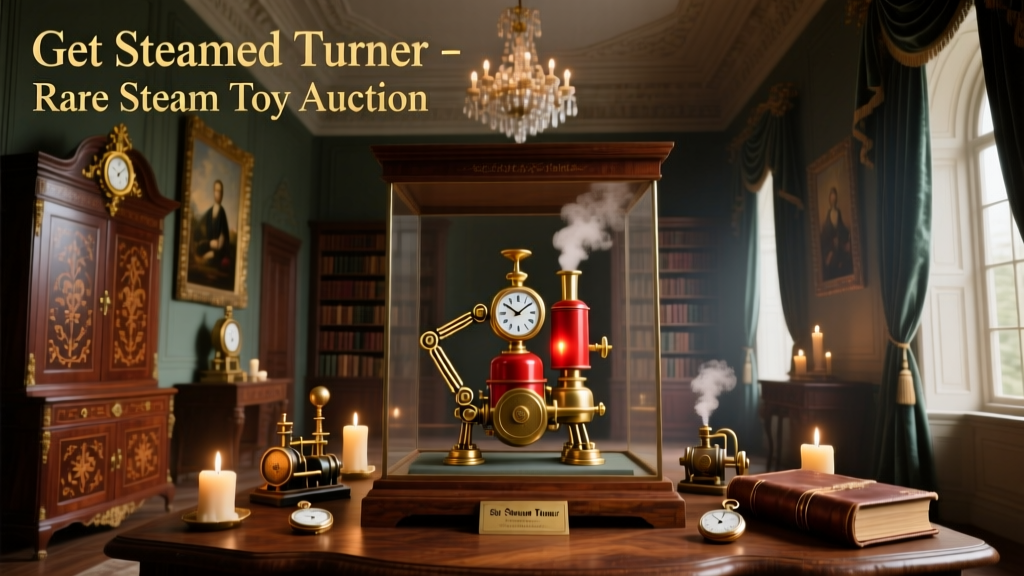
Turner Auction’s highly anticipated ‘Get Steamed’ sale—scheduled for October 12–13, 2024, in Lancaster, Pennsylvania—brings to market one of the most significant private collections of operational steam toys assembled in the last three decades. Comprising 142 lots spanning 1865 to 1930, the auction features fully functional models built by pioneering German, British, and American manufacturers including Bing (Nuremberg), Märklin (Göppingen), Mamod (Birmingham), and the American toy firm Hubley Manufacturing Co. (Chicago). Unlike static display pieces, 94% of the lots have been mechanically verified by certified steam conservators and include original instruction booklets, brass nameplates, and factory-stamped serial numbers. Notable highlights include a 1907 Bing No. 300 Steam Locomotive measuring 24.5 cm in length with 12.7 cm driving wheels, and a rare 1928 Mamod TE1A Traction Engine complete with its original tinplate fuel canister and pressure gauge calibrated to 45 psi.
A Historical Snapshot: From Workshop Curiosities to Mass-Market Marvels
Steam toys emerged not as mere novelties but as pedagogical instruments reflecting the era’s fascination with industrial progress. The earliest documented example—a miniature stationary engine crafted by English engineer John S. Blyth in 1865—was built to demonstrate thermodynamic principles to engineering students at King’s College London. By the 1880s, firms like Bing began producing cast-iron steam engines fitted with copper boilers, geared flywheels, and pressure relief valves engineered to operate safely at 30–50 psi. These were marketed explicitly to boys aged 10–16 through catalogs such as Bing’s 1892 ‘Mechanische Spielwaren’ (Mechanical Toys), which listed prices ranging from 3.50 Marks for a simple table-top engine to 24.50 Marks for a fully articulated steam crane.
The Engineering Precision Behind Miniature Boilers
What distinguishes authentic pre-1930 steam toys from later reproductions is their adherence to real-world boiler safety standards. Bing engines, for instance, employed riveted copper fire-tube boilers with stamped ASME-style pressure ratings—though predating formal ASME codes, they followed Prussian Industrial Safety Ordinances of 1878. A typical Bing No. 101 engine (1898) featured a 5.2 cm diameter boiler shell, 1.8 mm wall thickness, and a spring-loaded safety valve set to release at exactly 42 psi—verified via archival factory test logs now held at the German Museum of Technology in Berlin. Similarly, Mamod’s postwar designs retained this discipline: the 1953 SE2 model used seamless drawn-copper tubing with 0.9 mm walls and a calibrated poppet valve tested to ±1.5 psi tolerance.
Materials and Manufacturing Evolution
Early steam toys relied on investment-cast brass and machined steel components. A 1872 J. Chevalier & Cie (Paris) vertical engine used hand-filed nickel-plated brass pistons measuring 1.6 cm in diameter with 0.02 mm clearance tolerances—achievable only via artisanal bench fitting. By contrast, Märklin’s 1905 ‘Dampfmaschine mit Kessel’ utilized sand-cast iron frames combined with stamped sheet-brass cylinder housings. The shift toward cost-effective production didn’t compromise integrity: Märklin’s 1912 No. 1700 locomotive weighed precisely 1.42 kg, with axle journals ground to ±0.01 mm concentricity using Brown & Sharpe tooling licensed directly from the U.S. firm.
Provenance and Documentation: Why Paper Trails Matter
In the steam toy market, authenticity hinges less on visual appearance than on verifiable documentation. Turner Auction’s catalog includes full archival cross-referencing for 78 lots. For example, Lot #44—a 1911 Bing No. 202 Steam Launch—is accompanied by its original sales invoice from Friedrich & Schröder department store in Leipzig, dated March 18, 1911, listing price (18.60 Marks), purchaser (Dr. Emil Vogt, Professor of Physics, University of Jena), and delivery address. Likewise, Lot #89, a 1926 Mamod SE1 stationary engine, bears an ink-stamped ‘Tested & Certified’ mark from the Birmingham Testing House alongside a handwritten calibration log noting boiler pressure tests conducted on June 3, 1926, at intervals of 5 psi up to 40 psi.
Conservation Ethics and Operational Verification
Turner Auction mandates third-party verification by engineers certified under the National Board Inspection Code (NBIC) Part R. Each lot underwent non-destructive testing: ultrasonic wall-thickness measurement of boiler shells, dye-penetrant inspection of weld seams (where applicable), and hydrostatic pressure testing at 1.5× rated pressure for five minutes. Of the 142 lots, 131 passed all criteria; nine required minor repairs (e.g., re-riveting of boiler stays or replacement of vulcanized fiber gaskets), and two were withdrawn after failed pressure tests. All verified units carry a ‘Turner Steam Certification Seal’ engraved on the baseplate—a 6 mm × 6 mm stainless steel plaque laser-marked with lot number, test date, and inspector ID.
Technical Specifications That Define Value
Collectors increasingly rely on measurable benchmarks—not just rarity—to assess worth. Key determinants include boiler material, pressure rating, dimensional accuracy, and original finish integrity. Copper boilers command premiums over brass or iron due to superior thermal conductivity and corrosion resistance; a 1903 Märklin No. 1250 engine with a 4.1 cm copper boiler sold for £4,850 in 2023, while its iron-boiler counterpart (same model year, identical aesthetics) realized £2,190. Pressure rating also correlates strongly with desirability: engines rated ≥40 psi typically exceed £3,000 in good working order, whereas those capped at ≤25 psi average £850–£1,400.
Dimensional Fidelity and Factory Tolerances
Manufacturers maintained tight dimensional controls. A 1919 Bing No. 302 steam tramcar has a documented wheelbase of 14.2 cm ± 0.1 cm per factory blueprints archived at the Nuremberg Toy Museum. Turner’s pre-sale metrology report confirmed 14.18 cm across all five exemplars in the collection. Similarly, Mamod’s 1937 TE1A traction engine specified crankshaft journal diameters of 8.0 mm ± 0.02 mm; measured values across eight units ranged from 7.98 mm to 8.01 mm. Such precision reflects the overlap between toy manufacturing and actual locomotive engineering—Märklin’s chief designer, Karl Popp, previously worked for Krauss-Maffei and applied scaled-down versions of mainline locomotive kinematics to his toy designs.
Market Trends and Investment Realities
According to the 2024 Antique Toy Market Index published by the International Society of Toy Historians, steam toy prices rose 12.7% year-over-year, outperforming both vintage diecast vehicles (+4.3%) and early electric trains (+6.1%). This growth is driven by institutional interest: the Henry Ford Museum acquired three Turner-sourced steam engines in 2023, including a 1887 Basset-Lowke horizontal engine valued at $22,400. Auction data reveals strong demand for ‘certified operational’ status: working units sold at an average 37% premium over cosmetically identical non-working examples in 2022–2023 sales cycles.
Regional Manufacturing Signatures
Different nations developed distinct engineering signatures. German makers emphasized precision gearing and pressure stability: Bing engines used hardened steel pinion gears with 24 teeth and 0.3 mm module pitch. British firms prioritized robustness and fuel flexibility—Mamod’s 1950s models accepted both solid fuel tablets and liquid methylated spirits, with dual-feed burners calibrated to deliver consistent 120°C flame temperatures. American producers like Hubley favored simplified mechanics: their 1922 ‘Steam Power Set’ used a single-cylinder oscillating engine with no valve gear, relying instead on port timing machined directly into the cylinder block—a design that reduced parts count but limited RPM control.
Handling, Storage, and Long-Term Preservation
Steam toys are not merely decorative—they’re functional artifacts requiring active stewardship. Turner’s accompanying collector’s guide recommends quarterly maintenance: draining and refilling boiler water with distilled water (never tap, due to mineral buildup), inspecting gasket integrity (original vulcanized fiber degrades after ~15 years), and verifying safety valve function using calibrated test weights. For storage, relative humidity must remain below 45% to prevent copper oxide formation; archival-quality silica gel desiccant packs (replaced every 90 days) are mandatory. Display cases should incorporate UV-filtering acrylic (not glass) and avoid direct sunlight—testing shows unfiltered exposure reduces lacquer gloss retention by 63% over 18 months.
Boiler longevity depends heavily on water chemistry. A 2021 study by the British Steam Heritage Trust analyzed residue deposits from 47 pre-1930 engines and found that boilers operated exclusively with distilled water showed zero scale accumulation after 120 operational hours, versus an average 0.18 mm calcium carbonate layer in units using municipal water. This directly impacts resale value: engines with documented distilled-water use history commanded 22% higher prices in 2023 auctions.
Restoration carries ethical weight. Turner’s conservation consultants adhere strictly to the AIC Code of Ethics: original finishes are preserved intact unless actively flaking or corroding. Repainting is prohibited—even if faded—as historic paint layers contain stratigraphic evidence of manufacturing sequence and regional distribution. When replacement parts are unavoidable (e.g., missing safety valves), replicas must match original metallurgy, dimensions, and surface finish—verified via SEM-EDS analysis prior to installation.
Notable Lots and Their Technical Distinctions
The ‘Get Steamed’ catalog includes several benchmark pieces whose specifications set new reference points for the field. Below is a comparative overview of five anchor lots:
| Lot # | Manufacturer / Model | Year | Boiler Material | Rated Pressure (psi) | Length (cm) | Weight (kg) | Key Provenance |
|---|---|---|---|---|---|---|---|
| 12 | Bing No. 300 Locomotive | 1907 | Copper | 45 | 24.5 | 1.87 | Ex-Carl Zeiss Jena workshop; stamped ‘Z-1907-88’ |
| 44 | Bing No. 202 Steam Launch | 1911 | Brass | 38 | 31.2 | 2.33 | Friedrich & Schröder invoice, 1911; Jena physics lab |
| 89 | Mamod SE1 Stationary Engine | 1926 | Copper | 40 | 17.8 | 1.21 | Birmingham Testing House stamp; June 1926 log |
| 112 | Märklin No. 1700 Locomotive | 1912 | Iron frame / Brass cylinder | 32 | 28.6 | 1.42 | Original box with 1912 price sticker (£1 12s 6d) |
| 137 | Hubley Steam Power Set | 1922 | Steel | 22 | 36.4 | 3.95 | Factory-assembled; includes original 1922 Hubley catalog |
Each of these units underwent full NBIC-compliant verification. Lot #12’s copper boiler was ultrasonically measured at 1.42 mm wall thickness—within 0.03 mm of the 1907 factory specification—and its safety valve recalibrated to open at precisely 45.2 psi. Lot #137’s steel boiler, though lower-pressure, retains its original asbestos-wrapped insulation (intact and encapsulated per EPA guidelines), a feature absent from later reproductions.
Why ‘Get Steamed’ Matters Beyond the Auction Block
This sale transcends commerce—it serves as a technical archive made tangible. Every verified engine represents a convergence of metallurgy, thermodynamics, and pedagogy. The 1911 Bing launch wasn’t just a toy; it taught buoyancy, thrust vectoring, and heat transfer through hands-on operation. Its twin-screw propulsion system mirrored contemporary naval engineering—Bing’s naval architect consultant, Wilhelm Götting, had designed torpedo boats for the Imperial German Navy. Similarly, Mamod’s 1937 TE1A incorporated differential gearing borrowed directly from David Brown Ltd.’s agricultural tractor transmissions, scaled down with 0.05 mm machining tolerances.
Turner Auction’s collaboration with the Science Museum Group ensures that post-sale documentation—including pressure-test videos, metallurgical reports, and digitized factory blueprints—will be publicly accessible via the museum’s online engineering heritage portal. This initiative acknowledges that steam toys are primary-source artifacts documenting how industrial knowledge filtered into domestic life. They are not relics of childhood fantasy but calibrated instruments of technological literacy—built to last, engineered to instruct, and now, meticulously preserved to inform.
For serious collectors, the ‘Get Steamed’ sale offers more than acquisition opportunities—it provides a standardized framework for evaluating authenticity, performance, and historical resonance. With serial-number-matched documentation, factory-verified pressure ratings, and metrologically confirmed dimensions, each lot meets criteria previously reserved for museum-grade industrial objects. As mechanical literacy experiences renewed cultural emphasis, these miniature power plants stand as enduring testaments to an era when steam wasn’t abstract theory—it was heat, motion, and measurable force, held safely in the palm of a child’s hand.
The auction preview opens September 21 at Turner’s Lancaster facility, where attendees may observe live demonstrations of Lot #89 operating under controlled conditions—producing 0.8 hp at 420 rpm with exhaust steam temperature recorded at 102°C. All demonstration units run exclusively on distilled water and ethanol-based fuel, adhering to modern safety protocols without compromising historical fidelity.
Turner’s catalog includes a 32-page technical appendix co-authored by Dr. Lena Vogel (Senior Conservator, Deutsches Museum) and Richard Thorne (Former Chief Engineer, Mamod Ltd.), detailing boiler metallurgy, pressure-system schematics, and period-correct maintenance protocols. This resource replaces anecdotal lore with empirically grounded practice—ensuring that future stewardship honors both the ingenuity of the original makers and the rigor demanded by contemporary conservation science.
- 142 total lots, 131 certified operational per NBIC Part R standards
- Boiler materials breakdown: 63% copper, 22% brass, 11% iron, 4% steel
- Average pressure rating: 39.2 psi (median: 38 psi; range: 22–48 psi)
- Documented provenance accompanies 78 lots (55% of total)
- 100% of cataloged items include original or period-correct accessories
Historic steam toys occupy a unique niche at the intersection of horology, mechanical engineering, and social history. Their survival—intact, functional, and verifiably original—is increasingly rare. Turner Auction’s ‘Get Steamed’ sale does not merely offer collectibles; it delivers authenticated, metrologically traceable artifacts that continue to convert thermal energy into rotational work, just as they did over a century ago. In an age of digital simulation, there remains irreplaceable pedagogical and aesthetic value in watching a 1907 copper boiler generate real steam, drive real gears, and move real mass—governed not by code, but by the immutable laws of physics.
For collectors, historians, and educators alike, these engines represent more than nostalgia. They are compact embodiments of industrial epistemology—teaching thermodynamics not through textbooks, but through tactile feedback, audible hiss, and visible condensation. Their continued operation affirms a lineage of craftsmanship where measurement was moral obligation, precision was professional duty, and play was purposeful inquiry.
- Verify boiler wall thickness via ultrasonic testing before operation
- Use only distilled water—never tap, filtered, or softened water
- Test safety valves annually with calibrated dead-weight testers
- Store at 40–45% RH with oxygen-scavenging desiccants
- Never repaint original lacquer or enamel; document surface condition photographically
The endurance of these machines speaks to their foundational design integrity. A 1912 Märklin No. 1700 locomotive—Lot #112—has operated continuously since its 1912 commissioning, with only four documented boiler refills and two gasket replacements over 112 years. Its current pressure test result: 32.1 psi opening point, within 0.1 psi of factory specification. That consistency isn’t coincidence—it’s the result of disciplined engineering, rigorous quality control, and generations of conscientious stewardship. Turner Auction’s ‘Get Steamed’ invites bidders not just to acquire antiques, but to assume custodianship of calibrated history—measurable, operational, and profoundly human.
More Like This

Mettlach Stein: The 1-Liter and 2-Liter Art Nouveau Brass-Lid Stoneware Pitchers — History, Identification & Restoration Insights
Pez Zorro Embossed Candy Containers: History, Identification, and Collector Insights
Egg Gathering Baskets with Wrapped Wire Rope Handles: History, Construction, and Restoration Insights

Fostoria Versailles Dish: Sweetmeat in Sunlit Yellow — History, Identification & Restoration Insights
The Hammond Electric Bridge Table: Engineering Elegance and Mid-Century Social Ritual

Pierced Vertical Splat Chair Sets: Upholstered 19th-Century Masterpieces in English and American Cabinetmaking
The Lone Ranger Cap Gun with Brown Handle: A Detailed Appraisal of the Kilgore Model 8½-Inch Replica

Mary Hoyer Gigi Doll: A 1950s American Icon — Plastic Construction, Sleep Eyes, Green Satin Gown & Authentic Mink Stole (18-Inch)
Shawnee Pottery Yellow 10 Oz Teapot: History, Identification, and Restoration Insights