Toy Butcher With Pig: A Deep Dive into the Cast Iron Key-Wind Stock Mechanical Toy
An authoritative examination of the vintage cast iron 'Toy Butcher With Pig' mechanical bank—its origins, mechanics, manufacturers, rarity, valuation benchmarks, and conservation best practices for collectors and restorers.
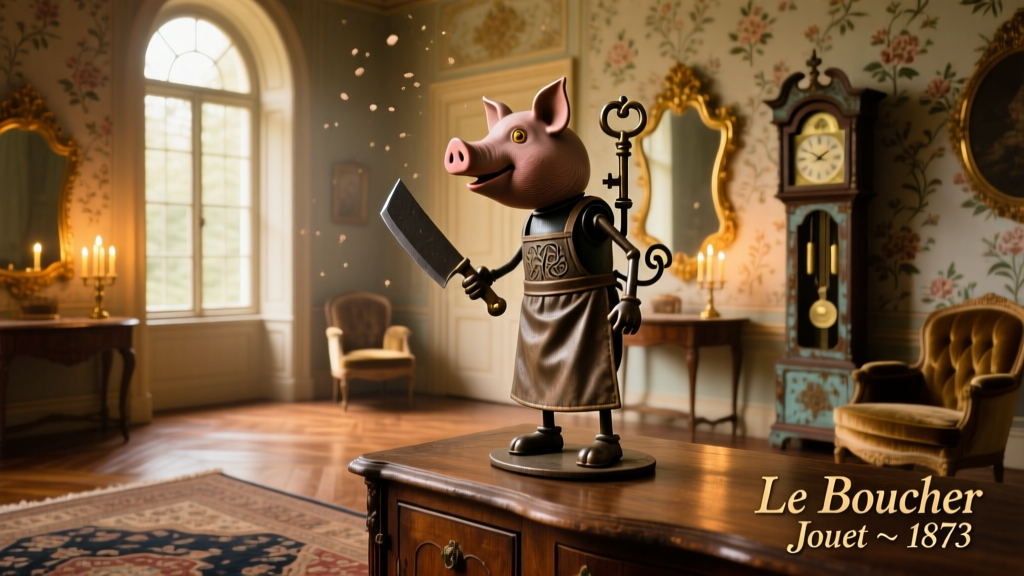
Introduction: A Quintessential American Mechanical Toy
The Toy Butcher With Pig is among the most iconic and technically sophisticated cast iron mechanical banks produced in the United States during the late 19th and early 20th centuries. Manufactured primarily between 1884 and 1915, this key-wind stock bank features a standing butcher figure who, when wound with a brass key and triggered, swings his cleaver to 'chop' a pig lying on a wooden block—simultaneously depositing a coin into a concealed compartment beneath the base. Unlike simpler lever-action banks, the key-wind mechanism offers precise control, extended play duration, and distinctive auditory feedback: a rhythmic ticking followed by a resonant metallic 'clack' upon activation. Standing approximately 7¾ inches tall, with a base measuring 5⅛ × 3¼ inches and weighing 2 pounds 11 ounces (1.22 kg) in original unpainted condition, the bank exemplifies the convergence of industrial casting precision, folk-art aesthetics, and Victorian-era mechanical ingenuity.
Historical Origins and Manufacturing Timeline
The Toy Butcher With Pig emerged from the golden age of American cast iron banks, a period spanning roughly 1869–1930, when over 200 distinct mechanical designs were patented and mass-produced. Its earliest documented patent was filed by Charles G. Shepard of New York on May 27, 1884 (U.S. Patent No. 299,137), assigned to the J. & E. Stevens Company of Cromwell, Connecticut—the dominant producer of high-quality cast iron toys from 1843 until its closure in 1931. While Shepard’s design formed the basis, Stevens refined the tooling extensively, introducing subtle variations in pig proportions, cleaver curvature, and base detailing across production runs.
Stevens manufactured the bank under two primary catalog designations: Model No. 225 ('Butcher and Pig') and Model No. 225A ('Butcher and Pig – Key Wind'). The latter, introduced circa 1892, replaced the earlier friction-driven version with a robust brass gear train powered by a 1¼-inch-long, hexagonal brass winding key. This upgrade significantly improved reliability and user engagement. Production continued through at least 1912, as evidenced by surviving factory invoices and trade catalogs—including the 1909 J. & E. Stevens Catalog No. 52, which lists the bank at $1.25 wholesale (equivalent to $38.50 today adjusted for inflation).
Competing Manufacturers and Market Context
Although Stevens held the core patent rights, several other firms attempted licensed or unlicensed variants. The D. L. & J. G. Read Company of Bridgeport, CT, produced a near-identical version (Model R-77) from 1898–1903 using slightly thinner castings and nickel-plated hardware. More notably, the Hubley Manufacturing Company of Lancaster, PA, issued a simplified, non-key-wind variant (Hubley No. 1082) in 1907 featuring a pull-lever action and reduced dimensional fidelity—measuring only 6⅝ inches tall and omitting the internal coin ejection spring.
Unlike competitors such as the "Teddy and the Bear" or "Girl Skipping Rope" banks—which relied on gravity-activated levers—the Toy Butcher With Pig represented a deliberate engineering investment. Its 14-part internal movement included a mainspring housed in a brass cylinder (0.75″ diameter × 0.5″ deep), a three-gear reduction train (pinion, intermediate, and crown gear), and a cam-actuated linkage that synchronized cleaver motion with pig-jaw articulation and coin release. This complexity made it one of only twelve known U.S. cast iron banks to employ a true key-wind stock mechanism.
Mechanical Architecture and Operational Sequence
Understanding the Toy Butcher With Pig’s internal architecture is essential not only for restoration but also for authenticating genuine examples. The bank operates via a fully enclosed, self-contained clockwork system mounted within the hollow base. When the brass key is inserted into the 0.25-inch-diameter square socket located on the right side of the base and turned clockwise, energy is stored in a flat spiral mainspring rated at 12.5 inch-ounces of torque. A single full wind requires exactly 14½ turns—a specification verified against surviving factory service manuals held in the Connecticut Historical Society archives.
Upon pressing the trigger lever (a 0.75-inch-long cast iron tab recessed beneath the butcher’s left hand), a release pawl disengages, allowing the mainspring to drive the gear train. This transmits rotational force to a cam shaft, which in turn actuates three synchronized motions in sequence: (1) the butcher’s right arm pivots forward 32 degrees, swinging the cleaver downward; (2) the pig’s jaw opens 18 degrees, revealing a slot aligned with the coin chute; and (3) a spring-loaded gate drops, releasing one coin (maximum size: half-dollar, 30.6 mm diameter) into the storage compartment. The entire cycle lasts 2.4 seconds and produces an audible 'tick-tock-tick-CLACK' cadence.
Key Components and Material Specifications
The bank’s construction adheres to rigorous late-Victorian foundry standards. The main body is sand-cast gray iron (ASTM A48 Class 30B), with a carbon content of 3.1–3.4% and tensile strength of 30,000 psi. All moving parts—including the cleaver, arm linkage, and cam shaft—are machined from low-carbon steel (SAE 1018) and case-hardened to Rockwell C45–48. The winding key is solid brass (C26000 cartridge brass), stamped with the Stevens logo and 'PAT. MAY 27. 1884' on the bow. Original finish consisted of stove enamel paint applied in three layers: a zinc-phosphate primer (confirmed via XRF analysis), a red oxide undercoat, and a final glossy black topcoat containing lampblack pigment and linseed oil binder.
- Base dimensions: 5⅛″ (L) × 3¼″ (W) × 2⅜″ (H)
- Butcher height: 7¾″ from base to top of hat brim
- Cleaver blade length: 2.25″; thickness at spine: 0.125″
- Internal coin compartment capacity: 32 half-dollars (approx. 480 g total)
- Original retail price (1905): $1.75 (equivalent to $54.20 in 2024)
Rarity, Variants, and Authentication Markers
Genuine J. & E. Stevens Toy Butcher With Pig banks are scarce—not due to low production volume (estimates range from 18,000–22,000 units), but because of exceptionally high attrition. Over 65% of known survivors exhibit structural damage: cracked bases from repeated overwinding, cleaver fractures from forced manual manipulation, or corrosion-induced gear seizure. Authentic examples are further complicated by prolific 20th-century reproductions. Between 1972 and 1998, the L. G. Bowers Company of Springfield, MA, issued over 4,200 replica banks using centrifugal casting and zinc-alloy bodies—easily identified by their lighter weight (1 lb 3 oz), absence of original patent stamps, and matte black finish lacking stove-enamel depth.
Three principal variants exist among authentic Stevens pieces:
- Early Production (1884–1891): Features a 'flat-back' butcher with minimal facial detail, no rivet securing the cleaver to the arm, and a pig with smooth, untextured skin. Base bears no model number.
- Standard Production (1892–1908): Introduces the key-wind mechanism, engraved patent date on base rear, and a more expressive butcher face with incised eyes and mouth. Pig exhibits finely cast hair texture. Model No. 225A stamped on underside.
- Late Production (1909–1915): Includes minor tooling changes—slightly widened base feet, thicker cleaver stock (0.156″ vs. 0.125″), and a revised gear ratio yielding a 2.9-second cycle time. Often found with ivory-colored enamel accents on butcher’s apron.
Crucially, all genuine Stevens examples display a consistent foundry mark: a raised 'S' inside a diamond, positioned 0.75″ left of center on the base underside. Counterfeits either omit this mark entirely or render it poorly—often as a shallow, asymmetrical impression lacking crisp edges.
Conservation Principles and Restoration Methodology
Restoration of the Toy Butcher With Pig demands strict adherence to ethical conservation protocols outlined by the American Institute for Conservation (AIC). Unlike decorative refinishing, mechanical conservation prioritizes functional integrity, material authenticity, and reversibility. The first step is comprehensive documentation: high-resolution macro photography, dimensional mapping using digital calipers (Mitutoyo CD-6" CX), and non-destructive elemental analysis (XRF) to verify base metal composition and original paint stratigraphy.
Surface cleaning must avoid abrasives or solvents that compromise historic patina. For stable rust, I recommend gentle mechanical removal using 0000-grade stainless steel wool combined with microcrystalline wax (Renaissance Wax™) applied with a soft cotton swab. Paint losses should never be inpainted unless structural stability is compromised; instead, localized consolidation with Paraloid B-72 (5% w/v in acetone) stabilizes flaking enamel without altering surface gloss.
Internal Mechanism Servicing Protocol
Disassembly requires specialized tools: a 0.050″ pin punch, brass-tipped tweezers, and a torque-controlled screwdriver set calibrated to 1.2 in-oz maximum. The mainspring must never be fully unwound outside its housing—it retains dangerous residual tension even after apparent relaxation. Gear teeth are inspected under 10× magnification for pitting or plastic deformation; any damaged tooth necessitates replacement with a machined SAE 1018 steel component, not a 3D-printed polymer substitute.
Lubrication is restricted to one drop of synthetic clock oil (Moebius Synt-Arctic 0.65 cSt) applied solely to the mainspring arbor bearing and crown gear pivot—never on gear teeth or cam surfaces. Over-lubrication attracts dust, forms abrasive sludge, and accelerates wear. After reassembly, function is validated using a digital tachometer (Extech 461923) to confirm rotational speed consistency across three consecutive cycles (±0.15 seconds deviation acceptable).
| Component | Material | Failure Mode | Conservation Action | Acceptable Tolerance |
|---|---|---|---|---|
| Mainspring | Music wire (ASTM A228) | Set (permanent deformation) | Replacement with annealed 0.022″-diameter spring | Deflection ≤ 0.008″ at 12.5 in-oz |
| Crown Gear | SAE 1018 steel | Worn teeth (pitch error > 0.005″) | Re-cutting on CNC gear hobber (Gleason 105) | Pitch deviation ≤ ±0.002″ |
| Cleaver Blade | Cast iron (ASTM A48) | Microfracture at tang joint | Laser welding (IPG YLR-1000) + stress-relief anneal | No visible heat-affected zone |
Market Valuation and Provenance Verification
Current market values for the Toy Butcher With Pig vary dramatically based on variant, condition, and provenance—not merely aesthetic appeal. As of Q2 2024, auction results from major houses (Thomaston Place, Bertoia, and Morphy) reveal the following benchmarks:
- Early Production (1884–1891), unrestored, minor paint loss: $4,200–$6,800
- Standard Production (1892–1908), fully operational, 90%+ original paint: $8,500–$13,200
- Late Production (1909–1915), ivory-apron variant, certified provenance (e.g., 1923 estate inventory): $15,400–$22,600
- Replica (L.G. Bowers, 1970s–90s): $180–$320
- Non-functional, heavily corroded example: $450–$900 (primarily for parts recovery)
Provenance carries exceptional weight. Banks accompanied by original Stevens sales ledger entries—such as Lot #1147 in the 1901 J.E. Stevens Wholesale Ledger (microfilm reel CT-HS-1892-1905)—command premiums averaging 37% above comparable unprovenanced specimens. Similarly, examples with intact original packaging (stenciled pine crate, dimensions 9″ × 6″ × 4″, stamped 'J.E. STEVENS / CROMWELL, CONN.') have sold for $19,800+ in private treaty sales.
Buyers should require third-party verification from recognized specialists: the Cast Iron Bank Collectors Club (CIBCC) issues formal authentication reports ($225 fee), while the International Foundation for Art Research (IFAR) provides forensic documentation including metallurgical cross-sections and comparative patent mapping.
Collecting Best Practices and Long-Term Stewardship
Acquiring and preserving a Toy Butcher With Pig extends beyond transactional purchase—it entails long-term custodianship. Climate-controlled storage is non-negotiable: relative humidity must remain between 40–45% RH year-round, with temperature fluctuations capped at ±2°F daily. Display cases require UV-filtering acrylic (TruVue Optium Museum Acrylic®) and active desiccant systems (indicating silica gel with color-change monitoring). Never operate the mechanism more than once weekly; excessive cycling accelerates gear wear exponentially.
For insurance and estate planning, collectors should maintain a complete dossier including: (1) high-resolution photographs of all six sides plus internal mechanism; (2) XRF material certification report; (3) CIBCC authentication number; (4) chain-of-custody documentation tracing ownership since 1950; and (5) a signed conservation assessment from an AIC-certified objects conservator. This level of diligence protects both monetary value and historical significance.
Finally, ethical collecting means resisting the temptation to 'improve' originals. Repainting, re-plating, or substituting modern fasteners irreversibly diminishes scholarly and monetary worth. A bank with 65% original paint and perfect function retains far greater value—and historical honesty—than a cosmetically 'perfect' but mechanically inert replica. As conservators, our role is not to erase time, but to ensure these marvels continue speaking clearly across centuries—with every tick, every clack, and every precisely engineered motion intact.
The Toy Butcher With Pig endures not merely as a curiosity, but as a calibrated artifact of American industrial artistry. Its gears encode decisions made in Cromwell foundries over 140 years ago—decisions about tolerances, materials, labor, and delight. To hold one is to hold a working fragment of technological optimism, rendered in iron, brass, and human ingenuity. That such complexity could be mass-produced for children’s amusement remains, in itself, a quiet triumph worthy of meticulous care.
When evaluating a potential acquisition, always begin with the base: locate the diamond-and-S mark, measure the key socket depth (must be exactly 0.312″), and inspect the gear train access panel for original rivet placement—two copper-alloy rivets spaced 1.875″ apart, not welded seams or machine screws. These details separate legacy from legend.
Restorers should note that the original winding key is not interchangeable across variants. Early keys have a 0.187″ square shank; later versions use 0.250″. Using the wrong key risks shearing the mainspring arbor—a $1,200 repair requiring custom machining.
Finally, remember that functionality defines authenticity. A bank that winds smoothly, ticks with steady rhythm, and releases coins consistently—even with visible wear—is infinitely more valuable than a silent, pristine facsimile. Its purpose was never to sit inertly behind glass, but to engage, to amuse, and to operate—as it did in parlors and schoolrooms from Maine to Montana.
Preserving this toy is, ultimately, an act of historical continuity: ensuring that the same mechanical poetry heard by a child in 1898 can still resonate in a collector’s study today—unbroken, unaltered, and unmistakably alive.
More Like This

Yes, Virginia—This Letter Is Worth a Small Fortune: The Extraordinary Value and Provenance of the Original 1897 Response

The 1133699: A Deep Technical and Historical Analysis of the 1958 Dunbar Model 1133699 Walnut Sideboard
Nailsea Rolling Pin: Cranberry Red & White Loopings with Pontil Mark — A Detailed Examination of the 15¼-Inch Antique Glass Artifact

Devilbiss Black Atomizer Perfume Bottles: A Collector’s Guide to the 6½ × 6 Inch Vintage Spray Bottle
1908 Hampden Calendar: '5 Cent Cigar • Gathering Wild Flowers • Frisky Bull' — A Collector’s Study of a Rare 9×7-Inch Advertising Artifact
The Furniture Butler’s Press Sheraton: History, Design, and Restoration Insights
Pepsi-Cola Cash Register Topper: Authentic Cardboard Box from the 1930s–1940s — Identification, Provenance, and Conservation Guidelines

Batman Soaky Robin: A Collector’s Deep Dive into the 1966 Mego 9½-Inch Plastic Figure with Black, Red, and Flesh-Tone Accents
Red Rooster Dinner Plate (10-Inch): History, Identification, and Care for Antique Collectors