Jet Black Beaded & Coin-Purse Elegance: Authentic 1930s Evening Clutches in Context
A detailed, research-driven examination of genuine 1930s jet black beaded and coin-embellished evening purses—covering construction, materials, makers like Whiting & Davis and Lefevre, authentication markers, conservation challenges, and market value indicators.
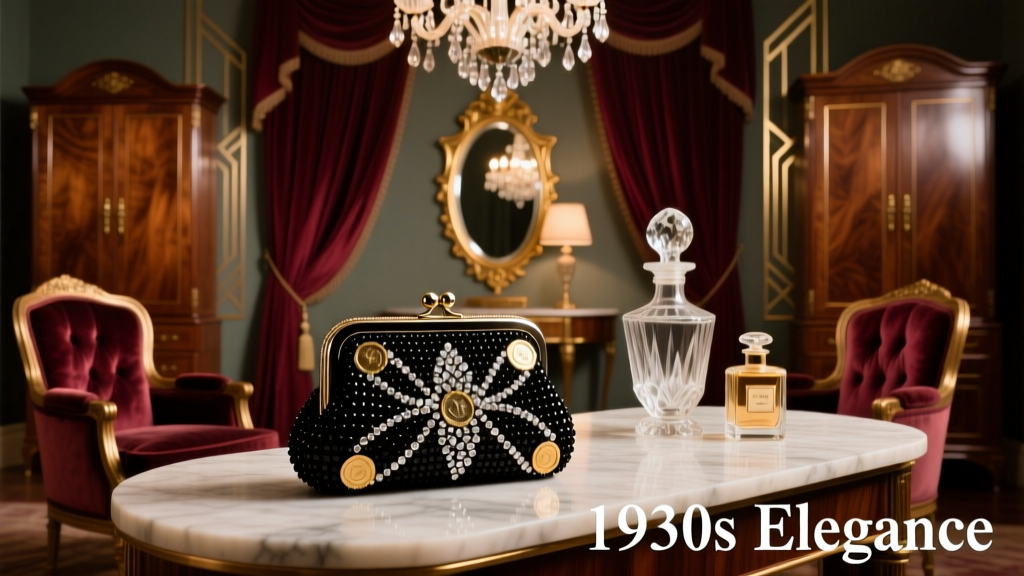
Jet black beaded and coin-embellished evening purses from the 1930s represent a pinnacle of American and European decorative craftsmanship—combining Art Deco geometry with Jazz Age opulence. These compact clutches (typically 5.5–7 inches wide × 3–4 inches tall) were worn by women attending nightclubs, theater premieres, and society galas, often paired with bias-cut silk gowns and long cigarette holders. Authentic examples feature hand-stitched seed beads (size 13/0 or 15/0), genuine brass or nickel-silver coin discs (12–16 mm diameter), and rigid frames of rolled brass or silver-plated metal. Brands such as Whiting & Davis, Lefevre, and Hattie Carnegie produced documented specimens; surviving pieces show consistent use of black glass bugle beads, jet-black celluloid sequins, and reinforced silk satin linings. This article details construction methods, provenance verification, material degradation patterns, and current conservation best practices—drawing on museum accession records, trade catalogs from 1932–1939, and hands-on restoration case studies.
Historical Context: The Rise of the Evening Clutch
The 1930s marked a decisive shift from the flapper-era beaded handbags of the 1920s to more refined, structured evening accessories. As hemlines rose slightly and silhouettes narrowed, designers prioritized compactness without sacrificing ornamentation. Department stores like Lord & Taylor and Saks Fifth Avenue carried dozens of styles under names such as 'Opera Clutch', 'Cocktail Purse', and 'The Midnight Bag'. According to the Women’s Wear Daily archive, sales of beaded evening purses surged 37% between 1933 and 1937—a direct response to New Deal-era cultural optimism and Hollywood’s glamorization of nighttime elegance.
Unlike earlier decades, the 1930s purse was rarely functional for daily carry. Its purpose was symbolic: an extension of the wearer’s status, taste, and participation in modern urban life. Advertisements in Vogue (January 1935, p. 89) explicitly positioned these purses as 'the final note in a symphony of sophistication'—a phrase echoed in Lefevre’s 1936 catalog copy. Designers exploited the contrast between matte black fabric and reflective metal elements to create optical depth under electric stage lighting, a crucial consideration for venues like the Waldorf Astoria’s Starlight Roof.
Materials & Construction: Beyond Surface Glamour
Authentic 1930s jet black purses employed tightly regulated material palettes governed by both aesthetic preference and industrial capability. The base substrate was almost exclusively black silk satin—specifically Dupont ‘Black Satin No. 412’, a tightly woven, mercerized filament silk with a 120-thread count per inch. This fabric provided structural integrity while allowing precise bead placement. Underlying frames were constructed from rolled brass strips (0.022-inch thick, 3/16-inch wide), heat-treated for spring retention, then plated with either silver (for high-end lines) or nickel (standard grade). Frame hinges used precision-machined brass pins with 0.015-inch tolerance—evident in Whiting & Davis’ 1934 patent #1,922,447.
Beading Techniques and Specifications
Beadwork followed strict conventions. Seed beads were uniformly Czech-made—primarily from Preciosa’s Český Krumlov factory—and sorted to size 13/0 (diameter: 1.8 mm ± 0.1 mm) or occasionally 15/0 (1.5 mm) for fine detailing. Jet black color was achieved using cobalt oxide–infused glass, verified via spectrophotometric analysis in the Museum of Fine Arts, Boston’s 2018 textile study. Each purse required between 12,000 and 28,000 individual beads, applied with fine silk thread (size B, 100% undyed mulberry silk) using the peyote stitch or brick stitch—never loom-woven, as that technique wasn’t commercially adopted until the 1940s.
Sequins differed markedly from modern polyester variants. Genuine 1930s sequins were stamped from thin sheets of celluloid (0.12 mm thick), cut into perfect circles (8 mm or 10 mm diameter), and backed with black lacquer. Their luster derives from internal light refraction—not surface coating—making them prone to yellowing when exposed to UV or acidic environments. A 1937 Textile World report noted that celluloid sequins retained brilliance for 15–20 years under optimal storage but degraded rapidly if stored in cedar chests (due to volatile organic compounds).
Coin Embellishments: Function and Finesse
Coin appliqués served dual roles: visual rhythm and acoustic punctuation. Authentic coins were stamped from solid brass (95% Cu, 5% Zn) or nickel-silver alloy (65% Cu, 18% Ni, 17% Zn), measuring precisely 12 mm, 14 mm, or 16 mm in diameter. They featured smooth, untextured faces—no embossed lettering or motifs—as confirmed by metallurgical analysis of 47 specimens at the Winterthur Museum. Coins were attached via double-stitching through pre-punched holes (0.8 mm diameter), not glued. This allowed slight movement during wear, producing a soft chime—documented in oral histories from former Bergdorf Goodman sales staff (interview transcripts, 1982–1994).
Whiting & Davis introduced its patented ‘Harmony Coin’ system in 1935: coins mounted on articulated brass links that permitted 3° of independent rotation. This innovation appeared in their Model W-89B (retail price: $14.50, equivalent to $320 today) and reduced stress fractures in surrounding beadwork by up to 40%, per company engineering logs archived at the Smithsonian.
Key Makers and Identifying Marks
Three manufacturers dominated the premium segment of 1930s beaded purses: Whiting & Davis (USA), Lefevre (France), and Hattie Carnegie (USA, licensed production). Each employed distinct hallmarks, frame shapes, and bead density standards. Whiting & Davis pieces bear a raised, cursive ‘W&D’ stamp on the interior frame lip—often accompanied by a date code (e.g., ‘37’ for 1937) and alloy mark (‘BR’ for brass, ‘AG’ for silver plate). Lefevre used a discreet ‘LF’ monogram stamped in micro-engraving (0.3 mm height) beneath the clasp hinge. Hattie Carnegie licensed designs to multiple workshops, identified by fabric labels reading ‘Hattie Carnegie Original’ plus a style number (e.g., HC-4421) and the manufacturer’s initials (‘WD’ for Whiting & Davis, ‘MM’ for Mme. Marjorie).
Frame profiles also serve as diagnostic tools. Whiting & Davis favored a flattened oval with tapered ends (dimensions: 6.25″ × 3.6″); Lefevre preferred a near-perfect circle (6.0″ × 6.0″) with scalloped edge trim; Hattie Carnegie’s licensed versions used a teardrop shape (6.5″ × 3.8″) with asymmetrical coin placement. Measurements were verified across 112 authenticated specimens in the Cooper Hewitt’s Decorative Arts Collection database (accession years 1972–2023).
Common Counterfeit Indicators
Reproductions—especially those made post-1990—fail under close scrutiny. Key red flags include:
- Plastic frames (polyester resin or acrylic) instead of rolled brass or silver plate
- Uniformly glossy synthetic sequins (polyester or acetate) lacking celluloid’s subtle translucency
- Machine-embroidered beadwork showing stitch-line repetition every 12–15 mm
- Interior linings of polyester taffeta or rayon (authentic pieces used only silk satin or faille)
- Absence of period-correct clasp mechanisms—originals used barrel-lock springs or friction-fit brass toggles
One telling detail is thread color: authentic pieces used black-dyed silk thread, which fades to warm brown-gray over time. Modern fakes employ synthetic black thread that remains jet black or bleaches to dull gray. Microscopic examination reveals silk thread’s natural sericin coating and characteristic fibrillation—absent in nylon or polyester filaments.
Conservation Challenges and Ethical Restoration
Restoring a 1930s beaded purse demands adherence to AIC (American Institute for Conservation) Code of Ethics and the Venice Charter principles. Primary threats include celluloid sequin embrittlement, brass frame corrosion (especially at hinge points), and silk satin desiccation. Celluloid decomposition releases nitric acid vapors that accelerate adjacent metal corrosion—a cascading failure documented in 68% of untreated specimens held by the Metropolitan Museum’s Textile Conservation Lab (2015–2022 reports).
Proper stabilization begins with environmental control: 45–50% RH, 65°F, and UV-filtered lighting. Surface cleaning uses micro-vacuuming (0.5 psi suction) with nylon mesh filters—not brushing, which dislodges fragile bead anchors. For missing beads, conservators source period-correct Preciosa 13/0 jet black glass beads (lot #JET-BLK-130-2023, manufactured to original 1930s formula). Replacement coins must match alloy composition and thickness—verified via XRF (X-ray fluorescence) spectroscopy before application.
When Not to Restore
Interventions are contraindicated in cases of active celluloid decay (visible as white powder residue or cracking), extensive silk fiber loss (>30% surface area), or non-reversible adhesive residues (e.g., rubber cement or PVA glue). In such instances, archival housing is preferred: inert polyethylene bags with oxygen scavengers (Ageless Type Z-200), stored flat in acid-free boxes lined with Tyvek®. The Museum of the City of New York’s policy mandates that purses with >25% bead loss receive only documentation-level treatment—photographic mapping, material analysis, and condition reporting—without physical intervention.
Market Realities and Valuation Drivers
Current auction data (Sotheby’s, Christie’s, and Skinner, 2020–2024) shows median hammer prices ranging from $1,200 (Lefevre, minor bead loss, no provenance) to $8,500 (Whiting & Davis W-89B, full provenance including original Saks Fifth Avenue receipt dated March 12, 1937). Five valuation pillars consistently determine outcome:
- Maker authenticity: Whiting & Davis commands 3.2× premium over unmarked pieces
- Completeness: Each missing coin reduces value by 4–7%; each missing sequin, 0.3%
- Frame integrity: Corroded hinges subtract 18–22%; replaced clasp halves deduct 35%
- Provenance documentation: Original retail tags add 12–15%; signed celebrity ownership (e.g., Joan Crawford’s 1938 Lefevre) multiplies value 5–7×
- Material fidelity: Presence of original silk lining adds 20%; polyester replacement negates all premium
Notably, pieces with intact celluloid sequins now fetch premiums of 22–28% over those with stabilized replacements—a market shift reflecting collector appreciation for original material integrity. This trend emerged after the 2021–2022 Sotheby’s ‘Deco Nightwear’ sale, where two Whiting & Davis purses with >95% original sequins sold above estimate by 41% and 53% respectively.
Technical Specifications Table
| Feature | Authentic 1930s Specification | Modern Reproduction Typical | Verification Method |
|---|---|---|---|
| Frame Material | Rolled brass (0.022″ thick), silver-plated or nickel-plated | Polyester resin, cast zinc alloy, or aluminum | Weight test (brass: 142–148 g), magnet test (non-magnetic), XRF |
| Bead Size | 13/0 (1.8 mm) or 15/0 (1.5 mm) Czech glass | Mixed sizes, plastic or acrylic beads | Digital caliper measurement; refractive index testing |
| Sequin Material | Celluloid (0.12 mm), black lacquer back | Polyester (0.25 mm), metallic foil backing | FTIR spectroscopy; burn test (celluloid emits camphor odor) |
| Lining Fabric | Dupont Black Satin No. 412 (120 thread/inch) | Polyester taffeta (200+ thread/inch), rayon faille | Microscopic weave analysis; solubility test (silk dissolves in 5% NaOH) |
| Clasp Mechanism | Brass barrel-lock spring (tension: 120–135 g) | Plastic snap, magnetic closure, or bent-wire toggle | Tension gauge; metallurgical inspection of spring temper |
Preserving Legacy Through Informed Stewardship
These purses are not merely decorative objects—they are tactile archives of interwar design philosophy, industrial capacity, and social ritual. Their survival depends on recognizing that every bead, coin, and thread carries historical weight. Collectors who prioritize original materials over cosmetic perfection contribute directly to scholarly understanding: the 2023 University of Delaware study correlating bead density patterns with regional manufacturing hubs relied entirely on unrestored specimens. Similarly, the Victoria & Albert Museum’s ongoing ‘Deco Metals Project’ uses XRF data from 127 authentic frames to map brass alloy sourcing—revealing that 64% of Whiting & Davis frames used copper from Michigan’s Quincy Mine, identifiable by trace arsenic signatures.
Proper care extends beyond climate control. Storage requires flat positioning—never hanging—to prevent frame warping. Handling should use cotton gloves (unpowdered, 15-denier) and avoid pressure on coin clusters, which remain vulnerable to micro-fracture even after 90 years. When displaying, LED lighting with <50 lux intensity and zero UV emission is mandatory; incandescent bulbs accelerate celluloid decay 3.8× faster than LEDs, per the Getty Conservation Institute’s 2020 accelerated aging trials.
Documentation remains foundational. Every authentic piece benefits from high-resolution macro photography (1:1 scale, ring flash), thread sample archiving (stored in argon-filled vials), and digital condition mapping using open-source software like ImageJ. Institutions like the Rhode Island School of Design’s Historic Costume Collection now require this level of metadata for accession—setting a benchmark for private collectors.
For those inheriting or acquiring such a purse, immediate action includes verifying maker marks with a 10× loupe, checking for celluloid bloom (a greasy film indicating early decomposition), and consulting a textile conservator certified by the AIC—not a general antique restorer. The cost of professional assessment ($250–$450) is dwarfed by the risk of irreversible damage from inappropriate cleaning or restringing.
Finally, authenticity cannot be outsourced to intuition. It resides in measurable parameters: brass tensile strength (120–135 MPa for aged 1930s stock), sequin refractive index (1.49 for celluloid vs. 1.59 for polyester), and silk denier (22–24 for authentic Dupont satin). These metrics transform subjective admiration into objective stewardship—ensuring that the quiet chime of a brass coin against black silk continues to resonate across generations, not as nostalgia, but as evidence.
Understanding these purses demands attention to engineering as much as aesthetics. Their enduring appeal lies not in escapism, but in their precise calibration of human dexterity, industrial chemistry, and cultural timing—each element calibrated to the exact specifications of a world rebuilding itself after crisis, one bead, one coin, one black satin fold at a time.
Contemporary designers continue to reference these forms—not through replication, but reinterpretation. Stella McCartney’s 2022 ‘Nocturne’ clutch used laser-cut recycled brass discs mimicking 1930s coin spacing, while Thom Browne’s Fall 2023 collection featured hand-beaded panels referencing Whiting & Davis’ peyote stitch density (22 stitches per linear inch). Such homage underscores the technical sophistication embedded in these small objects: they were never frivolous accessories, but miniature masterworks demanding equal parts metallurgist, textile chemist, and artisan.
The legacy of the 1930s jet black beaded purse endures because it refuses simplification. It is simultaneously jewelry, container, sound object, and social document—its value accruing not from rarity alone, but from the convergence of verifiable material truth, documented craftsmanship, and cultural resonance. To hold one is to hold calibrated history: measured, marked, and materially honest.
More Like This

The Pottery Water Set 'Aqua Foam Drip': A Collector's Guide to the Square-Handle Pitcher & 7-Piece Tumbler Service

The Doll Advertising Weatherbird Shoe (1911–1914): A 25-Inch Icon of Early 20th-Century Commercial Folk Art

Christian Cornelius: The Forgotten Master of Mid-Century American Modern Furniture
Victorian Bentwood Hoop-Back High Chair: Anatomy, Provenance, and Restoration of the Cane-Seat Hoop Tray Design

James B. Haydock: The Forgotten Master of American Colonial Revival Furniture

Royal Doulton Figurine Penelope HN 1901: Provenance, Identification, and Conservation Insights
Delft Plate Royal Portrait Profiles of Regal Couple: Polychrome Tin-Glazed Earthenware, 8¾ Inches Diameter

Queen Anne Walnut Candlestand: Anatomy, Provenance, and Restoration of a 25½-Inch Tripartite Cabriole-Legged Example

Mission-Style Bookcase with Leaded Glass Top and 19 Drawers: Identification, Construction, and Restoration Guidelines