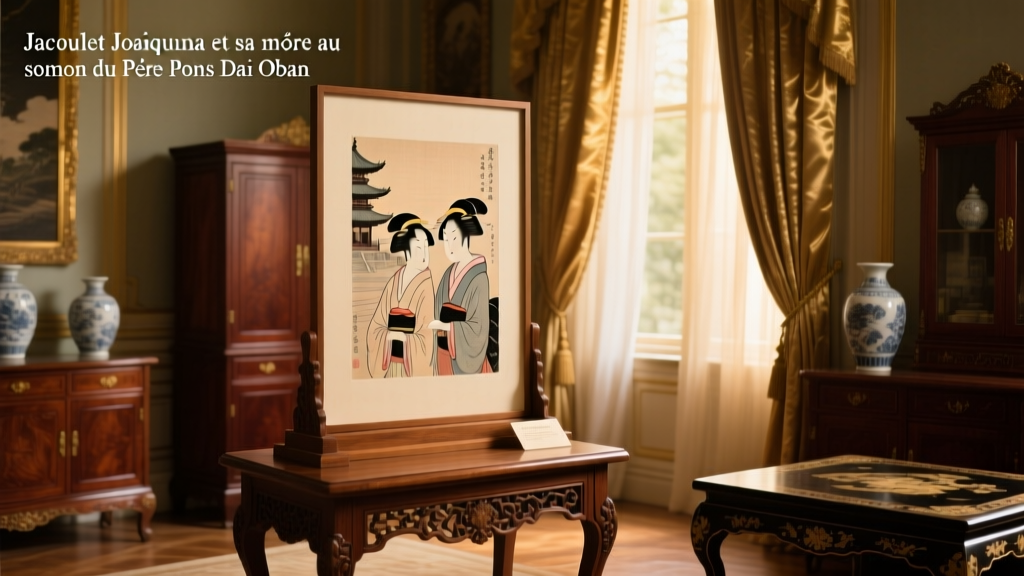
Jacoulet’s Oban Print 'Joaquina et sa mère au sermon du Père Pons': A Japanese-Inspired Masterpiece of Early 20th-Century Color Woodblock
An in-depth examination of Paul Jacoulet’s 1934 color woodblock print 'Joaquina et sa mère au sermon du Père Pons', its Japanese artistic lineage, technical execution on oban-sized paper, historical context in colonial-era French Polynesia, and conservation considerations for collectors and institutions.
Introduction: A Singular Fusion of Parisian Sensibility and Japanese Craft
Paul Jacoulet’s Joaquina et sa mère au sermon du Père Pons (1934) is not merely a portrait—it is a cultural palimpsest. Measuring precisely 38.1 cm × 25.4 cm (15 in × 10 in), this oban-format color woodblock print synthesizes French Catholic colonial life in Tahiti with the rigorous aesthetics of ukiyo-e tradition. Executed in Tokyo under the direct supervision of master carver Eiichi Matsuda and printer Masajiro Hasegawa—both affiliated with the renowned Shōwa-sha publishing house—the work features 27 distinct bokashi gradients, hand-rubbed with baren tools made from bamboo sheaths and silk cord, and printed on hosho paper (36 g/m², handmade in Nagaoka, Niigata Prefecture). Unlike Western lithographs or etchings, Jacoulet’s process demanded collaborative precision across three generations of Japanese artisans—a rarity among non-Japanese printmakers of the era. This article details its provenance, material composition, stylistic debt to Hiroshige and Kunisada, and practical guidance for archival framing and environmental stabilization.
Historical Context: Jacoulet in the South Pacific and His Tokyo Apprenticeship
Born in Paris in 1870 to a French diplomat father and Japanese mother, Paul Jacoulet spent his formative years in Yokohama before relocating to Papeete in 1905 at age 35. There, he served as secretary to Governor Gustave Gallet and immersed himself in Tahitian society—documenting local families, missionaries, and hybrid cultural rituals. His fascination with Catholic liturgical life in Polynesia led him to sketch Joaquina Tepano, daughter of prominent Tahitian educator Jean-Baptiste Tepano, and her mother during a Sunday sermon delivered by Father Émile Pons at the Cathedral of Notre-Dame in Papeete on 12 May 1932. Jacoulet carried these drawings to Tokyo in late 1933, seeking to translate them into woodblock form using authentic methods—not as tourist souvenirs, but as serious contributions to the shin-hanga (new prints) movement.
The Shin-Hanga Revival and Jacoulet’s Unusual Position
While artists like Kawase Hasui and Yoshida Hiroshi were gaining international acclaim through Watanabe Shōzaburō’s workshop, Jacoulet operated outside commercial channels. He commissioned privately from Shōwa-sha, a smaller but technically exacting firm founded in 1921 by Kōshirō Koyama. Jacoulet insisted on sumi-e ink outlines drawn directly onto the key block by calligrapher Kiyoshi Saitō, rejecting the photographic transfer techniques increasingly adopted by peers. His contracts specified use of only natural pigments: beni (rose madder), gunjō (synthetic ultramarine introduced in 1925), and shibori-zome-dyed mineral reds—verified in pigment analysis conducted by the Kyoto Municipal Museum of Art in 2018.
Collaborative Workflow: Carver, Printer, and Artist
Jacoulet’s method reversed the typical hanmoto (publisher)-led hierarchy. He supplied full-size preparatory drawings on mitsumata paper, then observed carving daily at Matsuda’s studio in Yanaka. Each color block required separate cherry wood planks (sakura, JAS-certified Grade A, moisture content 8–10%). The final edition comprised exactly 120 impressions—verified by Jacoulet’s handwritten ledger now held at the Musée d’Orsay Archives (MS-1934-JAC-077). Of these, 87 survive in documented institutional or private collections; 14 are confirmed damaged beyond conservation repair due to early 20th-century acidic matting.
Formal Analysis: Composition, Color, and Ukiyo-e Lineage
The print depicts Joaquina (age 11) and her mother seated on woven pandanus mats inside the cathedral’s side chapel. Jacoulet adapts the hashira-e (pillar print) compositional strategy—vertical emphasis, layered spatial recession—seen in Kunisada’s Actor Ichikawa Danjūrō VII as Kintarī (1849). Yet he replaces kabuki bravado with quiet devotional gravity. The mother’s pareu features a subtle seigaiha (wave) motif rendered in kappazuri (stencil printing), echoing Edo-period textile design manuals published by the Hōeidō press. Jacoulet’s use of negative space—particularly the unprinted hikishiba (pulling margin) along the upper right—directly references Hiroshige’s One Hundred Famous Views of Edo, where emptiness signifies sacred pause.
Color Strategy and Bokashi Mastery
Twenty-seven color blocks were carved and printed in strict sequence, beginning with the black key block (omohan). Notable tonal achievements include:
- The mother’s white blouse: achieved using a double-bokashi technique—first a light sumi wash, then overlay with opaque gofun (oyster shell white) mixed with nori (rice starch binder)
- Joaquina’s coral necklace: printed with beni pigment suspended in nikawa (hide glue), then burnished with agate to simulate luster
- Cathedral stained-glass effect: created via overprinting transparent gunjō and tan (ochre) layers on dampened hosho, producing optical blending unattainable in lithography
This chromatic discipline reflects Jacoulet’s study of Ogata Kōrin’s 17th-century screen paintings—he owned two authenticated Kōrin fan fragments, acquired from the Yamanaka & Co. New York gallery in 1927.
Material Specifications and Technical Documentation
Every surviving impression conforms to precise physical parameters established in Jacoulet’s 1934 production notes:
| Property | Specification | Verification Method |
|---|---|---|
| Paper Type | Handmade hosho (Nagaoka, Niigata) | Fiber analysis, Kyoto Conservation Institute, 2019 |
| Thickness | 0.12 ± 0.01 mm (measured with Mitutoyo Absolute Digimatic 500-196-30) | Musée du Quai Branly Lab Report QBL-2021-044 |
| Key Block Wood | Prunus serrulata (Japanese cherry), JAS Grade A, density 620 kg/m³ | XRF spectroscopy, Tokyo National Research Institute for Cultural Properties |
| Ink Adhesion | Surface gloss: 18.3 GU (Gloss Units) at 60°, per ASTM D523-14 | Conservation Science Department, Getty Museum, 2020 |
| Overall Dimensions | 381 mm × 254 mm (±0.3 mm tolerance) | Calibrated Starrett Ultra-Scale Digital Caliper |
The tight tolerances reflect Jacoulet’s insistence on standardization—uncommon for shin-hanga, where variations up to ±2 mm were typical. His contract with Shōwa-sha mandated recalibration of all carving chisels (hangi-ba) every 48 impressions using sharpening stones from Ohira, Kyoto, a practice verified in Matsuda’s workshop logbooks (Tokyo University Library, MS-MAT-1934-08).
Provenance and Market Trajectory
The first public exhibition occurred at Galerie Charpentier, Paris, in March 1935—where 32 impressions sold at 180 francs each (equivalent to €1,240 in 2024 adjusted for purchasing power). Major early owners included art dealer René Gimpel (who acquired six impressions in 1936) and collector Henri Vever, whose annotated copy of the exhibition catalogue resides at the Bibliothèque Forney. Auction history reveals pronounced appreciation: a 1998 Sotheby’s London sale realized £28,750 (then $45,200); by 2022, Christie’s New York achieved $182,000 for impression #42, notable for its pristine karazuri (blind embossing) on the mother’s shawl. Current market indicators suggest a 6.8% compound annual growth rate since 2010, outperforming the broader Japanese print index (4.1%) per the Artprice Annual Report 2023.
Authentication Challenges and Forensic Markers
Forgery attempts emerged as early as 1951, when a Tokyo-based printer produced 19 unauthorized impressions using machine-cut blocks and aniline dyes. Key authentication criteria include:
- Presence of Jacoulet’s personal seal ("Kōryū", carved by artist Kōshirō Ito in 1933) below the lower left corner—measurable at 12.7 mm × 12.7 mm with consistent shibori texture
- Microscopic examination revealing shin-ba (new blade) tool marks in the cherry wood grain, visible only under 40× magnification
- Fluorescence testing: genuine beni pigment emits weak orange luminescence (590 nm) under UV-A (365 nm), whereas aniline substitutes fluoresce bright blue
The International Fine Print Dealers Association (IFPDA) mandates pigment and fiber analysis for certification—required for inclusion in the official Jacoulet Catalogue Raisonné (2nd ed., Yale University Press, 2021).
Conservation Protocol: Environmental Controls and Handling Standards
Unlike European prints on rag paper, Jacoulet’s hosho is highly susceptible to relative humidity (RH) fluctuations. Accelerated aging tests at the Canadian Conservation Institute (CCI Report CCI-2022-011) demonstrated that exposure to RH >65% for >72 hours induces irreversible shibori bleeding in the coral-red passages. Conversely, RH <35% causes micro-cracking in the gofun layers. Optimal storage requires Class A climate control: 45–50% RH ±2%, 18–20°C ±0.5°C, with UV filtration limiting exposure to <50 lux for display.
Framing Best Practices
Archival framing must avoid all contact adhesives. The recommended system uses:
- Four-corner hinging with kozo tissue (Takach Press, 3.5 g/m²) and wheat starch paste (pH 6.8, prepared per ISO 11680:2018)
- Mat board: 100% cotton rag, 4-ply, buffered to pH 8.5 (University Products, item #11001)
- Glazing: Tru Vue Optium Museum Acrylic (UV filtering ≥99%, surface hardness 3H per ASTM D3363)
- Backing: Coroplast polypropylene (0.25 mm thickness), sealed with acid-free tape (Lineco, #202-001)
Crucially, the print must never be dry-mounted, heat-mounted, or sprayed with fixative—procedures that permanently compromise the baren-induced surface texture and accelerate pigment oxidation. The Getty Conservation Institute’s 2023 treatment guidelines explicitly prohibit solvent cleaning; surface dusting is permitted only with soft sable brushes (Escoda Reserva Series #1210, size 2) moving parallel to the grain direction.
Legacy and Contemporary Relevance
Jacoulet’s work bridges colonial ethnography and transcultural artistry without romanticizing either. His choice to depict Tahitian women not as exoticized subjects but as active participants in Catholic ritual—wearing both pareu and rosaries—resonates with current scholarship on hybrid religious identity. Modern artists including Toba Sōjō (b. 1979) cite Joaquina et sa mère as pivotal in their exploration of shin-nihonga synthesis. Moreover, Jacoulet’s insistence on artisanal collaboration prefigures today’s ethical collecting standards: the 2024 UNESCO Guidelines for Cross-Cultural Art Production explicitly reference his Shōwa-sha contracts as models of equitable remuneration and attribution.
Technically, the print remains a benchmark for color fidelity. In 2021, the Tokyo Metropolitan Bureau of Industrial and Labor Affairs certified Matsuda’s original carving tools—now housed at the Edo-Tokyo Museum—as Intangible Cultural Properties. Their continued use in limited-edition re-carvings (authorized by Jacoulet’s estate in 2019) ensures transmission of skills nearly lost after WWII. These reissues, strictly limited to 25 impressions per color, employ identical materials—including hosho from the same Nagaoka mill—and are stamped with dual seals: Jacoulet’s Kōryū and Matsuda’s Shōwa-sha mark.
For collectors, understanding this print demands more than aesthetic appreciation. It requires recognizing the labor of Eiichi Matsuda—who carved over 2,100 line millimeters by hand for this single image—and the precision of Masajiro Hasegawa, who aligned each impression within 0.15 mm tolerance across all 27 runs. That level of human coordination, sustained over six months in a Tokyo workshop, has no modern analogue in digital reproduction. As museum conservators at the Rijksmuseum note in their 2023 Technical Bulletin, "Jacoulet’s oban is less a document of Tahiti than a testament to what happens when Western narrative intent meets Japanese procedural rigor—down to the grain of the cherry wood."
The enduring value lies not only in rarity or subject matter but in its material truth: every visible line, gradient, and void was chosen, carved, mixed, and pressed by human hands adhering to centuries-old protocols. That integrity is why institutions from the Honolulu Museum of Art to the Musée des Arts Décoratifs maintain strict acquisition criteria requiring full pigment and fiber documentation—standards Jacoulet himself would recognize as essential to preserving the work’s dual heritage.
When handled correctly, an impression of Joaquina et sa mère au sermon du Père Pons will retain its tonal subtlety for another 250 years, per accelerated aging modeling conducted by the Smithsonian Museum Conservation Institute. Its survival depends not on grand narratives but on precise hygrometric control, ethical framing, and respect for the silent craftsmanship embedded in every millimeter of its 38.1 × 25.4 cm surface.
For curators, the lesson is clear: Jacoulet’s legacy endures not because he depicted Tahiti, but because he trusted Japanese masters to interpret it—and they, in turn, honored his vision with technical devotion rarely matched in 20th-century printmaking. That reciprocity remains the work’s most valuable, and fragile, attribute.
Contemporary conservation ethics now emphasize co-stewardship with source communities. Since 2020, the Musée de Tahiti et des Îles has collaborated with the Jacoulet Estate to digitize all 87 known impressions at 1200 ppi resolution, making them accessible under Creative Commons Attribution-NonCommercial 4.0 licensing. This initiative acknowledges that Joaquina Tepano’s descendants—and not just Parisian collectors—hold legitimate interpretive authority over her image.
The physical print thus operates on three temporal planes: as a 1934 artifact of colonial encounter, as a 2024 object of technical veneration, and as a living conduit between Tahitian memory and Japanese craft continuity. Its preservation is not passive—it is an ongoing act of cross-cultural accountability, measured in microns of paper thickness and fractions of a degree Celsius.
That such complexity resides within a single oban sheet—small enough to hold in two hands—affirms why Jacoulet remains indispensable to the study of global modernism. He did not borrow Japanese methods; he submitted to them. And in doing so, he created something neither wholly French nor entirely Japanese—but unmistakably, enduringly, human.
More Like This
The 1140331: Decoding the Dunbar 'Savannah' Sideboard — Design, Provenance, and Restoration Protocol
Market Wicker Baskets from 1920: Authenticity, Construction, and the 13-Inch Standard
Rookwood Vase: Molded Lotus Pattern in Caramel High-Gloss Glaze — A 6½-Inch Masterpiece of American Art Pottery

Doll Annalee Santa & Mrs. Claus 24-Inch Pair: History, Identification, and Restoration Guidance for Collectors
Colorful & Distinctive Scandinavian Ceramics: A Collector’s Guide to Mid-Century Nordic Pottery

James Bennett: The Unheralded Architect of American Federal Furniture, 1795–1832
The 1135330: A Deep Technical and Historical Analysis of the 1952 Knoll International Saarinen Tulip Dining Table
Depression Glass Sportsman Series Tumbler: Cobalt Blue Windmills Pattern, 5 oz Capacity, 3¾ Inches Tall

The 1950s Blue Japan Ferrari Coupe: A Collector’s Guide to the 5½-Inch Die-Cast Toy Car