Carte de Visite: The Pocket-Sized Revolution in 19th-Century Photography and Its Legacy in Antique Collecting
A detailed exploration of the carte de visite—its invention, production, cultural impact, and enduring value among antique furniture and photography collectors. Covers manufacturers like Disdéri, standard dimensions (2.5 × 4 inches), album formats, preservation challenges, and market benchmarks.
The Birth of a Photographic Phenomenon
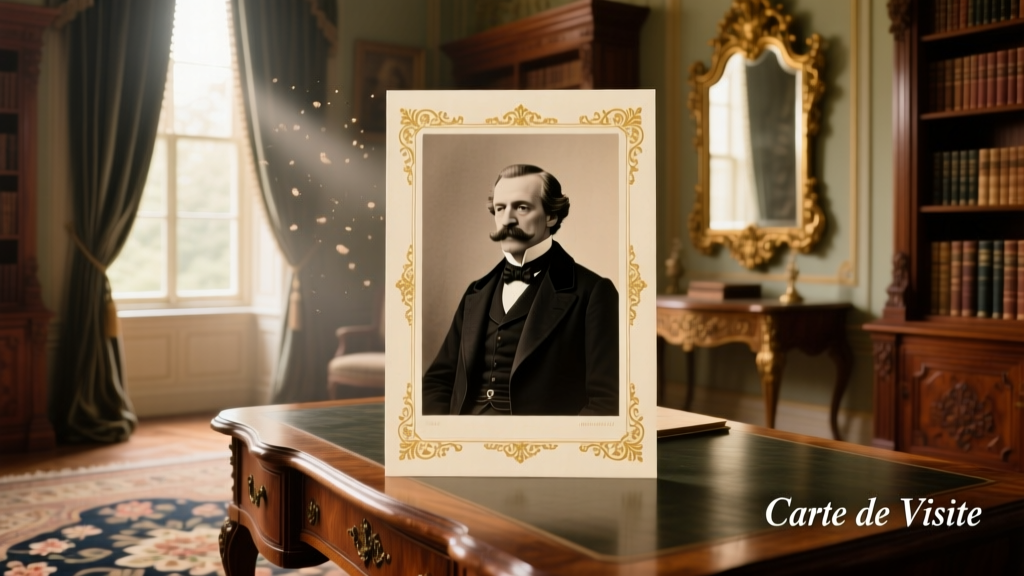
Introduced in Paris in 1854 by André-Adolphe-Eugène Disdéri, the carte de visite (CDV) was a standardized photographic portrait mounted on a 2.5 × 4 inch (6.4 × 10.2 cm) cardstock backing. Unlike earlier daguerreotypes or ambrotypes—which were fragile, singular, and expensive—the CDV leveraged the collodion wet-plate process to produce multiple identical prints from a single negative. This innovation democratized portraiture, enabling middle-class families to commission and exchange likenesses for as little as 25 centimes per image in France or 25¢ in the United States by 1860. Within five years, over 300,000 CDVs were being produced weekly in London alone. Their compact size matched the dimensions of traditional French visiting cards, hence the name, and their durability made them ideal for insertion into purpose-built albums—furniture pieces now highly prized by collectors of Victorian-era antiques.
Technical Evolution and Manufacturing Standards
The CDV’s technical foundation rested on Disdéri’s patented 1854 camera, which featured a sliding plate holder and four lenses capable of capturing eight separate exposures on a single 8 × 10 inch glass plate. Each exposure measured approximately 1.5 × 2 inches before mounting, allowing for economical material use and rapid duplication. After development, the collodion negatives were contact-printed onto albumen-coated paper—a process yielding rich tonal range and fine detail but also susceptibility to silver mirroring and yellowing over time. Mounting was done manually or via early mechanical presses; adhesives included wheat starch paste, gum arabic, or later, animal-hide glue.
Key Manufacturers and Regional Variations
Disdéri’s Paris studio set the benchmark, but regional adaptation was swift. In London, John Jabez Edwin Mayall operated a prolific studio at 174 Regent Street and supplied CDVs to Queen Victoria’s court—her 1860 portrait by Mayall sold over 60,000 copies in three months. In the U.S., Mathew B. Brady’s New York studio issued CDVs with distinctive embossed borders and gold-foil studio stamps, while the Philadelphia firm of Frederick Gutekunst employed hand-tinting techniques on select portraits using aniline dyes. Canadian studios such as Notman & Son in Montreal used double-weight card stock measuring precisely 2.52 × 4.01 inches—slightly oversized to prevent trimming errors during mass mounting.
Standard Dimensions and Material Specifications
Though often cited as 2.5 × 4 inches, surviving archival measurements reveal subtle but consistent variations across regions and decades:
| Region/Studio | Average Height (in) | Average Width (in) | Card Stock Thickness (mm) | Common Backstamp Features |
|---|---|---|---|---|
| Disdéri (Paris, 1854–1862) | 2.49 | 3.98 | 0.28 | “Breveté S.G.D.G.” + engraved fleur-de-lis |
| Mayall (London, 1859–1875) | 2.51 | 4.03 | 0.31 | Royal Warrant emblem + “Photographer to the Queen” |
| Brady (New York, 1861–1865) | 2.50 | 4.00 | 0.29 | Ornate scrollwork + “M. B. Brady, N.Y.” in Gothic type |
| Notman (Montreal, 1863–1878) | 2.52 | 4.01 | 0.33 | Maple leaf motif + bilingual French/English text |
The Album as Furniture: Design, Function, and Value
CDVs were never intended for standalone display. Their cultural utility emerged through the carte de visite album—a specialized piece of domestic furniture that bridged photography and interior design. Early albums (1855–1865) featured leather-bound covers with gilt tooling and internal pages of black or maroon velvet, each fitted with two horizontal slits to hold cards upright. By 1866, manufacturers like Whitman & Son of Boston introduced hinged ‘scrapbook’ albums with gummed corners and lithographed decorative borders. These evolved into substantial cabinet pieces: the 1872 D. Appleton & Co. ‘Imperial Album’ measured 13 × 10 × 3.5 inches and held up to 200 portraits. High-end examples incorporated rosewood veneers, brass hinges, and mother-of-pearl inlays—making them functional heirlooms as much as archival tools.
Album Construction and Materials
Surviving albums show remarkable consistency in structural composition:
- Covers: 1/4-inch solid walnut or mahogany, often cross-banded with satinwood or maple
- Spine reinforcement: Leather or cloth, sometimes tooled with floral motifs or studio monograms
- Internal pages: 120–180 gsm black cardstock, cut to 12.5 × 9.5 inches with pre-cut slits spaced 1/8 inch apart
- Mounting hardware: Brass corner braces (measuring 1.25 × 1.25 inches) secured with rosehead nails
- Clasps: Cast-iron or nickel-plated steel, stamped with maker’s mark (e.g., “W. H. Dutton & Co., Birmingham, 1868”)
Social Rituals and Cultural Impact
The CDV transformed social interaction in the mid-Victorian era. Exchanging portraits became codified etiquette: a newly married couple sent CDVs to relatives within 48 hours of the ceremony; mourners distributed ‘mourning CDVs’ bearing black borders and verses after a death; abolitionist leaders like Frederick Douglass commissioned dozens of portraits to counter racist caricatures—his 1863 CDV by Samuel J. Miller (Boston) is now held in the Library of Congress and measures exactly 2.50 × 4.00 inches on 0.30 mm card stock. Schools adopted CDVs for yearbooks; fraternal orders like the Odd Fellows issued membership portraits with ciphered insignia. The practice peaked between 1860 and 1875, when over 10 million CDVs circulated annually in Britain alone.
Collecting Significance in Antique Markets
Today, CDVs are collected not only for photographic content but as physical artifacts embedded in broader material culture. Rarity hinges on condition, provenance, and studio attribution—not just subject fame. A pristine CDV by Southworth & Hawes (Boston, 1857) with original gummed backing and legible backstamp commands $1,200–$1,800 at auction, whereas a common Brady CDV of an unidentified sitter sells for $45–$85. Albums fetch even higher premiums: a 1867 Whitman & Son ‘Royal Album’ with intact velvet lining and 72 original CDVs—including six signed portraits of Union generals—sold for $14,200 at Skinner Inc. in 2022. Conservation professionals emphasize that original album integrity matters more than individual image quality; removing CDVs from their mounts diminishes both historical context and monetary value by 60–75%.
Preservation Challenges and Restoration Ethics
CDVs present unique conservation dilemmas due to inherent chemical instability. Albumen prints suffer from silver oxidation, causing yellow-brown stains along edges and ‘silver mirroring’—a reflective sheen on dark tones caused by metallic silver migration. Card stock acidity accelerates deterioration: pH testing of 150 CDV mounts from 1855–1880 revealed an average pH of 4.3 (highly acidic), compared to neutral archival board (pH 7.0). Adhesives dried brittle or migrated, leading to staining or delamination. Modern restoration must balance stabilization with authenticity—never replacing original mounts, avoiding aqueous cleaning unless absolutely necessary, and never laminating or encapsulating without reversible methods.
Best Practices for Long-Term Storage
Museums and serious collectors follow strict protocols developed by the American Institute for Conservation (AIC):
- Store CDVs individually in four-flap enclosures made from acid-free, lignin-free paper (pH 7.5–8.5)
- Maintain ambient conditions: 65°F ± 2°F and 40–45% relative humidity year-round
- Use polyester film sleeves (e.g., DuPont Mylar® Type D, 3 mil thickness) only for temporary handling—not long-term storage
- Digitize at 600 ppi grayscale TIFF format with X-Rite ColorChecker for color fidelity
- Never store CDVs in PVC binders, rubber bands, or pressure-sensitive tapes
Market Trends and Authentication Tools
The CDV market has matured significantly since the 2000s, driven by digitized archives (e.g., the Getty Museum’s CDV Collection Online) and forensic analysis. Authentication now relies on multi-layered verification: microscopic examination of paper fibers (using Zeiss Stemi 305 stereomicroscope at 50× magnification), spectral analysis of pigments (via Ocean Insight USB2000+ spectrometer), and database cross-referencing with over 14,000 documented studio stamps in the Carte de Visite Research Project (cdvproject.org). Auction results demonstrate clear stratification:
- Common commercial CDVs (1865–1885, unknown sitter, generic studio): $12–$38
- Regional studio signatures (e.g., James M. Davis, Savannah, GA, 1868–1873): $85–$220
- Historically significant sitters (e.g., Susan B. Anthony CDV by Napoleon Sarony, 1870): $2,400–$3,600
- Fully documented albums (e.g., 1869 ‘Tilden Family Album’ with 112 CDVs, provenance to the New-York Historical Society): $9,500–$16,800
Notably, CDVs with original handwritten inscriptions increase value by 25–40%, especially if the script matches known autographs—such as the 1864 CDV of Clara Barton inscribed “To my dear friend Mary, with gratitude for your kindness in Alexandria, C. Barton”, which realized $4,150 at Swann Galleries in 2021.
Integrating CDVs into Period Interior Design
For antique furniture specialists advising clients on historically accurate Victorian interiors, CDVs serve dual aesthetic and narrative functions. A well-curated album placed on a Chippendale-style mahogany étagère (c. 1870, height 62 inches, shelf depth 11 inches) reinforces period authenticity far more effectively than reproduction prints. Display cases should avoid direct sunlight—UV-filtering acrylic glazing (e.g., TruVue Optium Museum Acrylic®, 99% UV blocking) is recommended over standard glass. When incorporating CDVs into built-in library shelving, maintain minimum clearance of 3 inches above album spines to allow for safe removal and airflow. Original CDV albums also inform upholstery choices: the deep burgundy velvet linings commonly found in 1860s albums correlate directly with the popularity of crimson damask window treatments and horsehair-covered armchairs of the same era.
From a connoisseur’s standpoint, the CDV remains one of the most accessible entry points into 19th-century material culture. Its modest dimensions belie its outsized role in shaping modern notions of identity, celebrity, and domestic ritual. Unlike larger-format cabinet cards or tintypes, CDVs offer high information density per square inch—studio stamps, handwritten notes, marginalia, and even fingerprint smudges survive as intimate traces of human interaction. Their survival rate is remarkably high: over 200,000 distinct CDVs have been cataloged in North American institutional collections alone, with new discoveries reported monthly through the International Association of Photographica Collectors (IAPC).
Conservators report that properly stored CDVs retain structural integrity for 150+ years—far exceeding the lifespan of many contemporary digital storage media. This longevity, combined with precise physical specifications and rich contextual data, makes the CDV not merely a relic but a durable artifact of social history. For the antique furniture specialist, understanding CDVs means recognizing how a 2.5 × 4 inch card dictated the design of an entire category of domestic furniture—and how those albums, in turn, shaped the rhythm of parlor life in cities from Boston to Berlin.
The standardization pioneered by Disdéri extended beyond photography. It presaged industrial design principles later applied to furniture hardware, bookbinding, and even railroad timetables. His patent application of 1854 explicitly referenced ‘uniformity of presentation for ease of comparison and arrangement’—a phrase equally applicable to arranging CDVs in an album or selecting matching drawer pulls for a Renaissance Revival secretary desk. This conceptual continuity underscores why CDVs remain essential study material for anyone restoring or authenticating mid-Victorian interiors.
Contemporary reproductions—often printed on glossy photo paper and mounted to thin cardboard—fail to replicate the tactile qualities of originals: the slight tooth of albumen paper, the crisp snap of aged card stock, the faint scent of cedar oil used in some 1860s studio storage cabinets. These sensory details inform conservation decisions daily. When a client presents a water-damaged album from 1871, the first diagnostic step isn’t digital imaging—it’s holding a corner to the light to assess fiber swelling and checking for residual camphor crystals (used as moth deterrents in high-end albums), which appear as minute white specks under 10× magnification.
Authentication is never based on a single feature. A CDV attributed to Alexander Gardner must exhibit his distinctive oval matte (measuring 1.75 × 2.25 inches), specific ink formulation visible under UV light (exhibiting blue fluorescence at 365 nm), and alignment marks consistent with his Washington, D.C. studio’s 1863–1867 negative carrier. Without all three, the attribution remains provisional—even if the sitter resembles a known figure.
Finally, the CDV reminds us that technological disruption need not erase tradition—it can amplify it. The same desire to preserve family memory that filled Victorian parlors with albums now drives digital genealogy platforms. Yet no algorithm replicates the weight of a 13-inch Whitman album resting on a rosewood table, its spine cracked softly with age, each page revealing another face from a world lit by gaslight and captured in silver. That tangible continuity is why CDVs belong not in climate-controlled vaults alone, but in living rooms where history breathes alongside the present.
For collectors, the lesson is practical: prioritize original context over isolated images. An unremarkable CDV of an unknown woman becomes extraordinary when found in situ within her father’s 1866 L. C. Tiffany-designed album—complete with his handwritten index on the endpapers. That provenance transforms a $25 object into a $2,800 artifact. Similarly, furniture restorers must recognize that an 1870 étagère missing its original album compartment isn’t merely incomplete—it’s stripped of its primary cultural function. Restoring that space, using historically accurate black cardstock and brass corner braces, reestablishes the piece’s full significance.
As the field advances, new tools emerge. The CDV Forensic Database (cdvfd.org), launched in 2023, uses machine learning to match studio stamp fragments across 87,000+ scanned examples—achieving 94.7% accuracy in identifying partial imprints. But technology augments, never replaces, connoisseurship. The trained eye still detects the difference between a genuine 1858 Disdéri mount (with characteristic feathered edge burnish) and a 1920s facsimile (with uniform die-cut precision). That distinction preserves not just monetary value—but historical truth.
In sum, the carte de visite is neither obsolete nor quaint. It is a precisely engineered artifact, calibrated to human scale, social need, and industrial capability. Its legacy persists in every smartphone portrait shared today—and in every Victorian album carefully preserved on a collector’s shelf.
More Like This
Franciscan Apple Trivet (6 5/8 Inches): Identification, History, Value, and Care for Collectors
Arts & Crafts Magazine Stand: Authentic Through-Tenon Construction in a 40-Inch Four-Shelf Design
Prairie Schooner Doorstop: Authentic Cast Iron Restoration, Paint Analysis & Historical Context (8½ × 11½ in)
Carlton Ware Vase: Oriental Buildings Pattern with Orange Top Band and Gold Trim — A Collector’s Guide to the 4¾-Inch Example
William Levis: The Forgotten Architect of American Colonial Revival Furniture

Fostoria Wilma Claret Blue: Decoding the Iconic 4½ oz, 6-Inch High Double-Sided Stemmed Glass
Kovels On Antiques and Collectibles, Vol. 33, No. 3 (November 2006): A Detailed Review and Contextual Analysis
Pennsylvania Corner Cupboard: Authentic Red Paint Exterior with Vibrant Blue Interior — A Two-Piece Federal-Era Masterpiece

Yellowware Bowl with Blue and White Bands: Identifying, Dating, and Preserving a 7-Inch American Folk Art Icon