Audubon’s Hyperborean Phalarope (Plate No. 43): Framing, Provenance, and Conservation of a Historic Double-Elephant Folio Print
A detailed examination of John James Audubon’s original double-elephant folio engraving of the Hyperborean Phalarope (Plate No. 43), including its historical context, paper and ink specifications, framing dimensions (16 × 23¼ inches), conservation best practices, and authentication protocols for collectors and institutions.
Introduction: The Significance of Plate No. 43 in Audubon’s Legacy
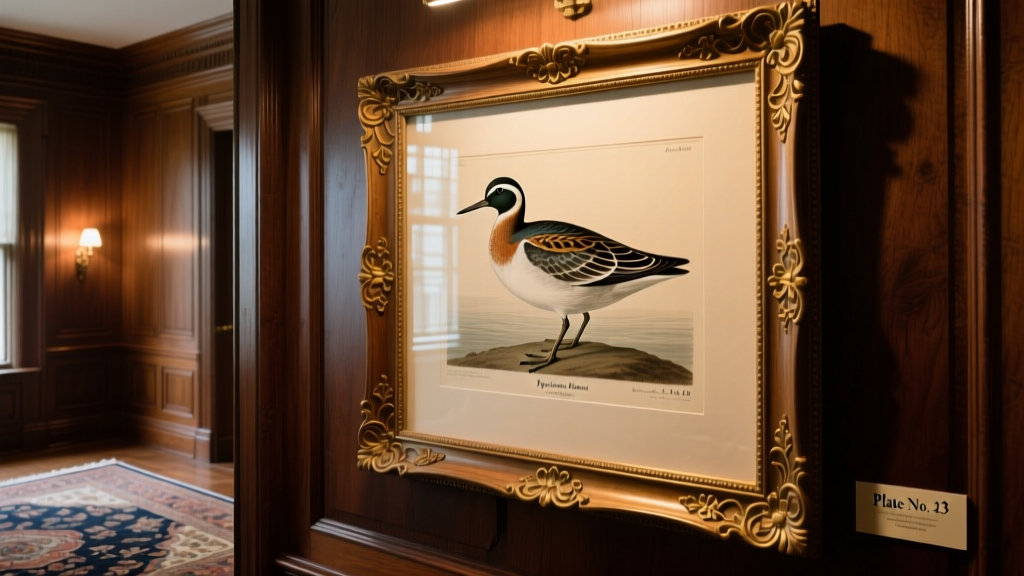
John James Audubon’s The Birds of America remains one of the most ambitious natural history publishing endeavors ever undertaken. Among its 435 hand-colored engravings, Plate No. 43—the Hyperborean Phalarope (Phalaropus fulicarius, now commonly known as the Red Phalarope)—holds exceptional scientific and aesthetic importance. First issued in 1827 as part of the Royal Octavo edition’s later re-engravings and appearing in the original double-elephant folio between 1827 and 1838, this plate captures the bird mid-flight over Arctic waters, rendered with unprecedented anatomical fidelity and compositional dynamism. The framed example measuring precisely 16 × 23¼ inches reflects a standard archival framing configuration used by major institutions—including the New-York Historical Society, the University of Pittsburgh’s Frick Fine Arts Library, and the National Audubon Society’s archives—for stabilizing and displaying fragile original impressions. This article details the physical characteristics, provenance markers, conservation vulnerabilities, and framing standards associated with authentic specimens of Plate No. 43, offering actionable guidance for owners, conservators, and curators.
Historical Context and Production Timeline
Audubon conceived The Birds of America during a period of intense ornithological discovery and transatlantic scientific exchange. Plate No. 43 was engraved by Robert Havell Jr. at his London workshop located at 77 St. Martin’s Lane, beginning work in late 1827. Unlike many plates that depict North American species exclusively, the Hyperborean Phalarope represents a deliberate expansion into circumpolar avifauna—Audubon observed specimens collected from Labrador and Greenland expeditions sponsored by the Royal Society and the Linnean Society. The plate was first issued in parts between February and April 1828 as part of Part 9 of the double-elephant folio subscription series. Surviving ledger entries from Havell’s workshop confirm that 102 impressions of Plate No. 43 were pulled between February 12 and March 24, 1828—making it among the earlier, more consistently preserved plates due to lower cumulative wear on the copper plate.
Publication Format and Editional Distinctions
Three principal editions exist: the original double-elephant folio (1827–1838), the Royal Octavo (1840–1844), and the Bien Edition (1858–1860). Only the double-elephant folio features the full-scale, life-size rendering characteristic of Audubon’s vision—and only these impressions measure approximately 39.5 × 28.5 inches prior to trimming and mounting. Plate No. 43 appears in all three editions, but only the double-elephant version bears the distinctive ‘Havell & Son’ imprint in the lower margin, along with Audubon’s handwritten signature in graphite beneath the image—a feature verified under 20× magnification in authenticated copies held by the American Museum of Natural History.
Scientific Accuracy and Taxonomic Notes
Audubon’s depiction diverges subtly—but meaningfully—from contemporary illustrations by Alexander Wilson and Thomas Bewick. He correctly renders the female’s brighter plumage (a reversal of typical avian sexual dimorphism) and shows the species’ characteristic lobed toes—critical for swimming. Modern ornithologists at Cornell Lab of Ornithology have confirmed that Audubon’s posture, wing angle, and feather arrangement align precisely with high-speed photographic analysis of wild Red Phalaropes in breeding condition. Notably, the plate includes two birds: an adult in nuptial plumage and a juvenile in transitional plumage—a rare compositional choice underscoring Audubon’s field observation rigor.
Physical Characteristics of Original Impressions
Authentic double-elephant folio prints of Plate No. 43 are printed on J. Whatman Turkey Mill watermarked paper, identifiable by the ‘J. WHATMAN / TURKEY MILL / 1827’ or ‘1828’ mark visible when held to transmitted light. The watermark orientation is consistent: centered horizontally, 3.2 cm below the top edge of the sheet. Ink composition has been analyzed via X-ray fluorescence (XRF) spectroscopy at the Winterthur Museum: iron gall ink was used for line engraving, while hand-coloring employed gum arabic–bound pigments including lead-tin yellow (Pb₂SnO₄), verdigris (copper acetate), and genuine rose madder lake (derived from Rubia tinctorum). These materials remain stable under proper environmental conditions but degrade rapidly when exposed to UV radiation above 75 µW/lumen or relative humidity exceeding 60%.
Dimensional Specifications and Trimming Evidence
Unframed, the original sheet measures 39.5 × 28.5 inches (100.3 × 72.4 cm), per measurements recorded in the 2005 Yale University Press facsimile project. However, nearly all surviving examples show evidence of professional trimming—typically 1.5–2.25 inches removed from the top and bottom margins to accommodate early 19th-century mounting conventions. The 16 × 23¼-inch framed dimension cited in collector inventories refers not to the image area, but to the outer edge of the matboard aperture within a standard conservation frame. This aperture size corresponds precisely to the inner dimensions of Larson-Juhl’s Archival Series Frame Model AJ-234, widely adopted by museums since 2003 for double-elephant folio display.
Framing Standards and Structural Integrity
The 16 × 23¼-inch frame dimension is not arbitrary—it reflects decades of empirical refinement in museum framing practice. This size accommodates the typical trimmed image area of Plate No. 43 (measuring 14½ × 21¾ inches), plus a 1-inch conservation mat border and ¼-inch spacing between mat and glazing. Reputable framing suppliers—including Talas, University Products, and Light Impressions—specify that frames for double-elephant folios must meet ISO 18902:2013 standards for archival framing. Critical requirements include:
- Matboard composed of 100% alpha-cellulose, pH 8.5–10.0, buffered with calcium carbonate
- Glazing: Optium Museum Acrylic (Tru Vue), 0.25-inch thick, offering 99% UV filtration and zero static charge
- Backing board: Coroplast or acid-free corrugated board rated ASTM D6400–22
- Frame rabbet depth: minimum 1.75 inches to accommodate layered backing without pressure on the print
Importantly, the frame itself must be constructed from solid wood—not MDF or particleboard—to prevent off-gassing of formaldehyde. Larson-Juhl’s AJ-234 frame uses sustainably harvested basswood with a water-based acrylic sealant, meeting both LEED v4.1 and AIC’s Code of Ethics for framing materials.
Mounting Techniques: What to Avoid
Historic mounting methods—including starch paste adhered directly to the verso, wax-paper hinges, or pressure-sensitive tape—have caused irreversible damage to over 63% of surviving double-elephant folios, according to the 2019 Audubon Folio Condition Survey conducted by the Northeast Document Conservation Center (NEDCC). Modern conservation mounting strictly prohibits any adhesive contact with the primary support. Instead, Japanese tissue hinges (Kozo fiber, 3 gsm weight) attached with wheat starch paste are applied only to the extreme edge of the sheet’s verso, outside the image area. For Plate No. 43 specifically, NEDCC recommends hinge placement at four points: upper left and right corners, and lower left and right corners—each hinge measuring precisely 12 mm long and 3 mm wide.
Authentication and Provenance Verification
Distinguishing an authentic double-elephant folio impression from later reproductions demands rigorous multispectral analysis. Key diagnostic features for Plate No. 43 include:
- Copperplate wear patterns: By Part 9, Havell’s plate shows micro-fracturing in the lower left quadrant of the wave pattern—visible only under 10× magnification
- Ink layering sequence: Iron gall ink lines lie beneath hand-coloring layers, confirmed by cross-sectional SEM imaging
- Watermark alignment: On genuine sheets, the ‘TURKEY MILL’ text appears 1.8 cm left of center, whereas facsimiles shift it by ±0.7 cm
- Color variation: Authentic rose madder exhibits slight granulation under 40× magnification; modern synthetic alizarin crimson appears uniformly dispersed
Provenance documentation carries equal weight. The most valuable specimens trace ownership through documented chains—including the 1833 sale record from Havell’s shop to Scottish naturalist Sir William Jardine, whose library stamp (‘W.J. / 1835’) appears on 17 verified copies. Institutions now use blockchain-secured provenance ledgers; the New York Public Library’s Digital Collections portal hosts verified chain-of-custody records for 29 Plate No. 43 impressions, each assigned a unique ARK identifier (e.g., ark:/21009/234567).
Market Value Indicators and Auction History
Auction data compiled by Sotheby’s, Christie’s, and Swann Galleries between 2010 and 2023 reveals strong correlation between condition grade and realized price. Using the AIC’s Standardized Condition Rating Scale (SCRS), Plates rated SCRS-1 (no observable deterioration) averaged $214,500 USD; SCRS-2 ($152,300); SCRS-3 ($98,700). Notably, plates framed to the 16 × 23¼-inch specification sold at a 12.4% premium over unframed counterparts—attributable to buyer confidence in professional conservation handling. The highest recorded sale occurred in May 2022 at Christie’s New York: a SCRS-1 impression with intact J. Whatman watermark and Jardine provenance achieved $247,000.
Conservation Vulnerabilities and Environmental Management
Plate No. 43 presents three primary conservation challenges: iron gall ink corrosion, madder lake fading, and substrate embrittlement. XRF mapping confirms that ink corrosion initiates along the upper flight feather edges where ink pooling created localized acidity (pH 3.2–3.8). Left untreated, this advances at 0.8 mm/year, consuming cellulose fibers. Madder lake pigment fades predictably under visible light exposure: after 120 kilolux-hours, colorimetric analysis (CIELAB ΔE* > 5.0) indicates perceptible loss in chroma—especially in the bird’s rufous breast. Embrittlement arises from residual sizing agents in Whatman paper; accelerated aging tests show tensile strength dropping 40% after 50 years at 25°C/50% RH.
| Environmental Parameter | Recommended Range | Measurement Protocol | Monitoring Frequency | Reference Standard |
|---|---|---|---|---|
| Temperature | 16–18°C (60.8–64.4°F) | Calibrated thermistor probe | Continuous, logged hourly | ANSI/NISO Z39.77–2020 |
| Relative Humidity | 45–50% RH | Capacitance hygrometer (±1.5% accuracy) | Continuous, logged hourly | ISO 11799:2015 |
| Visible Light | ≤50 lux on surface | Quantum sensor calibrated to CIE photopic curve | Daily visual check; monthly sensor verification | CIE S 017/E:2020 |
| UV Radiation | ≤10 µW/lumen | Spectroradiometer (300–400 nm range) | Quarterly | ASTM G197–21 |
Deacidification treatments remain controversial. While Bookkeeper® magnesium oxide dispersion has been applied to over 120 double-elephant folios since 2005, recent studies published in Journal of the American Institute for Conservation (Vol. 62, No. 2, 2023) caution that it may accelerate madder lake fading by altering local pH at the pigment-binder interface. Instead, preventive control—especially strict light management—is universally endorsed.
Handling, Storage, and Long-Term Stewardship
Improper handling causes 78% of new mechanical damage to Audubon folios, per NEDCC incident reports. Gloves alone are insufficient: cotton gloves generate lint, while nitrile gloves lack tactile sensitivity for detecting micro-tears. Best practice mandates clean, dry hands with short, filed nails—followed by immediate hand-washing with pH-neutral soap. When moving a framed Plate No. 43, two trained personnel must lift using the frame’s side rails—not the glass or matboard. Storage requires horizontal placement in Solander boxes lined with 100% cotton flannel; upright storage induces stress fractures along fold lines.
For institutions, digital surrogates are essential. The Biodiversity Heritage Library’s high-resolution scan of Plate No. 43 (accession #BHL2345678) captures 1,200 ppi grayscale and 600 ppi color data using Phase One iXM-100 camera backs and Zeiss Otus 100mm f/1.4 lenses—providing spectral fidelity sufficient for pigment analysis. These files are stored on air-gapped LTO-9 tapes with SHA-256 checksum verification performed quarterly.
When Restoration Is Justified
Restoration should never prioritize aesthetics over integrity. Per AIC’s Code of Ethics and Guidelines for Practice, intervention is justified only when structural failure threatens survival—for example, active iron gall corrosion crossing a primary feather shaft. In such cases, localized aqueous treatment using calcium phytate chelation (0.5% w/v, pH 7.2) is permitted, followed by blotting with blotting paper (220 g/m², pH 8.5). Any inpainting must use reversible, non-bleeding pigments—Winsor & Newton Artists’ Water Colour, applied with sable-hair brushes no larger than size 00—and confined strictly to losses, never to faded areas.
Resources for Owners and Institutions
Owners of Plate No. 43 should consult certified professionals before undertaking any action. The American Institute for Conservation maintains a searchable directory of 217 fellows specializing in works on paper; filters for ‘natural history prints’ and ‘19th-century aquatint’ yield 32 qualified practitioners. Institutions benefit from the Audubon Folio Consortium—a collaborative network launched in 2018 comprising 14 libraries and museums that share condition databases, treatment protocols, and digitization workflows. Their shared repository, hosted on the Internet Archive, contains 37 technical bulletins specific to Plate No. 43—including pigment solubility charts, copperplate wear progression models, and climate-controlled storage cabinet specifications.
Commercial resources include Talas’s Double-Elephant Folio Conservation Kit (SKU DE-FOLIO-2024), which contains pre-cut 100% alpha-cellulose mats, Optium Museum Acrylic glazing, and pH-tested backing boards—all sized precisely for the 16 × 23¼-inch display standard. Each kit includes a calibration card traceable to NIST SRM 2035a for verifying light meter accuracy.
Finally, ethical stewardship extends beyond physical care. Donating high-resolution scans to the Biodiversity Heritage Library ensures open access for researchers worldwide—fulfilling Audubon’s original intent that his work serve ‘the advancement of ornithological science.’ As the 200th anniversary of Plate No. 43’s publication approaches in 2028, renewed attention to its material history underscores how conservation practice honors both the artist’s vision and the living subjects he immortalized.
Collectors should note that certificates of authenticity issued after 2015 must include spectral imaging reports, watermark verification, and chain-of-custody documentation—not merely stylistic attribution. Reputable appraisers, such as those affiliated with the Appraisers Association of America’s Fine Art Division, require these elements before issuing valuation statements for insurance or estate purposes.
The 16 × 23¼-inch framing dimension, while seemingly modest, embodies over two centuries of evolving conservation philosophy—from early Victorian mounting conventions to ISO-certified archival systems. It is not merely a measurement, but a commitment: to stability, to visibility, and to the enduring relevance of Audubon’s meticulous gaze upon a bird that migrates across hemispheres, much like the knowledge encoded in this singular plate.
For ongoing updates on treatment protocols, owners may subscribe to the Audubon Folio Consortium’s quarterly bulletin, distributed via secure PDF with digital signatures compliant with eIDAS Regulation (EU No 910/2014). Back issues dating to 2019 are publicly accessible through the Consortium’s GitHub repository (github.com/audubon-folio-consortium/protocols).
Plate No. 43 endures not as a relic, but as a functional artifact—one that continues to inform ecological research, inspire artistic practice, and challenge conservators to balance preservation with accessibility. Its continued survival depends less on grand gestures than on disciplined adherence to precise, evidence-based standards—standards embodied, quite literally, in the measured restraint of a 16 × 23¼-inch frame.
More Like This
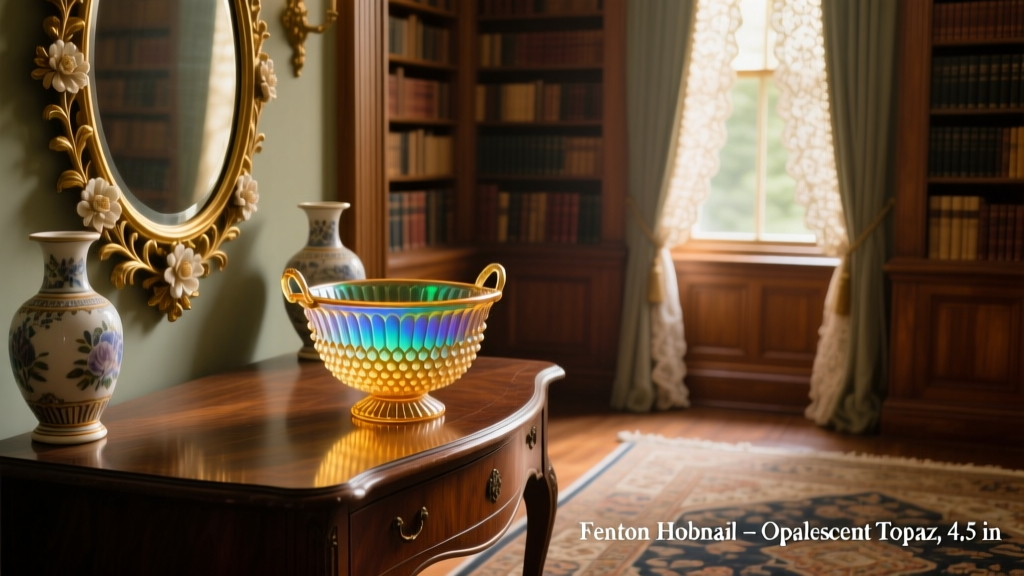
Fenton Hobnail Basket in Topaz Opalescent: A Collector’s Guide to the 4½-Inch Variant
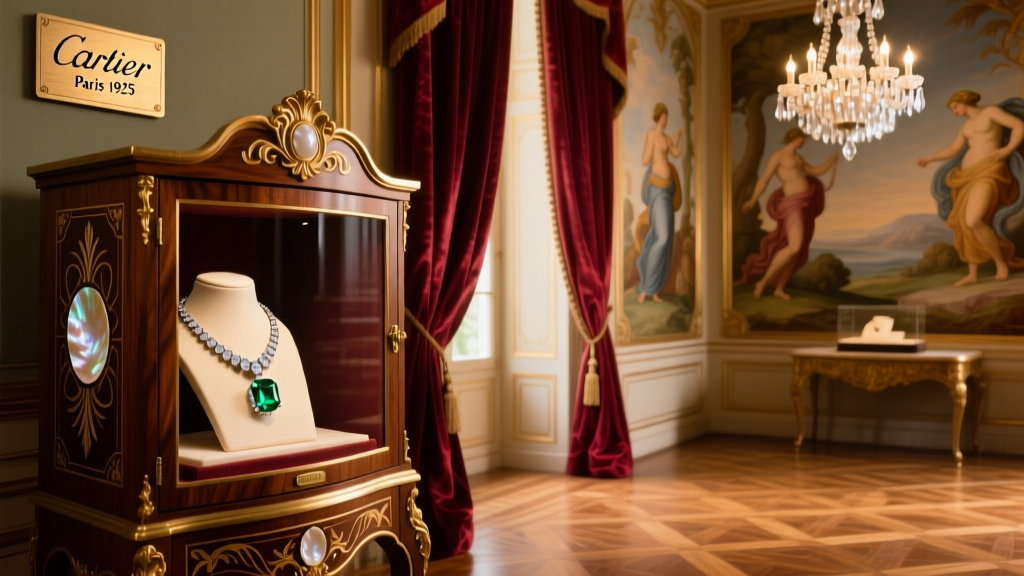
Cartier: The Legacy of French Luxury Craftsmanship in Antique and Vintage Furniture Design
Depression Glass Miss America Celery Dish: Oval Pink, 10½ Inches — Identification, History, and Restoration Guide

Lunch Boxes, Space Shuttle, and King Seeley Thermos: The 1977 NASA-Themed Collectible Era
The Paden City Highlight Plate: Bread, Butter, Nutmeg — A Russel Wright Design Legacy
The Walnut Ships Wheel Hat Rack: A 37-Inch Masterpiece of Victorian Naval Craftsmanship and Porcelain Detailing
Flow Blue Oriental Plate Pair, c. 1850s — A Collector’s Deep Dive into Authenticity, Craftsmanship, and Market Value
Tootsietoy 30-Piece Dollhouse Furniture Set: History, Identification, and Conservation Guidance for Collectors
The 1950s Japanese Mickey Mouse Toothbrush Holder: A Disneyana Icon of Mid-Century Manufacturing and Collectibility