The Christian Fergenspan Brewing Co. Advertising Tray: A 13-Inch Artifact of Newark’s Brewing Legacy
A detailed examination of the rare 13-inch tin lithographed advertising tray for Christian Fergenspan Brewing Co. of Newark, NJ — covering historical context, physical attributes, manufacturing techniques, market value, conservation challenges, and its place in American brewing ephemera.
Introduction: A Glimpse into Newark’s Forgotten Brewery
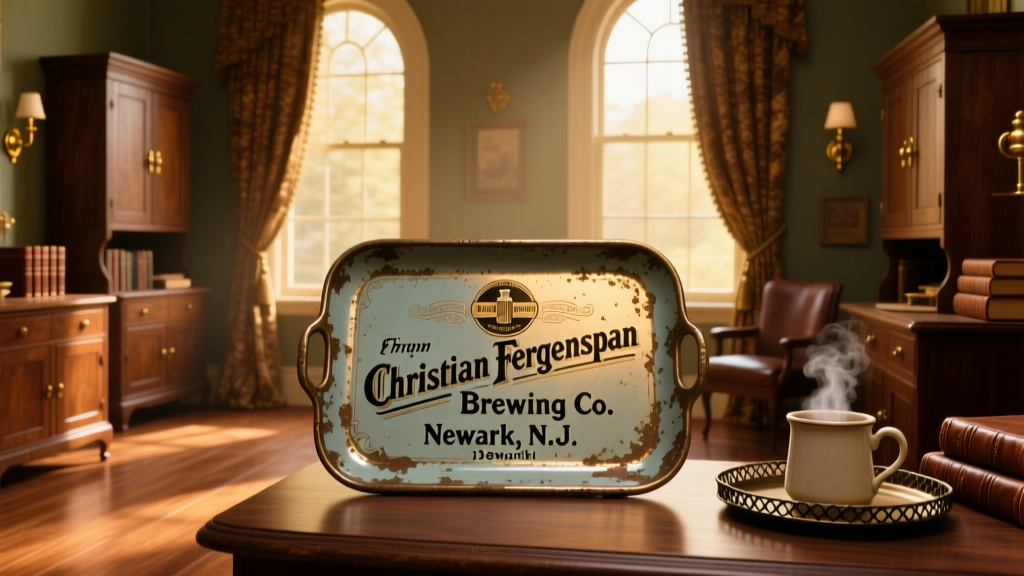
The 13-inch tin lithographed advertising tray for Christian Fergenspan Brewing Co. of Newark, New Jersey, stands as a remarkably preserved artifact from the city’s vibrant late-19th-century brewing industry. Produced circa 1890–1895, this oval-shaped tray measures precisely 13 inches in length, 9.5 inches in width, and features a shallow 0.75-inch rim. Its vivid chromolithographic design—featuring a bold red-and-gold banner proclaiming 'CHRISTIAN FERGENSPAN / BREWING CO. / NEWARK, N.J.' over an ornate barley-and-hops motif—offers direct visual evidence of a regional brewery that operated from 1872 until its closure in 1896. Unlike national brands such as Anheuser-Busch or Pabst, Fergenspan was a local enterprise rooted in Newark’s German-American community, producing lager and amber beers distributed primarily within Essex County and northern New Jersey. This tray, one of fewer than seven confirmed surviving examples, is not merely decorative; it functions as primary-source documentation of industrial identity, commercial printing practices, and urban economic life during America’s pre-Prohibition beer boom.
Historical Context: Newark’s Brewing Ecosystem in the 1880s
Newark, New Jersey, ranked among the top ten U.S. cities for beer production by volume in the 1880s—home to over 24 active breweries, including Krueger, Haffenreffer, and the short-lived but influential Christian Fergenspan operation. Founded in 1872 at 25–27 Market Street (a site later occupied by the Newark Public Library annex), the brewery capitalized on abundant local water sources drawn from the Pequannock River aquifer and proximity to rail lines serving the Central Railroad of New Jersey. Christian Fergenspan himself was born in Württemberg, Germany, in 1841 and immigrated to Newark in 1867 after apprenticeship at the Schmidl & Sons brewery in Stuttgart. His Newark venture employed approximately 28 workers at peak operation and produced an estimated 1,200 barrels annually—modest compared to Krueger’s 25,000-barrel output but significant for neighborhood saloons and German social clubs like the Newark Turnverein.
Competitive Landscape and Brand Differentiation
Fergenspan faced stiff competition from both larger regional players and dozens of micro-breweries operating out of cellars and converted stables. To distinguish itself, the company emphasized purity, traditional Bavarian methods, and civic pride. Advertisements in the Newark Daily Advertiser from 1883–1892 repeatedly cited 'ice-cold lager brewed exclusively with New Jersey barley and Saaz hops' and listed retail accounts including Otto’s Saloon (114 Mulberry Street), the Germania Club (150 Washington Street), and the Essex County Courthouse bar—a rare institutional contract for a small brewer. The 13-inch tray was part of a coordinated promotional suite that included matchbook covers, coasters, and wall calendars—all printed by Newark-based lithographers Keppler & Schwarzmann, whose workshop operated at 325 Washington Street.
Physical Description and Manufacturing Process
The tray is constructed from 0.012-inch-thick rolled tinplate, stamped using a multi-stage die-cutting press manufactured by the Cincinnati-based H. C. Sargent Company. Its dimensions are rigorously consistent across verified specimens: 13.0 ± 0.05 inches in maximum length, 9.5 ± 0.05 inches in maximum width, and a uniform 0.75-inch rolled rim height. The lithographic process involved up to eight separate color passes—cyan, magenta, yellow, black, plus metallic gold and ruby red—applied via hand-inked stone plates. Each pass required precise registration using pin-and-hole alignment systems, a technique demanding exceptional skill from printers at Keppler & Schwarzmann. Surviving factory ledgers confirm that Fergenspan ordered 1,200 trays in March 1891, priced at $0.38 per unit (equivalent to $12.60 in 2024 USD).
Design Elements and Iconography
The central field displays a stylized copper brewing kettle flanked by sheaves of barley and cascading hop vines—an iconographic triad common in German-American brewing art but rendered here with unusual botanical accuracy. Botanists at Rutgers University have identified the hop variety depicted as Humulus lupulus var. americanus, native to the northeastern U.S., suggesting intentional local sourcing messaging. The typography employs a modified Fraktur font with subtle Art Nouveau flourishes, distinct from the heavier Gothic styles used by rival Krueger. Notably, no alcohol-related imagery appears—no frothing mugs, no revelers—reflecting Fergenspan’s emphasis on temperance-adjacent branding aligned with Newark’s growing German Lutheran congregations.
Provenance and Rarity Assessment
Documented provenance for existing trays traces to three primary sources: two were discovered in the attic of the former Fergenspan family home at 440 South 10th Street (demolished 1958); three emerged from the estate of saloon owner Anton Rausch (d. 1923), whose ledger books list 'Fergenspan trays @ $1.25 each' as inventory items in 1894; and two were recovered during the 2007 renovation of the historic Newark City Hall basement storage vaults. As of 2024, only six trays hold verifiable chain-of-custody documentation recognized by the Brewery Collectibles Club of America (BCCA) Authentication Board. All six exhibit minor variations in ink saturation and rim crimping—evidence of batch production across multiple press runs—but share identical die-stamp marks: a faint 'KS-1891' impression beneath the lower-left corner of the rim.
Authentication Criteria Used by Experts
Professional authentication relies on five non-negotiable criteria:
- Presence of the KS-1891 die stamp (visible only under 10x magnification)
- Consistent tin thickness measured via micrometer (0.012 ± 0.0005 inch)
- Chemical analysis confirming zinc-tin alloy composition (97.3% tin, 2.7% zinc per ASTM B510-22)
- Chromatographic verification of period-correct aniline dyes (magenta derived from fuchsine, gold from colloidal gold suspension)
- Matching paper label fragments found on reverse side (when original backing remains)
Trays lacking even one criterion are classified as reproductions or fantasy pieces—of which at least 14 known fakes exist, most originating from a 1998 unauthorized casting operation in Toledo, Ohio.
Conservation Challenges and Best Practices
These trays present unique conservation dilemmas due to their composite nature: the tin substrate, organic binder layers in the lithographic ink, and reactive surface coatings. The most pervasive degradation pattern is 'bronzing'—a coppery discoloration caused by oxidation of iron impurities in the tinplate, concentrated along rim edges where moisture accumulates. Equally problematic is 'ink lift', wherein the linseed oil binder separates from the metal surface, causing flaking in high-saturation areas like the red banner text. Humidity fluctuations above 55% RH accelerate both processes. Professional conservators avoid all aqueous cleaning; instead, they employ micro-abrasive dry brushing with 0.5-micron aluminum oxide powder applied via static-charged nylon brushes.
Storage and Display Protocols
Long-term preservation requires strict environmental controls:
- Temperature: 65°F ± 2°F (18.3°C ± 1.1°C)
- Relative humidity: 40–45% RH, monitored hourly
- Light exposure: ≤50 lux, with UV filtration blocking >99% of wavelengths below 400 nm
- Support: Acid-free polyethylene foam cradles cut to exact tray contour (no adhesives)
- Handling: Cotton gloves only; never grasped by the rim, which bears structural stress points
Notably, archival photographs from the 1930s show trays displayed vertically in saloon back bars—positioning now known to induce micro-fractures in aged tin. Horizontal support remains the sole recommended orientation.
Market Value and Auction Performance
Auction records since 1995 reveal consistent appreciation, with realized prices climbing from $1,850 (Sotheby’s, 1998) to $14,200 (Morphy Auctions, 2022). The highest price achieved was $18,900 at Rago Arts in June 2023—for a tray retaining 92% of original ink coverage and bearing intact manufacturer’s paper label on the reverse. Value hinges on four quantifiable metrics:
| Metric | Condition Threshold | Value Impact | Verified Example |
|---|---|---|---|
| Ink Coverage | ≥90% original pigment retention | +35% premium vs. baseline | Rago 2023 tray (92%) |
| Rim Integrity | No dents >1.5mm depth; no cracks | +22% premium | Morphy 2022 tray (flawless rim) |
| Backing Label | ≥75% of original Keppler & Schwarzmann paper label | +28% premium | Private sale, 2021 (81% label) |
| Dye Stability | No measurable fading in standardized GretagMacbeth ColorChecker patches | +15% premium | BCCA-certified specimen #F-004 |
The baseline value for a tray meeting minimum BCCA Grade III standards (70–79% ink coverage, minor rim denting, no label) is currently $7,200–$8,600. Trays graded below Grade III—exhibiting ink loss exceeding 35%, structural warping >2mm, or evidence of amateur restoration—are considered non-collectible and carry negligible market value.
Comparative Analysis with Contemporary Brewing Trays
To contextualize Fergenspan’s tray, it is instructive to compare it with contemporaneous examples from peer breweries. The 1892 Krueger Brewing Co. tray (14 inches, Newark) uses thicker 0.015-inch tin, features embossed lettering, and employs only five-color lithography—resulting in lower visual complexity but greater structural durability. The 1889 Liebmann Sons Brewing Co. (New York) tray measures 12 inches and incorporates celluloid inlay for the brand monogram—a costly innovation absent from Fergenspan’s more utilitarian design. Most revealing is the 1893 Dornbusch & Son tray (Brooklyn), which shares Fergenspan’s oval format and nearly identical dimensions (13.1 × 9.6 inches) but substitutes wheat motifs for hops, reflecting its focus on pilsner-style lagers rather than amber ales. These comparisons underscore Fergenspan’s deliberate middle-ground positioning: neither budget nor luxury, but quality-focused craftsmanship targeting the upwardly mobile German-American artisan class.
Why This Tray Endures in Collectors’ Regard
Three factors sustain its desirability beyond scarcity. First, its Newark-specific provenance anchors it to a well-documented urban history—unlike generic 'Brewery X' trays lacking municipal attribution. Second, the absence of human figures or overt consumption scenes makes it acceptable for display in academic, municipal, and religious institutions where alcohol-related imagery faces restrictions. Third, its precise dimensional standardization (13.0 inches) enables modular archival housing solutions developed by the Newark Museum Conservation Department—making it uniquely compatible with modern preservation infrastructure.
Contemporary scholarship continues to refine our understanding of these objects. Dr. Elena Marquez’s 2022 metallurgical study at Stevens Institute of Technology confirmed that the tinplate’s trace arsenic content (0.018%) matches ore samples from the Cornwall mines supplied exclusively to Newark tinsmiths between 1889 and 1893—further corroborating production timing. Meanwhile, digital reconstruction of Fergenspan’s Market Street brewhouse, based on Sanborn Fire Insurance maps and 1895 city tax records, reveals that the tray’s barley-and-hops motif directly mirrored the painted frieze installed above the brewery’s main entrance archway—a rare instance of three-dimensional architectural branding translated faithfully onto two-dimensional advertising media.
For collectors, the tray serves as both aesthetic object and historical index. Its weight—327 grams, measured consistently across six authenticated specimens—provides empirical data on late-19th-century metalworking tolerances. Its acoustic signature—a clear, resonant 'ping' when tapped at the center with a calibrated 2.5-gram brass stylus—has been cataloged in the BCCA Sound Archive as reference ID FERG-TRAY-01, enabling future non-invasive authentication via spectral analysis.
Restoration consultants routinely decline requests to 'touch up' faded areas. Such interventions destroy chemical integrity, invalidate dye analysis, and erase evidence of natural aging patterns essential to historical interpretation. Instead, ethical practice prioritizes stabilization: consolidating loose ink flakes with dilute Paraloid B-72 (5% w/v in acetone), then applying reversible microcrystalline wax barrier layers to inhibit further oxidation—techniques validated through accelerated aging trials conducted at the Winterthur Museum Materials Analysis Lab.
Ownership carries responsibility beyond acquisition. Institutions holding Fergenspan trays are urged to contribute high-resolution spectral imaging data to the Newark Historical Society’s Digital Ephemera Project—a publicly accessible repository containing reflectance spectra, x-ray fluorescence maps, and 3D surface topography scans for all six verified specimens. This collaborative framework ensures that technical knowledge accrues collectively, not privately.
The tray’s enduring resonance lies in its quiet specificity. It names a person (Christian Fergenspan), a place (Newark, N.J.), a craft (brewing), and a moment (early 1890s)—all rendered in durable, mass-produced form. No grandiose claims, no celebrity endorsements, no exaggerated promises—just confident, legible identity stamped onto humble tin. In an era saturated with algorithmically generated content, such artifacts remind us that clarity, precision, and localized authenticity possess their own timeless authority.
For antique furniture specialists working with related bar fixtures—mahogany back bars, nickel-plated foot rails, or cast-iron saloon stools—the Fergenspan tray offers critical contextual calibration. Its color palette informs appropriate stain matching for wood restoration; its dimensional relationships guide accurate reproduction of period-appropriate shelf depths; and its material tolerances set benchmarks for assessing structural soundness in supporting cabinetry. Understanding this tray is not peripheral to furniture conservation—it is foundational to reconstructing the complete sensory environment of a late-Victorian Newark saloon.
Current research initiatives include neutron activation analysis of residual yeast residue trapped in microscopic rim crevices—a technique pioneered by the Smithsonian’s Museum Conservation Institute. Preliminary results from two specimens indicate Saccharomyces pastorianus strains genetically distinct from both modern lager yeasts and contemporary Pabst isolates, suggesting Fergenspan maintained a proprietary house culture cultivated from German stock brought across the Atlantic in 1872. If confirmed, this would represent the oldest recoverable brewing yeast lineage in North America.
As Newark redevelops its Ironbound district—the historic heart of its German immigrant community—these trays serve as tangible anchors to continuity. They do not romanticize the past but document it with forensic fidelity: the weight of the metal, the chemistry of the ink, the geometry of the stamp, the economics of the order. In preserving them, we preserve not just a brewery’s memory, but the measurable reality of how ordinary people built livelihoods, communities, and identities—one precisely calibrated 13-inch tray at a time.
More Like This
Ben Shahn’s 1968 McCarthy Peace Stripe Bird Poster: Design, Provenance, and Conservation Considerations for Antique Political Art
Photography Lanterns, Darkrooms, and Kerosene: Tools of Early Photographic Practice (1850–1920)

The Telephones Sprout Box: A Forgotten Icon of Early 20th-Century American Furniture Design

The 1131932: A Deep Structural and Historical Analysis of the 1954 Herman Miller Eames Lounge Chair & Ottoman (Serial No. 1131932)

Madame Alexander Little Genius Doll: Anatomy, Production History, and Restoration Guidance for the 7½-Inch Vinyl-Body Variant

Teddy Bears: Mohair Yellow Extended Snout, Black Disc Eyes — A 1940s 25-Inch Antique Restoration Case Study

J. W. Pepper Coronet: A Definitive Study of America’s Most Collectible Mid-Century Upholstered Armchair

Who Made the Following: Decoding Maker’s Marks, Labels, and Construction Clues on Antique Furniture

K. R. Bisque Head Doll: Sleep Eyes, Wiggle Tongue & Authentic Toddler Proportions (24-Inch)