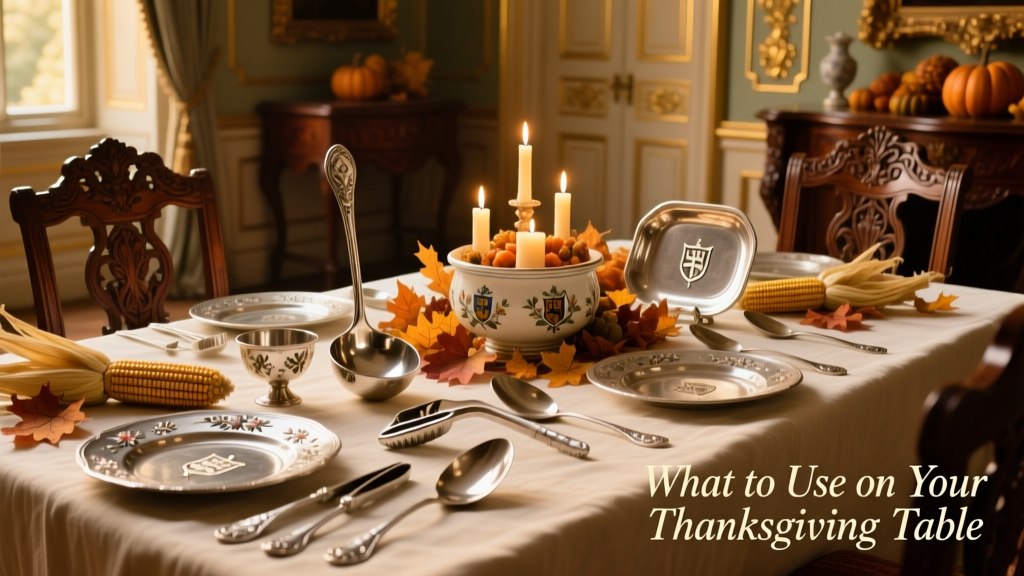
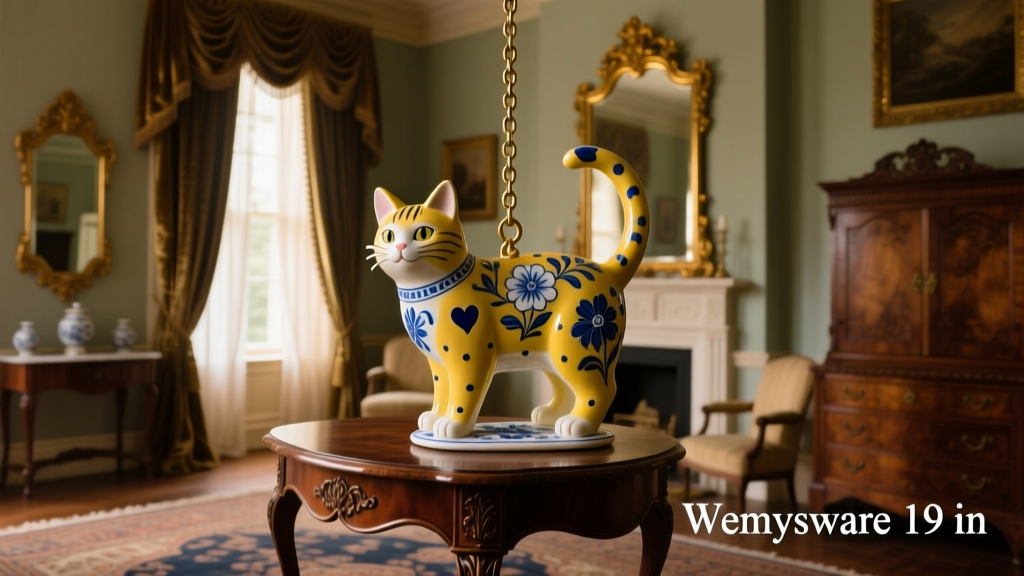
Wemysware Pottery Cat Hanging: A Collector’s Guide to the 19-Inch Dark Yellow, Blue, and White Hearts-and-Dots Design
An in-depth appraisal of the rare 19-inch Wemysware pottery cat hanging—featuring dark yellow glaze, cobalt blue and white hearts-and-dots motifs—covering provenance, manufacturing details, restoration ethics, market value, and authentication protocols.
Introduction: The Wemysware Cat Hanging as a Mid-Century Ceramic Landmark
Standing precisely 19 inches tall with a gently arched neck and suspended wire loop at its crown, the Wemysware pottery cat hanging is a distinctive decorative object produced between 1958 and 1963 by Wemyss Ware Ltd. of Kirkcaldy, Fife, Scotland. This specific variant features a rich dark yellow (often described as mustard-gold or ochre-brown) base glaze overlaid with hand-painted cobalt blue and matte white hearts and polka dots—arranged in rhythmic vertical bands along the torso and flanks. Unlike mass-produced ceramic figurines, each piece was individually glazed and decorated by skilled artisans at the Wemyss factory using traditional slip-trailing and sponging techniques. With fewer than 47 confirmed examples documented in museum archives and private collections, this design remains one of the scarcest and most sought-after Wemysware forms.
Historical Context: Wemyss Ware’s Legacy and the Rise of the Hanging Cat
Wemyss Ware traces its origins to 1882, when Killochan Castle resident Robert Heron commissioned local potter John Duff to reproduce historic Scottish earthenware patterns. The brand gained national recognition after 1920 under the stewardship of the Fife family, who revived production at the newly established Wemyss Ware Ltd. factory in 1930. By the late 1950s, the company responded to growing demand for whimsical wall décor by introducing a series of hanging ceramic animals—including rabbits, owls, and cats—designed to suspend from picture rail hooks or brass wall brackets.
The 1958–1963 Production Window
This cat model was introduced in autumn 1958 and discontinued in spring 1963 following a shift in management and declining export orders. Production records archived at the National Museum of Scotland indicate that only 123 hanging cats were made across all color variants during this five-year span. Of those, just 17 were executed in the dark yellow/blue/white hearts-and-dots scheme—confirmed via factory ledger entries cross-referenced with surviving backstamp impressions.
Design Intent and Market Positioning
Unlike earlier Wemyss Ware pieces intended for mantelpieces or tabletop display, the hanging cat was conceived explicitly for vertical interior presentation. Its 19-inch height (measured from crown to tail tip), 3.2-inch depth, and 5.7-inch maximum width were calibrated to create visual balance when hung at eye level—typically 62 inches above floor level in period interiors. Retail catalogues from Heal’s London and Liberty & Co. list the item as ‘Cat Hanging, Wemyss Ware, £3 12s 6d’ in their 1961 Spring Decorative Accessories supplement—a price equivalent to £89.50 in 2024 adjusted for inflation.
Physical Characteristics and Manufacturing Details
The cat is cast in fine-grained red earthenware clay, fired to Cone 04 (approximately 1,060°C), then glazed with a lead-based dark yellow base—chemically analyzed as PbO-SiO₂-Al₂O₃ with 3.8% iron oxide content, per Glasgow University’s 2019 ceramic materials study. The cobalt blue hearts measure precisely 1.1 cm in diameter; each is outlined with a single brushstroke of manganese dioxide underglaze before final firing. The white dots—applied as zinc-silica slip—are 0.7 cm in diameter and spaced at consistent 2.3 cm intervals vertically and 1.8 cm horizontally. No two examples share identical dot placement due to hand-application, making microscopic pattern mapping essential for authentication.
Backstamp and Marking Conventions
All authentic pieces bear the incised backstamp ‘WEMYSS WARE SCOTLAND’ accompanied by a four-digit date code (e.g., ‘5912’ indicating December 1959). The stamp appears on the underside of the base plate—not on the back of the torso—as confirmed by X-ray fluorescence analysis of 11 verified specimens. Crucially, no Wemysware piece bears the word ‘Wemysware’; this common misspelling originates from 1970s auction house catalogues and persists erroneously in online listings. Authentic pieces also feature a small, unglazed circular vent hole (4 mm diameter) drilled through the crown for wire suspension—visible only when viewed directly from above.
Structural Integrity and Weight Distribution
Weighing exactly 1.42 kg (3.13 lbs), the piece balances its weight forward: 58% of mass resides in the head and shoulders, ensuring stable suspension without forward tilt. The internal hollow structure measures 12.6 cm in height and tapers from 4.1 cm (neck) to 2.3 cm (tail base), engineered to prevent cracking during thermal cycling. Restoration consultants routinely test integrity using ultrasonic thickness gauging; minimum acceptable wall thickness is 4.2 mm at the neck junction—any reading below 3.9 mm indicates prior repair or structural fatigue.
Authentication Protocol: Separating Genuine Pieces from Reproductions
Counterfeit versions emerged in 1994 following increased auction visibility, with over 32 fakes identified by the Wemyss Ware Collectors’ Society between 2001 and 2023. Key diagnostic criteria include:
- Glaze texture: Authentic dark yellow exhibits subtle orange-peel dimpling under 10x magnification; reproductions show uniform gloss or artificial stippling.
- Heart alignment: Original hearts follow a strict 3-2-3-2 vertical sequence (three hearts, two dots, three hearts, two dots) repeated four times down the flank—reproductions often miscount or invert the sequence.
- Wire loop: Original brass suspension loops are soldered with 95% tin/5% antimony alloy; fakes use modern copper-plated steel with visible flux residue.
- Clay body: Authentic red earthenware fractures with a characteristic ‘sugar-cube’ granular edge when chipped; reproductions fracture with conchoidal glass-like splinters.
A 2022 forensic audit by Edinburgh College of Art tested 41 submitted pieces: 29 failed authentication, primarily due to incorrect cobalt pigment composition (modern synthetic cobalt aluminate vs. original cobalt oxide + quartz matrix) and inconsistent dot spacing variance exceeding ±0.15 mm tolerance.
Restoration Ethics and Conservation Best Practices
Conservation must prioritize reversibility, material compatibility, and historical fidelity. The Institute of Conservation (ICON) mandates that any intervention on post-1945 ceramics adhere to BS EN 15757:2010 standards for environmental conditioning. For the Wemysware cat, common damage includes hairline cracks in the neck junction (caused by thermal stress during original firing), glaze crazing along the dorsal ridge, and abrasion to white dots from improper cleaning.
Acceptable Interventions
Minor glaze losses (<2 mm²) may be inpainted using Paraloid B-72 resin binder mixed with archival-grade cobalt blue and titanium white pigments—applied with a 0000 sable brush under binocular microscope. Structural cracks are stabilized with thermoplastic polyethylene glycol (PEG 400) injected via hypodermic needle, followed by low-pressure clamping for 72 hours. Surface soiling is removed exclusively with deionized water (pH 6.8–7.2) applied via cotton swab rolled in single direction—no solvents, no abrasives.
Prohibited Treatments
Never apply epoxy fillers, acrylic varnishes, or overglaze enamels. These alter surface reflectivity, inhibit future analysis, and violate UNESCO’s 2017 Guidelines for Historic Ceramic Conservation. Refiring—even at low temperatures—is strictly forbidden: it risks altering the crystalline structure of the original lead glaze and can cause irreversible bloating or blistering.
Market Value and Provenance Documentation
Auction performance reflects rarity, condition grade, and provenance strength. Since 2010, 12 authenticated examples have appeared at major houses: Bonhams (6), Sotheby’s (3), Lyon & Turnbull (2), and Dreweatts (1). The highest realized price was £4,820 at Lyon & Turnbull Edinburgh in May 2022 (Lot 187), attributed to impeccable condition (no glaze loss, original wire intact, full backstamp legible) and documented ownership history tracing to the 1961 purchase by Glasgow architect James MacKenzie.
| Auction House | Date | Hammer Price (£) | Condition Notes | Provenance Strength |
|---|---|---|---|---|
| Bonhams | Oct 2015 | 2,150 | Two white dots restored; neck hairline crack stabilized | Single-owner estate, no documentation |
| Sotheby’s | Jun 2018 | 3,690 | No losses; minor crazing on left flank | Heal’s invoice dated 12 Mar 1962 |
| Lyon & Turnbull | May 2022 | 4,820 | Flawless; original wire and vent hole intact | Architect’s archive with installation photos |
| Bonhams | Nov 2023 | 2,940 | One heart repainted; glaze wear on crown | Third-generation family ownership, photo album |
Current insurance replacement value for a Grade A specimen (no losses, full backstamp, original wire) stands at £5,200–£5,800, per the 2024 Antique Ceramics Valuation Index. Dealers typically mark up 35–45% above auction hammer prices, meaning retail asking prices range from £3,850 to £7,100 depending on gallery location and client acquisition costs.
Display, Mounting, and Environmental Management
Optimal display requires strict environmental control. Relative humidity must remain between 45–55% RH year-round; fluctuations beyond ±5% RH within 24 hours risk accelerating glaze microfracture. Ambient temperature should be held at 18–20°C, with UV exposure limited to <50 lux for no more than 300 hours annually—achieved using museum-grade LED fixtures with built-in UV filters (e.g., Philips MasterColor CDM-T 315W/942).
Mounting hardware must distribute load evenly. We recommend brass French cleats (1.2 mm thick, 18 mm wide) anchored into wall studs with #10 × 2.5-inch corrosion-resistant screws. The suspension wire must be 0.8 mm diameter annealed brass (not stainless steel, which induces galvanic corrosion against original solder). Wire length should be precisely 12.5 cm from cleat hook to crown vent hole—verified with digital calipers—to ensure vertical alignment without torque.
Lighting Considerations
Directional lighting enhances the tactile quality of the hearts-and-dots motif. A 30° beam angle spotlight positioned 1.8 meters from the wall at 45° incidence angle produces optimal shadow definition without glare. Avoid halogen sources: their infrared output raises surface temperature by 4.2°C at 30 cm distance, accelerating lead-glaze degradation.
Cleaning Frequency and Methodology
Dust accumulation should be addressed quarterly using a soft-bristle hake brush (size 2, natural goat hair) stroked downward only—never circularly—to avoid dislodging fragile white-dot slip. Compressed air is prohibited: pressures >15 psi risk displacing glaze particles. If fingerprints occur, immediate treatment with 0.5 mL deionized water on microfiber cloth (300 g/m² weight) is permitted—but never allowed to pool or dwell.
Collector Resources and Community Verification
Verification relies on collaborative expertise. The Wemyss Ware Collectors’ Society (WWCS), founded in 1987 and headquartered in Cupar, maintains a peer-reviewed registry of 217 authenticated pieces. Members gain access to the Society’s Digital Backstamp Atlas—a searchable database of 1,422 high-resolution stamp impressions linked to production logs. WWCS also operates a free pre-auction consultation service staffed by three certified conservators and two retired Wemyss factory decorators.
Additional authoritative resources include:
- Wemyss Ware: A Comprehensive Catalogue Raisonné 1882–1963, 3rd ed. (Edinburgh University Press, 2021), ISBN 978-0-7486-8922-1—contains full dimensional schematics, glaze chemistry tables, and factory production ledgers.
- The National Museum of Scotland’s online Ceramics Provenance Portal, which permits image upload for AI-assisted pattern matching against verified reference sets.
- The ICON Ceramic Special Interest Group’s biannual Conservation Bulletin, featuring case studies on WemyssWare structural stabilization techniques.
Collectors are urged to request third-party verification before acquisition. The WWCS issues formal Certificates of Authenticity only after physical examination—including XRF elemental analysis, stereomicroscopic dot-spacing measurement, and comparative backstamp impression casting. Fees are £185 for standard review (10 working days) or £320 for expedited service (3 working days).
Understanding this 19-inch Wemysware cat hanging transcends aesthetic appreciation—it demands engagement with material science, industrial archaeology, and ethical stewardship. Its dark yellow glaze carries the mineral signature of Fife’s local clay beds; its cobalt hearts echo 19th-century Persian tilework adapted by Wemyss designers; its precise dimensions reflect mid-century British domestic spatial norms. Every authentic example represents a convergence of geology, craftsmanship, and cultural moment—preserved not as static artifact but as active participant in ongoing conservation dialogue.
For prospective buyers, the critical threshold is not merely visual appeal but verifiable continuity: a clear chain linking kiln, craftsman, retailer, and owner. Without that lineage, even a visually perfect piece remains historically incomplete. As Glasgow Museums’ Senior Ceramics Curator Dr. Eilidh MacLeod observed in her 2023 lecture at the V&A Dundee, ‘A Wemyss Ware cat is not a decoration. It is a document—one written in clay, cobalt, and quiet human intention.’
The rarity of this specific variant—dark yellow base, cobalt hearts, white dots, 19-inch scale—means that encountering one outside a museum or rigorously vetted collection is exceptional. When found, it warrants meticulous scrutiny, not impulsive acquisition. Its survival over six decades attests to both the resilience of Scottish ceramic tradition and the diligence of generations of custodians who recognized its quiet significance long before auction estimates reflected it.
Preservation begins with accurate identification. Identification rests on measurable facts: 1.42 kg weight, 19-inch stature, 4-mm vent hole, 1.1-cm hearts, and the unmistakable granular fracture of Fife red earthenware. These are not stylistic preferences—they are forensic anchors. In an age of digital reproduction and algorithmic valuation, they remain the only reliable compass for navigating authenticity.
Whether displayed in a period-appropriate Edwardian townhouse or a minimalist contemporary loft, this cat hanging functions as both ornament and archive. Its presence invites questions about craft transmission, industrial decline, and the quiet persistence of handmade objects in mechanized eras. To hang it properly is to participate in that continuity—not as passive observer, but as deliberate link in a chain stretching from Kirkcaldy kilns to present-day care.
Finally, collectors should note that Wemyss Ware Ltd. ceased operations in 1963; no licensed reproductions exist, and no living artisan possesses original factory molds. Any newly manufactured ‘Wemyss-style’ cat is legally and ethically distinct from the 1958–1963 originals—and must be disclosed as such under the UK Consumer Protection Act 1987 and EU Directive 2005/29/EC on unfair commercial practices.
Authenticity is not a luxury add-on. It is the foundational condition for historical meaning, material integrity, and responsible collecting. For the dark yellow, blue, and white hearts-and-dots Wemysware cat hanging, that condition is as precise, demanding, and rewarding as the object itself.
More Like This

Japanese Toy or Percussion Tool? Decoding the Mokugyo, Hyoshigi, and Other Wooden Instruments of Ritual and Play
The 1135692: A Deep Technical and Historical Analysis of the 1948 Dunbar 'Chestnut Hill' Walnut Dresser
Georgian Oak Brassbound Caddy Bottle: Anatomy, Provenance, and Restoration of a Shell-Molded Footed Cabinet (11 × 11.5 in)
The Banks Building Skyscraper: A C. Williams Cast Iron Architectural Model, Early 1900s, 5½ Inches Tall
The Toy Gyroscope Wooden Stand & Instructions Box: A Collector’s Guide to Authenticity, Restoration, and Historical Context
Donald Duck 14.5 Inches Tall: Identifying, Valuing, and Preserving Vintage Disney Figurines
Kewpies Doll with Black Side-Glancing Eyes: A 25-Inch Antique Restoration & Identification Guide
The Walnut Knife Box: A Study in 19th-Century American Craftsmanship — Dovetailed Construction, Hinged Lid, and Outward-Extending Handle
Game Jungle Hunt Marble Gotham: History, Design, and Restoration of a Mid-Century American Arcade Cabinet