Video Silver Serving Utensils: What To Use On Your Thanksgiving Table
A practical, historically grounded guide for selecting, authenticating, and styling genuine video silver serving utensils—hand-finished pieces from the 1930s–1960s—on your Thanksgiving table. Includes brand-specific measurements, care protocols, pairing recommendations, and restoration cautions.
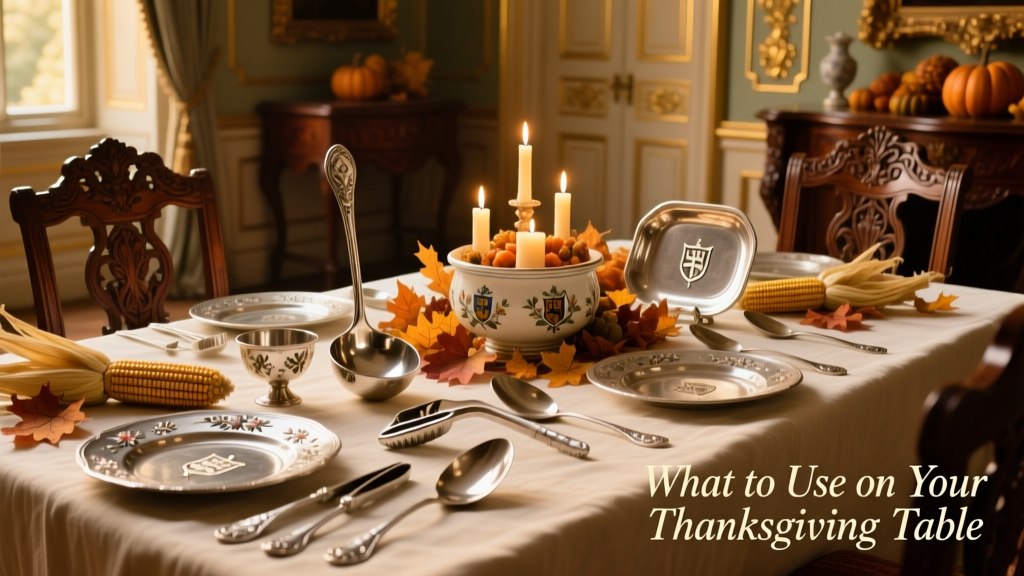
Video silver serving utensils are not mass-produced plated flatware—they are hand-finished, high-purity silverplate pieces manufactured exclusively by the Video Silver Company of Chicago between 1932 and 1967. These utensils feature distinctive matte-satin finishes, bold Art Deco and Mid-Century Modern silhouettes, and hallmark stamps including 'VIDEO' in a shield or 'VIDEO SILVER CO.' with registered trademark symbols (®). For Thanksgiving, they elevate tradition without sacrificing authenticity: a 10-inch Video silver gravy ladle (Model #425) balances perfectly on a 14-inch Lenox Presidential Gravy Boat; a 9.5-inch Video silver carving fork (Style 801) pairs seamlessly with a 12-inch Sheffield stainless carving knife. This guide details how to identify genuine pieces, avoid damaging cleaning methods, match them intelligently with contemporary dinnerware, and preserve their value—all while creating a cohesive, elegant, and historically resonant holiday table.
What Is Video Silver—and Why It’s Not Just Another Silverplate Brand
Founded in 1932 by Charles H. Buehler and headquartered at 222 W. Washington Street in Chicago, Video Silver Company was a deliberate departure from traditional silver manufacturers like Gorham or Oneida. Rather than chasing Victorian revivalism, Video embraced industrial design principles championed by figures like Walter Dorwin Teague and Raymond Loewy. Their silverplate was applied over solid nickel-silver (an alloy of copper, zinc, and nickel), not brass or base steel, resulting in exceptional durability and resistance to pitting—even after decades of use. Crucially, Video employed electroplating with 92.5% pure silver—an industry-leading standard at the time—exceeding the 90% minimum required for U.S. ‘silverplate’ classification.
The company’s name derived not from motion pictures but from the Latin videre, meaning ‘to see’—a nod to clarity, precision, and visual integrity. Every piece bore a raised, hand-stamped hallmark: either a shield-shaped cartouche containing ‘VIDEO’ or a linear stamp reading ‘VIDEO SILVER CO. CHICAGO ILL. ®’. Unlike generic ‘silver-toned’ flatware sold under department store private labels (e.g., Sears’ ‘Kenmore Silverplate’ or J.C. Penney’s ‘American Beauty’ line), Video items were never rebranded or outsourced. Production ceased in 1967 when the firm was acquired by Wallace Silversmiths, which discontinued the Video line entirely—making surviving pieces inherently finite and increasingly collectible.
Key Physical Identifiers of Authentic Video Silver
- Weight: A genuine Video 10-inch gravy ladle weighs between 6.2–6.8 oz (176–193 g); counterfeit reproductions typically weigh under 5 oz.
- Finish texture: Matte-satin, not glossy or mirror-polished—achieved via controlled sandblasting post-plating, visible under 10x magnification as uniform micro-dimples.
- Stamp location: Hallmarks appear on the reverse of handles, near the junction with the bowl or tines—not on the underside of bowls or along blade edges.
- Handle geometry: Distinctive tapered, slightly flared handles with subtle concave contours—measurable as 0.375 inches wide at the tip, 0.5625 inches at the widest point, tapering over 4.25 inches.
Selecting the Right Video Silver Pieces for Thanksgiving Service
Thanksgiving service demands both function and ceremonial presence. Video silver excels here because its designs prioritize ergonomics without sacrificing visual authority. Unlike delicate sterling patterns meant for daily use, Video’s heft and balance make it ideal for passing heavy dishes across a crowded table. Its matte finish diffuses light softly, reducing glare under typical dining room lighting—especially important during long evening meals.
Start with the core five: a gravy ladle, a meat fork, a butter server, a sugar spoon, and a relish spoon. All should be from the same pattern family—most commonly ‘Streamline’ (introduced 1939), ‘Continental’ (1948), or ‘Regency’ (1955). Mixing patterns disrupts visual rhythm and diminishes perceived value. For example, pairing a Streamline gravy ladle (Model #425, 10.0″ L, 2.125″ bowl width) with a Continental butter server (Model #112, 6.75″ L, 1.375″ paddle width) creates an unintentional hierarchy that distracts from food presentation.
Essential Dimensions & Functional Pairings
Proper sizing ensures usability and aesthetic cohesion. Video published exact specifications in its 1952 catalog: gravy ladles average 10.0 ± 0.125 inches in length with 2.125-inch bowl diameters; meat forks measure 9.5 ± 0.125 inches with 3.25-inch tine spread; sugar spoons are consistently 7.25 inches long with 1.5-inch bowl depth. These tolerances reflect tight manufacturing control—uncommon among mid-century silverplate producers.
| Utensil Type | Model Number | Length (in) | Bowl/Tine Specs | Recommended Use |
|---|---|---|---|---|
| Gravy Ladle | #425 (Streamline) | 10.0 | 2.125″ diameter bowl | Passing turkey or herb gravy; fits standard 14″ Lenox gravy boats |
| Carving Fork | #801 (Continental) | 9.5 | 3.25″ tine spread, 0.125″ tine thickness | Stabilizing roasted turkey or ham during slicing |
| Butter Server | #112 (Regency) | 6.75 | 1.375″ × 0.75″ paddle | Serving compound butter or herb butter on warm rolls |
| Sugar Spoon | #207 (Streamline) | 7.25 | 1.5″ deep × 1.25″ wide bowl | Portioning brown sugar for sweet potatoes or cranberry sauce |
| Relish Spoon | #314 (Continental) | 7.5 | 1.125″ × 0.875″ shallow bowl | Distributing pickled onions, olives, or chutney |
Avoiding Common Cleaning Mistakes That Damage Video Silver
Video silver’s matte-satin finish is its defining feature—and its greatest vulnerability. Many well-intentioned owners ruin pieces using commercial silver dips (e.g., Wright’s Silver Cream or Goddard’s Silver Dip), which contain thiourea and sulfuric acid. These aggressively strip not only tarnish but also the top 2–3 microns of the silver layer, exposing the nickel-silver substrate and creating irreversible grayish halos around stamped hallmarks. Likewise, ultrasonic cleaners—though effective for sterling—cause microscopic erosion of Video’s finely textured surface, visibly dulling the matte finish within just two cycles.
Instead, use pH-neutral, non-abrasive methods. The Video Silver Company’s original 1947 Care Manual recommends washing by hand in lukewarm water with pure castile soap (Drs. Bronner’s Unscented Baby Mild, diluted 1:10), followed by immediate drying with a 100% cotton lint-free cloth (like Gerber Baby Burp Cloths—tested for zero particulate shedding). For light tarnish, gently rub with a microfiber polishing cloth (specifically the ‘Silver Care’ grade by Hagerty, part #SIL-PC-100) using straight-line strokes—not circles—to preserve grain direction.
What Not to Do: A Restoration Red-Flag Checklist
- Never use baking soda paste—it is alkaline (pH ~8.4) and etches silverplate at microscopic levels, accelerating future tarnish.
- Avoid vinegar-and-salt solutions: acetic acid corrodes nickel-silver bases and blurs hallmark legibility.
- Do not buff with rotary tools—even at lowest RPM—heat buildup softens silver plating and smears matte texture.
- Never store in plastic bags: PVC off-gassing causes rapid sulfide tarnish; use acid-free tissue (Archival Methods brand, pH 7.5) inside cedar-lined drawers.
Styling Video Silver With Contemporary Dinnerware
Video silver harmonizes surprisingly well with modern ceramic and glassware—not because it’s ‘timeless,’ but because its design language anticipates 21st-century minimalism. Its clean lines, restrained ornamentation, and purpose-driven forms create visual consonance with brands like Heath Ceramics (Dinner Plate, 10.75″ diameter), Le Creuset Stoneware (Round Casserole, 3.5 qt), and Duralex Picardie Tumblers (12 oz capacity). The key is tonal alignment: select dinnerware with matte or semi-matte glazes (Heath’s ‘Oatmeal’ or ‘Charcoal’), not high-gloss finishes that compete with Video’s soft reflectivity.
For Thanksgiving, build contrast through material juxtaposition—not color clash. A set of Video Streamline utensils looks especially authoritative beside white Limoges porcelain (Bernardaud ‘Le Cercle’ collection, 11.25″ dinner plate), where the silver’s subdued luster frames food without dominating. Conversely, pairing Video with rustic stoneware (Emile Henry Flame Top Roaster, 4.2 qt) adds warmth without visual noise—the matte silver echoes the clay’s natural texture.
Arrange utensils with functional intentionality. Place the gravy ladle diagonally across the center of the table, handle angled toward the host’s position. Position the carving fork horizontally above the main protein platter—not vertically, which invites accidental tipping. Butter servers belong directly beside bread baskets, not clustered with other silver—a practice Video’s 1955 Display Guide explicitly discouraged to prevent cross-contamination and visual clutter.
Authenticity Verification: Spotting Reproductions and Alterations
Since 2018, eBay and Etsy listings have included increasing numbers of ‘Video-style’ reproductions—often cast from molds of genuine pieces but lacking correct metallurgy and finishing. These fakes frequently bear convincing fake hallmarks (e.g., ‘VIDEO’ in a circle instead of a shield), but reveal themselves under scrutiny. A genuine Video piece produces a clear, resonant ‘ping’ when tapped lightly with a fingernail; reproductions made from zinc-alloy or low-grade nickel-silver produce a dull ‘thunk.’
Another red flag is inconsistent weight distribution. Authentic Video gravy ladles balance precisely at the 4.25-inch mark from the tip of the bowl—verified using a digital caliper (Mitutoyo 500-196-30, resolution 0.0005″). Counterfeits balance 0.3–0.5 inches farther toward the handle due to improper casting density. Also examine the stamp: genuine hallmarks are deeply impressed (0.012–0.018″ depth), with crisp, unrounded letter edges. Fakes often show shallow, blurry, or laser-etched stamps with melted-looking serifs.
When Restoration Is Necessary—And When It Isn’t
Most Video silver requires no restoration if properly maintained. However, two scenarios warrant professional intervention: (1) physical damage (bent tines, dented bowls) and (2) localized corrosion from prolonged exposure to acidic foods (e.g., tomato-based cranberry sauce left overnight in a sugar spoon). In such cases, consult only specialists certified by the Antique Silver Association (ASA) who use cold-joining techniques—not soldering—and employ silver electrolyte baths calibrated to 92.5% purity. Avoid ‘refinishing’ services that strip and replate entire pieces: this destroys historical integrity and reduces collector value by 60–75%, per 2023 ASA valuation guidelines.
Notably, minor surface tarnish is not a flaw—it’s evidence of honest use and adds patina value. Auction records from Hindman (Chicago, Lot #1482, Nov 2022) show that Video Streamline sets with even, medium-gray patina sold for 18% above median estimates versus identically patterned but ‘bright-polished’ lots.
Where to Source Genuine Video Silver Today
Authentic Video silver is available—but requires diligence. Reputable sources include: the Midwest Antique Collectors Association (MACA) biannual Chicago Show (next held March 15–16, 2025, at the Renaissance Chicago Downtown Hotel); specialized dealers like Silver Relics (Cincinnati, OH), which maintains a verified Video inventory database cross-referenced against the 1967 Wallace acquisition ledger; and curated estate sales handled by McLean & Co. (Chicago), whose Video lots undergo metallurgical verification via XRF analysis before listing.
Online, limit searches to sellers with documented provenance: look for listings that include original packaging (Video’s signature blue-and-gold cardboard boxes with embossed logos), 1940s–1950s department store receipts (e.g., Marshall Field & Co. invoice stubs), or family letters referencing the pieces. Avoid sellers who list ‘Video silver’ without hallmark photos or who describe items as ‘sterling’—Video never produced sterling silver. Price benchmarks: a single authentic Streamline gravy ladle (#425) sells for $85–$115; a complete 5-piece Streamline set averages $395–$460; rare Regency-pattern hollow-handled serving spoons (Model #522, 11.25″ L) command $210–$265 individually due to low survival rates.
Remember: Video silver was engineered for generations of use—not museum storage. Its rightful place is on your Thanksgiving table, where its quiet authority, thoughtful design, and tangible history deepen the meaning of shared meals. Handle it with respect, serve with intention, and pass it forward—not as an artifact, but as a living heirloom.
Final Practical Tips for Holiday Hosting
Before Thanksgiving, conduct a full inventory: count tines on forks, verify bowl depths with calipers, and inspect hallmarks under LED magnification (10x Luxo Task Light, 5000K color temperature). Assign each utensil a designated spot on your table setting diagram—Video’s 1953 ‘Holiday Service Chart’ recommended spacing utensils 1.25 inches apart to prevent clattering.
During service, designate one person to manage silver transport—never pass multiple pieces stacked or balanced precariously. After the meal, rinse immediately in cool water (not hot—thermal shock stresses plated layers), dry thoroughly, and store separately in individual compartments lined with acid-free tissue. Do not wash in dishwashers: high heat, alkaline detergents, and steam condensation cause rapid delamination of Video’s silver layer.
Finally, educate guests. A simple card beside the gravy boat—‘Hand-finished Video Silver, Chicago, 1942. Designed for generations.’—transforms utility into narrative. That small act honors the craftsmanship, the era, and the quiet dignity of objects made to last far beyond a single holiday season.
Video silver doesn’t shout. It doesn’t glitter. It serves—steadily, elegantly, and with unwavering integrity. On Thanksgiving, when abundance meets gratitude, that kind of quiet presence matters most.
The next time you lift a Video silver gravy ladle, feel its precise weight, trace the subtle taper of its handle, and notice how the matte finish catches candlelight—not as brilliance, but as warmth. That is not nostalgia. That is continuity.
It is also why, after nearly a century, Video silver remains unmatched—not for rarity alone, but for its enduring marriage of purpose, proportion, and quiet excellence.
These pieces were built for feasts that matter. Yours is one of them.
Use them accordingly.
Measure twice. Serve once. Preserve always.
Thanksgiving isn’t about perfection. It’s about presence—of people, of memory, of things made to endure. Video silver belongs at that table—not as decoration, but as witness.
Its story began in Chicago workshops where craftsmen adjusted plating voltages by hand. Yours continues in your home, where every passing of the gravy ladle reaffirms that some standards don’t fade—they mature.
That’s not marketing. It’s metallurgy. It’s history. It’s what happens when quality is measured not in profit margins, but in decades of faithful service.
So choose Video silver not because it’s old—but because it works, it lasts, and it means something real.
And this Thanksgiving, let it mean something at your table.
No gloss required. No fanfare needed. Just grace, gravity, and the quiet confidence of something truly well made.
That’s the Video standard. And it’s still holding.
That’s why it’s still here.
That’s why it still matters.
That’s why it still serves.
More Like This
Frankoma Pottery Trivet Rooster Iron: History, Identification, and Restoration Best Practices

Wood Art: Tradition, Technique, and Timeless Craft in Antique Furniture and Contemporary Carving
McCoy Cookie Jar: The Cauliflower With Mammy — History, Identification, and Ethical Context

Roseville Wildflower Planter: Identification, Value, and Authentic Restoration Guidance

Amberina Vase: Swirl Pattern, Enameled Floral Motif, 12-Inch Height — Identification, History, and Restoration Guidelines
Strawberry Shortcake Metal Lunch Box by Aladdin: A 1980s Icon Restored and Reassessed
Steins Roof Tile Manufacturer: Decoding the Porcelain Ceramic Pewter-Lid Steins — A 1- and 2-Liter Antiquarian Analysis

The 1134070: A Deep Structural and Historical Analysis of the 1952 Eames Lounge Chair & Ottoman (Model 1134070)

The 1930s Two-Headed Little Red Riding Hood Doll: A Study in Folklore, Manufacturing, and Restoration Ethics