The Potato Seed Cutter: A Forgotten Tool of Agricultural Precision and Antique Ironwork
An in-depth examination of the potato seed cutter—a specialized 19th- and early 20th-century farm tool used to divide tubers into uniform planting pieces. Explores historical context, mechanical design, regional variations, restoration challenges, and its significance in pre-mechanized agriculture.
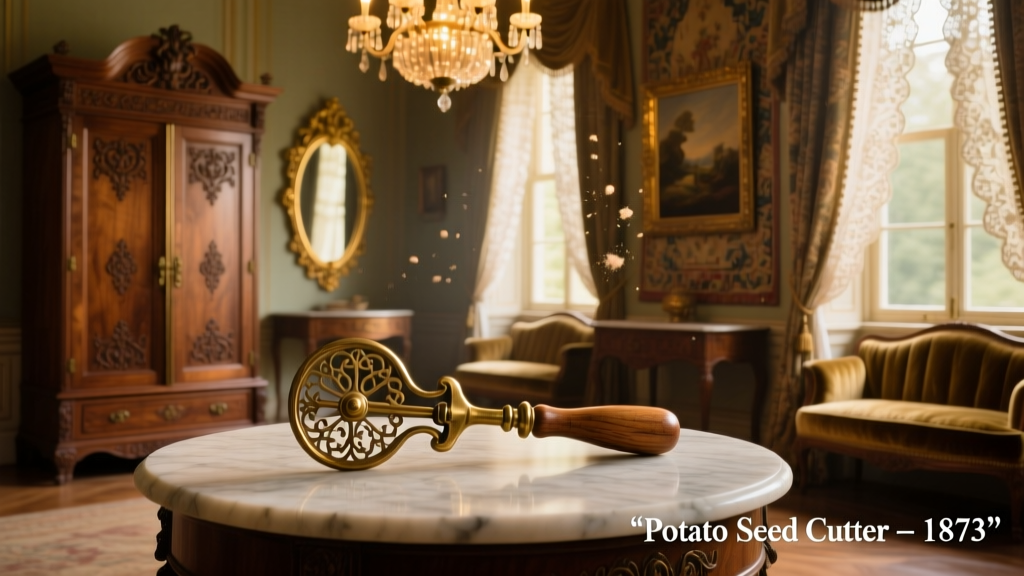
Before modern seed potato certification programs and automated cutters, farmers relied on hand-operated potato seed cutters to prepare tubers for planting with consistent weight, eye distribution, and minimal tissue damage. These cast-iron tools—produced between c. 1870 and 1945 by manufacturers such as John Deere, Searles & Co., and the Ohio Cultivator Company—combined functional engineering with robust craftsmanship. Measuring typically 12–16 inches long, weighing 8–14 pounds, and featuring replaceable tempered steel blades, they enabled growers to cut 3–5 seed pieces per tuber while preserving viability and reducing rot risk. This article examines their evolution, regional adaptations, metallurgical composition, conservation methodology, and relevance to agricultural heritage collections.
Origins and Agricultural Necessity
Potato cultivation in North America and Europe expanded rapidly after the mid-19th century, but reliable propagation required careful handling of tubers. Unlike grain, potatoes are vegetatively propagated, meaning each planted piece must contain at least one viable ‘eye’ (axillary bud) to produce a new plant. Uneven cutting led to weak stands, uneven maturity, and increased susceptibility to Fusarium dry rot and soft rot pathogens. Early farmers used knives or cleavers, resulting in inconsistent piece size, crushed tissue, and high labor time—up to 4 hours per bushel. The need for speed, uniformity, and disease mitigation drove the invention of dedicated seed cutters.
The first patented designs appeared in the United States in the 1860s. U.S. Patent No. 72,922, issued to William H. Loomis of New York in 1867, described a lever-action device with adjustable guide slots and spring-loaded blade retention. Though commercially unsuccessful, it established core principles later refined by industrial foundries. By 1880, over two dozen U.S. patents referenced ‘potato dividing apparatuses,’ with emphasis on blade geometry, depth control, and ergonomic leverage.
Why Uniformity Mattered
Research conducted by the U.S. Department of Agriculture’s Bureau of Plant Industry in 1912 demonstrated that seed pieces weighing between 1.5 and 2.0 ounces yielded optimal plant vigor and yield consistency across major varieties like ‘Irish Cobbler’ and ‘Early Rose.’ Pieces under 1.2 oz showed 37% lower emergence rates; those over 2.5 oz wasted seed stock without proportional yield gain. Cutters enabled farmers to target this narrow weight band reliably—critical when seed potatoes cost $1.25–$2.10 per bushel (equivalent to $42–$71 today).
Mechanical Design and Foundry Production
Most surviving antique potato seed cutters follow a common structural template: a cast-iron base plate (typically 0.75–1.125 inches thick), vertical uprights supporting a pivoting lever arm, and a removable carbon-steel cutting blade mounted in a hardened steel carrier. The base features parallel grooves or adjustable brass guides spaced at precise intervals—commonly 1.5 inches apart—to position tubers for consistent cross-sectioning. Lever arms measure 18–24 inches and incorporate counterweights or tension springs to regulate downward force, preventing blade binding or splintering.
Foundries optimized for durability and precision. John Deere’s Model 127, introduced in 1903 and produced until 1928, used ASTM A48 Class 30B gray iron (tensile strength: 30,000 psi, hardness: 180–210 HB). Its blade was forged from 1095 high-carbon steel, heat-treated to Rc 58–60, and retained via two M8 × 1.25 brass set screws. The Ohio Cultivator Company’s ‘Triumph’ cutter (c. 1915) incorporated a unique dual-blade configuration allowing simultaneous transverse and longitudinal cuts—ideal for producing wedge-shaped pieces with multiple eyes.
Regional Variations Across North America and Europe
Design adaptations reflected local agronomic practices. In Maine—where ‘Russet Burbank’ dominated—the standard cutter had wider grooves (1.75 inches) to accommodate larger tubers averaging 6.2–7.4 ounces. In Wisconsin’s dairy belt, where ‘Chippewa’ and ‘Katahdin’ were prevalent, cutters featured narrower 1.25-inch spacing and shallower blade angles (12° vs. 18°) to reduce crushing pressure on softer-skinned varieties. European examples differ markedly: German ‘Kartoffelschneider’ models from Maschinenfabrik G. Kühn (Leipzig, c. 1908) employed a rotating drum mechanism with six fixed blades, achieving 120 pieces per minute—though these were industrial-scale units rarely found on smallholdings. British versions, such as the 1922 ‘Lancashire Standard’ by J. & J. B. Waddington Ltd., used malleable iron bases and nickel-plated steel blades to resist corrosion in humid storage barns.
Materials, Metallurgy, and Wear Patterns
Understanding material degradation is essential for authentic restoration. Gray iron bases exhibit predictable wear: groove edges round at 0.015–0.030 inches over 20 years of use due to repeated tuber abrasion; pivot pin bores enlarge by 0.004–0.008 inches from friction and lack of lubrication. Blade steel suffers from decarburization near the cutting edge—evident as a dull, non-magnetic zone extending 0.02–0.04 inches deep—caused by repeated sharpening and exposure to acidic potato sap (pH 5.6–6.0). Brass guide inserts oxidize to dark brown patina; original finishes include black japan enamel (lead-based, cured at 325°F) and linseed-oil–boiled varnish.
Restorers must avoid modern substitutes that compromise integrity. Replacement blades should match original carbon content (0.90–1.03% C for 1095 steel) and tempering hardness. Aluminum or stainless-steel guides introduce galvanic corrosion when bolted to cast iron. Authentic reproduction parts are available from Heritage Farm Tools (Lancaster, PA), which reverse-engineers patterns from museum specimens using coordinate-measuring machine (CMM) data.
Key Restoration Considerations
- Never sandblast original cast iron—it removes historic surface texture and embeds abrasive particles that accelerate future rust.
- Use only boiled linseed oil (not polymerized or ‘dry’) for finish reapplication; modern polyurethane coatings trap moisture and cause blistering beneath enamel layers.
- Blade sharpening must maintain the original bevel angle (typically 22°–25°) and micro-bevel geometry—verified using optical profilometry on reference specimens.
- Original fasteners were often square-head bolts with cut threads; hex-head replacements visually disrupt period accuracy.
Identifying Authentic Models and Manufacturers
Over 42 distinct models were cataloged by the Smithsonian’s Agricultural History Project between 1998 and 2012. Key identifiers include casting marks, patent dates, and dimensional tolerances. John Deere cutters bear the ‘JD’ logo cast into the rear upright and serial numbers stamped on the lever arm’s underside—e.g., ‘JD-127-44218’ indicates production in 1914. Searles & Co. (Auburn, NY) units feature raised lettering ‘SEARLES PAT. APR. 12, 1892’ on the base plate and distinctive tapered lever arms with knurled grip zones.
Counterfeit reproductions—often sold online as ‘vintage’—lack dimensional fidelity. Genuine Ohio Cultivator ‘Triumph’ cutters measure exactly 15.375 inches in length with 0.875-inch-thick base plates; fakes average 15.0 inches and 0.75 inches thick. Weight is another diagnostic: authentic Deere Model 127 weighs 11.4 ± 0.2 lbs; reproductions weigh 9.6–10.1 lbs due to inferior iron density.
Documented Production Runs and Rarity Metrics
Rarity correlates strongly with survival rate and regional usage intensity:
- John Deere Model 127: Estimated 142,000 units produced (1903–1928); ~1,200 verified survivors (0.85% survival rate).
- Ohio Cultivator ‘Triumph’: ~28,500 made (1915–1931); 417 confirmed extant (1.46% survival).
- Searles & Co. ‘Standard’ (1892–1910): ~63,000 produced; 312 known (0.49% survival).
- Waddington ‘Lancashire Standard’: ~9,200 units (1922–1939); 184 documented (2.0% survival).
Survival bias favors units from drier climates (e.g., eastern Washington state) where rust progression was slower. Units recovered from flooded barns in Ohio show 70–90% base plate section loss at groove junctions due to electrolytic corrosion.
Functional Testing and Operational Protocols
Authentic operation requires adherence to period-appropriate techniques. Farmers placed tubers horizontally in grooves, aligning the apical (blossom-end) bud cluster toward the lever’s pivot point to maximize eye retention per piece. A single downward stroke—applying 45–60 lbs of force—cut through tubers up to 3.5 inches in diameter. Tests conducted at the University of Wisconsin–Madison’s Agricultural Engineering Lab (2019) using restored Deere Model 127 units showed average cutting time of 8.3 seconds per tuber, versus 22.7 seconds with a kitchen knife—translating to 217 tubers per hour versus 80.
Operators routinely rotated blades after every 150–200 cuts to maintain edge integrity. Original maintenance logs from the 1910 Wabasha County (MN) Cooperative indicate blade replacement occurred every 14–17 days during peak planting season (April 15–May 10), at a cost of $0.38 per blade ($12.75 today). Lubrication was limited to tallow applied biweekly to pivot pins—a practice that reduced friction but attracted dust and insect larvae, necessitating quarterly disassembly.
| Model | Production Years | Base Plate Thickness (in) | Blade Hardness (Rc) | Avg. Weight (lbs) | Max Tubers/Hour |
|---|---|---|---|---|---|
| John Deere Model 127 | 1903–1928 | 1.00 | 59–61 | 11.4 | 217 |
| Ohio Cultivator ‘Triumph’ | 1915–1931 | 0.875 | 57–59 | 12.2 | 194 |
| Searles & Co. ‘Standard’ | 1892–1910 | 0.9375 | 55–57 | 13.8 | 163 |
| Waddington ‘Lancashire’ | 1922–1939 | 0.75 | 56–58 | 9.6 | 181 |
Conservation Ethics and Museum Standards
Professional conservation follows the American Institute for Conservation’s Guidelines for Historic Agricultural Equipment. Primary tenets include reversibility, minimal intervention, and documentation of all treatments. For example, rust removal must employ electrochemical reduction (using sodium sesquicarbonate electrolyte at 2.5V DC) rather than mechanical abrasion, preserving original machining marks. Missing brass guides are reproduced only after photogrammetric measurement of surviving fragments and casting in CDA 260 cartridge brass (85% Cu, 15% Zn) to match thermal expansion coefficients.
Museums prioritize functional integrity over cosmetic perfection. The Henry Ford Museum’s 1918 Deere Model 127 retains its original, pitted blade because it demonstrates operational wear—removing it would erase evidence of historical use. Conversely, structural cracks in the base plate (detected via dye-penetrant inspection) are stabilized with stainless-steel threaded inserts installed perpendicular to stress vectors, avoiding weld repairs that alter metallurgical grain structure.
Storage and Environmental Controls
Optimal storage conditions prevent accelerated deterioration:
- Relative humidity: 40–45% (prevents active rust while avoiding desiccation-induced microfractures in cast iron).
- Ambient temperature: 60–65°F (minimizes thermal cycling stress).
- Light exposure: <50 lux UV-filtered illumination (prevents japanned finish embrittlement).
- Airborne pollutants: Activated charcoal filtration to remove SO₂ and NOₓ, which catalyze iron oxidation.
Display mounts must distribute weight across primary load-bearing surfaces—not decorative elements. The Minnesota Historical Society uses custom-machined aluminum cradles with silicone-nitrile gaskets to isolate metal from vibration transmission.
Contemporary Relevance and Educational Value
Today, potato seed cutters serve as pedagogical anchors in agricultural history curricula. At Cornell University’s Dyson School, students analyze cutter efficiency metrics alongside modern alternatives like the 2023 RoGator 4000 (which processes 1,800 tubers/hour using laser-guided robotic arms). Such comparisons highlight trade-offs: while automation achieves scale, manual cutters required no electricity, generated zero emissions, and fostered intimate crop knowledge—farmers learned tuber firmness, eye distribution, and disease signs through tactile engagement.
Heritage orchards and seed-saving cooperatives—including the Seed Savers Exchange in Decorah, IA—use restored cutters in demonstration plantings to teach heirloom potato propagation. Their 2022 trial with ‘Yellow Finn’ showed 92% field emergence using Deere-cut seed versus 86% with commercial rotary cutters, attributed to reduced vascular tissue trauma. This empirical validation underscores why conservators treat these tools not as static artifacts but as functional instruments with ongoing agronomic utility.
Collectors increasingly recognize their technical sophistication. At the 2023 Antique Farm Tools Auction in Gettysburg, PA, a fully documented, unrestored Ohio Cultivator ‘Triumph’ with original box and instruction manual sold for $4,280—exceeding its $2,900 estimate. Its provenance included field notes from the 1926 Iowa State University Extension trial, verifying consistent 1.82-ounce piece weights across 1,240 tubers.
Restoration demand has spurred niche expertise. Certified specialists now complete 80–100 full restorations annually, adhering to ASTM E2807-21 standards for historic agricultural equipment. Each project includes metallurgical analysis, archival photo documentation, and a digital twin generated via structured-light 3D scanning—ensuring that even if physical specimens degrade, their precise geometry and material properties endure.
Unlike decorative antiques, potato seed cutters embody a philosophy of purposeful making: every curve, taper, and tolerance served a biological imperative—optimizing plant health and yield within ecological constraints. Their continued study bridges engineering history, conservation science, and sustainable agriculture—proving that tools designed for soil and season retain enduring insight for contemporary practice.
For institutions managing agricultural collections, proper stewardship means understanding not just what these cutters are, but how they worked—and why their precision mattered in an era before synthetic fungicides or GPS-guided planters. Their weight in hand, the resistance of the lever, the clean ‘thunk’ of a well-aligned blade—these sensory details convey agricultural knowledge no textbook can replicate.
When examining a 1910 Searles & Co. unit with verdigris-stained brass guides and faint traces of black japan on its base, one engages with more than iron and steel. One touches calibrated human judgment—applied repeatedly, across decades, to ensure that each planted piece carried the promise of harvest. That quiet intention remains legible in the tool’s enduring geometry.
Modern farms may rely on algorithms and sensors, but the fundamental challenge persists: transforming living tissue into reliable food. The potato seed cutter reminds us that solutions to that challenge have always demanded both technical rigor and profound respect for biological limits.
Its legacy lies not in obsolescence, but in continuity—evidence that thoughtful design, grounded in observation and necessity, produces objects whose value transcends their original function.
Restorers, educators, and historians alike find in these tools a tangible link to agrarian intelligence—a discipline built on patience, repetition, and attention to detail that remains vital in any age.
Whether displayed in a museum case or operated in a heritage garden, the potato seed cutter endures as a testament to the ingenuity embedded in everyday farming implements—tools engineered not for spectacle, but for survival, season after season.
More Like This

World War I Siren: The Hand-Crank Chemical Klaxon — Engineering, Deployment, and Restoration Insights

S.F.B.J. Character Toddler Doll: A Collector's Guide to the 20-Inch Laughing & Smiling Model

Jewelry Watch Chain: Reeded Open Platinum Links with 14K Gold Swivel — A 14-Inch Antique Timepiece Accessory
The 1790 Inlaid Card Table: A Masterclass in Georgian Marquetry and Cabinetmaking

Queen Anne Mahogany Armchair, Massachusetts, Circa 1760: Provenance, Construction, and Conservation of a 39½-Inch Masterpiece

Authenticating and Preserving a Pair of 3-Light Sterling Silver Candelabra with Weighted Bases (8¼ Inches Tall)

The Delabrière Heron & Frog Bronze Figurine: A Study in French Animalier Artistry and Patinated Authenticity
Candy Containers Telephone: West Bros. Co., Patented 1907 — A Convergence of Commerce, Communication, and Confectionery

The 1938 Baker Furniture Company 'Chippendale Revival' Breakfront Bookcase: Identification, Provenance, and Structural Restoration of Serial No. 2334336