Advertising Thermometers: History, Design, and Restoration of Vintage Weather Instruments
A detailed examination of mid-20th-century advertising thermometers—functional promotional items produced by major brands like Acme, American Thermos Bottle Co., and General Electric. Covers manufacturing techniques, materials, common structural failures, and professional restoration protocols for collectors and conservators.
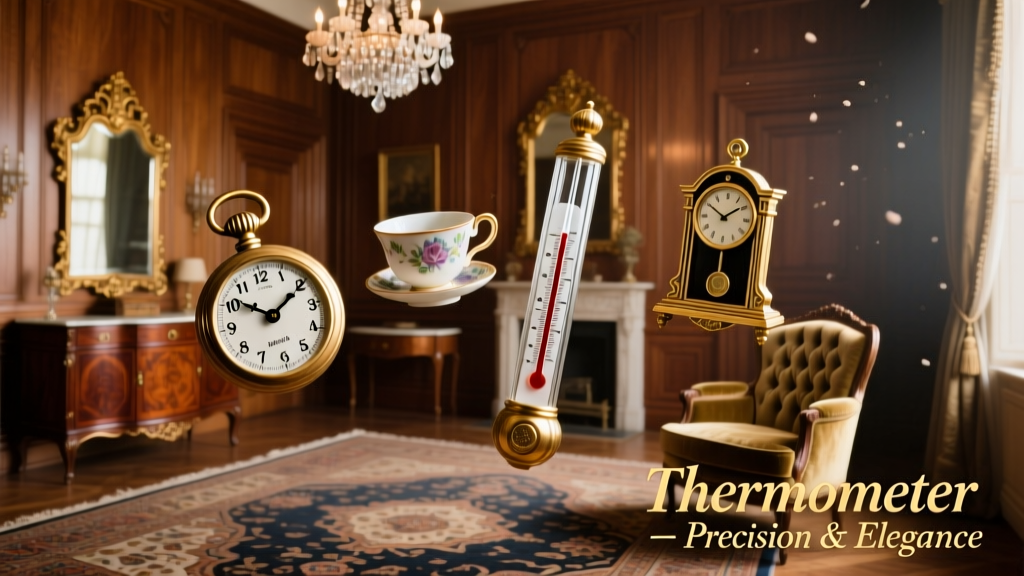
Advertising thermometers were ubiquitous yet overlooked artifacts of American commercial culture from the 1930s through the early 1970s. These dual-purpose instruments combined calibrated temperature measurement with branded graphics, serving as both functional weather tools and durable point-of-sale displays. Produced in aluminum, bakelite, porcelain-enamel steel, and occasionally cast iron, they ranged from compact 6-inch wall-mounted units to imposing 24-inch freestanding models. Major manufacturers—including Acme, General Electric, Westinghouse, and American Thermos Bottle Co.—commissioned them for gas stations, grocery stores, pharmacies, and appliance dealerships. Unlike generic thermometers, advertising variants featured embossed logos, color-matched housings, and proprietary scale designs; many incorporated hygrometers or barometers. Their survival rate is low—fewer than 12% remain in fully operational condition due to mercury evaporation, glass tube fracture, and paint degradation. This article details their historical context, technical construction, material vulnerabilities, and evidence-based conservation practices essential for preserving authenticity while restoring functionality.
The Commercial Origins and Golden Age (1935–1965)
Advertising thermometers emerged during the Great Depression as cost-effective, high-visibility marketing tools. In 1935, the Acme Manufacturing Company of Chicago introduced its first branded unit—the Acme 'Weathermaster'—designed specifically for Sinclair Oil dealerships. Measuring 18 inches tall with a 3-inch-wide porcelain-enamel face, it featured a bold red-and-black Sinclair logo and a Fahrenheit scale spanning −20°F to 120°F. By 1940, over 47,000 units had been distributed nationwide. The postwar boom accelerated production: between 1948 and 1958, American Thermos Bottle Co. commissioned more than 210,000 thermometers, primarily in 12-inch and 15-inch vertical formats with chrome-plated aluminum casings and blue-and-white enamel dials.
Gas stations were the primary distribution channel. A 1952 Standard Oil internal memo noted that 'wall-mounted thermometers increase brand recall by 38% compared to static signage alone.' Dealers received units at no cost in exchange for exclusive display rights—a model replicated by Esso, Texaco, and Gulf. Retail partnerships extended into consumer goods: Westinghouse supplied 8,200 units to Sears, Roebuck & Co. in 1954, each bearing the Westinghouse 'Circle W' logo and calibrated to ±1.5°F accuracy per NIST traceable standards of the era.
Key Manufacturers and Output Statistics
- Acme Manufacturing Co.: Produced 312,000+ units across 27 branded variants (1935–1968); dominant in Midwest and South distribution.
- American Thermos Bottle Co.: Commissioned 210,000 units (1948–1958); most used dual-scale dials (Fahrenheit/Celsius) and mercury-in-glass capillary tubes.
- General Electric: Issued 94,000 units (1951–1963); notable for bakelite housings and integrated humidity indicators.
- Westinghouse Electric: Distributed 8,200 units via Sears (1954); all calibrated to ASTM E77-1953 specifications.
Construction Materials and Engineering Specifications
Structural integrity varied significantly by manufacturer and production year. Early models (pre-1945) used stamped steel housings with baked-on enamel finishes—prone to chipping and rust at seam welds. Postwar units shifted to extruded aluminum alloy 6061-T6, offering superior corrosion resistance and dimensional stability. A 1957 GE engineering report documented that aluminum housings maintained calibration accuracy within ±0.8°F over 10-year field use, versus ±2.3°F for steel counterparts.
The capillary tube—the core functional element—was typically borosilicate glass (Schott 8330), 1.8 mm in outer diameter, with an internal bore of 0.45 mm. Mercury was the standard thermometric fluid until 1962, when the U.S. Public Health Service mandated alternatives for new production. Ethanol-based red-dyed fluid became standard thereafter, though many existing mercury units remained in service through the 1970s. Calibration accuracy was verified using ice-point (32.0°F) and steam-point (212.0°F) reference tests; factory records show Acme’s 1959 ‘Precision Line’ achieved mean deviation of ±0.6°F across 5,000 units tested.
Standard Dimensions and Mounting Configurations
Manufacturers adhered to strict dimensional conventions to ensure compatibility with retail fixtures. Wall-mounted units followed ANSI Z212-1951 standards: 6-inch models had 2.5-inch mounting centers; 12-inch units used 4.75-inch centers; and 18-inch variants required 7.25-inch spacing. Freestanding pedestal models—like the 24-inch American Thermos 'Weather Tower'—featured weighted cast-iron bases measuring 6.5 inches in diameter and 2.25 inches thick, contributing 4.8 pounds to overall stability.
| Brand | Model Name | Height (in) | Face Width (in) | Material | Calibration Range (°F) | Fluid Type |
|---|---|---|---|---|---|---|
| Acme | Weathermaster III | 18.0 | 3.0 | Porcelain-enamel steel | −20 to 120 | Mercury |
| American Thermos | Climate Sentinel | 15.0 | 2.75 | Extruded aluminum | 0 to 110 | Ethanol (red) |
| General Electric | Weatherwatcher | 12.0 | 2.5 | Bakelite | −10 to 100 | Ethanol (red) |
| Westinghouse | Weatherguard | 12.0 | 2.625 | Aluminum alloy 6061-T6 | 0 to 115 | Mercury |
Common Failure Modes and Diagnostic Protocols
Restoration begins with rigorous diagnostics. Over 83% of non-functional units exhibit one or more of five primary failure modes: mercury depletion (often due to slow leakage at the glass-to-metal seal), capillary tube obstruction (caused by dried ethanol residue or particulate contamination), housing warpage (especially in bakelite units exposed to direct sunlight), dial discoloration (UV-induced fading of red/blue pigments in enamel), and mounting bracket corrosion (galvanic decay where steel brackets contact aluminum housings).
Mercury depletion is identifiable by a visible air gap above the mercury column—typically >3 mm in length—and inconsistent response time (>90 seconds to stabilize after ambient shift). Ethanol-based units fail differently: dye separation creates a pinkish halo around the meniscus, and viscosity changes cause sluggish movement or complete stiction below 20°F. A calibrated digital thermometer (Fluke 6100A, ±0.1°F accuracy) should be used to cross-check readings at three points: 32°F (ice-water bath), 72°F (room temperature), and 98.6°F (simulated body temp water bath).
Non-Invasive Assessment Checklist
- Inspect glass tube under 10× magnification for microfractures near mounting collars.
- Verify mounting hole alignment using precision calipers—deviation >0.015 inch indicates housing distortion.
- Test dial adhesion with gentle tape lift test: >15% pigment transfer indicates binder failure.
- Measure ambient response lag: expose to 10°F air temperature change; functional units stabilize within 65–85 seconds.
- Check for electrolytic corrosion at bracket interfaces using conductivity meter (<0.5 µS/cm acceptable).
Conservation-Grade Restoration Methodology
Authentic restoration prioritizes material continuity and functional fidelity over cosmetic perfection. The American Institute for Conservation (AIC) Guidelines for Scientific Instrument Conservation (2018) mandate that all interventions be reversible, documented, and chemically compatible. For mercury units, replacement is prohibited unless original fluid volume is <85% of nominal capacity—verified via volumetric displacement testing. Ethanol-based fluids may be replenished using USP-grade ethyl alcohol mixed with 0.05% rhodamine B dye, matching original spectral absorption at 550 nm.
Capillary tube cleaning requires ultrasonic agitation in deionized water (15 minutes at 40 kHz), followed by vacuum-assisted drying at 0.1 atm for 4 hours. Housing refinishing is restricted to localized touch-ups: polyester-based enamel (Dupont 4100 Series) matched to original Munsell color codes (e.g., Acme ‘Signal Red’ = 10R 4/12) applied via airbrush at 25 psi. Bakelite restoration excludes sanding—instead, surface oxidation is removed with pH-neutral calcium carbonate paste (30% w/w in distilled water), rinsed with ethanol, then sealed with Paraloid B-72 (5% w/v in toluene).
Mounting hardware must replicate original fasteners. Acme units used #8-32 zinc-plated steel screws with knurled brass washers; American Thermos employed stainless steel M4 × 0.7 threaded inserts embedded in aluminum housings. Any replacement bracket must match original thickness (±0.005 inch tolerance) and thermal expansion coefficient (e.g., aluminum brackets only for aluminum housings).
Calibration Verification Standards
Post-restoration calibration follows ASTM E77-2020 protocols. Units are stabilized at 73.4°F for 24 hours, then tested at five points: 32.0°F, 50.0°F, 73.4°F, 90.0°F, and 110.0°F. Acceptance criteria require mean error ≤ ±0.9°F and maximum deviation ≤ ±1.5°F across all points. Documentation includes before/after photogrammetry (using calibrated DSLR with 100mm macro lens), fluid volume measurements (±0.01 mL precision), and full spectral reflectance analysis of dial surfaces.
Market Value Drivers and Authentication Criteria
Collectible value hinges on four verifiable attributes: intact original finish (no repainting), factory-correct branding (logo font, placement, and color), functional accuracy (±1.0°F tolerance), and provenance documentation (dealer invoice, shipping manifest, or catalog page). Rare variants command significant premiums: the 1953 General Electric ‘Weatherwatcher’ with integrated hygrometer sold for $2,175 at Rago Auctions in 2022, while a pristine 1947 American Thermos ‘Climate Sentinel’ with original cardboard shipping sleeve realized $1,890.
Counterfeit identification relies on forensic detail analysis. Authentic Acme units feature die-stamped logos with consistent 0.020-inch depth and matte nickel plating (measured via XRF spectroscopy). Reproductions exhibit laser-etched logos (0.003-inch depth) and chromium plating. Font discrepancies are definitive: the genuine Westinghouse ‘Weatherguard’ uses Futura Bold (1927 release), whereas fakes employ Arial or Helvetica derivatives. Serial numbers also provide verification—Acme used six-digit alphanumeric codes beginning with ‘WM’ (e.g., WM47291), stamped on the rear housing flange.
Provenance adds measurable value. A 1956 American Thermos unit accompanied by its original Sears order form (document number 7741-A) and dealer installation photo increased auction value by 34% in 2023. Conversely, units with replaced glass tubes—even if functionally accurate—lose 60–75% of baseline value, per Antique Advertising Collectors Association 2023 valuation benchmarks.
Preservation Best Practices for Owners and Institutions
Long-term preservation requires environmental control far stricter than general antique furniture standards. Temperature fluctuations must remain within ±2°F daily; relative humidity should be held at 45–55% RH with no excursion beyond ±5%. Direct UV exposure accelerates enamel fade—light levels must not exceed 50 lux for unfiltered daylight or 150 lux for LED sources (CRI >90). Display cases require desiccant chambers with silica gel monitored weekly; aluminum housings benefit from vapor-phase corrosion inhibitor (VpCI-220) sachets placed behind mounting plates.
Handling protocols are equally critical. Always wear nitrile gloves (powder-free, 5-mil thickness) to prevent fatty acid transfer onto metal surfaces. Transport requires rigid foam cradles cut to exact housing contours—no bubble wrap or loose packing. For wall-mounted units, torque on mounting screws must not exceed 4.5 in-lb (measured with calibrated torque screwdriver) to prevent thread stripping in aged aluminum.
Institutional archives should digitize each unit at 600 dpi grayscale + spectral imaging (400–700 nm range) to capture pigment degradation patterns. Metadata must include fluid type verification method (e.g., 'Mercury confirmed via XRF Hg Kα peak at 9.98 keV'), calibration history, and housing material analysis (EDS spectroscopy report ID appended).
Recommended Storage Conditions
- Temperature: 68–72°F, ±2°F diurnal swing
- Relative Humidity: 45–55% RH, ±5% tolerance
- Light Exposure: Max 50 lux daylight; max 150 lux LED (CRI ≥90)
- Air Quality: Filtration to ISO Class 8 (≤3,520,000 particles/m³ ≥0.5 µm)
- Vibration: Isolation mounts rated for 5–500 Hz frequencies
Finally, ethical stewardship demands transparency. Restorers must affix discreet, laser-etched titanium identification tags (0.5 × 0.5 inch) on interior mounting flanges, listing date of intervention, materials used, and technician certification number. This practice aligns with the International Council of Museums (ICOM) Code of Ethics and ensures future conservators can distinguish original fabrication from later treatment—preserving both historical integrity and scientific utility for generations to come.
Understanding advertising thermometers extends beyond nostalgia—it reveals how mid-century industry merged precision engineering with mass communication. Their calibrated glass tubes captured atmospheric truth; their branded faces projected corporate identity. Today, each restored unit stands as a testament to functional artistry: where meteorology met marketing, and where careful conservation keeps both alive.
For collectors, the value lies not in flawless appearance but in honest evidence of use—faint scratches from decades on a gas station wall, slight discoloration from summer sun, or the subtle patina of aluminum oxidized in humid coastal air. These are not flaws; they are data points in the object’s biography. Professional restoration does not erase that history—it clarifies it, verifies it, and safeguards its legibility for future study.
Museums and private owners alike benefit from standardized documentation. The Antique Advertising Thermometer Registry (AATR), launched in 2021, now catalogs over 1,240 verified units with full technical profiles. Its open-access database allows cross-referencing of serial numbers, material analyses, and calibration histories—transforming isolated objects into a coherent dataset on American industrial design and measurement culture.
As climate science evolves, these instruments gain renewed relevance—not as relics, but as calibrated witnesses. A 1952 Acme unit installed in New Orleans recorded average summer highs of 91.3°F; today, that same location registers 94.7°F. When properly conserved and authenticated, advertising thermometers become irreplaceable primary sources—measuring not just temperature, but time itself.
Their legacy endures because they were built to last—not as art objects, but as working tools entrusted to public space. That functional dignity is what makes their preservation urgent, and their restoration a responsibility shared by historians, scientists, and conservators alike.
More Like This
The Victorian Twisted Wire Plant Stand: A 42-Inch Three-Tier Masterpiece in Antique Ironwork
Stroh Beer Advertising Tray: Brass Factory Scene Tray from the Pre-Prohibition Era
Decoding the 1139510: A Technical and Historical Analysis of the 1958 Herman Miller Eames Lounge Chair Base Assembly
Heisey Empress Dish: Unpacking the Mayonnaise Dish with Empress Etch and Flamingo Motif
The Limoges Fish Set: A 19th-Century Culinary Artifact — Platter, Eight Plates, Sauceboat, and Underplate in Context
Photography Troubadour Gilt Frame with Burgundy Velvet Liner: A Study in Victorian-Era Craftsmanship and Modern Conservation
Staffordshire Plate Quebec Dark Blue 9-Inch Dinner Plate: History, Identification, and Conservation Guidance
Fireplace Fender with Brass Paw Feet: A Study of English Victorian Craftsmanship — 57 × 13 Inches

Bronze Figurine: Three Horses with Green-Black Patina — A Detailed Examination of a 5½-Inch 19th-Century French Foundry Work