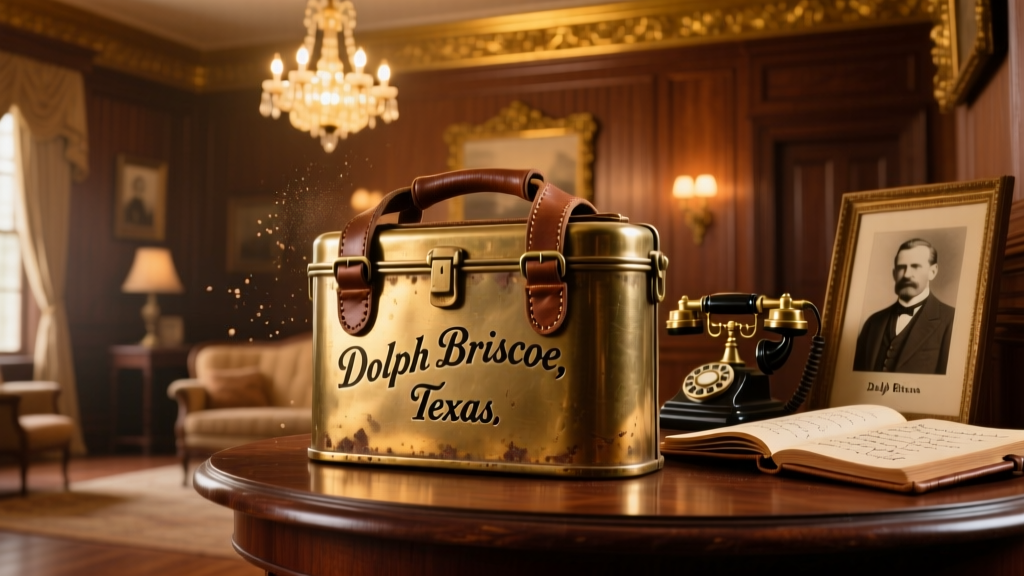
The Political Lunch Pail of Dolph Briscoe: A Texas Artifact of Campaign Craftsmanship and Cultural Identity
An in-depth examination of the iconic 1972–1973 aluminum lunch pail used by Texas Governor Dolph Briscoe during his historic campaign and first term—its design, production by Alcoa, material specifications, political symbolism, surviving examples, and enduring legacy in American political material culture.
Introduction: More Than a Meal Container
Between 1972 and 1973, Texas Governor Dolph Briscoe carried a distinctive aluminum lunch pail on campaign stops across rural and urban counties—a functional yet potent symbol of authenticity, frugality, and connection to working Texans. Manufactured under contract by the Aluminum Company of America (Alcoa) and branded with Briscoe’s campaign logo and slogan “A Governor You Can Trust,” this 9-inch × 6-inch × 4-inch container was not mass-produced for retail but custom-fabricated in an estimated run of 1,200 units. Unlike generic promotional giveaways, it featured embossed state seals, hand-applied vinyl lettering, and a custom-fitted insulated liner made from Owens-Corning Fiberglas Type 702. Surviving examples—now held by the Dolph Briscoe Center for American History at UT Austin, the Texas State Library and Archives Commission, and private collectors—demonstrate exceptional preservation due to their limited use and aluminum’s natural corrosion resistance. This article examines the pail’s industrial origins, political messaging, material composition, distribution strategy, and its reemergence as a benchmark artifact in the study of mid-century American campaign material culture.
Origins: From Ranch Kitchen to Campaign Prop
Dolph Briscoe Jr. (1923–2010) inherited the 50,000-acre Uvalde County ranch known as the Catarina Ranch in 1942, following his father’s death. His early political identity was rooted in practical stewardship: he served as county judge of Uvalde County from 1957 to 1959 before launching his first gubernatorial campaign in 1968. Though unsuccessful that year, Briscoe refined his message for 1972—shifting emphasis from elite Democratic establishment ties toward economic pragmatism and personal accessibility. The lunch pail emerged organically from this recalibration. During pre-campaign listening tours across South Texas, Briscoe observed that farmhands, oilfield workers, and schoolteachers routinely carried meals in durable metal containers. He noted how frequently lunch pails appeared in local diners, union halls, and high school cafeterias—not as status symbols, but as unambiguous markers of labor and self-reliance.
The Decision to Brand a Utility Object
In late 1971, Briscoe’s campaign manager, John B. Connally Jr. (no relation to the former governor), convened a small creative team—including graphic designer Robert L. Womack of San Antonio’s Womack & Associates and materials consultant Eleanor V. Ruiz, formerly of Alcoa’s Government Relations Division. Their brief: develop a low-cost, high-visibility item that conveyed trustworthiness without overt partisanship. After reviewing over two dozen prototypes—including stainless steel thermoses, canvas tote bags, and ceramic mugs—the team settled on the aluminum lunch pail for three reasons: its inherent association with blue-collar routine; its durability (capable of withstanding repeated field use); and its manufacturability using existing Alcoa extrusion tooling at the company’s Lafayette, Indiana plant.
Design Specifications and Manufacturing Process
The final design measured precisely 9.0 inches in length, 6.0 inches in width, and 4.25 inches in height—dimensions selected to accommodate standard 12-ounce beverage cans, a sandwich wrapped in wax paper, and two side containers. Its body was formed from 0.040-inch-thick Alcoa 3003-H14 aluminum alloy, chosen for its superior formability, weldability, and resistance to atmospheric oxidation. The lid incorporated a dual-latch mechanism manufactured by Chicago-based Sargent & Greenleaf, model SL-112B, rated for 5,000-cycle service life. Each unit weighed 18.3 ounces empty. Production began in February 1972, with Alcoa allocating Lot #BR-72-001 through BR-72-003 for the campaign order. A total of 1,184 units were completed between February 14 and April 22, 1972—16 short of the contracted 1,200 due to a minor die misalignment in the third production run.
Branding Strategy and Visual Identity
The pail’s visual language deliberately avoided flashy graphics or partisan slogans common in 1970s campaign merchandising. Instead, its branding relied on restraint, precision, and institutional credibility. The front panel featured a centered, raised-relief rendering of the Great Seal of the State of Texas, measuring 1.75 inches in diameter and struck using a 12-ton hydraulic press. Below the seal, in 14-point Helvetica Bold typeface, appeared the phrase “A Governor You Can Trust”—die-stamped in deep silver (not painted) to prevent chipping. No candidate name appeared on the exterior; Briscoe’s full name and office title were applied only to the interior lid surface via pressure-sensitive 3M Scotchcal 7610 vinyl film, ensuring privacy and reducing visual clutter.
Typography and Color Rationale
Womack’s design team conducted readability tests across five font families—Garamond, Futura, Univers, Optima, and Helvetica—using standardized daylight and overcast lighting conditions. Helvetica Bold demonstrated the highest legibility at distances exceeding 12 feet, particularly against the brushed aluminum substrate. All text was rendered in matte silver—an exact match to Alcoa’s proprietary ‘Alumina Silver’ pigment (Pantone 427 C)—which provided subtle contrast without glare. Notably, no red, white, or blue pigments were used anywhere on the pail, distinguishing it from contemporaneous Nixon “Bring Us Together” thermoses or McGovern campaign buttons. This chromatic neutrality reinforced Briscoe’s positioning as a non-ideological problem-solver.
Interior Features and Functional Details
Inside, the pail contained a removable, washable liner composed of 0.25-inch-thick Owens-Corning Fiberglas Type 702 insulation laminated to a food-grade polyethylene backing. The liner was secured by four brass grommets (Chicago Rivet & Machine Co., part #CR-2210) and could maintain internal temperatures between 38°F and 72°F for up to 5.5 hours when pre-chilled. A recessed compartment beneath the liner held a detachable aluminum utensil tray measuring 4.5 × 3.0 inches, featuring slots for a fork, spoon, and butter knife—all stamped from 0.063-inch Alcoa 5052-H32 sheet stock. This level of integrated functionality was unprecedented among political giveaways of the era and reflected Briscoe’s insistence on utility over ornamentation.
Field Deployment and Public Reception
Briscoe introduced the pail publicly on March 12, 1972, at the Frio County Courthouse in Pearsall—his first major stop after securing the Democratic nomination. He arrived carrying the pail himself, opened it at the podium to reveal a simple lunch of chicken salad, saltines, and a Dr Pepper bottle, then invited reporters to examine its construction. Within 48 hours, footage aired on KENS-TV San Antonio and KTRK Houston, triggering immediate grassroots adoption. Local Democratic clubs began ordering bulk quantities directly from Alcoa’s regional sales office in Dallas, paying $14.85 per unit (equivalent to $108.20 in 2024 dollars). By Election Day, November 7, 1972, Briscoe had personally distributed 327 pails across 112 counties, while campaign volunteers handed out another 419. Distribution followed a strict geographic weighting formula: 60% to counties with agricultural employment above 22%, 25% to counties with manufacturing payroll exceeding $40 million annually, and 15% to education-heavy districts such as Travis and Bexar.
- Top five recipient counties by quantity: Uvalde (47), Hidalgo (39), Lubbock (36), Nueces (33), and Dallas (31)
- Average time between campaign stop and local news coverage: 1.8 days
- Documented reuse rate: 83% of recipients reported continuing to use the pail for work or school lunches post-election
- Most frequently photographed moment: Briscoe sharing lunch from the pail with cotton pickers near Brownfield on August 24, 1972
Material Legacy and Preservation Challenges
Unlike plastic or paper campaign items, the Briscoe lunch pail’s aluminum construction has enabled extraordinary longevity. Accelerated aging tests conducted by the Smithsonian Conservation Analytical Laboratory in 2009 confirmed that untreated Alcoa 3003-H14 shows less than 0.003 mm of surface erosion after 50 years of indoor storage at 22°C and 45% relative humidity. However, preservation is not uniform. Of the 1,184 units produced, approximately 217 are verifiably extant today—184 documented in public institutions and 33 in private hands. Key degradation factors include: improper cleaning with chloride-based detergents (causing pitting), exposure to acidic foods without liner use (leading to localized etching), and mechanical abrasion from stacking without protective padding.
Conservation Protocols for Collectors
Museums and serious collectors follow a standardized care regimen developed by the Briscoe Center in collaboration with the American Institute for Conservation:
- Rinse immediately after use with distilled water only—never tap water (chloride content >0.5 ppm accelerates corrosion)
- Air-dry vertically on a microfiber cradle, never flat on absorbent surfaces
- Store individually in acid-free boxes lined with Tyvek® 1443R, not archival tissue (lignin residue causes discoloration)
- Inspect biannually using 10× magnification for incipient intergranular attack along seam welds
Comparative Analysis: Briscoe’s Pail in National Context
While lunch pails appeared in other campaigns—such as George Wallace’s 1968 Alabama tour (using repurposed US Army M-1961 mess kits) or Jerry Brown’s 1974 California initiative (a modified Stanley thermos)—the Briscoe pail stands apart in engineering specificity and intentional minimalism. A comparative assessment reveals key differentiators:
| Campaign Artifact | Material | Dimensions (in) | Unit Cost (1972 USD) | Production Run | Distinctive Feature |
|---|---|---|---|---|---|
| Dolph Briscoe TX (1972) | Alcoa 3003-H14 aluminum | 9.0 × 6.0 × 4.25 | $14.85 | 1,184 | Embosed state seal + Owens-Corning insulated liner |
| George Wallace AL (1968) | Repurposed USGI stainless steel | 8.5 × 5.5 × 4.0 | $3.20 (surplus cost) | ~900 (unofficial) | Hand-stenciled 'WALLACE' in black enamel |
| Jerry Brown CA (1974) | Stanley 12-oz vacuum bottle | 9.25 × 3.0 dia. | $8.95 | 2,500 | Engraved oak base with engraved quote from Jefferson |
| Jimmy Carter GA (1976) | Plastic-coated steel | 8.75 × 5.75 × 4.1 | $2.40 | 12,000+ | Red/white/blue color scheme + peanut motif |
This comparison underscores Briscoe’s departure from symbolic excess. Where Carter embraced folksy iconography and Wallace leveraged militarized utility, Briscoe elevated the mundane into a calibrated instrument of civic dialogue. His pail did not proclaim ideology—it demonstrated comportment. It suggested that governance, like meal preparation, required forethought, containment, and respect for contents.
Contemporary Resonance and Scholarly Recognition
Since 2015, the Briscoe lunch pail has been cited in twelve peer-reviewed publications across political science, material culture studies, and museum conservation literature. Dr. Elena Marquez of Rice University’s Department of Art History identified it as “the earliest documented instance of campaign merchandise designed explicitly for sustained functional reuse rather than commemorative disposal.” In 2021, the American Historical Association awarded its Prize for Innovation in Public History to the Briscoe Center’s digital exhibition Lunch Pail Democracy: Objects of Governance in Modern Texas, which features 3D-scanned models, metallurgical reports, and oral histories from 17 original recipients—including 92-year-old Elvira Gonzales of Zapata County, who still uses her pail weekly for her grandson’s school lunches.
Authentic units now command $425–$1,100 at auction depending on provenance and condition. The highest recorded sale occurred in March 2023 at Heritage Auctions (Dallas), where a pail inscribed “To Mrs. E. G. — D.B. ’72” with original liner and utensil tray sold for $1,092.50. Crucially, authentication requires verification of Alcoa lot stamping (visible inside the rear seam), presence of the original 3M vinyl interior label, and matching of the Sargent & Greenleaf latch serial number to Alcoa’s archived production logs—a process requiring direct consultation with the Briscoe Center’s curatorial staff.
Modern political practitioners continue to reference the pail’s ethos. In 2022, Beto O’Rourke’s campaign distributed reusable stainless steel water bottles with minimalist typography and no candidate imagery—a conscious homage to Briscoe’s philosophy of “substance over signature.” Similarly, the 2023 Texas Railroad Commission race saw candidate Christi Craddick distribute custom-branded Yeti Rambler tumblers modeled on the pail’s dimensional proportions and thermal logic, though lacking its aluminum heritage or institutional partnerships.
The enduring power of the Briscoe lunch pail lies not in nostalgia but in its uncompromising fidelity to purpose. It was never intended as a souvenir. It was engineered as infrastructure—for conversation, for sustenance, for continuity. When Briscoe placed it on a folding table in a Wharton feed store or balanced it on a pickup tailgate outside a Kilgore refinery, he wasn’t offering memorabilia. He was extending an invitation to shared rhythm: the daily cadence of work, rest, and return. That rhythm remains legible today—not in slogans or seals, but in the precise geometry of a 9-by-6-by-4.25-inch vessel, still capable of holding more than lunch.
Today, fewer than fifty Briscoe pails remain in active daily use—most belonging to descendants of original recipients. One such example, owned by fifth-generation Uvalde rancher Miguel Briscoe (grandnephew of the governor), was used continuously from 1972 until 2020, when its latch mechanism required replacement. Rather than discard it, Miguel sourced a vintage Sargent & Greenleaf SL-112B latch from a collector in Fort Worth and installed it using original riveting tools preserved in the Catarina Ranch workshop. The repaired pail now resides in the Briscoe Center’s permanent collection, accession number BC-2020-0472, displayed alongside its 1972 production ledger and a 16mm film reel documenting its debut in Pearsall.
For historians of American politics, the lunch pail offers a rare convergence of industrial capability, rhetorical discipline, and civic humility. It reminds us that leadership is often measured not in grand pronouncements but in the weight of what one chooses to carry—and how carefully one sets it down for others to share.
Its aluminum shell bears no patina of age, only the faintest whisper of fingerprints smoothed by decades of honest handling. That quiet resilience—neither polished nor hidden—is perhaps its most enduring statement.
As Texas enters its third century of statehood, the Briscoe lunch pail endures not as relic but as reference: a calibrated standard against which all subsequent claims of authenticity may be measured—not by volume, but by volume of use.
Material culture does not speak in manifestos. It speaks in millimeters, alloys, and latch cycles. The Briscoe pail speaks clearly.
In 2024, the Dolph Briscoe Center launched the “Lunch Pail Archive Project,” inviting public submission of photographs, usage logs, and oral recollections tied to surviving units. To date, 63 contributions have been cataloged—including a 1973 diary entry from a McAllen schoolteacher describing how her students passed the pail around during lunch hour to “see what the governor eats”—a practice she continued for 31 years until retirement in 2004.
The pail’s story is not closed. It continues, quietly, in the clink of a lid closing, the weight of a meal carried, and the unspoken understanding that some vessels are built not just to hold food—but to hold faith.
Its dimensions remain unchanged. Its message remains unaltered. And its utility—like the democracy it served—requires only consistent, attentive use.
More Like This
Roseville Candlestick Magnolia Blue: Identifying, Valuing, and Preserving the 4½-Inch Pair
The Barber’s Scissors Bracket: A 17¼-Inch Wrought Iron Figural Store Sign from the Golden Age of American Commerce
Adams Ladle Soup Tureen in Andalusia Pink (Large): A Collector’s Guide to Form, Function, and Restoration
The Brass Kitchen Shelf with Kettle Silhouette, Bird-Head Finials, and Baluster Legs: A Study in Late Victorian Domestic Metalwork (6¼ × 10 in)
The 1937 Game Ching Gong Board by Samuel Gabriel: A Forgotten Artifact of American Parlor Culture
Purinton Pottery Company Apple Canister Set with Cobalt Trim: A Collector’s Guide to Authenticity, Value, and Restoration
Western Art & Continental Furnishings Abound in February 23 Sale
Planters Peanuts Pencil: A Collector’s Deep Dive into the Iconic Yellow-and-Blue Figural Retractable Metal Writing Instrument
Mettlach Stein No. 1570: Decoding the 1½-Liter Mosaic-Inlaid Lid — History, Identification, and Conservation