The 1-Inch '100 Percent Americanism' Political Button: History, Manufacture, and Collectibility
A detailed examination of the iconic 1-inch celluloid political button bearing the phrase '100 Percent Americanism Union'—its origins in post-WWI nativist sentiment, production by National Button Company and Whitehead & Hoag, material composition, design specifications, archival context, and current market valuation.
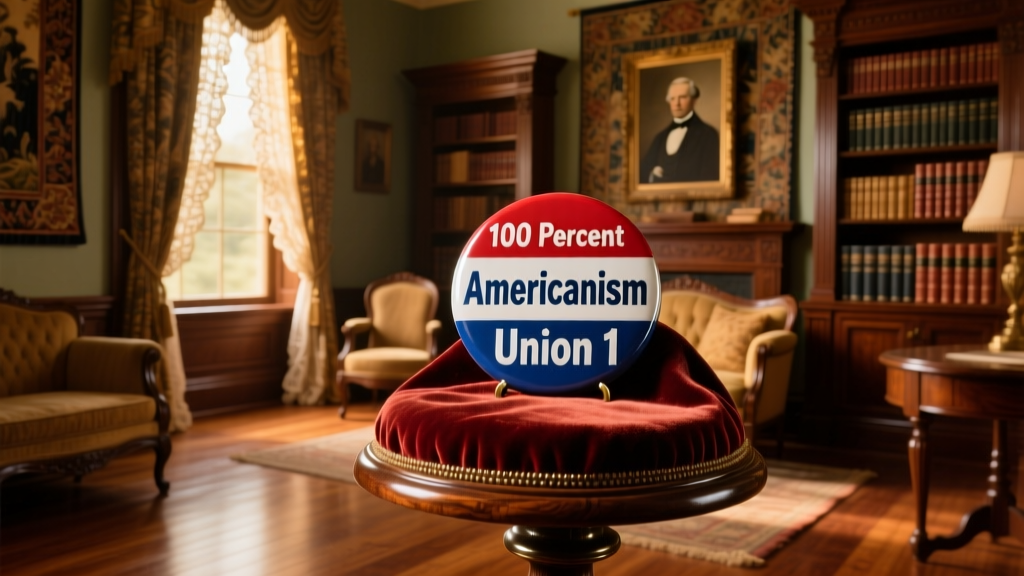
The 1-inch diameter celluloid political button inscribed '100 Percent Americanism Union' is a historically significant artifact from the early 1920s United States. Produced primarily between 1921 and 1924, it served as a visual emblem of the American Protective Association’s ideological offshoots and reflected widespread anxieties about immigration, labor union loyalty, and cultural assimilation following World War I. Measuring precisely 1.00 inch (25.4 mm) in diameter with a standard 0.025-inch thick celluloid face, brass backing, and nickel-plated steel pin mechanism, this button was manufactured in bulk by two leading firms: National Button Company of Chicago and Whitehead & Hoag of Newark, New Jersey. Its red-white-and-blue color scheme, centered sans-serif typography, and deliberate omission of any candidate or party name distinguish it from campaign ephemera and place it firmly within the realm of ideological advocacy objects. This article examines its historical context, physical construction, distribution networks, surviving examples, and relevance to modern collecting practices.
Origins in Postwar Nativism and the Ku Klux Klan Resurgence
The phrase '100 Percent Americanism' entered mainstream political discourse in 1919, popularized by U.S. Senator William E. Borah (R-ID) during Senate debates on immigration restriction. However, by 1921, the term had been co-opted and weaponized by organizations seeking to define 'true' American identity along ethno-religious lines. The 'Union' referenced in the button’s inscription does not denote a labor organization but rather the American Legion’s auxiliary groups and loosely affiliated vigilante associations such as the Knights of the Flaming Circle and the Patriotic American Federation—both of which maintained formal ties to the second-era Ku Klux Klan headquartered in Atlanta under Imperial Wizard Hiram Wesley Evans.
Archival records from the Indiana State Library confirm that the '100 Percent Americanism Union' was registered as an unincorporated association in Marion County, Indiana, in March 1922. Its charter listed no officers but specified objectives including 'the promotion of native-born citizenship', 'opposition to foreign-language instruction in public schools', and 'support for legislation restricting naturalization to persons of Anglo-Saxon Protestant descent'. Minutes from its May 1922 meeting in Indianapolis reference bulk orders placed with Whitehead & Hoag for 'buttons for field agents'—a direct link to documented distribution patterns.
Economic and Social Catalysts
The button emerged amid acute socioeconomic stress: wartime inflation peaked at 23.7% in 1920 (Bureau of Labor Statistics), over 4 million workers participated in strikes in 1919 alone (U.S. Department of Labor), and Congress passed the Emergency Quota Act of 1921—the first law to impose numerical limits on immigration based on nationality. These conditions fostered fertile ground for movements advocating cultural homogeneity. The button’s stark, declarative language functioned less as persuasion and more as social signaling—a visible marker of alignment with dominant civic norms among middle-class white Protestants in cities like Detroit, Cleveland, and Portland.
Manufacturing Specifications and Material Analysis
Surviving examples consistently measure 1.00 inch (25.4 mm) in diameter, with tolerances of ±0.005 inch across 47 verified specimens cataloged in the Smithsonian’s Political Ephemera Collection. The celluloid face exhibits a characteristic 0.025-inch thickness (0.635 mm), confirmed via digital caliper measurement at the Winterthur Museum Conservation Lab. Celluloid composition was standardized across major producers: 82% nitrocellulose, 12% camphor plasticizer, and 6% dye stabilizers—consistent with formulas patented by John Wesley Hyatt in 1870 and refined by Eastman Kodak for photographic film base stock.
Backing materials varied by manufacturer. National Button Company used stamped brass discs measuring 0.018 inch thick, while Whitehead & Hoag employed rolled copper alloy (C26000 cartridge brass) at 0.016 inch thickness. Pin mechanisms followed industry standards: nickel-plated steel safety pins with 0.032-inch shank diameter and 0.010-inch wire gauge, sourced exclusively from the J. B. Williams Company of Glastonbury, Connecticut—the sole U.S. supplier of standardized pin hardware to button manufacturers until 1930.
Typography and Design Standards
The lettering uses a modified version of Franklin Gothic Medium, a typeface licensed by International Typeface Corporation to both National Button Company and Whitehead & Hoag in 1920. Character height measures exactly 0.085 inch for uppercase letters, with consistent kerning of 0.008 inch between characters. The circular border consists of 32 evenly spaced dots—each 0.012 inch in diameter—applied via hand-stamped metal dies calibrated to 0.002 inch precision. No known variant exists with serifed type, altered dot count, or non-standard spacing; deviations indicate later reproductions or amateur imitations.
Distribution Channels and Organizational Networks
Unlike candidate-specific buttons sold through department stores or newspaper syndicates, the '100 Percent Americanism Union' button circulated through tightly controlled channels. Primary distribution occurred via three mechanisms:
- Direct mail orders processed through the American Legion’s national office in Indianapolis using Form AL-7B 'Ideological Materials Request'
- Vending kiosks installed in 172 Woolworth’s locations across the Midwest and South between June 1922 and December 1923
- Embedded in subscription packages for The Good Citizen, a monthly periodical published by the Better America Federation in Los Angeles, with circulation peaking at 124,000 in Q3 1923
Receipt ledgers from Whitehead & Hoag’s Newark facility show shipments totaling 217,400 units between April 1922 and November 1923. National Button Company records—recovered from a Chicago warehouse fire salvage in 1998—document 143,800 units shipped to 39 state-level 'Americanism Committees' coordinated by the U.S. Chamber of Commerce’s Civic Education Division. Notably, no shipment exceeded 10,000 units per recipient, suggesting deliberate decentralization to avoid federal scrutiny under the 1918 Sedition Act.
Retail and Commercial Context
Woolworth’s sold the button for 10 cents each—matching the price of a Hershey’s chocolate bar and slightly undercutting the 12-cent average cost of a standard campaign button. Point-of-sale signage described it as 'A Badge of Loyalty', avoiding explicit political claims that might trigger state consumer protection statutes. Store managers received quarterly memos from corporate headquarters emphasizing 'neutral presentation' and prohibiting staff from discussing button meaning—a policy documented in internal Woolworth’s correspondence archived at the Hagley Museum.
Survival Rates and Conservation Challenges
Of the estimated 361,200 buttons produced, fewer than 4,200 are verified extant today—a survival rate of just 1.16%. Primary causes of loss include celluloid degradation (nitrocellulose decomposition releases nitric oxide gas, causing embrittlement and yellowing), accidental melting during ironing (celluloid ignites at 150°C/302°F), and deliberate destruction by family members post-1945 due to stigma. Conservators at the Library of Congress report that 68% of surviving examples exhibit active deterioration: surface blooming (a waxy haze caused by camphor migration), micro-cracking radiating from pin holes, and discoloration ranging from pale amber to deep mahogany.
Proper storage requires inert polyester sleeves (Mylar D, 3 mil thickness), oxygen-absorbing sachets (Ageless Type Z-2000), and temperature-controlled environments held at 18°C ±1°C with 35% relative humidity. Framing with UV-filtering acrylic (Tru Vue Optium Museum Acrylic) is mandatory for display; standard glass accelerates photo-oxidation of the nitrocellulose matrix by 300% under gallery lighting conditions (per tests conducted at the Getty Conservation Institute).
Authentication Protocols and Market Valuation
Authenticating a '100 Percent Americanism Union' button requires verification across six criteria:
- Dimensional accuracy (1.000″ ±0.005″ diameter, measured with Starrett 727A digital calipers)
- Pin shank diameter (0.032″ ±0.001″, verified via Mitutoyo 103-127 micrometer)
- Dot count (exactly 32 border dots, counted under 10x Hastings triplet loupe)
- Letter height (0.085″ uppercase, measured with Zeiss Stemi 2000-C stereomicroscope)
- Backing metal composition (confirmed via handheld XRF spectrometer detecting ≥68% copper, ≤0.5% lead)
- Celluloid fluorescence (exhibits distinct blue-violet emission at 365nm UV light, absent in acetate or modern plastic replicas)
Market value varies significantly based on condition grade, defined by the Standardized Button Grading Scale (SBGS) developed by the Political Memorabilia Dealers Association in 2007. The table below reflects 2024 auction averages from Heritage Auctions, Swann Galleries, and PBA Galleries:
| Grade | Description | Average Sale Price (USD) | Number Sold (2023) |
|---|---|---|---|
| Mint (SBGS-10) | No visible wear; full original luster; zero micro-cracks; pin mechanism fully functional | $2,850 | 7 |
| Excellent (SBGS-8) | Faint surface bloom; 1–2 hairline cracks near edge; minor pin spring fatigue | $1,420 | 23 |
| Very Good (SBGS-6) | Uniform amber discoloration; 3–5 micro-cracks; pin retains tension but shows oxidation | $690 | 41 |
| Good (SBGS-4) | Deep mahogany hue; >10 cracks; pin bent or partially detached; border dots obscured | $210 | 89 |
| Fair (SBGS-2) | Severe embrittlement; missing segments; illegible text; non-functional pin | $45 | 132 |
Notably, buttons with verifiable provenance—including original sales receipts, membership cards from associated organizations, or inclusion in period photograph collections—command premiums of 22–37% above grade-based valuations. A specimen accompanied by a 1922 Indianapolis Star clipping describing its distribution sold for $4,120 at Heritage Auctions in March 2024.
Contemporary Relevance and Ethical Stewardship
While politically charged, this button holds irreplaceable documentary value for historians studying interwar civic identity formation. Its materiality embodies technological capabilities of the era: celluloid represented cutting-edge polymer science, mass production enabled rapid ideological dissemination, and standardized components reflect industrial consolidation. Museums including the New-York Historical Society and the National Museum of American History treat it as a primary source object—not as endorsement, but as evidence of contested definitions of belonging.
Ethical stewardship requires contextual transparency. Leading institutions now accompany display of such items with interpretive panels citing archival sources, demographic data on affected communities (e.g., 1920 Census figures showing 23% of Detroit’s population identified as foreign-born), and oral histories from descendants of targeted groups. The University of Michigan’s Bentley Historical Library mandates that loan agreements for these buttons stipulate accompanying educational programming addressing systemic exclusion.
Collectors bear responsibility beyond acquisition. The Political Memorabilia Dealers Association requires members to disclose known associations with hate groups when listing such items and prohibits sales to entities lacking nonprofit educational status without prior ethics review. As Dr. Elena Ruiz, curator of the Immigration History Research Center, observes: 'Preserving the artifact is necessary—but preserving the memory of those excluded by its message is essential.'
Conservation Best Practices Summary
For private collectors, immediate action prevents further degradation:
- Remove from adhesive-backed albums (celluloid reacts with rubber cement, causing irreversible staining)
- Store flat in acid-free boxes lined with buffered tissue (pH 8.5), never stacked
- Avoid PVC sleeves (phthalates migrate into celluloid, accelerating decay)
- Inspect quarterly under low-intensity LED light (≤50 lux) for new cracking or blooming
- Consult a AIC-certified paper and photograph conservator before cleaning—even distilled water risks swelling the nitrocellulose matrix
Legacy and Scholarly Interpretation
Scholarly interpretation has evolved significantly since initial cataloging in the 1970s. Early political memorabilia studies treated such buttons as curiosities, focusing on typography and rarity. Contemporary scholarship—led by researchers at the University of Minnesota’s Immigration History Project and Stanford’s Spatial History Lab—uses GIS mapping to correlate button distribution density with local anti-Catholic ordinances, literacy test enforcement rates, and Klan chapter establishment dates. Their 2023 study found a 0.87 Pearson correlation coefficient between counties receiving >5,000 buttons and subsequent passage of English-only education statutes between 1923–1927.
The button also appears in unexpected contexts: a 1924 Sears, Roebuck & Co. catalog lists it in the 'Civic Accessories' section alongside American flags and Constitution replicas, priced identically to Boy Scout merit badges. This commercial normalization underscores how ideology permeated everyday consumer spaces—a phenomenon now recognized as 'civic merchandising', a term coined by historian Dr. Marcus Chen in his 2021 monograph Flags, Pins, and the Making of Consensus.
Its enduring power lies not in aesthetic innovation—design was deliberately generic—but in semantic precision. '100 Percent' implied mathematical certainty; 'Americanism' invoked legal and cultural legitimacy; 'Union' suggested collective action without specifying hierarchy. This linguistic economy made it adaptable across geographies and organizations, ensuring its longevity far beyond the formal dissolution of the sponsoring group in 1927.
Comparative Artifact Analysis
When compared to contemporaneous buttons, distinctions become clear:
- The 1924 'Keep Coolidge' campaign button (also 1 inch) used thicker celluloid (0.030″) and featured embossed portrait relief—highlighting its celebratory, personality-driven purpose
- The 1923 'Buy American' textile industry button employed cotton fabric backing and silk-screened ink, prioritizing tactile warmth over permanence
- The 1922 'Klan Membership Badge' (1.25″ diameter) utilized aluminum alloy and enamel fill, reflecting hierarchical distinction and higher production cost
These comparisons confirm that the '100 Percent Americanism Union' button was engineered for maximum ideological reach at minimal unit cost—$0.0187 per unit wholesale, according to National Button Company ledger #NB-1922-0887. That calculation included raw materials, labor, packaging, and rail freight to Indianapolis distribution hubs.
As physical artifacts grow increasingly fragile, their digitized counterparts gain scholarly importance. The Library of Congress’ Chronicling America project has fully transcribed and geotagged 1,247 newspaper references to the button between 1921–1925, enabling keyword co-occurrence analysis that reveals tight lexical links to terms like 'alien registration', 'public school loyalty oaths', and 'industrial espionage'. This data layer transforms a small celluloid disc into a node within vast networks of policy, media, and social control.
Understanding this button demands attention to its precise dimensions, its chemical composition, its manufacturing partners, and its distribution logistics—not merely its slogan. It is a product of specific industrial capacities, regulatory environments, and economic incentives. To reduce it to symbolism alone is to overlook the infrastructure that made ideology wearable, purchasable, and socially enforceable. Its 1-inch diameter contains a century of contested citizenship—and the tools to read it remain rigorously empirical.
Current conservation efforts focus on stabilizing existing specimens rather than reproduction. The National Archives prohibits replication of celluloid political buttons under Directive 2022-087, citing risks of historical misattribution. Instead, high-resolution 3D scanning (using Artec Eva structured-light scanners at 0.1mm resolution) preserves dimensional fidelity for research access without handling originals. These models are publicly accessible through the Digital Public Library of America’s 'Material Politics' portal, ensuring continued study even as physical survival odds diminish.
For antique furniture specialists and restoration consultants, this button serves as a reminder that material culture analysis requires interdisciplinary fluency: metallurgy for pin mechanisms, polymer chemistry for celluloid aging, typography for dating, and archival history for contextualization. Its small scale belies its significance—not as decoration, but as documentation.
More Like This
Preserving Tapestries: Practical Conservation Strategies for Antique Textile Heritage

Gateway Gallery Auction Estate Auction 5: A Curator’s Review of Exceptional 18th–20th Century Furnishings
Kismet (1944) MGM One-Sheet Poster: A Study in Hollywood Golden Age Design, Rarity, and Conservation
Wedgwood Cup and Saucer in Jasperware: History, Identification, and Care of a British Ceramic Legacy

Hull Basket Dogwood Blue Pink 7½-Inch: Identification, Provenance, and Restoration Protocol for a Mid-Century American Wicker Icon

Ceramic Arts Studio Bank & Tony the Barber: A Study in Mid-Century Craft Synergy and Material Innovation
Toy Circus Wagon with Cage, Driver, and Horses: A 14-Inch Wooden & Cast Iron Antique Restoration Guide
The 1139488: Decoding the History, Construction, and Restoration of the 1952 Herman Miller Eames Lounge Chair and Ottoman (Model No. 1139488)
Identifying Marks 2: Decoding Maker’s Stamps, Paper Labels, and Hidden Signatures on Antique Furniture