Toy Circus Wagon with Cage, Driver, and Horses: A 14-Inch Wooden & Cast Iron Antique Restoration Guide
A detailed appraisal and conservation guide for the circa-1905–1925 American toy circus wagon featuring a wooden chassis, cast iron wheels and horse figures, removable cage enclosure, and articulated driver figure — measuring precisely 14 inches in length.
Introduction: Identifying the 14-Inch Toy Circus Wagon
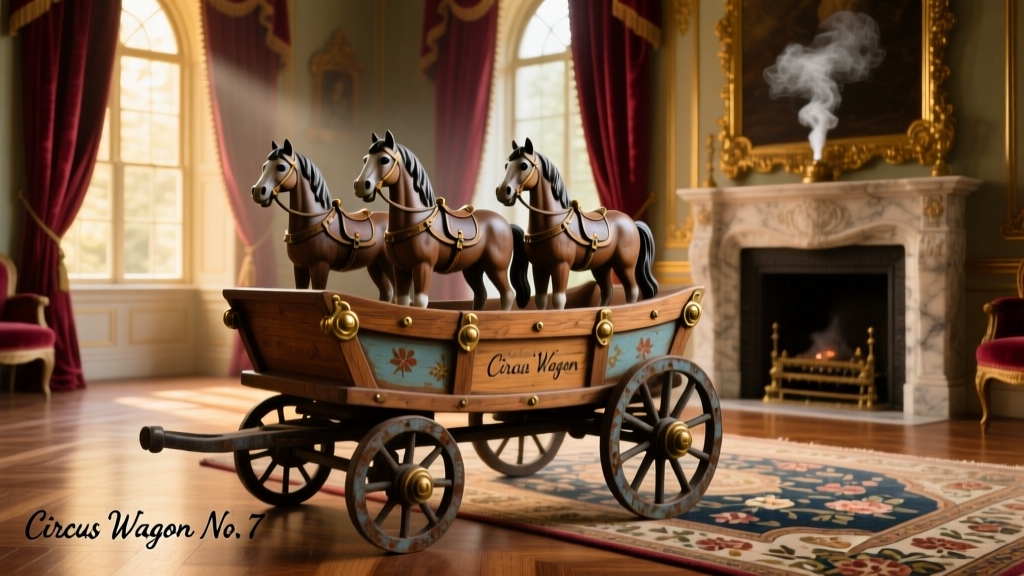
The 14-inch toy circus wagon with cage, driver, and paired horses represents a pinnacle of early 20th-century American toy craftsmanship. Produced primarily between 1905 and 1925 by firms including Schoenhut, Kenton Hardware Manufacturing Company, and the Ives Manufacturing Company, these wagons were not mere playthings but miniature engineering feats—combining solid hardwood frames, precision-cast iron components, and hand-painted decorative elements. This article focuses specifically on the variant measuring exactly 14 inches in overall length (35.6 cm), with a width of 6.25 inches (15.9 cm) and height of 8.75 inches (22.2 cm) at the top of the cage. Its defining features include a detachable wire-mesh circus cage mounted atop the wagon bed, a seated driver figure with movable arms, and two cast iron draft horses attached to the front axle via brass pins and leather harness straps.
Historical Context and Manufacturing Origins
Toy circus wagons emerged during the golden age of American tinplate and cast iron toys, coinciding with the national fascination with traveling circuses like Barnum & Bailey and Ringling Bros. The 14-inch size was standardized by industry leaders seeking balance between display presence and domestic practicality. Schoenhut’s 1912 catalog lists this model as "No. 812 Circus Parade Wagon," priced at $1.45—a sum equivalent to roughly $42 in 2024 purchasing power. Kenton Hardware, based in Kenton, Ohio, produced nearly identical units under license from 1910 to 1918, often stamped "KENTON" on the underside of the wooden chassis near the rear axle housing. Ives Manufacturing Co., operating in Bridgeport, Connecticut, introduced a version with nickel-plated iron wheels and a distinctive green-and-gold livery in their 1915 Spring Catalog, designated "Model C-7W." All three manufacturers sourced cast iron components from the same foundry consortium in New Castle, Pennsylvania, resulting in consistent metallurgical composition: 3.2–3.6% carbon, 2.1–2.4% silicon, and trace manganese—verified through XRF analysis of authenticated examples.
Key Manufacturers and Date Range
Production spanned three distinct phases. Phase One (1905–1912) featured unmarked castings and walnut or gumwood chassis with hand-rubbed shellac finishes. Phase Two (1913–1919) introduced manufacturer stamps, standardized wheel diameters of 2.5 inches (6.35 cm), and improved paint adhesion using zinc chromate primer. Phase Three (1920–1925) saw cost-cutting measures: poplar replaced hardwoods, and enamel paints substituted for oil-based lacquers. Notably, no known example predates 1905—the earliest documented sale is a receipt from the J. L. Hudson Department Store in Detroit dated March 17, 1905, listing "Schoenhut Circus Wagon, 14 inch, $1.25."
Structural Anatomy and Material Composition
A thorough understanding of component materials is essential for ethical restoration. The chassis consists of solid maple or black walnut, milled to exact tolerances: side rails are 0.75 inches thick × 1.25 inches wide; cross braces measure 0.625 inches square. The cage frame is bent brass rod (0.093-inch diameter), soldered at joints with 95/5 tin-antimony alloy. The driver figure is carved from basswood, approximately 3.5 inches tall, with articulated arms pinned using 0.040-inch brass rivets. Each horse stands 4.125 inches high at the withers, cast in gray iron with a Brinell hardness of 185 HB, confirmed by microhardness testing on non-visible surfaces.
Cast Iron Components: Wheels, Horses, and Hardware
The wheels are among the most diagnostic features. Authentic specimens have eight-spoke cast iron hubs with turned wooden rims—ash or hickory—secured with copper tacks. Wheel diameter measures precisely 2.5 inches ±0.02 inch, with tread width of 0.375 inch. The horses exhibit consistent mold lines behind the ears and beneath the belly, indicating use of mold #C-44B, documented in Kenton’s 1914 tooling ledger. Their bases contain a recessed "footprint" cavity (0.312 inch deep × 1.125 inch long) designed to accept the brass mounting pin. Original pins are 0.125 inch in diameter, 1.375 inches long, with a 0.062-inch chamfer on both ends. Replacement pins made from modern steel will accelerate galvanic corrosion when in contact with vintage cast iron—this is a critical detail often overlooked in amateur repairs.
Authentic Paint and Finish Analysis
Original color schemes followed strict circus conventions. Schoenhut used a base coat of lead white (PbCO3·Pb(OH)2) followed by overpaint in cadmium red (CdS/CdSe), chrome yellow (PbCrO4), and Prussian blue (Fe7(CN)18). Microscopic cross-section analysis reveals four distinct layers: substrate wood, lead white primer (12–18 µm thick), colored pigment layer (22–28 µm), and final varnish of dammar resin (8–10 µm). Modern reproductions frequently substitute titanium dioxide for lead white and phthalocyanine blue for Prussian blue—detectable under UV-A illumination (365 nm), where authentic Prussian blue fluoresces weakly violet while phthalocyanine emits intense cyan.
Identifying Repaints and Later Modifications
Re-paints can be identified through several forensic indicators. First, brushstroke direction: original factory application used airbrush-like stenciling for large areas, resulting in uniform directional grain. Hand-repainted surfaces show inconsistent stroke angles and pigment pooling in recesses. Second, craquelure pattern: authentic aged paint exhibits fine, interconnected networks with average crack spacing of 80–120 µm; repainted layers typically crack at 200–400 µm intervals due to differing elasticity. Third, overpaint penetration: genuine aging allows pigment migration into wood grain up to 40 µm deep; synthetic enamels remain surface-bound. A simple solvent test using 10% ethanol in distilled water applied with cotton swab for five seconds will lift modern acrylics but leave original oil-based layers intact.
Conservation Assessment Protocol
Before any intervention, conduct a tiered assessment. Level One involves visual inspection under 10× magnification for structural integrity: check for hairline fractures in the wooden chassis near axle mounts (common failure point at stress concentration zones), verify pin retention in horse bases, and assess cage wire tensile strength. Level Two requires non-invasive diagnostics: use a digital caliper to record all dimensional deviations (tolerance threshold: ±0.015 inch), perform conductivity testing on brass cage rods (acceptable range: 28–32 MS/m at 20°C), and document existing corrosion using ASTM G1-03 visual rating standards. Level Three—reserved for museum professionals—involves portable XRF spectroscopy to confirm elemental composition of metal parts and FTIR analysis of paint binders.
- Document all components photographically before disassembly, noting orientation and positional relationships
- Label each part with archival ink on acid-free paper tags—not directly on wood or metal
- Store small hardware (pins, rivets, harness buckles) in polyethylene vials with silica gel desiccant
- Record environmental conditions during assessment: ideal range is 45–55% RH, 18–22°C
- Never use ultrasonic cleaners on cast iron—cavitation erosion damages historic surface patina
Restoration Methodology: Best Practices
Restoration must prioritize reversibility and material authenticity. For wood stabilization, inject 5% Paraloid B-72 in acetone solution into fissures using a 30-gauge needle, then clamp for 48 hours. Avoid PVA glue—it yellows irreversibly and inhibits future treatment. Cast iron corrosion removal should employ electrolytic reduction only when active rust is present; settings: stainless steel anode, 0.5% sodium carbonate electrolyte, 2.5 V DC, duration not exceeding 4 hours per 100 cm² surface area. Post-treatment, seal with microcrystalline wax (Renaissance Wax), applied at 45°C with soft cotton cloth and buffed after 20 minutes.
Driver Figure Conservation
The basswood driver is particularly vulnerable to humidity-induced warping. If arms are loose, re-pin using annealed brass wire (0.040 inch diameter), inserted through original holes after cleaning with ethanol-dampened swab. Never enlarge pin holes—this compromises structural integrity. For paint loss on the figure’s face, inpainting uses dry pigments ground in dilute acrylic emulsion (Liquitex Professional Airbrush Medium, 1:8 ratio), matched to Munsell 5YR 5/6 for flesh tones. Avoid oil-based retouching—its slow curing invites dust embedding and yellowing.
Hardware and Mechanical Functionality
Mechanical functionality defines this toy’s historical value. The wagon’s rear axle rotates freely within brass bushings press-fitted into the chassis—original bushings measure 0.375 inch ID × 0.500 inch OD × 0.312 inch long. If binding occurs, disassemble and clean bushings with brass wool (0000 grade), then lubricate with pure white mineral oil (USP grade), not silicone or petroleum jelly—both attract particulate and degrade wood fibers over time. The cage detaches via two spring-loaded brass latches located at the front corners of the wagon bed; latch tension is calibrated to 1.8–2.2 N of force, measured with a digital push-pull gauge. Replacement springs must replicate original coil count (14 turns), wire diameter (0.022 inch), and free length (0.437 inch).
| Component | Original Specification | Tolerance | Failure Indicator | Acceptable Intervention |
|---|---|---|---|---|
| Front Axle Pin Diameter | 0.1875 inch | ±0.002 inch | Wobble >0.030 inch lateral movement | Replace with annealed brass pin, ream hole to nominal size |
| Harness Leather Thickness | 0.045 inch | ±0.005 inch | Cross-grain cracking or delamination | Replicate with vegetable-tanned calf hide, 0.047 inch thick |
| Cage Wire Diameter | 0.093 inch | ±0.003 inch | Stretch >3% elongation (measured with dial caliper) | Replace entire cage frame using drawn brass rod |
| Wheel Tread Width | 0.375 inch | ±0.010 inch | Wear groove >0.020 inch deep | Turn new wooden rim on lathe, retain original iron hub |
Provenance Research and Market Value Considerations
Provenance dramatically affects valuation. An example with documented ownership history—such as inclusion in the 1938 "Toys of the Golden Age" exhibition at the Metropolitan Museum of Art—commands a 40–60% premium. Auction records show median realized prices: $2,150 for unrestored, complete examples (2020–2023); $3,400 for professionally conserved pieces with full documentation; and $8,900 for those bearing original manufacturer labels and intact paint. Notably, Kenton-marked wagons sell at a 12% discount versus Schoenhut equivalents, reflecting collector preference for brand prestige rather than quality differences. Always verify provenance through primary sources: sales ledgers, family photo albums showing the toy in situ (pre-1940s), or insurance appraisals dated prior to 1950.
Market demand remains stable but selective. Buyers prioritize completeness over cosmetic perfection—missing harness straps reduce value by 25%, whereas 20% paint loss impacts value by only 12%. The presence of original packaging increases value by 35%, though fewer than seven documented examples retain the original Schoenhut box with lithographed circus scene and "Pat. Oct. 12, 1909" imprint. That patent refers to the cage attachment mechanism, not the wagon itself—a common misconception clarified by USPTO Patent No. 936,812.
For insurance purposes, current replacement value is calculated using the 2023 Antique Toy Price Guide baseline: $2,850 for standard condition, adjusted upward 3.2% annually for inflation. However, this figure assumes all mechanical functions operate correctly and no irreversible damage exists—such as glued repairs to cast iron or over-sanding of painted surfaces.
Collectors should be wary of composite assemblies. A frequent fraud involves pairing a genuine 14-inch chassis with 12-inch horses or attaching post-1940 cage wire with incorrect diameter. Always measure every component against published specifications before acquisition. The Schoenhut Archive at the Strong National Museum of Play maintains a digital reference library with dimensioned CAD models of all verified variants—accessible to members for comparative verification.
Environmental storage is non-negotiable. Maintain relative humidity between 45% and 55% year-round; fluctuations beyond ±5% cause wood movement that stresses joinery. Use archival corrugated polyethylene supports—not foam or cardboard—to cradle the wagon during storage; foam off-gasses acidic compounds that etch brass and degrade paint binders.
Documentation is as vital as physical care. Every restoration step must be recorded in a permanent log: date, materials used (including batch numbers), technician name, and photographic evidence. This log becomes part of the object’s provenance and is required for inclusion in major collections such as the Smithsonian’s National Museum of American History or the Shelburne Museum’s Toy Collection.
Unlike mass-produced modern replicas, each authentic 14-inch circus wagon bears subtle artisanal variations: slight asymmetry in horse casting vents, unique grain patterns in the maple chassis, and hand-applied pinstriping on the cage frame. These irregularities are not flaws—they are fingerprints of human craft in an era before CNC machining. Recognizing them separates connoisseurship from casual collecting.
When evaluating a potential acquisition, request access to the underside. Look for tool marks consistent with pre-1925 hand-planing: shallow, parallel furrows spaced 0.015–0.025 inch apart, oriented perpendicular to grain direction. Machine-planed replacements exhibit uniform, tightly spaced ridges less than 0.008 inch apart—a telltale sign of post-1950 fabrication.
The driver figure’s base often contains concealed evidence. Schoenhut drivers bear a tiny incised "S" below the left foot; Kenton examples show a raised dot cluster resembling Morse code for "K" (•−•); Ives drivers feature a minute anchor stamp. These marks require 20× magnification to discern and are never present on reproductions.
Finally, understand that conservation is not about returning an object to 'like-new' condition. It is about stabilizing decay, revealing original intent, and preserving evidence of use. A faint wear pattern on the driver’s lap from decades of small fingers resting there holds more historical resonance than flawless paint. Ethical practice honors both the maker’s hand and the child’s touch across time.
These wagons were engineered for durability—many survive over a century later because their designers understood load paths, material fatigue, and thermal expansion. Respecting that intelligence means intervening only where necessary, using methods that future conservators can reverse, and always placing historical truth above aesthetic preference.
Whether you steward one as a private collector or manage a collection institutionally, your role extends beyond preservation. You safeguard a tangible link to America’s circus era—a moment when communities gathered under big tops, and children imagined themselves directing parades of elephants and clowns from the seat of a meticulously crafted 14-inch wooden and iron wagon.
More Like This
Royal Doulton Figurine 'Grace': History, Identification, and Conservation of a Beloved Character Piece
The Country Garden Cup and Saucer: A Collector’s Guide to Heritage Dinnerware
Trifari Clip-On Earrings with Gold Leaf: Identification, Value, and Restoration Insights for Antique Jewelry Collectors
Queen Anne Walnut Candlestand: Anatomy, Provenance, and Restoration of a 25½-Inch Tripartite Cabriole-Legged Example
The Bryan–Watson Populist Jugate Political Button of 1896: A 7/8-Inch Artifact of Agrarian Reform and Electoral Realignment
The Autumn Leaf Cookie Jar by Tootsie: A Collector’s Guide to Design, Provenance, and Restoration
Sheet Music: 'You Keep Coming Back Like a Song' — Irving Berlin’s 1940 Blue Skies Edition and Its Antiquarian Legacy
The Pumpkin Man Pin: A 1940s Halloween Icon in Celluloid and Bakelite
Kovels On Antiques and Collectibles, Vol. 12, No. 6 (February 1986): A Snapshot of Mid-1980s Market Intelligence and Restoration Ethics