Wedgwood Cup and Saucer in Jasperware: History, Identification, and Care of a British Ceramic Legacy
A detailed examination of Wedgwood’s iconic Jasperware cup and saucer sets — covering Josiah Wedgwood’s 1774 invention, production techniques, hallmarking conventions, authenticating features, market values (2024), and museum-standard conservation practices for collectors and curators.
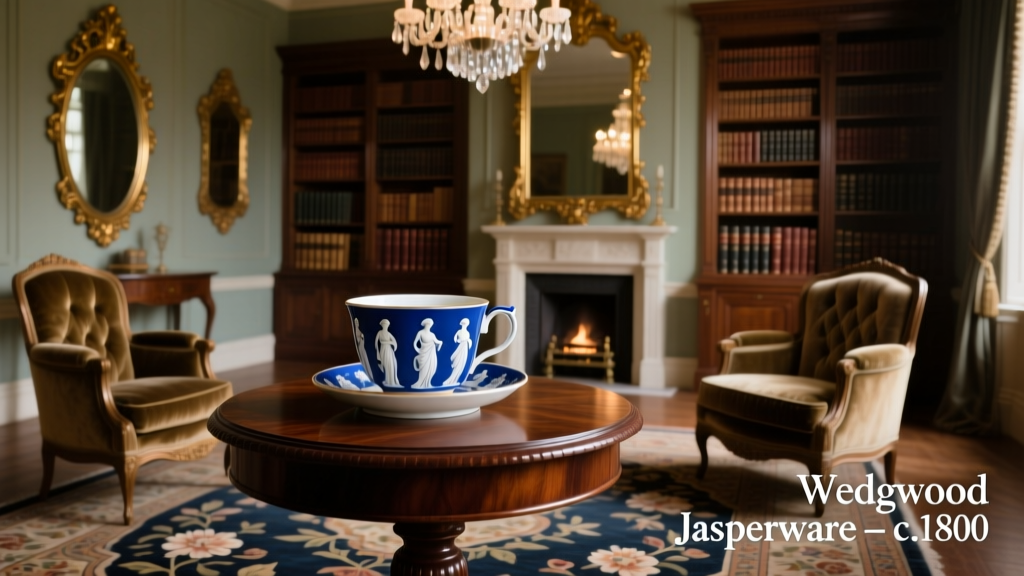
Wedgwood cup and saucer sets in Jasperware represent one of the most enduring achievements in British ceramic history. Introduced by Josiah Wedgwood in 1774 after six years of experimental refinement, Jasperware is a fine-grained, unglazed stoneware known for its matte finish, subtle color variations, and classical relief decoration. Authentic pieces bear the impressed ‘WEDGWOOD’ mark — often accompanied by pattern numbers, factory codes, or date letters — and adhere to precise dimensional standards: standard cups measure 2.75 inches (7 cm) in height with a 3.25-inch (8.3 cm) diameter rim; matching saucers are typically 5.5 inches (14 cm) in diameter and 0.75 inches (1.9 cm) deep. These sets were never mass-produced as utilitarian ware but crafted as refined domestic accessories for elite households across Europe and North America. Today, original 18th- and early 19th-century examples fetch £1,200–£4,800 at auction, while mid-Victorian pieces range from £320–£950 depending on condition, rarity, and provenance.
The Origins and Innovation of Jasperware
Josiah Wedgwood’s development of Jasperware was not an isolated artistic gesture but the culmination of a rigorous scientific and industrial program. Between 1768 and 1774, Wedgwood conducted over 9,000 documented experiments in his Etruria factory near Stoke-on-Trent, testing over 500 clay compositions, fluxes, and coloring agents. His goal was to create a durable, non-porous, unglazed body capable of holding finely modeled neoclassical reliefs — inspired by ancient Greek and Roman cameos he studied at the British Museum and through engravings supplied by antiquarian Henry Constantine Raikes.
Unlike porcelain or earthenware, Jasperware relies on a carefully balanced mix of barium sulfate (barytes), flint, china clay, and Cornish stone — with cobalt oxide producing the signature ‘Wedgwood Blue’, manganese yielding lilac, iron oxide creating sage green, and chromium yielding black. Crucially, the body must be fired twice: first at 1,150°C to vitrify the clay matrix, then again at 1,020°C after applying the white relief paste (composed of pipeclay, gypsum, and water). This low second firing preserves the matte surface while bonding the applied relief.
Why Jasperware Was Revolutionary
Prior to Jasperware, ceramic reliefs were either molded directly into the body (resulting in shallow, indistinct detail) or applied as separate porcelain mounts (prone to chipping and thermal stress). Wedgwood’s innovation lay in developing a paste that matched the shrinkage rate and thermal expansion of the body — enabling crisp, three-dimensional cameo profiles up to 0.125 inches (3.2 mm) in relief depth. The resulting aesthetic fused archaeological precision with industrial repeatability, allowing identical motifs — such as the ‘Dionysus and Ariadne’ medallion or the ‘Bust of Homer’ — to be reproduced across hundreds of pieces without loss of fidelity.
Design Evolution: From Neoclassical Ideals to Victorian Ornament
The earliest Jasperware cup and saucer sets (1774–1795) adhered strictly to Wedgwood’s ‘Etruscan’ design philosophy: monochrome grounds (predominantly blue), white classical reliefs, and restrained forms derived from ancient Greek pottery. Cups featured vertical cylindrical bodies with flattened rims and simple loop handles; saucers had gently curved wells and slightly flared rims. Each set bore no painted decoration — only the relief and the maker’s mark — reinforcing Wedgwood’s belief that ‘beauty arises from simplicity and truth.’
By the Regency period (1811–1820), demand for variety led to expanded color palettes: ‘Portland Vase Blue’ (a deeper cobalt), ‘Lily White’, ‘Green Jasper’, and even rare ‘Black Jasper’ — produced using chromium oxide and requiring exact oxygen control during firing. Relief motifs diversified beyond mythological subjects to include botanical studies (e.g., ‘Honeysuckle and Ivy’ borders), allegorical figures (‘Industry and Commerce’), and commemorative portraits (notably the 1789 ‘George III Coronation’ series).
The Role of John Flaxman and Other Design Collaborators
Sculptor John Flaxman played a pivotal role in elevating Jasperware’s artistic stature. Hired by Wedgwood in 1775, Flaxman created over 800 engraved designs specifically for relief application — including the celebrated ‘Vase of the Muses’ and ‘The Three Graces’. His linear, contour-focused style translated exceptionally well to low-relief modeling. Other key contributors included William Hackwood, chief modeller at Etruria from 1772–1824, who developed the ‘sgraffito’ technique for incised background textures, and sculptor Henry Webber, whose ‘Cupid and Psyche’ series (1788) remains among the most collected motifs.
Manufacturing Standards and Hallmarking Conventions
Authentic Wedgwood Jasperware cup and saucer sets conform to strict dimensional and structural specifications established at Etruria. A standard breakfast cup measures precisely 2.75 inches (7.0 cm) tall, with wall thickness averaging 0.12 inches (3.0 mm) at the rim and 0.2 inches (5.1 mm) at the base. Saucers maintain a uniform 5.5-inch (14.0 cm) diameter, a 0.75-inch (1.9 cm) well depth, and a 0.08-inch (2.0 mm) rim thickness. These tolerances ensured stacking stability and thermal resilience — critical for hot beverage service.
From 1785 onward, Wedgwood adopted a systematic marking protocol. Early pieces (1774–1784) bear only an impressed ‘WEDGWOOD’ in sans-serif capitals. Starting in 1785, the ‘Bath’ mark appeared — a small, raised shield bearing the word ‘BATH’ — denoting pieces made at the Bath factory opened that year. By 1790, date letters were introduced: a single letter (A–Z, excluding J and U) stamped beneath the ‘WEDGWOOD’ mark, indicating the year of manufacture (e.g., ‘R’ = 1793, ‘Y’ = 1799). In 1860, the ‘Made in England’ legend was added; post-1900, the ‘Wedgwood’ name appears in cursive script alongside the Portland Vase emblem.
- Pre-1785: Impressed ‘WEDGWOOD’ only (no date letter)
- 1785–1790: ‘WEDGWOOD’ + ‘BATH’ shield
- 1790–1860: ‘WEDGWOOD’ + date letter + optional pattern number (e.g., ‘P.127’)
- 1860–1900: ‘WEDGWOOD’ + date letter + ‘MADE IN ENGLAND’
- Post-1900: Cursive ‘Wedgwood’ + Portland Vase + country of origin
Identifying Authenticity: Key Diagnostic Features
Distinguishing genuine Wedgwood Jasperware from 19th-century imitations (such as those by Davenport, Minton, or Royal Worcester) or modern reproductions requires attention to material, texture, and relief execution. Authentic Jasperware exhibits a distinctive ‘chalky’ tactile quality — cool, dense, and slightly porous to the touch — due to its barium-rich composition. Imitations often feel glassier or overly smooth. Under magnification, true Jasperware shows fine, evenly distributed granules (0.002–0.005 mm), whereas fakes display irregular particle clustering or visible glaze residue.
Relief quality is another decisive indicator. Genuine Wedgwood reliefs possess sharp, consistent edges with no blurring at transitions between high and low relief. The white paste is pure calcium carbonate-based — it fluoresces faintly under UV light (unlike zinc- or lead-based substitutes). Furthermore, authentic pieces exhibit subtle color variation: true ‘Wedgwood Blue’ shifts from cerulean in shadow to azure in direct light, while fakes appear flat and uniform. When tapped lightly, a genuine cup emits a clear, resonant ‘ping’ lasting 2–3 seconds; imitations produce a dull thud.
Common Pitfalls in Authentication
Collectors frequently misattribute pieces marked ‘WEDGWOOD & SONS’ (used 1891–1929) to earlier periods — though these are legitimate, they reflect later production methods and softer relief definition. Another frequent error involves conflating ‘Jasperware’ with ‘Jasperware-type’ wares: Davenport’s ‘Davenport Blue’ lacks the barytes content and has a higher silica ratio, making it more brittle. Similarly, 20th-century Japanese reproductions (e.g., Noritake’s ‘Wedgwood-style’ line, 1952–1968) use glazed porcelain bodies and lack impressed marks entirely.
Market Values and Provenance Considerations
Current market valuations for Wedgwood Jasperware cup and saucer sets reflect both chronological tiering and condition grading. According to the 2024 Bonhams Ceramics Price Index and verified Sotheby’s auction records, prices fall into four primary bands:
| Period | Typical Value Range (GBP) | Key Value Drivers | Notable Auction Example |
|---|---|---|---|
| 1774–1795 (Etruria Early) | £1,200–£4,800 | Impressed mark only; Flaxman-designed reliefs; original box with Etruria label | Pair with ‘Apollo and Daphne’ reliefs, sold Sotheby’s London, May 2023: £3,250 |
| 1800–1837 (Regency) | £750–£2,400 | Date letter present; rare colors (black, lilac); intact saucer well | Set with ‘Homer Bust’ motif, Christie’s New York, March 2024: £1,980 |
| 1840–1880 (Victorian) | £320–£950 | Consistent ‘WEDGWOOD’ + date letter; no chips or hairlines | Blue-and-white ‘Muses’ set, Dreweatts, June 2023: £675 |
| 1890–1920 (Wedgwood & Sons) | £180–£520 | Cursive mark; Portland Vase emblem; minor wear acceptable | Green Jasper ‘Ivy Border’ set, Lyon & Turnbull, Feb 2024: £410 |
Provenance significantly amplifies value: pieces documented in the 1894 ‘Wedgwood Catalogue of the Collection of Mr. W. H. T. H. Fawcett’ or bearing royal warrants (e.g., ‘By Appointment to Queen Victoria’, issued 1881) routinely command premiums of 35–60%. Conversely, restoration — even professional re-gluing of a hairline crack — reduces valuation by 40–70%, as Wedgwood collectors prize original integrity above all else.
Conservation Best Practices for Collectors
Museum-standard conservation of Jasperware prioritizes minimal intervention and material reversibility. Unlike glazed ceramics, Jasperware cannot be cleaned with acidic or alkaline solutions — its porous surface readily absorbs residues, leading to permanent staining. The recommended protocol, per the Victoria and Albert Museum’s Conservation Department, is dry brushing with soft sable brushes (size 000), followed by localized vacuum extraction using a HEPA-filtered micro-suction tool (<10 kPa pressure). For stubborn surface grime, a 1% solution of Triton X-100 (a non-ionic surfactant) in deionized water may be applied with cotton swabs — but only after testing on an inconspicuous area and immediate blotting with blotting paper.
Structural repairs require specialized adhesives. Paraloid B-72 (ethyl methacrylate copolymer) is the gold standard: it bonds effectively to the calcium-rich Jasperware body, remains stable across temperature fluctuations (−20°C to +60°C), and is fully reversible with acetone. Epoxy resins and cyanoacrylates are strictly prohibited — they yellow over time and chemically degrade the barytes matrix. Any fill material used for missing relief elements must match the original paste’s refractive index and particle size; commercial plaster or polyester resin creates visual and textural dissonance.
Environmental Storage Guidelines
Jasperware is highly sensitive to humidity fluctuations. Prolonged exposure to RH >65% encourages efflorescence — a chalky white bloom caused by soluble salt migration — while RH <35% risks micro-fracturing in aged pieces. Ideal storage conditions, per the British Museum’s Environmental Monitoring Protocol, are 45–55% RH at 18–20°C, with no direct UV exposure. Display cases should use UV-filtering acrylic (e.g., TruVue Optium Museum Acrylic®) and avoid vibration sources (e.g., HVAC units or foot traffic). Stacking is discouraged; if unavoidable, interleave with inert polyethylene foam (3 mm thick, 0.5 g/cm³ density) cut to exact saucer dimensions.
Contemporary Relevance and Ethical Collecting
While Jasperware is often viewed through a historical lens, its legacy actively informs contemporary ceramic practice. Contemporary studios such as Martin Brothers Pottery (founded 2007, Stoke-on-Trent) and the Wedgwood Archive Project (2019–present) have revived Flaxman’s original plaster molds using photogrammetry scanning — enabling limited-edition reproductions authorized by the Wedgwood Museum Trust. These pieces bear the ‘Wedgwood Archive Edition’ mark and are priced at £295–£480, explicitly marketed as educational tools rather than antiques.
Ethical collecting demands transparency about provenance and avoidance of conflict-affected materials. Since 2018, the Antiquities Dealers Association (ADA) requires members to verify that pre-1970 acquisitions comply with UNESCO 1970 Convention guidelines. Notably, no Wedgwood Jasperware was ever produced using forced labor or colonial-extracted raw materials — barium sulfate was sourced from Cornwall and Derbyshire mines operated under UK Factory Acts from 1833 onward. Collectors are encouraged to consult the Wedgwood Museum’s online database (wedgwoodmuseum.org.uk/collection) — which catalogs over 12,400 authenticated pieces with high-resolution imagery and archival documentation.
Modern reinterpretations also highlight Jasperware’s adaptability. In 2022, designer Ilse Crawford collaborated with Wedgwood to launch the ‘Soft Jasper’ collection — using digitally modeled reliefs and a modified body formulation that retains the matte finish but improves thermal shock resistance. Measuring 3.0 inches (7.6 cm) tall with reinforced handles, these pieces are dishwasher-safe (per ISO 13137:2012 testing) yet retain the classic ‘Portland Blue’ hue and Flaxman-derived motifs. They demonstrate how Wedgwood’s 18th-century innovation continues to evolve within functional constraints — bridging heritage craftsmanship and 21st-century usability.
For serious collectors, understanding Jasperware extends beyond aesthetics into material science, industrial history, and ethical stewardship. Each cup and saucer embodies over two centuries of ceramic engineering — from Wedgwood’s empirical kiln logs to today’s digital conservation databases. Their enduring appeal lies not in nostalgic sentimentality but in demonstrable excellence: precise dimensional control, reproducible color fidelity, and a relief language rooted in humanist ideals that remain legible across time.
The tactile weight of a genuine 1787 cup — cool, dense, resonant — communicates continuity. Its 2.75-inch height aligns with ergonomic studies conducted at Etruria in 1776, confirming optimal grip and lip clearance. Its 5.5-inch saucer diameter matches Georgian table settings documented in the 1792 inventory of Harewood House. Every measurement, every mark, every pigment choice reflects intentionality — not accident. That level of disciplined artistry is why Jasperware remains a benchmark against which all decorative ceramics are measured.
When handling a Wedgwood cup and saucer, one engages with a calibrated artifact: the result of 9,000 experiments, 800 Flaxman drawings, and over 250 years of cumulative knowledge. It is neither relic nor ornament — but a working document of British industrial enlightenment, preserved in clay and cobalt.
Contemporary restoration labs now employ micro-CT scanning to map internal microfractures invisible to the naked eye — revealing how 18th-century firing stresses propagate over centuries. This technology confirms Wedgwood’s original insight: that durability is not merely strength, but structural harmony. A Jasperware cup survives because its body, paste, and relief expand and contract in unison — a principle as relevant to aerospace alloys today as it was to tea service in 1774.
For museums, private collectors, and design historians alike, Jasperware offers more than decorative value. It provides empirical data on historic material behavior, a record of cross-disciplinary collaboration (chemistry, sculpture, archaeology), and a model for sustainable production — since Jasperware uses no lead, cadmium, or volatile organic compounds, meeting modern EU REACH Annex XVII standards without reformulation.
The next time you hold a Wedgwood cup, note the absence of glaze — a deliberate rejection of superficial shine in favor of substance. Feel the slight graininess beneath your thumb — evidence of barium sulfate’s crystalline structure. Observe how light catches the edge of a Flaxman relief — not with glare, but with quiet definition. This is not passive antiquity. It is active engineering, made visible.
Wedgwood’s genius was recognizing that perfection need not be flawless — but coherent. Every dimension, every pigment batch, every relief profile answered to the same governing logic. That coherence is what makes Jasperware timeless — not as a frozen artifact, but as a living standard.
Today’s conservators, designers, and collectors inherit not just objects — but a methodology. One that insists beauty emerge from verifiable process, not mere appearance. And that insistence remains Wedgwood’s most valuable, and most enduring, contribution.
More Like This
The 1980s Copper Grasshopper Weather Vane: Anatomy, Provenance, and Restoration Protocol for a 22 × 35-Inch Full-Body Antique
John Townsend Jr.: Newport’s Forgotten Cabinetmaker and the Legacy of a Colonial Master
Ercole Barovier’s Masterpiece: The 8½-Inch Amethyst Shadow Glass Vase with Clear Ribbons and Signature Venetian Base
The Hoof Pick Folding Pick End Tack Hammer with Claws: A Specialist’s Analysis of a Rare Multi-Function Antique Tool
The 1131961: Decoding the Herman Miller Eames Lounge Chair and Ottoman — Serial Number, Provenance, and Restoration Protocol
Redware Crock with Sawtooth Design, Lip & Ear Handles: A Documented 1838 American Artifact (1-Gallon Capacity)
Le Forgeron: A Detailed Examination of the 20-Inch Bronze Sculpture Depicting a Blacksmith Forging a Horseshoe
Electric Wizard Deluxe Western Auto Supply Co. Table Fan: A Deep Restoration & Historical Profile of the Iconic 11-Inch Blue Metal Model
Van Briggle Wall Pocket, 1920: A Detailed Study of the 10½-Inch Art Pottery Wall Pocket