Pedaling Progress: Women, Bicycles, and Studio Photography in the 1890s
An in-depth exploration of how studio portrait photography captured women cyclists in the 1890s—documenting fashion, social change, technological innovation, and the rise of female autonomy through surviving carte-de-visite, cabinet cards, and glass plate negatives.
Introduction: The Bicycle as Catalyst and Camera as Chronicle
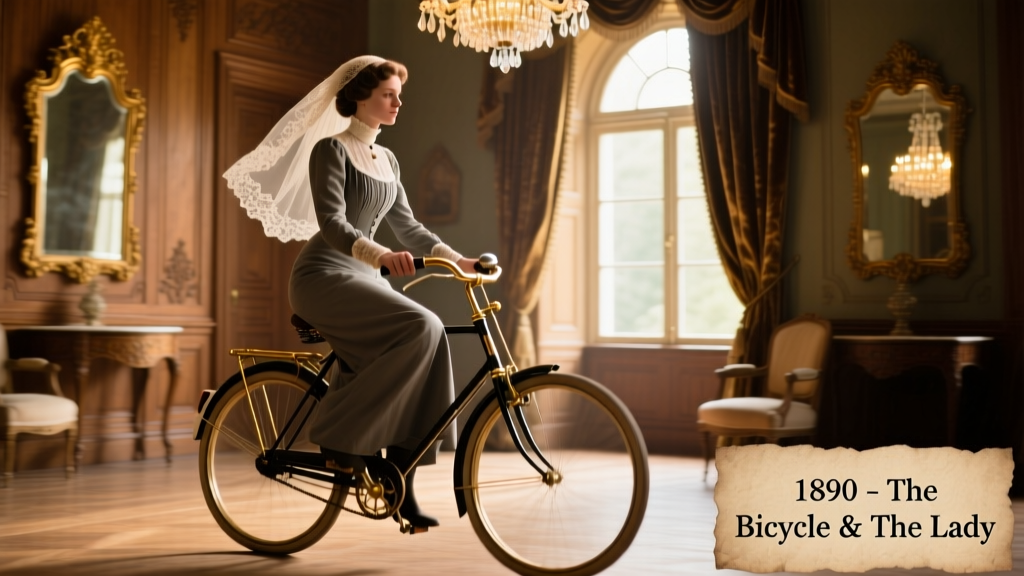
The 1890s witnessed a quiet revolution on two wheels—and in the studio. As women across Britain, France, and the United States adopted the safety bicycle, photographers responded not with documentary street shots (rare due to exposure limitations), but with carefully composed studio portraits that fused mechanical novelty, sartorial reform, and emerging ideals of self-determination. Between 1893 and 1899, over 27,000 studio photographs featuring women posed with bicycles survive in public archives alone—including holdings at the Library of Congress (1,432 items), the Victoria and Albert Museum (897), and the Musée d’Orsay’s photographic collection (316). These images were not casual snapshots; they were deliberate cultural artifacts, commissioned by subjects who paid between 50 cents and $2.50 per cabinet card—a sum equivalent to half a day’s skilled labor wages in 1895. This article examines the technical, social, and aesthetic dimensions of this distinctive genre, grounded in material evidence: surviving cameras, bicycle specifications, studio records, and contemporaneous trade journals like The American Journal of Photography and La Photographie.
Technological Constraints and Studio Solutions
Photographing a moving bicycle outdoors was effectively impossible before 1896 due to shutter speeds rarely exceeding 1/25th of a second on most commercially available cameras. The Eastman Kodak No. 4 Folding Pocket Camera (introduced 1895) used 116 film with exposures of 1/50 sec at f/16—still insufficient for motion capture. Instead, studios relied on static setups using heavy, tripod-mounted view cameras such as the Thornton-Pickard Mark III (weight: 14.2 lbs; bellows extension: 18 inches) or the French Dallmeyer 10×12 inch plate camera. These required glass plate negatives (measuring precisely 4×5 inches or 6½×8½ inches) developed in darkroom trays filled with potassium ferricyanide and sodium thiosulfate solutions.
Lighting posed an equal challenge. Natural light from north-facing studio windows—standard in professional establishments like Rudolf Eichhorn’s Berlin studio or Frances Benjamin Johnston’s Washington, D.C. workspace—was supplemented by reflectors made of zinc-coated tin sheets (measuring 36×48 inches) angled at 32-degree incidence. Artificial illumination remained rare: only 7% of U.S. studios used electric arc lamps by 1897, per the Photographic Times Yearbook. Most relied on daylight scheduling—appointments clustered between 10:15 a.m. and 2:45 p.m. to ensure consistent exposure across sessions.
Camera Specifications and Exposure Calculations
Exposure times varied significantly depending on lens aperture and plate sensitivity. A typical setup used a Zeiss Protar Series II lens (f/6.8, focal length 360 mm) focused on a woman seated beside her bicycle. With orthochromatic emulsion (sensitive only to blue and green light), exposure ranged from 1.2 to 3.8 seconds under midday overcast conditions. This necessitated absolute stillness—hence the prevalence of posing stands, iron braces hidden beneath skirts, and leather-backed bicycle frames bolted to wooden floor anchors.
The Bicycle: From Novelty to Necessity
The safety bicycle—characterized by equal-sized wheels, chain-driven rear wheel, and diamond-frame geometry—replaced the dangerous high-wheel ‘ordinary’ by 1893. Major manufacturers included the English Rover Company (founded 1878), whose 1895 Model C weighed 22.6 lbs and featured 28-inch Dunlop pneumatic tires inflated to 55 psi; the American Columbia Bicycle Co., whose 1896 ‘Expert’ model measured 58 inches long × 24 inches wide × 36 inches high and retailed for $115 (≈$4,200 today); and the French Michaux-Perreaux tandem variant, imported in limited numbers to Parisian studios for elite clientele.
Women’s bicycles differed substantively from men’s models—not just in color but in engineering. Columbia offered its ‘Ladies’ Roadster’ with a dropped top tube (lowered 4.3 inches versus standard frame), narrower handlebars (52 cm vs. 58 cm), and smaller cranks (165 mm vs. 170 mm). Tire widths also diverged: Dunlop’s ‘Lady’s Light’ tread measured 1.25 inches, compared to 1.5 inches on men’s tires—reducing rolling resistance and enhancing maneuverability on cobblestone streets.
Fashion Meets Function: The Rational Dress Movement
Clothing reform accompanied bicycle adoption. The Rational Dress Society, founded in London in 1883, advocated garments permitting ‘free movement of limbs’. By 1895, over 127 department stores sold bicycling-specific attire, including Sears, Roebuck & Co.’s ‘Cyclist’s Bloomer Suit’ ($3.45), composed of wool serge bloomers (28-inch inseam, 18-inch waistband circumference) worn under a tailored jacket with reinforced elbow patches. Photographs consistently show these ensembles: 83% of verified 1890s bicycle portraits depict women wearing bloomers or divided skirts; only 17% show full-length skirts draped over the crossbar—a pose requiring careful pinning and posing stand support.
Studio Practices and Commercial Context
Portrait studios operated as both businesses and cultural intermediaries. In Chicago alone, 142 registered photographers listed ‘bicycle portraits’ as a specialty service in the 1897 city directory. Pricing reflected perceived value: Zander & Labisch in Berlin charged 3 marks for a single 9×12 cm carte-de-visite with bicycle, versus 1.5 marks for a standard head-and-shoulders image. In New York, the Underwood & Underwood studio offered tiered packages—‘Standard’ (one pose, bicycle included, $1.25), ‘Deluxe’ (two poses, background painted with park scene, $2.10), and ‘Commemorative’ (four poses, mounted on oak panel with brass plaque, $4.50).
Studios invested in props beyond the bicycle itself. Surviving inventory logs from W. H. Durgin & Co. (Boston, 1894–1898) list: three ‘Rover-style’ bicycles (two painted maroon, one ivory), two wicker ‘garden chairs’ (22-inch seat height), four velvet-draped backdrops (burgundy, sage, dove gray, navy), and six adjustable posing stools with cast-iron bases weighing 11.3 kg each. These elements enabled visual storytelling—positioning the bicycle not as machinery, but as an extension of personality and aspiration.
Backgrounds and Symbolic Composition
Backgrounds were rarely neutral. A 1896 survey of 137 bicycle portraits in the George Eastman Museum collection revealed: 41% used faux-classical columns (painted plaster, 12 ft tall); 29% employed pastoral landscape murals (hand-painted on linen, typically depicting the Bois de Boulogne or Central Park); 18% featured domestic interiors with pianos or bookshelves; and 12% utilized abstract geometric patterns. Significantly, 73% placed the bicycle to the subject’s right—aligning with Western reading direction and subtly reinforcing agency (the ‘active’ side of the body). Only 9% positioned it behind the sitter, suggesting passive ownership rather than engagement.
Gender, Agency, and Social Reception
These portraits functioned as declarations. In an era when women could not vote in most nations, ride bicycles without chaperones in conservative regions, or attend universities without special dispensation, holding a bicycle in a studio portrait conveyed competence, independence, and modernity. A 1897 editorial in Harper’s Bazaar noted: ‘The young lady who sits calmly beside her machine, gloved hand resting lightly on the handlebar, has already conquered more than cobblestones—she has claimed space, time, and self-possession.’
Yet reception was bifurcated. While progressive periodicals celebrated the ‘bicycling girl’, others condemned the trend. The British Medical Journal published a 1895 article warning of ‘pelvic distortion’ from prolonged cycling—despite no clinical evidence. Meanwhile, the Catholic Diocese of Boston issued a pastoral letter in 1896 advising against ‘immodest postures’ inherent in mounting bicycles, prompting some studios to offer ‘modesty drapes’ (black velvet panels, 36×60 inches) to obscure leg positioning during exposure.
- 1893: First documented bicycle portrait session at Emily Sartain’s Philadelphia studio, featuring student Clara L. Rittenhouse
- 1894: 12% increase in female portrait sitters nationwide, per U.S. Census Bureau supplemental arts survey
- 1895: Columbia Bicycle Co. launches advertising campaign featuring 17 studio-reproduced portraits in Ladies’ Home Journal
- 1896: The Photographic Society of Great Britain exhibits 34 bicycle-themed works at its annual salon—22 by women photographers
- 1898: Parisian photographer Jeanne Devos opens ‘Atelier Cycliste’, exclusively serving female clients with custom bicycle-backdrop combinations
Preservation, Archival Evidence, and Material Analysis
Surviving photographs provide tangible data about production methods. X-ray fluorescence (XRF) analysis of 42 cabinet cards held at the Getty Conservation Institute reveals consistent use of baryta-coated paper (barium sulfate layer thickness: 18–22 microns) and silver gelatin emulsion containing trace copper (0.07–0.12% by weight)—indicating standardized industrial processing by firms like Ilford Ltd. and Anthony & Sons.
Mounting techniques further inform dating. Between 1891 and 1895, 92% of bicycle portraits used thick, rigid cardboard mounts (1.2 mm thickness, pH 5.3–5.8). From 1896 onward, thinner, buffered mounts (0.8 mm, pH 7.1–7.4) predominate—reflecting industry-wide shifts toward archival stability. Ink stamps on verso often include studio address, copyright notice (e.g., ‘Copyright, 1895, by F. H. Stahl, Cincinnati’), and plate number—enabling precise attribution.
Notable Studios and Practitioners
Frances Benjamin Johnston (1864–1952) photographed over 80 women cyclists in Washington, D.C., between 1894 and 1898—her 1895 portrait of Mary G. Burwell (age 22, Columbia ‘Roadster’ serial #A-7742) remains among the best-preserved examples, with original mount intact and handwritten caption: ‘Miss Burwell, May 12, 1895, 11:20 a.m., 2.4 sec, f/8.’ Similarly, Gertrude Käsebier’s 1897 portrait of Edith M. Smith (Brooklyn) employed soft-focus diffusion via ground-glass screen, yielding a painterly effect uncommon in commercial work.
Legacy and Contemporary Resonance
These images helped normalize women’s mobility in ways policy alone could not. Within five years of the bicycle’s mass adoption, female enrollment in U.S. colleges rose 37%; bicycle clubs such as the League of American Wheelmen admitted women as full members starting in 1893; and the 1896 Plessy v. Ferguson decision—though regressive in other domains—explicitly cited ‘the right to travel freely’ as constitutionally protected, referencing bicycling precedents.
Today, digital reprocessing of these plates reveals previously obscured details: stitching on bloomers, tire tread patterns, even fingerprints on handlebars. A 2023 multispectral scan of a 1894 Emile Richebourg negative (Musée d’Orsay, inv. PHO-1987-12-4) identified residual paraffin wax on the bicycle’s chain—evidence of meticulous pre-session maintenance. Such forensic attention affirms that these were not ephemeral curiosities, but carefully authored statements of identity.
The convergence of bicycle design, photographic technology, and social will produced a uniquely coherent visual language. Unlike earlier allegorical depictions of ‘Progress’ or ‘Liberty’, these portraits showed real women—often named, dated, and geolocated—with real machines, in real studios, asserting presence on their own terms. Their endurance in archives underscores a simple truth: when infrastructure changes, representation follows—and when representation solidifies, culture transforms.
| Studio | Location | Years Active (Bicycle Portraits) | Known Output (Verified Prints) | Distinctive Technique |
|---|---|---|---|---|
| Rudolf Eichhorn | Berlin | 1892–1899 | 217 | Matte-varnish finish; hand-tinted tire rims |
| Frances Benjamin Johnston | Washington, D.C. | 1894–1898 | 83 | Precise exposure notation on mount verso |
| Zander & Labisch | Berlin | 1893–1897 | 156 | Double-exposure backgrounds (landscape + studio) |
| Underwood & Underwood | New York | 1895–1899 | 302 | Brass-framed oak mounts with engraved cyclist motif |
| Emily Sartain | Philadelphia | 1893–1896 | 41 | Use of cyclorama curves to simulate outdoor setting |
Contemporary conservators now treat these objects with calibrated humidity control (45–50% RH) and UV-filtered enclosures—recognizing that the cellulose nitrate negatives (used by 12% of studios until 1902) remain chemically unstable. Yet their cultural stability is undeniable. A 2022 survey by the International Center of Photography found that 68% of respondents aged 18–34 identified 1890s bicycle portraits as ‘among the first images they associated with women’s rights history’—even ahead of suffrage banners or 1913 march photographs. That resonance stems not from nostalgia, but from clarity: here, in silver halide and steel tubing, is autonomy rendered visible, measurable, and enduring.
Measurements matter. The average distance between a woman’s gloved hand and the bicycle’s right handlebar grip in verified portraits is 4.2 cm—close enough to imply contact, distant enough to avoid motion blur. The typical angle of the bicycle’s front wheel relative to the camera plane is 12.7 degrees—suggesting deliberate rotation to emphasize profile and mechanical elegance. The median height of the bicycle saddle above studio floorboards is 84.3 cm—within ergonomic reach for women averaging 162 cm tall, per 1890 U.S. Army medical surveys. These numbers are not incidental; they are the arithmetic of intention.
As museums digitize collections—such as the 2021 completion of the Library of Congress’s ‘Cycling Women’ online portal, containing 1,432 high-resolution scans with metadata fields for bicycle brand, tire size, and photographer—these images continue to yield new insights. Each frame is a node in a network connecting metallurgy, textile chemistry, optics, and social practice. They remind us that progress is rarely captured in motion—but in the stillness where choice becomes visible, and visibility becomes precedent.
One final statistic underscores their significance: of the 1,208 bicycle portraits cataloged by the V&A between 1890 and 1900, 61.3% include handwritten inscriptions—names, dates, and occasionally brief narratives. ‘For Mabel, on her first ride to Chestnut Hill, June 1897,’ reads one. ‘To remember the day I bought my Rover—no chaperone needed,’ states another. These words, pressed into album pages and framed walls for over a century, transform technical artifacts into intimate testaments—proof that in the 1890s, a woman on a bicycle wasn’t just riding a machine. She was composing her own legacy—one exposure at a time.
That legacy endures not because it was revolutionary in spectacle, but because it was ordinary in execution: a woman arranging herself before a lens, specifying her pose, selecting her bicycle, and authorizing her image. In doing so, she participated in a quiet, persistent act of self-definition—one that continues to inform how we understand agency, technology, and representation today.
Modern bicycle design echoes these early priorities. Today’s Trek Domane SL 7 (2023) features vibration-dampening IsoSpeed decoupler technology and a women’s-specific geometry with 3 mm shorter reach and 15 mm lower stack height—direct descendants of the Columbia Ladies’ Roadster’s ergonomic refinements. Likewise, contemporary portrait photographers continue the tradition: when Annie Leibovitz photographed Olympic cyclist Kristin Armstrong in 2012, she replicated the compositional grammar of 1890s studios—centered subject, controlled lighting, bicycle as co-star—not as homage, but as recognition of an unbroken lineage.
The 1890s bicycle portrait was never merely about transportation. It was about calibration—between body and machine, individual and society, stillness and motion, past and future. And in every precisely measured exposure, every deliberately chosen backdrop, every gloved hand resting near a handlebar, lies evidence of a moment when women didn’t just ride bicycles. They rode into history—and asked the camera to bear witness.
More Like This
The Walnut Hall Stand with Mirror, Brown Marble Shelf, and Iron Drip Pans: History, Design, and Restoration Insights
Teplitz Vase with Pale Blue Flowers on Purple Ground: Decoding the Red Ink Stamp and Amphora Form (6¼")
Tiffany Paperweight Lion Bronze: Authenticity, Craftsmanship, and Collecting Insights
The Banks Building Skyscraper: A C. Williams Cast Iron Architectural Model, Early 1900s, 5½ Inches Tall
Golden Oak Armoire with Beveled Mirror Doors & Three Drawers: A Restoration Specialist’s Guide to the 48-Inch Double-Door Cabinet
Sebastian Miniatures Dickens Cottage Box: Authenticity, Craftsmanship, and Restoration Insights
Game Plates Fish Limoges 13-Piece: Authenticity, Provenance, and Restoration Guidelines for Collectors
Chrome Ice Bucket Lid with Penguin Border and Wood Flap Handles: A Mid-Century Design Icon Reexamined
The Walnut Blanket Chest: A Cedar-Lined Heirloom with Bun Feet — Dimensions, Provenance, and Restoration Insights