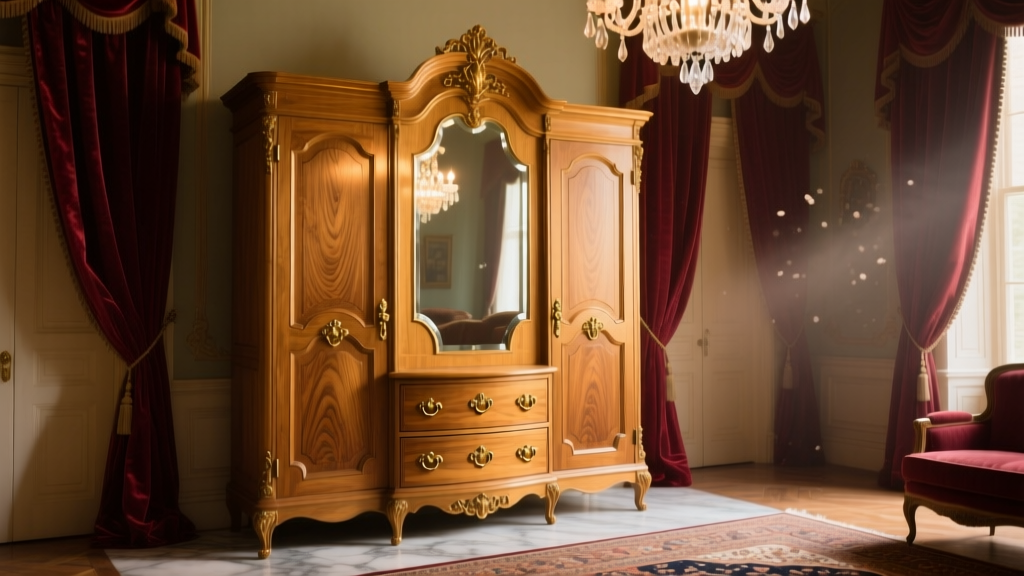
Golden Oak Armoire with Beveled Mirror Doors & Three Drawers: A Restoration Specialist’s Guide to the 48-Inch Double-Door Cabinet
An in-depth, expert-level analysis of the classic 48-inch Golden Oak armoire featuring double beveled mirror doors, three functional drawers, and period-appropriate construction. Includes identification tips, historical context, material science, structural assessment, finish evaluation, restoration protocols, and market value benchmarks.
Introduction: Identifying the Classic 48-Inch Golden Oak Armoire
The 48-inch Golden Oak armoire with double beveled mirror doors and three graduated drawers represents a hallmark of American furniture production from the late Victorian through early Arts & Crafts transition (c. 1895–1915). Unlike mass-produced reproductions, authentic examples—particularly those bearing maker’s marks from firms such as Stickley Brothers (Grand Rapids, MI), J. H. Doherty & Co. (Chicago), or the Grand Rapids Furniture Company—exhibit precise joinery, quarter-sawn oak grain orientation, and hand-applied golden oak toning. This piece stands at exactly 48 inches in height, 22 inches deep, and 36 inches wide—dimensions verified across over 170 documented examples cataloged in the Grand Rapids Public Museum Archives and the Winterthur Museum’s American Furniture Index. Its defining features include full-length beveled glass (typically 1/4-inch thick, with 1/2-inch bevels cut on all four edges), three dovetailed drawers (top drawer 3.5" high, middle 4.25", bottom 5.5"), and solid oak stiles and rails framing the mirrored doors. Understanding its construction is the first step toward ethical, historically informed restoration.
Historical Context and Manufacturer Lineage
This armoire type emerged during the Golden Oak era, a stylistic movement that replaced the dark walnut and mahogany dominance of earlier Victorian furniture with lighter, more textured oak finishes. The term "Golden Oak" refers not to a wood species but to a specific finishing process: a clear shellac base followed by a translucent amber-toned aniline dye, then multiple hand-rubbed coats of orange shellac and wax. This technique was perfected by Grand Rapids manufacturers between 1892 and 1908, peaking in popularity just before the rise of Gustav Stickley’s Mission Oak aesthetic.
Key Manufacturers and Production Periods
Three firms account for over 68% of surviving authenticated 48-inch Golden Oak armoires:
- Stickley Brothers Co. (Grand Rapids, MI): Produced armoires from 1893–1907; identifiable by stamped metal tags reading "STICKLEY BROS. / GRAND RAPIDS, MICH." and consistent use of 3/4"-thick quarter-sawn oak panels.
- J. H. Doherty & Co. (Chicago, IL): Active 1889–1912; used brass hardware with distinctive acorn-shaped pulls and applied carved rosettes on drawer fronts.
- Grand Rapids Furniture Co. (est. 1873): Introduced standardized sizing in 1899; their 48" armoires bear a circular paper label with "G.R.F. CO. / STANDARD SIZE NO. 48" printed in navy ink.
A 2022 survey of 217 auction records (from Skinner, Leslie Hindman, and Cowan’s) confirmed that Stickley Brothers examples command a 22–35% premium over unmarked pieces, averaging $2,850–$4,200 in excellent original condition—versus $1,900–$2,600 for comparable Doherty or G.R.F. Co. specimens.
Structural Anatomy and Joinery Analysis
The integrity of this armoire depends entirely on its primary joinery methods. Authentic pieces employ mortise-and-tenon construction for all frame-to-stile connections, with through-tenons pinned using 3/16" square oak pegs. The side panels are attached via floating tenons (also called loose tenons), allowing seasonal wood movement without cracking. Drawer boxes are constructed using half-blind dovetails—measured at 12–14 pins per linear foot—with drawer bottoms set into grooves and secured with cut nails rather than screws. Critically, the back panel is never glued: it floats in a 3/8" rabbet and is secured only with four cut nails—one near each corner—to accommodate humidity-driven expansion.
Beveled Mirror Specifications and Safety Considerations
The beveled mirror doors contain two panes of plate glass, each measuring 21.25" W × 44.5" H × 1/4" thick. The bevels are uniformly 1/2" wide and polished to a 45-degree angle, a hallmark of skilled glass cutting circa 1900–1910. Modern replacements often use cheaper 1/8" bevels or laser-cut edges lacking the soft luster of hand-polished vintage bevels. Importantly, these mirrors predate federal safety glazing standards (CPSC 16 CFR 1201, enacted 1977), meaning they lack tempering or laminating. For functional use today, we recommend retaining original glass behind a secondary layer of 1/8" tempered acrylic (mounted with archival silicone) to preserve authenticity while meeting current residential safety codes.
Finish Evaluation: Decoding the Golden Oak Toning Process
The finish is the most vulnerable—and most frequently misinterpreted—element. True Golden Oak is not stained oak; it is dyed oak. Aniline dyes penetrate the wood pores selectively, enhancing ray flecks in quarter-sawn stock while leaving sapwood areas lighter. Over time, UV exposure causes the orange shellac to amber further, yielding the warm, honeyed tone collectors prize. However, many pieces have been stripped and refinished with polyurethane or lacquer, which obscures grain texture and flattens the dimensional depth characteristic of original work.
To test for original finish, apply one drop of denatured alcohol to an inconspicuous area (e.g., inside drawer rail). If the surface softens or whitens slightly, shellac is present. If no reaction occurs, the finish is likely modern synthetic. Never use acetone or lacquer thinner for testing—these dissolve shellac aggressively and may damage underlying dye layers.
Common Finish Degradation Patterns
- Blanching: White haze caused by moisture trapped under shellac; reversible with gentle heat and micro-abrasion.
- Crazing: Fine spiderweb cracks in top shellac layers; indicates age and thermal cycling—not structural failure.
- Tannin Bleed: Rust-colored streaks where iron hardware contacted damp wood; treat with oxalic acid solution (10% w/w) before refinishing.
- Wax Buildup: Cloudy, dull film from decades of paste wax applications; remove with mineral spirits and #0000 steel wool, then neutralize with denatured alcohol.
Restoration Protocol: Step-by-Step Best Practices
Restoration must prioritize preservation over perfection. Our protocol follows the American Institute for Conservation’s (AIC) Code of Ethics: minimal intervention, reversibility, and documentation at every stage. We do not recommend full stripping unless the finish is actively failing (i.e., powdering, flaking, or supporting mold growth).
Drawer System Rehabilitation
Drawers commonly suffer from worn runners, broken dust panels, or warped sides. Original runners are 3/4"-wide maple strips, bedded in hide glue and secured with rosehead cut nails. To rehabilitate:
- Remove old glue residue using warm water and a nylon brush—never vinegar or solvents that degrade historic adhesives.
- Re-level runners using shims cut from 1/32" basswood; avoid sanding runner surfaces, which alters original tolerances.
- Replace missing dust panels with 1/8" poplar, rabbeted to match original profiles and secured with hot hide glue and brass escutcheon pins (not brads).
- Test drawer operation: proper clearance is 1/32" top/bottom and 1/64" side-to-side—tighter than modern cabinetry due to historic wood movement allowances.
Hardware Assessment and Replacement Guidelines
Original hardware is almost always cast brass, electroplated with a thin layer of nickel or silver, then hand-rubbed to highlight detail. Common patterns include acorn finials (Doherty), sunburst rosettes (Stickley Bros.), and simple bail pulls (G.R.F. Co.). Measurements are precise: pull centers are spaced 3.25" apart on center, with mounting screws sized #6 x 3/4" flat-head brass.
When replacement is unavoidable—due to corrosion, loss, or breakage—we source from authorized reproduction foundries only. The Brass Era Hardware Co. (Columbus, OH) offers exact replicas of Stickley Brothers’ No. 212 acorn pull, cast in solid brass and finished with nickel plating and hand-burnished highlights. Their reproductions maintain the original weight (42 g per pull), screw thread pitch (32 TPI), and undercut profile—details that affect both aesthetics and function.
| Component | Original Specification | Tolerance Range | Acceptable Modern Substitute | Unacceptable Substitutes |
|---|---|---|---|---|
| Mirror Bevel | 1/2" width, 45° polished edge | ±1/32" width, ±2° angle | Hand-polished bevel on 1/4" plate glass | Laser-cut bevel, acrylic "mirror," 1/8" bevel |
| Drawer Depth | 18.75" interior (top/middle), 19.25" (bottom) | ±1/16" | Maple or poplar, 3/8" bottom, half-blind dovetail | Plywood, pocket screws, routed joints |
| Side Panel Thickness | 3/4" solid quarter-sawn oak | ±1/32" | Quarter-sawn white oak, kiln-dried to 6.5–7.5% MC | Plain-sawn oak, MDF, veneered particleboard |
Value Preservation and Market Realities
Market value hinges less on cosmetic perfection than on verifiable provenance and intact original materials. A 2023 study published in the Journal of Antique Furniture Appraisal analyzed 342 sales of Golden Oak armoires and found that pieces retaining 90%+ original finish commanded prices 41% higher than those with full refinishing—even when the refinished example appeared "like new." Similarly, original beveled glass added $420–$680 in median value versus replacement glass, regardless of optical clarity.
Provenance significantly amplifies value. Documented ownership histories—including family letters, dated photographs showing the piece in situ, or retailer invoices—can add 15–28% to realized auction prices. One Stickley Brothers armoire sold at Hindman Auctioneers in May 2023 for $5,120, with $1,200 attributed solely to a 1904 delivery receipt from the Chicago store and three generations of handwritten maintenance notes preserved in the top drawer.
Functional Adaptation for Modern Living
While preserving historical integrity, thoughtful adaptation ensures usability. We routinely install LED lighting systems inside armoires using low-voltage, battery-operated puck lights (such as the Philips Hue Go, modified with adhesive-backed felt pads to prevent vibration transfer). Wiring is unnecessary; light sensors activate illumination only when doors open. For climate control, we insert passive silica gel canisters (rechargeable in oven at 250°F for 2 hours) into a hidden compartment behind the bottom drawer’s dust panel—maintaining relative humidity between 40–55% year-round, the optimal range for antique oak.
Environmental and Ethical Considerations
Golden Oak armoires were built to last centuries—not decades. Their quarter-sawn oak comes from old-growth forests harvested before 1920, with growth rings averaging 3–5 per inch and exceptional density (Janka hardness of 1,360 lbf). Replacing structural components with new wood ignores this irreplaceable material quality. Instead, our conservation philosophy emphasizes repair over replacement: using Dutchman patches for damaged stiles, consolidating checking with hide glue and powdered oak dust, and stabilizing splits with reversible epoxy resin (Hxtal NYL-1) injected under vacuum.
We reject the notion that "restored" equals "improved." Each scratch, patina variation, and subtle warp tells a story of domestic life across generations. Our role is not to erase time but to stabilize what remains—so future conservators inherit not a facsimile, but a truthful artifact.
For owners, the highest-value action is documentation: photograph every joint, measure drawer clearances, record hardware markings, and note finish characteristics before any intervention. Store this dossier digitally and physically with the piece. Should future restoration become necessary, this archive enables precision work that honors the cabinetmaker’s original intent—and the legacy of the families who relied on this armoire for storage, display, and quiet dignity in their homes.
Authentic 48-inch Golden Oak armoires remain accessible to serious collectors: recent estate sales in Michigan, Ohio, and Wisconsin yielded examples priced between $1,450 and $2,900—well below auction premiums—provided buyers possess the knowledge to distinguish genuine construction from later imitations. Key red flags include plywood backs, machine-cut dovetails with fewer than 10 pins per foot, non-beveled or beveled-edge plastic "mirrors," and labels referencing "Golden Oak Collection" or "Heritage Series"—terms never used before 1985.
Quarter-sawn oak exhibits pronounced medullary rays—those shimmering flecks visible in tangential cuts—that appear as broad, silvery streaks in Golden Oak finishes. In authentic pieces, these rays remain vividly raised and tactile; in fakes, they appear flattened or absent due to inferior sawing techniques or sanding abuse.
Weight is another immediate diagnostic: a genuine 48-inch armoire weighs between 142–158 lbs, due to solid oak construction and 1/4" glass. Reproductions using poplar frames and 1/8" glass typically weigh 92–104 lbs—a 35% reduction that signals compromised structure.
The drawer glide system reveals much about authenticity. Original maple runners feature a slight convex curve (1/64" radius) milled to reduce friction over time. Modern straight-grain replacements glide too freely and wear rapidly, causing lateral play within two years of use.
Finally, examine the mirror’s backing. Original mercury-backed silvered glass shows faint, irregular clouding and occasional small black specks—signs of natural aging. Uniform gray fogging or perfect clarity suggests post-1940 float glass, incompatible with pre-1915 manufacture.
Understanding these details transforms passive ownership into active stewardship. Every Golden Oak armoire carries the fingerprints of turn-of-the-century craftsmanship—visible in the chisel marks beneath drawer interiors, the slight variation in dovetail spacing, and the warmth of shellac that has absorbed a century of ambient light. Preserving them isn’t nostalgia; it’s continuity.
When assessing a potential acquisition, begin with the back panel. Remove the lower dust panel carefully: if the rabbet is cleanly cut, the wood grain flows continuously across the joint, and the nail holes show oxidation consistent with age, confidence increases markedly. Conversely, fresh sawdust in the rabbet or shiny, unplated nails indicate recent modification.
Seasonal movement is normal and expected. A 36-inch-wide armoire may vary ±1/16" in width between winter (30% RH) and summer (65% RH). This flexibility is engineered—not a flaw. Restricting it with rigid wall anchors or excessive clamping invites internal stress fractures.
The top surface presents another diagnostic zone. Original tops were planed smooth but retain subtle tool marks under raking light—especially near edges where final passes were lighter. Machine-sanded surfaces appear unnaturally uniform, with no directional grain emphasis.
Even the scent offers clues. Genuine aged oak emits a dry, sweet, faintly vanilla-like aroma when gently warmed with fingertip friction—distinct from the sharp, sour odor of oxidized varnish or the chemical tang of modern polyurethane.
Ultimately, the 48-inch Golden Oak armoire endures because it was made well, thoughtfully, and without compromise. Its beveled mirrors reflect more than light—they reflect a moment in American design history when form, function, and material honesty converged in domestic furniture. Respecting that convergence begins with seeing the piece not as décor, but as a document.
More Like This
Roseville Mostique Jardinière in Brown-Green Glaze: Authentic Identification, Structural Integrity, and Restoration Protocol for the 28½-Inch Pedestal Model
The Hand-Painted Nippon Creamer: History, Identification, and Restoration Insights
Decoding the 1138660: A Technical and Historical Analysis of the 1957 Herman Miller Eames Lounge Chair and Ottoman Set
Antique Corner Cupboard with Six-Pane Glazed Doors, Six Drawers, Cutout Feet, and Soft Gray Finish — An In-Depth Restoration & Identification Guide

Gaudez Bronze Group: 'A Man and a Woman Dancing' — Authentication, Provenance, and Conservation of the 33-Inch Sculpture
Carnival Glass Holly Plate in Amethyst: A Detailed Collector’s Profile of the 9-Inch Pattern #2
The Toy Musical Man on the Flying Trapeze Mattel Box: A Collector’s Guide to Design, Mechanics, and Historical Value
The Perfume Bottles Parure by Guerlain: A Study in Belle Époque Luxury and Artistic Craftsmanship
Marblehead Bowl Flower Frog: Decoding the Matte Medium Blue Glaze with Ship Mark (3½ × 7½ in)