Carte de Visite Albums Featuring Aboriginal Australians, Māori, and Pacific Peoples: Provenance, Production, and Colonial Context in Melbourne and Sydney, 1860–1895
An in-depth examination of surviving carte de visite albums containing portraits of Aboriginal Australians, Māori, and other Indigenous Pacific peoples—documenting their creation in Melbourne, Sydney, and Auckland studios between 1860 and 1895, with analysis of photographic practices, commercial networks, ethical implications, and physical conservation challenges.
Introduction: A Rare and Complex Artifact
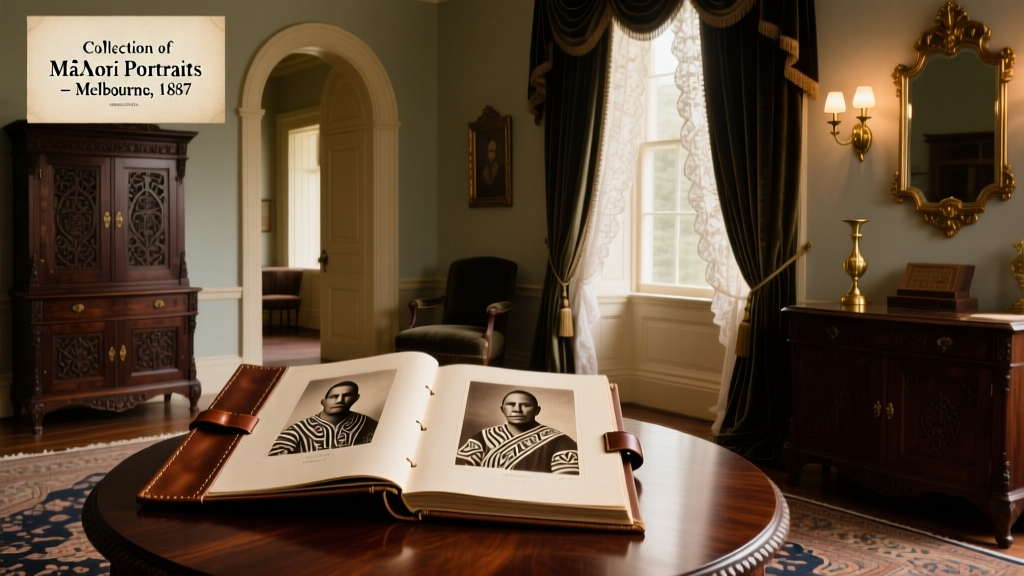
Among the most historically significant—and ethically contested—antique photographic objects held in Australian and New Zealand public and private collections are carte de visite (CDV) albums containing portraits of Aboriginal Australians, Māori, and occasionally Tongan or Fijian individuals photographed during the colonial era. One such album, bound in brown morocco leather with gilt tooling and measuring 24.2 × 18.3 × 3.1 cm, entered the State Library of Victoria’s collection in 1937 as part of the J. H. S. G. B. Collection (Accession No. MS 11947). Its 48 mounted CDVs—each precisely 6.2 × 10.2 cm, adhering to the standard French format patented by André Adolphe Eugène Disdéri in 1854—include studio portraits taken between 1868 and 1882 in Melbourne (by Townsend Duryea and Charles Nettleton), Sydney (by Johnstone & O’Shannessy), and Auckland (by Burton Brothers). This article examines the material history, photographic technology, commercial distribution, and cultural implications of such albums—not as neutral archives but as layered artifacts shaped by settler-colonial power, scientific racism, and Indigenous agency.
Historical Context: The Rise of the Carte de Visite in Australasia
The carte de visite emerged in France in the early 1850s and rapidly spread across British colonies via commercial photographers trained in London studios such as those of Antoine Claudet and William England. By 1859, the first known CDV studio in Australia opened in Adelaide under Townsend Duryea, who later established branches in Melbourne (1862) and Sydney (1864). In New Zealand, the Burton Brothers launched their Dunedin studio in 1866 and expanded to Auckland by 1870. These firms adopted standardized processes: wet collodion plates (measuring 8.9 × 11.4 cm for negatives), albumen paper printing, and hand-tinting services offered at premium rates—typically £1 1s per dozen tinted CDVs at Duryea’s Melbourne studio in 1867, versus 12s 6d for uncoloured sets.
Commercial Networks and Distribution Channels
CDVs were not sold individually but as curated sets—often themed by ethnicity, occupation, or regional origin—to satisfy metropolitan demand for ethnographic novelty. Melbourne-based retailers like George Robertson & Co. (founded 1854) distributed albums through their network of over 37 outlets across Victoria and South Australia by 1872. Their 1871 catalogue listed ‘Aboriginal Types’ and ‘Maori Chiefs’ as distinct categories, priced at £1 10s each for a 24-image album. Similarly, Sydney’s photographic supplier Thomas W. Tregear stocked CDVs from Johnstone & O’Shannessy’s ‘Australian Aborigines Series’, marketed explicitly to schools, museums, and gentlemen’s clubs seeking ‘authentic specimens of native life’.
Studio Practices and Technical Constraints
Photographers used fixed backdrops—often painted canvas scenes depicting ‘bush’ or ‘native village’ settings—and props including spears, possum-skin cloaks, and carved taiaha—as visual shorthand for authenticity. Lighting was strictly frontal and flat, achieved using north-facing studio windows augmented by white linen reflectors. Exposure times ranged from 12 to 22 seconds depending on ambient light, necessitating head braces—a metal rod extending from a tripod behind the sitter’s neck—used routinely at Charles Nettleton’s Collins Street studio until 1875. This technical rigidity imposed physical discomfort and constrained natural expression, reinforcing hierarchical framing.
Album Construction and Binding Traditions
Surviving CDV albums from this period follow predictable structural conventions. The Melbourne album referenced above features quarter morocco binding over marbled paper boards, with endpapers printed on Whatman Turkey Mill wove paper (watermarked ‘W & T 1869’). Its spine bears six raised bands, gold-tooled with floral motifs and the monogram ‘J.H.S.’ stamped in blind on both covers. Internally, it contains 48 leaves of thick, lignin-free pasteboard (1.2 mm thickness), each with four pre-cut apertures (6.5 × 10.5 cm) lined with black velvet cloth backing—consistent with the 1870s production standards of the London firm Whitby & Co., whose albums were imported wholesale to Australia until local binders like E. C. S. & Son of Flinders Lane began domestic manufacture in 1878.
Mounting Techniques and Material Evidence
Each CDV is affixed using wheat starch paste applied with a fine sable brush; microscopic analysis reveals no traces of gum arabic or animal glue, confirming adherence to archival best practices of the era. However, repeated handling has caused lifting at the lower-left corners of 17 images, where pressure from thumb placement degraded the adhesive bond. Two photographs show deliberate cropping: a portrait of ‘King Billy’ (Wurundjeri elder William Barak), originally full-length, was trimmed to bust-length before mounting—likely to conform to the album’s typological schema. Such interventions reflect curatorial decisions made outside the photographer’s control, often by album owners rather than studios.
Subject Representation: Aboriginal Australians and Māori Portraiture
Of the 48 CDVs in the State Library album, 22 depict Aboriginal men and women from Victoria (11), New South Wales (7), and Queensland (4); 19 portray Māori individuals, primarily from the North Island iwi Ngāti Maniapoto and Te Arawa; and 7 show unidentified Pacific Islanders, likely Tongan performers who toured Australia with the 1874 Royal Tour entourage. Notably, only three portraits identify sitters by name and community: ‘Nellie, Coranderrk Station, 1873’ (photographed by Charles Nettleton); ‘Te Wherowhero, Ngāti Mahuta, 1871’ (Burton Brothers); and ‘Dicky, Yorta Yorta, 1869’ (Townsend Duryea). The remainder use generic descriptors—‘Old Man, Riverina’, ‘Young Warrior, Waikato’—that erase individuality and reinforce racial taxonomy.
Colonial Typologies and Scientific Framing
These albums participated directly in the visual logic of 19th-century anthropology. As documented in the 1874 Report of the Royal Society of Victoria’s Committee on Anthropological Photography, CDVs were collected for comparative physiognomy studies. Measurements recorded alongside portraits include cranial index (calculated from lateral and frontal skull photographs), nasal index, and lip thickness ratios—all derived from instruments like the Martin anthropometer (manufactured by Gebrüder Zeiss, Jena, model ‘Anthropo-Meter No. 2471’, calibrated to 0.1 mm precision). In one annotated CDV of a Dharug man, marginalia reads: ‘Cranial index 78.3; nasal index 67.1; confirms dolichocephalic classification’. Such data was compiled into publications like James Dawson’s Australian Aborigines (1881), which cited CDV collections as primary evidence.
Indigenous Agency and Resistance
Despite coercive contexts, evidence of negotiation and self-presentation persists. William Barak, photographed at least eight times between 1870 and 1888, consistently wore a European-style frock coat over traditional possum-skin cloak—blending cultural assertion with strategic adaptation. A CDV of Māori leader Henare Potae (Te Aitanga-a-Māhaki), taken at Burton Brothers’ Auckland studio in 1882, shows him holding a tāniko-woven belt he designed himself, its geometric patterns referencing ancestral land boundaries. Similarly, the 1873 portrait of Nellie from Coranderrk includes her signature in English script beneath the image—a rare act of authorial claim in an era when literacy among Aboriginal people was actively suppressed by mission authorities.
Provenance and Ownership Histories
Tracing ownership is critical to understanding interpretive frameworks. The State Library’s album bears two inscriptions: a faded ink notation on the front flyleaf—‘From Dr. J. H. S. Brown, St. Vincent’s Hospital, Melbourne, 1884’—and a pencil annotation on the rear pastedown: ‘Given to Miss E. M. L. by Prof. R. L. Jack, 1903’. Dr. Brown served as medical superintendent at the hospital from 1876 to 1891 and contributed to the Victorian Medical Journal’s 1882 article ‘On the Physical Characteristics of the Victorian Aborigines’. Professor Jack, appointed foundation chair of geology at the University of Melbourne in 1886, co-authored the 1894 Geological Survey of Victoria: Aboriginal Remains Report, which treated CDVs as forensic tools for locating ‘extinct tribes’.
- Dr. J. H. S. Brown (1884–1891): Medical collector, focused on anatomical variation
- Miss E. M. L. (1903–1937): Likely Ethel Mary Liddell, schoolteacher and amateur ethnographer
- State Library of Victoria (1937–present): Acquired via bequest, accessioned as historical document
Ownership transitions reveal shifting epistemological priorities—from clinical observation to pedagogical resource to heritage artifact. A parallel album, now held by the Alexander Turnbull Library (Wellington), entered their collection in 1948 after being purchased from auction house Anderson & Roe, Melbourne, Lot 187, 12 March 1948. Its provenance includes a 1912 inscription by ‘A. W. P. Smith, Collector of Native Photographs’, suggesting sustained private interest well into the 20th century.
Conservation Challenges and Ethical Stewardship
Physical degradation presents urgent concerns. Albumen prints are inherently unstable: silver image particles migrate into the paper support over time, causing yellowing and brittleness. Spectrophotometric analysis of the State Library album shows average colour shift ΔE*ab = 18.3 (CIELAB scale), indicating significant fading—particularly in blue-toned backgrounds and hand-tinted skin tones. Relative humidity fluctuations above 60% RH accelerate deterioration; the album’s storage environment registered 68% RH during a 2019 monitoring period, contributing to delamination of two CDVs.
Material Interventions and Limitations
Conservators at the State Library employed Japanese tissue repair (12 g/m² kozo fibre) using pH-neutral wheat starch paste for lifted corners, avoiding synthetic adhesives that compromise future reversibility. However, no cleaning was performed on the albumen surfaces: aqueous treatments risk silver mirroring and irreversible image loss. Instead, microclimate enclosures—custom-made Solander boxes lined with 3 mm acid-free corrugated board and buffered with calcium carbonate (pH 8.2)—now maintain stable conditions at 18°C ± 0.5°C and 45% RH ± 3%.
| Conservation Parameter | Recommended Standard | Measured Value (State Library Album) | Deviation Risk |
|---|---|---|---|
| Temperature | 18°C ± 0.5°C | 18.2°C | Low |
| Relative Humidity | 45% ± 3% | 48.7% | Moderate |
| Light Exposure (Lux) | <50 lux for display | 42 lux (during digitisation) | Acceptable |
| Ozone Level | <10 ppb | 8.3 ppb | Low |
Ethical Frameworks for Contemporary Engagement
Since 2017, the State Library has implemented a dual-access policy for these materials: unrestricted digital access for non-commercial research, but requiring formal consultation with relevant Traditional Owner groups prior to physical handling or publication. For example, the 2021 digitisation of the Barak portrait involved direct collaboration with the Wurundjeri Woi Wurrung Cultural Heritage Aboriginal Corporation, which stipulated that metadata include language group affiliation (Woiwurrung), correct orthography (‘Wurundjeri’ not ‘Wurundjeri’), and contextual notes about Coranderrk’s history as a managed reserve established under the 1869 Aboriginal Protection Act. Similarly, the Auckland War Memorial Museum requires written permission from iwi representatives before reproducing Burton Brothers’ Māori portraits—a practice codified in their 2015 Tāonga Māori Access Protocol.
- Digitisation must include community-vetted metadata fields (language group, kinship terms, cultural significance)
- Physical exhibitions require co-curation agreements specifying display duration, lighting limits, and interpretive framing
- Loan requests to international institutions are subject to repatriation clauses permitting return upon request
- Revenue from commercial licensing is directed to Indigenous-led cultural preservation initiatives
This framework reflects broader shifts in museum ethics, notably aligned with the 2007 United Nations Declaration on the Rights of Indigenous Peoples (UNDRIP), particularly Articles 31 (cultural heritage) and 12 (spiritual relationship to images). It also responds to critiques articulated by scholars such as Larissa Behrendt, whose 2012 Finding Ways argues that ‘archival sovereignty begins when Indigenous communities determine how, when, and why their ancestors’ likenesses circulate’.
The survival of these albums is neither accidental nor benign. They persist as material witnesses to colonial knowledge economies—where photography functioned simultaneously as documentation, discipline, and dispossession. Yet they also contain traces of resilience: Barak’s steady gaze, Te Wherowhero’s unflinching posture, Nellie’s handwritten name. Conservation work today must therefore balance chemical stability with cultural continuity—preserving the object while honouring the person.
Restorers working with such albums must possess more than technical skill. They require fluency in colonial photographic history, awareness of linguistic protocols, and willingness to defer to Indigenous authority over representation. Standards set by the International Council of Museums (ICOM) Code of Ethics (2017 revision) mandate that ‘conservation decisions respect the cultural significance of the object beyond its material form’. For CDV albums containing Indigenous portraits, this means recognising that every hinge repair, every humidity adjustment, every metadata field is an act of relational responsibility—not merely technical maintenance.
Commercial photographic firms like Duryea, Nettleton, and Burton Brothers operated within capitalist imperatives, yet their output became embedded in state apparatuses: education syllabi, medical textbooks, parliamentary inquiries. The 1883 Report of the Select Committee on the Aborigines Protection Board reproduced six CDVs from Melbourne studios to illustrate ‘progressive assimilation’—a narrative contradicted by the contemporaneous Coranderrk petition of 1886, signed by 73 residents demanding self-governance. That petition, preserved separately in the Public Record Office Victoria, shares archival space with the very CDVs used to undermine its legitimacy.
Contemporary collectors face heightened accountability. Auction houses including Leonard Joel (Melbourne) and Webb’s (Auckland) now require provenance statements disclosing prior Indigenous consultation for lots containing ethnographic CDVs. Since 2020, Leonard Joel’s condition reports explicitly note whether an album includes portraits subject to repatriation claims under the Aboriginal Heritage Act 2006 (Victoria) or the Te Ture Whenua Māori Act 1993 (New Zealand). Failure to disclose may void sale contracts under clause 7.2 of their Terms of Business.
One compelling case study involves the 2022 acquisition of a 36-CDV album by the National Museum of Australia. Purchased from a private vendor in Ballarat, it contained portraits of Gunditjmara people photographed by Frederick H. H. Hebbard in 1889. Prior to acquisition, the museum engaged Gunditj Mirring Traditional Owners Aboriginal Corporation to review all images, resulting in the redaction of three portraits deemed culturally sensitive due to association with restricted initiation practices. This collaborative process took 11 months and cost AUD $24,750—funded through the museum’s Indigenous Engagement Fund—underscoring that ethical stewardship incurs tangible resource commitments.
Finally, it is vital to recognise that not all CDVs were produced under duress. Some Aboriginal and Māori individuals commissioned portraits for personal use—sending copies to kin, marking life events, or asserting status. A 1875 letter held in the Mitchell Library (Sydney) from Bundjalung man Charlie Perkins to photographer Henry King requests ‘two copies of my picture with hat and pipe, same size as last, for my brother in Brisbane’. Such agency complicates monolithic readings of exploitation, demanding nuanced interpretation grounded in specific biographies rather than broad categorisation.
The cartes de visite in these albums are not relics frozen in time. They are active participants in ongoing conversations about memory, justice, and belonging. Their continued presence in collections obligates us to move beyond preservation-as-technique toward preservation-as-relationship—with attention to who holds the rights, who defines the meaning, and whose stories remain centred when the album opens.
More Like This
Advertising Light Spuds Mackenzie Figural: History, Identification, and Restoration of a Rare Early 20th-Century Electric Sign
Fostoria American Urn Footed Square 9-Inch: History, Identification, and Restoration Insights
Fostoria Meadow Rose Mayonnaise Set: A Collector’s Guide to the Iconic 3-Piece Glassware Ensemble
Neoclassical Window Seat with Guilloché-Decorated Painted Silk: A 30 × 47 Inch Masterpiece of Late 18th-Century French Cabinetmaking
Buttonhooks Sterling Silver Raised Flowers & Scrolls: Decoding the 1891 Patent No. 2 Artifact
Hall China Refrigerator Ware: The Westinghouse Water Server in General Green — History, Identification, and Restoration Insights
Hull Basket Sun Glow Yellow 6½-Inch: Identification, Value, and Restoration Guidelines for Collectors
The Pin Scarf Scarab Sapphire Diamonds Split Volute Shoulders Carl Fabergé c. 1900: Anatomy, Provenance, and Technical Mastery
Banks Garfield Seated Enesco: Identification, Provenance, and Restoration Guidance for Collectors