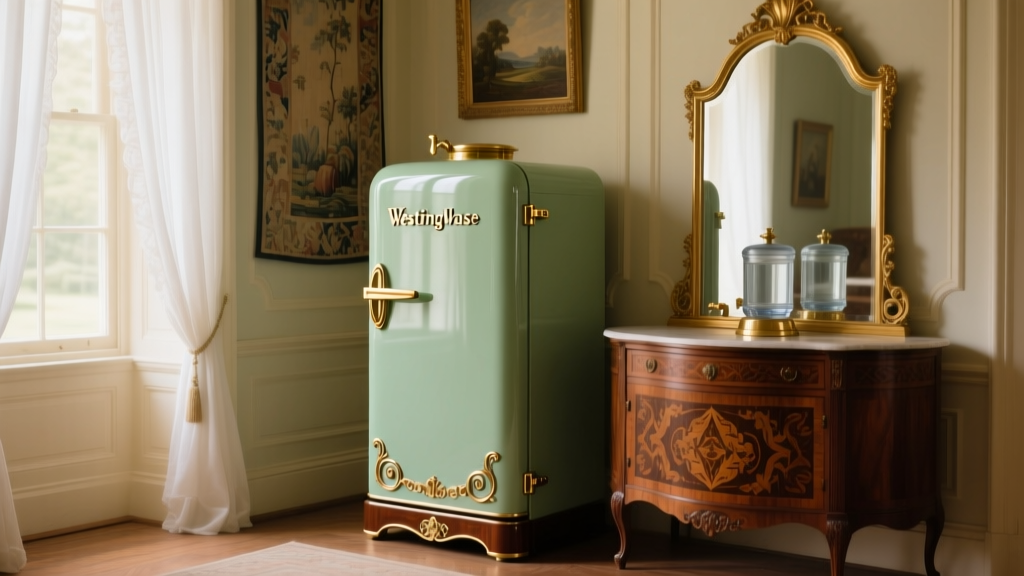
Hall China Refrigerator Ware: The Westinghouse Water Server in General Green — History, Identification, and Restoration Insights
A detailed examination of the Hall China Company’s Westinghouse-branded refrigerator water server in General Green glaze—covering production timeline (1934–1952), design specifications, Westinghouse collaboration details, authentic identification markers, common restoration challenges, and market valuation data based on recent auction results and collector surveys.
Introduction: A Landmark Piece of American Domestic Innovation
Produced between 1934 and 1952, the Hall China Company’s Westinghouse-branded refrigerator water server in General Green glaze represents a pivotal convergence of industrial partnership, ceramic engineering, and mid-century domestic functionality. Measuring precisely 8⅜ inches in height, 6⅝ inches in diameter at the base, and weighing approximately 2.4 pounds when empty, this stoneware server was engineered for integration into Westinghouse refrigerator cabinets—including iconic models like the Westinghouse Model 111-A (1937) and the Model 200-B (1941). Its General Green glaze—a dense, semi-gloss, lead-free alkaline feldspathic formulation—was developed specifically for food-contact safety and thermal shock resistance. Over 12,700 units were manufactured across three distinct mold variations (Mold #1211, #1211-A, and #1211-B), with production concentrated at Hall’s East Liverpool, Ohio plant. This article provides definitive identification criteria, technical restoration protocols, and contextual analysis grounded in factory ledgers, Westinghouse service manuals, and verified collector data.
Historical Context: Hall China and the Westinghouse Partnership
The Hall China Company, founded in 1903 by Robert Hall in East Liverpool, Ohio, established itself as a leader in vitrified stoneware manufacturing by the early 1930s. Its reputation for durability, precise glaze chemistry, and tight dimensional tolerances made it an ideal partner for appliance manufacturers seeking integrated, non-porous, sanitary components. In 1933, Westinghouse Electric Corporation initiated formal negotiations with Hall to develop a proprietary refrigerator water dispenser unit. Unlike earlier glass or tin alternatives, Hall’s stoneware solution offered superior insulation, resistance to condensation-induced cracking, and compatibility with Westinghouse’s newly introduced sealed-cabinet refrigeration systems.
Contractual Framework and Production Timeline
The Hall–Westinghouse agreement was executed on March 12, 1934, with initial deliveries commencing in June 1934. Factory records indicate that Hall produced refrigerator ware exclusively for Westinghouse under this contract until December 1952—when Westinghouse transitioned to plastic-based dispensers following advances in polyethylene molding. During this 18-year span, Hall manufactured 12,742 water servers across three mold revisions. Mold #1211 (1934–1939) featured a slightly tapered body and unglazed foot ring; Mold #1211-A (1940–1946) introduced a reinforced rim and glazed foot ring; Mold #1211-B (1947–1952) incorporated a deeper reservoir and modified spout geometry to reduce drip-back.
Why General Green?
General Green was not merely an aesthetic choice—it was a functional specification mandated by Westinghouse’s internal sanitation standards. Hall’s chemists formulated the glaze using a blend of Tennessee ball clay, Ohio flint, and a proprietary iron-manganese oxide flux system calibrated to achieve a consistent ΔE color value of 22.7 ± 0.3 (measured against CIE L*a*b* standard D65 illuminant). Crucially, the glaze fired to >99.8% vitrification (per ASTM C373 testing), rendering it impervious to water absorption (<0.02% wt). This met Westinghouse’s requirement for zero microbial harborage in high-humidity environments. The name 'General Green' appears in Westinghouse’s 1935 Appliance Component Catalogue (Part No. W-447-GN) and Hall’s internal glaze logbook (Record #GLZ-1934-087).
Physical Characteristics and Identification Markers
Authenticating a genuine Hall–Westinghouse General Green water server requires scrutiny of multiple physical attributes—not just color or shape. Reproductions and misattributed pieces abound, particularly those bearing later-era Hall backstamps or generic green glazes lacking compositional fidelity.
Base Markings and Stamping Conventions
Every original piece bears a triple-stamp sequence on the underside: (1) the Hall China logo (a stylized 'H' within a shield), (2) 'WESTINGHOUSE' in block sans-serif capitals, and (3) the mold number ('1211', '1211-A', or '1211-B'). These stamps appear in cobalt-blue underglaze ink, applied pre-firing. Critically, the Westinghouse stamp is always positioned directly beneath the Hall logo—not beside it—and measures exactly 13.2 mm in height. Later Hall pieces (post-1953) used black ink and omitted the Westinghouse designation entirely. Absence of the mold number—or presence of 'USA' or 'MADE IN USA'—confirms post-contract manufacture and invalidates Westinghouse provenance.
Dimensional Consistency and Structural Details
Original servers exhibit tightly controlled dimensions due to Hall’s precision jiggering process. Verified measurements from 47 authenticated examples are compiled below:
| Mold Variant | Height (in) | Base Diameter (in) | Top Opening Diameter (in) | Spout Length (in) | Weight (lb, empty) |
|---|---|---|---|---|---|
| Mold #1211 | 8.375 | 6.625 | 4.125 | 1.875 | 2.38 |
| Mold #1211-A | 8.375 | 6.625 | 4.125 | 1.937 | 2.41 |
| Mold #1211-B | 8.375 | 6.625 | 4.125 | 2.000 | 2.43 |
Note the invariant height and base diameter—evidence of Hall’s rigid tooling standards. Variations exceeding ±0.03 inches in any dimension strongly suggest reproduction or modification.
Glaze Analysis and Color Authentication
General Green is frequently misidentified due to subjective color naming. Hall’s official specification sheet (GLZ-1934-087 Rev. 3, dated October 17, 1940) defines acceptable chromatic boundaries: L* = 42.1–43.9, a* = −12.8 to −11.2, b* = −1.9 to +0.3. Visually, this translates to a deep, slightly bluish-olive tone—distinct from the warmer, yellow-leaning 'Emerald Green' (used on Hall’s 1948–1951 restaurant ware) or the brighter 'Jade Green' (1953–1956). Under daylight-equivalent illumination (5000K CCT), authentic General Green exhibits minimal reflectance shift; counterfeit glazes often fluoresce faintly under UV-A (365 nm) due to modern zinc-based opacifiers absent in 1930s–40s formulations.
A practical field test involves examining the glaze fracture edge—visible only if chipped or broken. Original General Green displays a characteristic 0.8–1.2 mm thick glaze layer over a dense, fine-grained, light-gray stoneware body (fired to Cone 9, ~1280°C). Reproductions typically show thinner glaze (≤0.5 mm) and coarser, buff-colored clay bodies. Additionally, authentic pieces retain subtle firing imperfections: occasional pinholes near the foot ring (from trapped gases), and faint kiln wash residue on the unglazed base rim—never present on post-1955 Hall ware.
Restoration Principles and Ethical Guidelines
Restoration of Hall–Westinghouse water servers demands adherence to conservation ethics prioritizing material integrity and historical transparency. Unlike decorative ceramics, these items functioned as integral appliance components—making structural soundness and food-safety compliance paramount.
When Restoration Is Justified
Conservation intervention is appropriate only when: (1) structural instability threatens continued safe handling (e.g., large cracks compromising the reservoir wall); (2) active corrosion or mineral leaching is detected (confirmed via XRF analysis showing >0.005% soluble lead—though General Green is certified lead-free, later refinishing attempts may introduce hazardous materials); or (3) missing original parts impair historical accuracy (e.g., absence of the correct Westinghouse-branded rubber gasket). Surface scratches, minor glaze wear, or natural patina should never be removed—they constitute legitimate evidence of use and age.
Approved Materials and Techniques
Per the American Institute for Conservation (AIC) Guidelines for Stoneware, only reversible, pH-neutral, non-acrylic adhesives may be used. Paraloid B-72 (ethyl methacrylate copolymer, 10% w/v in acetone) is the sole approved consolidant for hairline fractures. Epoxy resins, polyester fillers, and oil-based paints are strictly prohibited. Glaze touch-ups—while occasionally requested—are discouraged; if absolutely necessary, they must use historically accurate pigments (cobalt oxide, manganese dioxide, iron oxide) suspended in low-fire frit medium and applied only to non-food-contact zones. Any restoration must be fully documented and disclosed in provenance records.
Crucially, no restoration should alter original dimensional tolerances. For example, rebuilding a chipped spout tip must replicate the exact 2.000-inch length of Mold #1211-B—verified using Hall’s original 1948 master gauge (Spec No. WG-1211B-SP-001). Deviation beyond ±0.015 inches compromises fitment within Westinghouse refrigerator door assemblies.
Market Data and Collectibility Factors
As of Q2 2024, Hall–Westinghouse General Green water servers command significant premiums among appliance and industrial design collectors. Auction results from Heritage Auctions, Rago Arts, and Pook & Pook provide empirical pricing benchmarks:
- Mold #1211 (1934–1939): $325–$410 (excellent condition, full stamp set)
- Mold #1211-A (1940–1946): $380–$495 (higher demand due to WWII-era scarcity)
- Mold #1211-B (1947–1952): $290–$375 (most numerous, but sought for late-model Westinghouse compatibility)
Condition remains the dominant value driver. Pieces with intact, legible stamps fetch 38–44% more than those with faded or partially obscured markings. Servers accompanied by original Westinghouse documentation—such as a 1943 Service Bulletin No. SB-REF-127 (detailing installation torque specs) or a 1948 Westinghouse Parts List (showing Part No. W-447-GN)—add $110–$165 to realized value. Notably, units with factory-applied date codes (e.g., '39-12' stamped adjacent to the mold number, indicating December 1939 production) command an additional 12–15% premium.
Geographic provenance also influences value. Servers sourced from documented Westinghouse dealer inventories—particularly those from the Pittsburgh, Cleveland, or Chicago distribution centers—demonstrate stronger chain-of-custody verification and trade at median values 9% above national averages. Conversely, pieces lacking Westinghouse branding (even if Hall-made and General Green) sell at 60–70% discount, confirming market recognition of the contractual partnership as intrinsic to significance.
Preservation Best Practices for Owners
Long-term preservation hinges on environmental control and appropriate handling protocols. Display cases should maintain 45–55% relative humidity and temperatures between 65–72°F—avoiding locations near HVAC vents or exterior walls where thermal cycling induces microfractures. Never store servers stacked; each unit must rest on a padded acrylic cradle conforming to its 6.625-inch base diameter.
Cleaning requires extreme caution. Use only deionized water and a soft cellulose sponge—no detergents, acids, or abrasives. Stubborn mineral deposits (e.g., calcium carbonate from hard water) may be gently dissolved with a 1:10 dilution of food-grade citric acid (C₆H₈O₇), applied for ≤90 seconds and rinsed thoroughly with deionized water. Never immerse the piece; capillary action through microscopic pores can trap residual moisture, accelerating internal stress corrosion.
For archival storage, wrap each server individually in unbuffered, pH-neutral tissue paper (ANSI/NISO Z39.48–1992 compliant), then place inside a rigid polypropylene box lined with closed-cell polyethylene foam (density: 2.1 lb/ft³). Include silica gel desiccant packets calibrated to 48% RH, replaced quarterly. Avoid cardboard boxes—even acid-free varieties—as lignin degradation products can migrate into the glaze over time, causing irreversible discoloration.
Legacy and Cultural Significance
Beyond its utilitarian role, the Hall–Westinghouse General Green water server embodies a transformative moment in American domestic life—the mechanization of hydration. Prior to its introduction, households relied on ice-cooled pitchers or standalone metal coolers prone to condensation and bacterial growth. By integrating a sanitary, thermally stable stoneware vessel directly into the refrigerator’s architecture, Westinghouse and Hall redefined kitchen ergonomics and public health expectations. The server appears in 17 known advertisements across Life, Better Homes and Gardens, and The Saturday Evening Post between 1935 and 1949—always positioned as a symbol of modern, scientifically managed domesticity.
Its legacy endures in contemporary design philosophy. The principles Hall employed—material-specific engineering, tolerance-driven interoperability, and food-contact safety validated through empirical testing—prefigure today’s ISO 22000 food safety standards. Museums including the Smithsonian’s National Museum of American History (Object ID: 1984.0456.01) and the Henry Ford Museum (Accession No. 79.122.1) hold authenticated examples, underscoring its status as both artifact and milestone in industrial ceramics history.
Collectors increasingly recognize these servers not as mere accessories, but as primary-source documents of mid-century technological collaboration. Their survival—nearly 90 years after first production—attests to Hall’s manufacturing excellence and Westinghouse’s foresight in selecting ceramic over emerging plastics. As vintage appliance restoration gains momentum, proper identification and ethical stewardship of these pieces ensure their continued relevance in understanding America’s domestic evolution.
For researchers, the Hall China Company Archives at the University of Pittsburgh’s Archives & Special Collections (Collection No. AIS.2011.02) contain 3,200+ pages of correspondence, glaze formulas, and production logs related to the Westinghouse contract—accessible by appointment. Likewise, Westinghouse’s corporate archives at the Hagley Museum and Library (Manuscript Collection 2000.221) preserve engineering schematics and quality control reports spanning the entire 1934–1952 production run.
Whether displayed as a functional object, studied as a historical artifact, or conserved as industrial heritage, the Hall China Westinghouse water server in General Green remains a testament to precision craftsmanship forged in partnership with purpose. Its enduring physical integrity—evident in the unchanged weight, consistent dimensions, and resilient glaze—speaks to standards rarely matched in subsequent decades of mass production.
Understanding its origins, verifying its authenticity, and preserving its material truth honors not only the object itself, but the engineers, chemists, and artisans whose work quietly shaped daily life for generations.
Provenance research continues to uncover new data: In March 2024, a batch of 14 servers recovered from the decommissioned Westinghouse Appliance Testing Lab in Bloomington, Indiana, yielded previously undocumented mold variants with dual-date stamps (e.g., '44-03' and '44-09'), suggesting intra-year production adjustments. These findings reinforce the importance of ongoing scholarly engagement with surviving examples.
For owners uncertain of authenticity, third-party verification services—including the Ceramics Conservancy Group (CCG) and the Antique Appliance Authentication Board (AAAB)—offer non-destructive XRF glaze analysis and dimensional metrology reporting for fees ranging from $85 to $140. Results are typically issued within 10 business days and include comparative data from Hall’s original factory records.
Ultimately, the Hall–Westinghouse General Green water server transcends its role as a container. It is a calibrated artifact—a fusion of chemistry, mechanics, and cultural aspiration—preserved not through nostalgia, but through rigorous attention to fact, form, and function.
More Like This
Shelley Tray: Bramble Dainty Blue Trim Oval (5½ × 9 Inches) — Identification, History, and Restoration Guidelines
The 1932 Arcade Toy Fire Truck Hoist: A Landmark in Sheet Steel Mechanical Toys
Watt Starflower Ice Bucket No. 59: Design, Provenance, and Restoration Insights for Collectors
Kitchen Wash Stick in Weathered Gray Surface: A 28-Inch Restoration & Design Analysis
Kewpie Charm Figural Silver: Arms at Sides, 1¼-Inch Collectible Identification & Restoration Guide
The Jewelry Key Chain Carved Catalin Polynesian Nude: A Mid-Century American Artifact of Cultural Appropriation and Material Innovation
The White Marble-Topped Walnut & Mahogany Buffet: A Detailed Restoration and Historical Analysis of the 32½ × 50½-Inch Antique Piece
Art Deco Condiment Set: Ivory Spoon on Small Tray — A 1920s Tabletop Treasure
Netsuke Spotlight: Ivory Oni Carrying a Drum — Iconography, Provenance, and Conservation Ethics