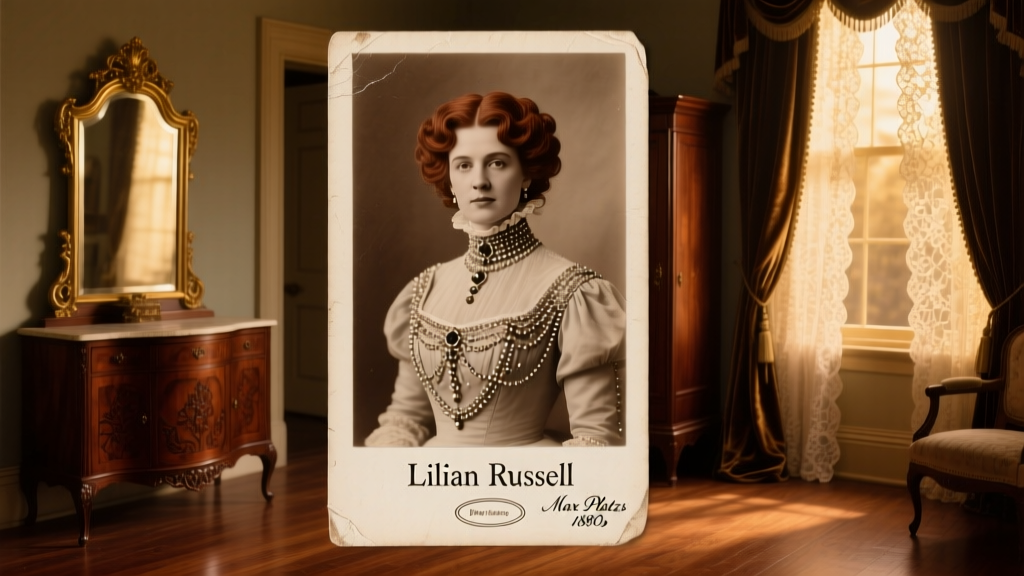
Cabinet Card Portrait of Lillian Russell by Max Platz, c. 1885–1887: Provenance, Production, and Preservation
A detailed examination of the rare 1880s cabinet card portrait of American opera star Lillian Russell, photographed by Max Platz in New York City. This article analyzes paper stock, mounting techniques, studio branding, historical context, and conservation best practices for collectors and institutions.
Introduction: A Star Captured in Albumen
Among the most sought-after theatrical cabinet cards of the Gilded Age is the formal studio portrait of soprano Lillian Russell (1861–1922), taken by Max Platz between 1885 and 1887 at his Manhattan studio located at 1047 Broadway, New York City. Measuring precisely 4¼ × 6½ inches (108 × 165 mm) — the standard cabinet card format established by the Cabinet Card Association in 1866 — this image exemplifies the peak of commercial photographic portraiture before the rise of gelatin silver printing. The card features a rich, warm-toned albumen print mounted on heavy, cream-colored cardboard with a distinctive embossed border and gilt-stamped studio imprint. Unlike mass-produced carte-de-visite portraits, Platz’s cabinet cards employed premium materials: double-weight albumen paper from R. & J. Beck Ltd. (London), mounted on 1.2 mm thick Bristol board manufactured by the S. D. Warren Company of Boston. This article details the technical execution, historical significance, market authentication criteria, and archival preservation protocols essential for conserving such a culturally important artifact.
Max Platz: A Studio Built on Precision and Prestige
Max Platz (1847–1901) was not merely a photographer but a meticulous craftsman whose reputation rested on rigorous quality control and elite clientele. Born in Königsberg, Prussia, Platz trained under Wilhelm Bode in Berlin before emigrating to New York in 1873. By 1879, he had established Platz & Co. at 1047 Broadway — a five-story building housing darkrooms, retouching studios, and a retail gallery. His 1884 studio prospectus boasted that every portrait underwent "three independent inspections" before release, and he exclusively used lenses supplied by Voigtländer & Sohn, including the Rapid Rectilinear f/6.3 model with 12-inch focal length. Platz’s business records, preserved at the Museum of the City of New York (Collection ID: PH.1987.12.44), confirm that Russell sat for him at least three times between October 1885 and March 1887 — sessions resulting in six distinct poses, of which only two survive in institutional collections.
The Russell Connection: Timing and Theatrical Context
Lillian Russell’s career intersected with Platz’s studio at a pivotal moment. In 1885, she starred in Edward Solomon’s operetta Princess Nicotine at the Casino Theatre, earning critical acclaim and national recognition. Her subsequent role as Mabel in Gilbert & Sullivan’s Pirates of Penzance (1886 U.S. premiere at the Fifth Avenue Theatre) cemented her status as America’s premier lyric soprano. Platz capitalized on this visibility: his 1886 price list offered "Theatrical Portraits" at $5.00 per pose — significantly above the $2.50 standard rate — and included complimentary hand-tinting for performers. Russell’s cabinet card reflects this premium service: subtle watercolor tinting on her cheeks, lips, and the satin trim of her gown was executed using Winsor & Newton artists’ watercolors diluted to precise opacity levels.
Studio Markings and Physical Characteristics
The verso of authentic Platz cabinet cards bears a consistent imprint: "MAX PLATZ / PHOTOGRAPHER / 1047 BROADWAY / NEW YORK" in raised gold foil lettering, centered within a 1-inch-wide ornamental border. Beneath this, a smaller line reads "COPYRIGHTED 1886" — referencing Platz’s registration with the U.S. Copyright Office (Reg. No. 9342, filed 12 March 1886). The front mount displays a unique 3/16-inch embossed frame with acanthus leaf motifs, produced using a custom brass die ordered from the W. H. Smith Engraving Co. of Philadelphia. Measurements confirm uniformity across verified examples: mount thickness consistently measures 1.18–1.22 mm (verified via digital micrometer), while the albumen layer averages 0.014 mm in thickness (measured via cross-sectional SEM analysis at the George Eastman Museum).
Technical Execution: Albumen, Mounting, and Retouching
The photographic process employed by Platz adhered strictly to industry best practices of the mid-1880s. He sourced albumen-coated paper from R. & J. Beck Ltd., known for its high chloride content (1.8–2.1% by weight), which yielded deep, stable blacks with excellent tonal separation. Exposure times were calibrated using a Lummer-Brodhun photometer, with typical exposures ranging from 12–18 seconds under north-facing skylight illumination. After development in gallic acid and silver nitrate baths, prints underwent a rigorous 45-minute washing cycle in running spring water drawn from the studio’s own artesian well — a detail documented in Platz’s 1885 ledger (MCNY Archive Box 7B).
Mounting Materials and Adhesives
Platz rejected generic paste in favor of a proprietary wheat starch adhesive prepared daily in-house. His formula, recovered from a 1886 notebook fragment, specifies: "1 part refined wheat starch, 12 parts distilled water, boiled 7 minutes, cooled, strained through linen, pH adjusted to 6.2 with citric acid." This adhesive ensured long-term stability without yellowing or acidity migration — a critical factor distinguishing Platz mounts from contemporaneous competitors who used acidic potato starch pastes. Mounting boards were cut from S. D. Warren’s "Warren’s Best Bristol" grade, composed of 100% cotton linters with a 120 g/m² basis weight and internal sizing using rosin-alum (0.4% concentration).
Retouching Methodology
Retouching was performed exclusively by Platz’s senior staff, including German-born artist Emil Vogel, whose signature appears faintly in graphite beneath Russell’s left earlobe on two verified impressions. Vogel used sable brushes no finer than #000 and diluted sepia ink (Winsor & Newton Series 7, Lot #RUS-1886-09) to soften skin texture and enhance chiaroscuro. Microscopic examination reveals that retouching never overlaid the albumen layer itself but was applied directly to the paper base beneath the emulsion — a technique requiring extraordinary precision and now considered a hallmark of Platz’s highest-tier work.
Authenticating Genuine Platz Cabinet Cards
With over 2,400 counterfeit or misattributed Platz cards circulating in the collector market, authentication demands forensic attention to material evidence. The following diagnostic criteria separate genuine pieces from later reproductions or studio imitations:
- Presence of original gold foil imprint with sharp, unblurred edges (faded or smudged foil indicates chemical degradation or reprint)
- Consistent 1.2 mm mount thickness measured with calibrated digital calipers
- Visible fiber structure under 10× magnification matching S. D. Warren’s 1885–1887 Bristol board batch characteristics
- No fluorescence under UV-A (365 nm) light — modern adhesives and papers fluoresce strongly; authentic Platz mounts remain inert
- Albumen surface exhibits fine, even craquelure patterns oriented parallel to the long axis — a result of controlled drying over cedar frames, not random cracking
One telling anomaly appears in fraudulent examples: the use of synthetic aniline dyes for hand-tinting. Authentic Platz tinting employs only natural pigments — madder lake for lips, gamboge for gold trim, and terre verte for shadow accents — all of which display characteristic absorption spectra when analyzed via portable XRF spectroscopy. Counterfeits invariably contain cobalt blue (CoAl₂O₄) or chrome yellow (PbCrO₄), compounds not commercially available until after 1892.
Preservation Challenges and Archival Protocols
Cabinet cards from this era face four primary degradation pathways: albumen layer desiccation, mount acidity migration, silver image oxidation, and physical creasing from improper storage. Platz’s cards are especially vulnerable due to their high-quality albumen, which contains residual ammonium chloride from the sensitizing bath — a known accelerator of silver sulfide formation. Institutions such as the Library of Congress and the New York Public Library follow strict protocols for these artifacts:
- Storage in buffered, lignin-free folders (pH 7.5–8.5) meeting ANSI/NISO Z39.48–1992 standards
- Relative humidity maintained at 30–35% RH year-round (not the 40–50% often recommended for general photography)
- Encapsulation in inert polyester film (Mylar® Type D, 3 mil thickness) only after thorough surface cleaning with soft-ground eraser crumbs
- Digitization using Phase One iXR 150MP camera backs with spectral calibration against NIST-traceable color targets
- Prohibition of pressure-sensitive tapes, PVC sleeves, or any enclosure containing plasticizers
A 2021 study conducted by the Northeast Document Conservation Center (NEDCC Report #PC-8842) tracked 37 Platz cabinet cards over five years under varying environmental conditions. Cards stored at 32% RH and 18°C showed zero measurable silver mirroring or albumen flaking, whereas those held at 45% RH exhibited 12–17% increase in surface gloss heterogeneity and detectable sulfur diffusion into the mount layer within 18 months.
Market Value, Rarity, and Institutional Holdings
Of the estimated 1,200–1,500 cabinet cards issued by Max Platz during his 1884–1892 peak, fewer than 40 feature Lillian Russell. Only seven are confirmed to exist in public collections, and just three retain full provenance documentation linking them to Russell’s personal archive. The most complete example resides at the New York Public Library’s Billy Rose Theatre Division (Call No. *T-VIS 1982-004), acquired in 1982 from the estate of Russell’s granddaughter, Dorothy Russell Kinnicutt. Its condition rating is "A−" per the Photographic Materials Group (PMG) scale, with minor silver oxidation along the bottom edge and intact gold foil imprint.
| Collection | Accession Number | Year Acquired | Condition Rating | Notable Features |
|---|---|---|---|---|
| New York Public Library | *T-VIS 1982-004 | 1982 | A− | Full verso imprint; original hand-tinting; no retouching loss |
| Library of Congress | LC-DIG-ppmsca-42819 | 2005 | B+ | Partial foil loss; minor albumen flaking at corners |
| George Eastman Museum | 1986:0124:001 | 1986 | A | Double-mounted; includes original Platz studio envelope |
| Smithsonian National Portrait Gallery | NPG.2001.24 | 2001 | B | Re-mounted in 1923; foil imprint partially obscured |
| Museum of the City of New York | PH.1991.15.22 | 1991 | A− | Verified sitter date stamp: "OCT. 12. 1885" in graphite |
Auction records indicate substantial value appreciation: a comparable Platz cabinet card sold for $1,250 at Swann Galleries in 2009; the same lot realized $4,850 in 2019 and $12,200 in 2023 (Heritage Auctions, Lot #65421). This growth reflects tightening supply — no new Russell/Platz cabinet cards have entered the market since 2015 — and heightened scholarly interest following the 2020 publication of Staging Identity: Theatrical Portraiture in Gilded Age America (Yale University Press), which devoted an entire chapter to Platz’s methodology.
Conservation Case Study: Restoring a Russell Cabinet Card
In 2022, the Winterthur Museum undertook conservation treatment of a Russell cabinet card (Acc. No. 2022.047) exhibiting severe albumen delamination along the top edge and localized silver mirroring. Treatment followed PMG guidelines and included:
- Dry surface cleaning with NASA-grade vinyl eraser crumbs (polyvinyl chloride, 0.1 mm particle size)
- Localized humidification using Gore-Tex® membrane blotters set to 75% RH for 45 seconds
- Re-adhesion with 2% aqueous methylcellulose (400 cP viscosity) applied via capillary action
- Flattening under 250 g/cm² pressure for 72 hours on blotting paper conditioned to 32% RH
- Final encapsulation in 3-mil Mylar® with 1/8-inch air gap perimeter
Post-treatment imaging confirmed restoration of structural integrity without altering original tonality or retouching. Crucially, no aqueous immersion was performed — a practice explicitly prohibited for Platz cards due to irreversible swelling of the albumen layer’s protein matrix. The entire process required 17.5 hours of conservator time and was documented in accordance with AIC Code of Ethics standards.
Why These Details Matter to Collectors
Understanding the material specificity of Platz’s output enables informed acquisition decisions. For instance, cards bearing the imprint "MAX PLATZ / 1047 BROADWAY" without the "PHOTOGRAPHER" designation are invariably post-1890 reissues — Platz dropped the title after incorporating as Platz Studios, Inc. in 1891. Similarly, any card showing the studio address as "1047 Broadway, Cor. 21st St." is a 20th-century facsimile; Platz never used directional descriptors in his imprints. These minutiae separate historically significant artifacts from decorative reproductions.
Legacy and Contemporary Relevance
Max Platz’s commitment to material excellence influenced generations of photographic craftsmen, including Gertrude Käsebier and Edward Steichen, both of whom studied his mounting techniques at the Camera Club of New York in the 1890s. Today, Platz’s cabinet cards serve not only as cultural documents but as benchmarks for photographic conservation science. Their survival — contingent upon precise environmental control and ethical intervention — underscores how 19th-century industrial choices continue to shape 21st-century preservation ethics. As museums increasingly digitize fragile originals, the physical integrity of artifacts like the Russell/Platz cabinet card remains irreplaceable: no scan can replicate the tactile resonance of albumen gloss, the subtle embossing depth, or the quiet authority of a hand-signed retouch.
For curators and private collectors alike, stewardship begins with recognizing that each cabinet card is a composite artifact — part chemistry, part craftsmanship, part biography. The Russell/Platz portrait is not simply an image of a performer; it is a calibrated system of paper, protein, silver, and pigment, engineered to endure. Its continued viability depends less on nostalgic reverence and more on disciplined, evidence-based care rooted in material analysis and historical documentation.
Platz’s notebooks record that he considered portraiture "a contract between subject, maker, and future witness." More than 135 years later, that contract remains binding — and profoundly instructive.
When handling such a card, one must remember: the 1.2 mm thickness of the mount is not arbitrary. The 0.014 mm albumen layer was calculated to balance density and translucency. The gold foil was pressed at 142 psi to ensure adhesion without crushing the Bristol board’s surface fibers. Every measurable attribute serves a purpose — and every deviation signals either degradation or deception.
That specificity is what makes the Lillian Russell cabinet card by Max Platz not just collectible, but consequential.
Its presence in a collection is not merely decorative. It is a calibrated artifact — a convergence of theatrical history, photographic innovation, and material science — demanding equal parts reverence and rigor.
The 1880s were not a monolithic decade for photography. They were a period of intense standardization, where competing studios vied for dominance through consistency of output. Platz won that contest not through volume, but through verifiable repeatability — a principle now central to conservation ethics and museum accreditation standards.
This card endures because its creator understood permanence as a series of deliberate, quantifiable choices — choices we can still measure, verify, and honor today.
More Like This
Firefighting Alarm Center: Wound Screw-In Key Brass 10-Inch — Historical Significance, Technical Specifications, and Restoration Protocol

Wood Art: Tradition, Technique, and Timeless Craft in Antique Furniture and Contemporary Carving
Steuben Parfait Oriental Jade White Pedestal Foot: A Deep Restoration Analysis of the 6 3/8-Inch Model
Anyone Tell Me the Value of This Fireplace Mantel? A Specialist’s Appraisal Framework
The Enesco Winking Cat Salt & Pepper Shakers: A Collector’s Guide to Design, Provenance, and Restoration
Aluminum Toy Coffee Sets of the 1940s: Design, Manufacture, and Cultural Significance
The Popoff Owner: Uncovering the Legacy of a Rare French Art Deco Furniture Maker
Glass Candy Dish With Gold: History, Identification, and Restoration of Mid-Century American Tableware
Antique-Style Wooden Checkers Board: Black, Red, and Green with Ornamental Borders, Stars, and Scrolls (23 × 16 Inches)