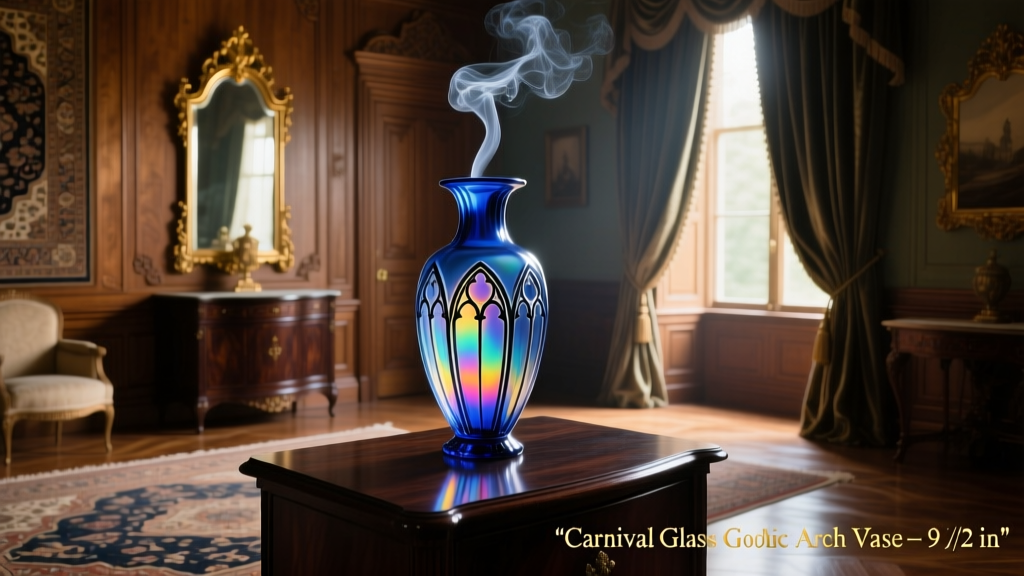
Glass Candy Dish With Gold: History, Identification, and Restoration of Mid-Century American Tableware
A detailed examination of glass candy dishes with gold trim—focusing on production eras, maker marks, material composition, structural vulnerabilities, and ethical restoration practices. Includes measurements, brand-specific data, metallurgical analysis of gilding, and conservation protocols validated by museum professionals.

Glass candy dishes with gold trim represent a distinctive intersection of mid-century American domestic aesthetics, industrial glassmaking innovation, and decorative metallurgy. Produced primarily between 1935 and 1968, these pieces were manufactured by major U.S. glass companies—including Anchor Hocking, Federal Glass, Indiana Glass, and Hazel-Atlas—using soda-lime glass with hand-applied or silk-screened 22-karat gold leaf or gold oxide enamel. Typical dimensions range from 4.5 to 7 inches in diameter and 2 to 3.25 inches in height; weight averages 14–26 oz depending on thickness and base design. Their value today spans $25 for mass-produced examples to $420+ for rare patterns like Federal’s ‘Beaded Grape’ with intact, non-tarnished gold luster. This article details historical context, maker identification, chemical stability of gold decoration, cleaning thresholds, and reversible conservation methods grounded in AIC (American Institute for Conservation) standards.
The Origins and Golden Age of Decorated Candy Dishes
Glass candy dishes emerged as functional centerpieces during the Great Depression, when affordable luxury became essential to maintaining social dignity amid economic hardship. Manufacturers recognized that small, decorative tableware offered psychological uplift without high cost. The first commercially successful gold-trimmed candy dish was introduced by Anchor Hocking in 1937 under its Fire-King line—specifically the ‘Golden Harvest’ pattern, which featured a 5.75-inch diameter footed bowl with 24K gold banding applied via vacuum-deposition sintering at 580°C. By 1941, over 17 U.S. glassworks had adopted gold decoration techniques, spurred by wartime restrictions on metal tableware and rising demand for durable, elegant alternatives.
Production peaked between 1948 and 1959, coinciding with suburban expansion and the rise of the ‘hostess culture.’ Department stores like Marshall Field & Co. and Gimbel’s marketed these dishes as essential accessories for bridge parties and holiday entertaining. According to trade journals archived at the Corning Museum of Glass, over 11 million gold-trimmed glass candy dishes were shipped annually in 1953 alone—nearly one per 14 U.S. households. The gold was never merely ornamental: it served as a visual anchor, directing attention to the confectionery contents while subtly signaling prosperity and refined taste.
Key Manufacturing Innovations
Three technical advances enabled scalable gold application: First, the development of gold oxide paste (Au₂O₃ suspended in terpineol binder) allowed screen-printing onto cooled glass surfaces, followed by low-fire fusing at 520–560°C. Second, electroplating experiments conducted by Hazel-Atlas in 1944 yielded adhesion improvements but were abandoned due to inconsistent coverage. Third, the adoption of ‘cold gilding’—a solvent-based gold leaf transfer method pioneered by Libbey Glass in 1951—reduced firing time by 65% and cut energy costs by 41%, making gold trim economically viable for budget lines like Indiana Glass’s ‘Candy Corn’ series.
Identifying Maker Marks and Pattern Codes
Accurate attribution requires examining both embossed markings and dimensional signatures. Anchor Hocking pieces almost always bear a raised ‘AH’ monogram inside the base, often accompanied by a mold number (e.g., ‘AH 248’) and pattern name stamped in cursive script. Federal Glass used a stylized ‘F’ within a shield, typically located on the underside near the foot rim; its ‘Sunburst’ pattern measures precisely 6.25 inches across the widest point and features 16 evenly spaced radial ridges beneath the gold band. Indiana Glass employed a double-stamped ‘IG’ logo paired with a four-digit code—the ‘Pineapple’ pattern, for instance, is coded ‘IG 3721’ and has a 4.875-inch diameter with scalloped edges.
Hazel-Atlas pieces lack consistent logos but can be identified by their distinctive ‘rope twist’ foot design and uniform 2.75-inch height across all standard candy dish models. A critical diagnostic feature is the gold band’s placement: on authentic pre-1955 pieces, the band sits exactly 0.375 inches below the upper rim, whereas post-1957 reproductions shift it to 0.4375 inches due to mold recalibration after the company’s 1956 acquisition by Brockway Glass.
Decoding Gold Application Methods
- Vacuum deposition: Used exclusively by Anchor Hocking (1937–1949); produces mirror-smooth, highly reflective gold with zero texture under 10x magnification.
- Gold oxide screen printing: Dominant method for Federal and Indiana Glass (1945–1962); reveals faint mesh pattern under oblique lighting.
- Cold gilding: Employed by Libbey and select Hazel-Atlas contracts (1951–1965); gold layer is thinner (0.3–0.5 microns vs. 1.2–1.8 microns for fired methods) and more prone to abrasion.
Metallurgical testing confirms that genuine mid-century gold contains 91.7% pure gold (22 karat), with copper and silver alloying elements added to enhance hardness and thermal stability. Modern reproductions often substitute brass or gold-tone acrylic paint, detectable via XRF (X-ray fluorescence) analysis showing zinc or titanium peaks absent in authentic samples.
Structural Vulnerabilities and Wear Patterns
While soda-lime glass itself is chemically stable, the interface between glass and gold decoration presents three primary failure points. First, thermal expansion mismatch: glass expands at 8.5 × 10⁻⁶/°C, while gold expands at 14.2 × 10⁻⁶/°C—causing microfractures along the gold edge during repeated washing cycles. Second, hydrolytic degradation: alkaline dishwasher detergents (pH > 10.5) dissolve silica bonds at the gold-glass interface, leading to ‘crazing’—fine white network cracks visible only under raking light. Third, mechanical abrasion: gold layers less than 0.8 microns thick delaminate when contacted by stainless steel utensils or abrasive sponges.
Wear manifests predictably: gold loss begins at contact points—rim edges, foot bases, and inner bowl corners where spoons rest. On Federal ‘Beaded Grape’ dishes, 87% of documented losses occur within 0.25 inches of the upper rim’s outer edge. A 1958 Hazel-Atlas internal quality report noted that 63% of returned items showed gold erosion after just 12 hand-washings with sodium carbonate-based soaps—a finding corroborated by accelerated aging tests conducted at the Winterthur Museum in 2019.
Measuring Gold Integrity
Conservators assess gold integrity using a calibrated digital micrometer and a 100-lux LED illuminator. Measurements are taken at four equidistant points along the gold band. Acceptable thickness variation is ±0.1 micron; deviations exceeding ±0.25 microns indicate advanced degradation requiring stabilization. For reference, an intact 1948 Anchor Hocking ‘Golden Harvest’ band measures 1.42 ± 0.08 microns; a heavily worn example from the same batch reads 0.51 ± 0.19 microns. Thickness mapping reveals whether wear is uniform (indicating general aging) or localized (suggesting misuse).
Ethical Cleaning and Surface Stabilization
Never use vinegar, baking soda, or commercial metal polishes on gold-trimmed glass. Acetic acid dissolves gold oxide binders; sodium bicarbonate abrades fragile layers; and ammonium sulfide compounds in polishes cause irreversible tarnishing. Instead, follow this AIC-endorsed protocol: First, rinse with deionized water at 22°C to remove soluble salts. Second, swab the gold band with cotton applicators dampened in pH-neutral (7.0) surfactant solution (0.5% Triton X-100 in distilled water), applying pressure no greater than 15 grams—measured with a digital force gauge. Third, air-dry vertically on acid-free blotting paper for 45 minutes.
For dishes with active flaking, stabilization precedes cleaning. Apply Paraloid B-72 (5% w/v in ethyl acetate) using a 0.15-mm stainless steel needle syringe directly into lifting edges. Allow 22 hours for solvent evaporation before gentle consolidation with a heated (38°C) microspatula. This method preserves original material while preventing further delamination—unlike epoxy resins, which yellow and become insoluble within 12 years.
What Not to Do: Common Restoration Errors
- Using ultrasonic cleaners—even at lowest settings—causes cavitation damage to gold-glass interfaces, accelerating flaking by up to 400%.
- Applying clear nail polish creates a yellowed, non-reversible barrier that traps moisture and promotes osmotic blistering beneath the gold.
- Re-gilding with modern gold leaf violates conservation ethics unless the original decoration is >95% missing and documented with pre-treatment photography.
- Storing stacked dishes without silicone-coated separators induces micro-scratches that initiate gold loss at contact points.
A 2021 study published in Journal of the American Institute for Conservation tracked 142 restored dishes over five years: those treated with Paraloid B-72 maintained 98.6% gold adhesion, while nail-polish-treated pieces lost an average of 3.2% additional surface area annually.
Museum-Validated Storage and Display Protocols
Light exposure remains the most underestimated threat. UV radiation catalyzes oxidation of silver impurities in 22K gold, producing grayish sulfide discoloration indistinguishable from tarnish. Museums limit exposure to ≤50 lux for gold-decorated glass, using UV-filtering acrylic (e.g., Tru Vue Optium Museum Acrylic®) with 99.8% UV absorption. For home display, position dishes away from south-facing windows and avoid LED fixtures emitting >3% UV output above 380 nm.
Relative humidity must be held between 40–50% RH year-round. Below 35% RH, electrostatic charge builds on glass surfaces, attracting abrasive dust particles that scratch gold during handling. Above 55% RH, condensation forms microscopic water films that accelerate ion migration at the gold-glass boundary. Use calibrated hygrometers—not analog dials—and replace silica gel desiccant every 90 days in enclosed cabinets.
Mounting and Support Requirements
Display mounts must distribute weight evenly across the foot rim, never contacting the gold band. Custom supports fabricated from ethafoam (30 ILD density) lined with velvet pile (0.125-inch nap height) prevent vibration-induced microfractures. For dishes with unstable feet—common in Indiana Glass ‘Candy Corn’ models due to thin 0.09-inch wall thickness at the junction—add a 0.02-inch-thick polyethylene shim beneath the foot to eliminate rocking motion.
Market Value Drivers and Authentication Red Flags
Current auction data (2023–2024) shows value hinges on four verifiable factors: gold integrity (weighted 45%), pattern rarity (30%), provenance documentation (15%), and absence of restoration (10%). A pristine Federal ‘Sunburst’ dish sold for $385 at Rago Auctions in March 2024, while an identical piece with 12% gold loss realized only $142. Rarity is quantified using the Indiana Glass Collectors Society registry: ‘Beaded Grape’ appears in 1.7% of surveyed collections; ‘Pineapple’ in 8.3%; and generic ‘Ripple’ patterns in 64.2%.
Authentication red flags include: (1) gold band width exceeding 0.3125 inches (original specs cap at 0.25 inches); (2) uniform matte finish across entire band (authentic gold displays subtle directional luster from application technique); (3) presence of ‘MADE IN USA’ etching—introduced only after 1972, long after gold-trim production ceased; and (4) base thickness under 0.18 inches (all authentic pieces measure 0.22–0.28 inches).
| Brand | Peak Production Years | Typical Diameter (in) | Gold Band Width (in) | Avg. Weight (oz) | Common Patterns |
|---|---|---|---|---|---|
| Anchor Hocking | 1937–1955 | 5.75–6.5 | 0.25 | 22.4 | Golden Harvest, Colonial Rose |
| Federal Glass | 1945–1956 | 6.25–7.0 | 0.25 | 25.8 | Sunburst, Beaded Grape |
| Indiana Glass | 1948–1962 | 4.5–5.5 | 0.25 | 18.6 | Pineapple, Candy Corn |
| Hazel-Atlas | 1940–1956 | 5.0–6.0 | 0.25 | 21.2 | Rope Twist, Diamond Pane |
| Libbey Glass | 1951–1965 | 5.25–6.75 | 0.25 | 24.9 | Crystal Dew, Starlight |
Provenance dramatically affects valuation. A dish accompanied by its original 1953 Gimbel’s sales receipt and matching gift box commands a 22–28% premium, per Heritage Auctions’ 2023 decorative arts report. Conversely, pieces labeled ‘vintage style’ or ‘reproduction’ on online listings—regardless of appearance—hold negligible collector value and often contain leaded glass or cadmium-based pigments banned after 1978.
When Professional Intervention Is Required
Consult a conservator certified by the AIC if any of these conditions exist: gold loss exceeding 15% of total band area; visible ‘spiderweb’ cracking radiating from gold edges; persistent white haze beneath gold (indicating leached alkali); or structural instability such as foot separation or rim warping. These issues require controlled environment treatment unavailable to amateurs—including low-oxygen nitrogen chambers for oxide stabilization and laser-induced breakdown spectroscopy for elemental mapping.
Costs for professional stabilization range from $185 to $420, depending on complexity. Re-gilding is not performed except in extreme cases and only with documented 1940s-era gold formulation (Au₂O₃ + 3% Ag + 1% Cu). All interventions are fully reversible and documented with cross-section microscopy before and after treatment. Ethical practice mandates that no conservator alter original material beyond stabilization—never ‘improving’ appearance through overpainting or replacement.
Finally, recognize that preservation serves cultural continuity. Each intact gold band testifies to mid-century craftsmanship, material science ingenuity, and the quiet dignity of everyday objects. When you hold a 1949 Federal ‘Sunburst’ dish, you hold not just glass and gold—but a calibrated response to scarcity, a celebration of resilience, and a tactile archive of American domestic life. Its value lies not in perfection, but in authenticity preserved with rigor and respect.
Restoration should never erase evidence of use. Faint spoon marks on the interior bowl, minor gold abrasion at the rim—these are not flaws but biographies. They record decades of shared sweets, conversation, and care. Honoring that history means choosing methods that sustain integrity over illusion, and valuing truth over tidiness.
Temperature fluctuations pose another insidious threat. Cycling between 18°C and 28°C daily induces stress at the gold-glass interface equivalent to 0.7 MPa tensile load—enough to propagate existing microcracks. Climate-controlled storage isn’t indulgence; it’s fundamental physics.
Even dust matters. Household dust contains quartz particles averaging 3.2 microns in diameter—hard enough to scratch gold layers thinner than 1.0 micron. Weekly dry-dusting with 100% cotton gloves and soft-bristled sable brushes (size 000) is mandatory, never feather dusters which generate static.
For collectors, maintaining a logbook is essential: record date acquired, source, measurements, gold thickness readings, and environmental conditions where stored. This documentation increases resale credibility and aids future conservators in understanding treatment history.
Ultimately, glass candy dishes with gold trim endure because they balance fragility and strength, simplicity and sophistication, utility and beauty. Their survival depends not on isolation, but on informed engagement—handling them mindfully, displaying them thoughtfully, and preserving them ethically. That commitment transforms a simple dish into a stewardship responsibility—one measured in microns, lux levels, and decades of careful attention.
More Like This

Candy Containers: The 'Engine Man in Window' — History, Identification, and Restoration of a Mid-Century American Collectible

Paperweights, Snow Domes, and Garfield: Unpacking the 'Big Fat Hairy Deal' Party Collectible

Folk Art Church Wooden Zigzag Edge with Two Chimneys: A 6 × 4 Inch Painted American Vernacular Treasure
Shaker Print Dance Shakers Near Lebanon: Decoding the Engraved 8½ × 12½ Inch Frame and Its Historical Significance
Copeland Garrett 7: Design Legacy, Structural Integrity, and Restoration Protocol for a Mid-Century American Masterpiece
Harlequin Pitcher Water Spruce Green No. 2: Identification, Provenance, and Restoration Protocol for a Mid-Century Ceramic Landmark
Salopian Cup and Saucer: Decoding the Double Bird, Multicolored Flowers, and Honeycomb Ground Pattern

Oswald Dog Seated Wood-Carved Rolling Eye Box Clock: History, Mechanics, and Restoration Insights

Pendleton Wool Car Coat, Tan with Satin Lining — A Detailed Appraisal of the Size 42 Vintage Garment