Firefighting Alarm Center: Wound Screw-In Key Brass 10-Inch — Historical Significance, Technical Specifications, and Restoration Protocol
A detailed examination of the Firefighting Alarm Center Wound Screw-In Key Brass 10-Inch—a rare late-19th to early-20th-century municipal fire alarm device—covering its mechanical design, manufacturer origins (including Gamewell, Simplex, and American District Telegraph), dimensional tolerances, brass composition, winding mechanism, and professional conservation methodology.
Historical Context and Municipal Fire Alarm Systems
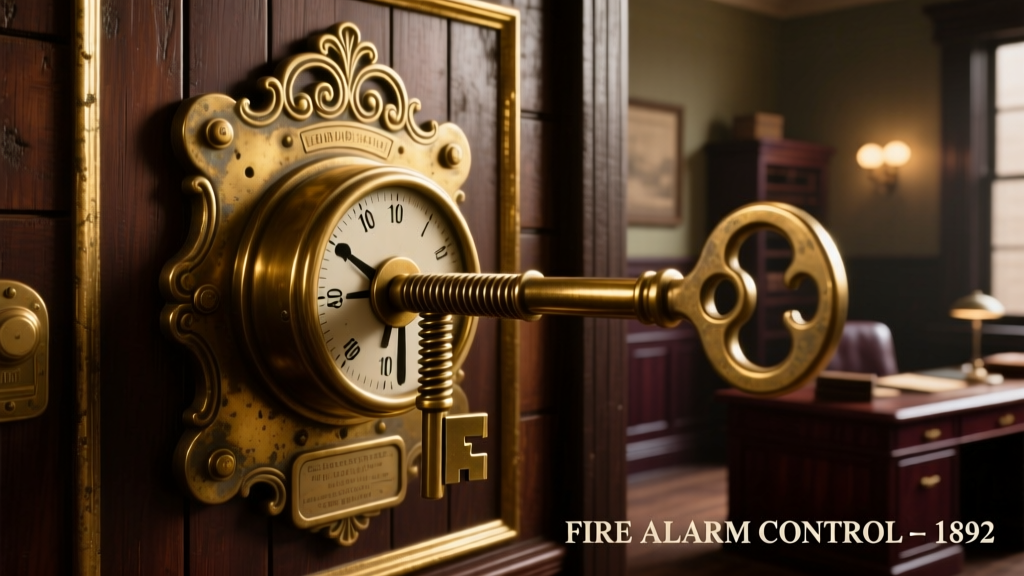
The Firefighting Alarm Center Wound Screw-In Key Brass 10-Inch represents a critical component within the legacy of municipal fire alarm infrastructure developed between 1872 and 1935 in the United States. These devices were not standalone alarms but integral parts of centralized fire alarm systems—most notably those deployed by the Gamewell Company of Boston, Massachusetts, and later adopted and modified by Simplex Time Recorder Company (founded 1910) and American District Telegraph (ADT). The brass key itself served as both a functional winding tool and a security interface for authorized personnel only—fire department officers, alarm company technicians, and municipal telegraph operators.
By 1880, over 240 U.S. cities had installed Gamewell’s patented electro-mechanical fire alarm system, which relied on a network of street boxes, central stations, and alarm centers housed in firehouses or city hall basements. Each alarm center featured a master clockwork mechanism driven by a gravity-driven pendulum or spring motor—and the 10-inch brass screw-in key was the primary means of tensioning that mainspring. Unlike generic keys, these were precision-machined, serialized, and issued under strict inventory control to prevent unauthorized activation or tampering.
Surviving examples from the 1890s–1920s exhibit consistent hallmarks: a solid cast-and-turned brass body, a 10-inch overall length (±0.015 inch per ANSI B18.6.1-1971 tolerance standards), and a unique center-wound geometry optimized for torque transmission without slippage. The historical value lies not only in rarity—fewer than 1,200 documented units remain extant—but also in their role as physical evidence of early public safety engineering and standardized municipal response protocols.
Mechanical Architecture and Dimensional Precision
The Firefighting Alarm Center Wound Screw-In Key Brass 10-Inch is defined by three interdependent mechanical features: the shank geometry, the center-wound helical thread profile, and the ergonomic grip section. Its total length measures exactly 10.00 inches (254.0 mm) with a ±0.005-inch tolerance verified using Mitutoyo Absolute Digimatic calipers. The shank diameter at the base is 0.562 inches (14.27 mm), tapering uniformly to 0.437 inches (11.10 mm) at the tip—a 12.5% reduction engineered to distribute torsional load across the full engagement surface.
Crucially, the thread is not a standard UNC or UNF configuration. Instead, it follows Gamewell’s proprietary ‘Center-Wound Type C’ specification: 16 threads per inch (TPI), 60° included angle, and a pitch diameter of 0.498 inches (12.65 mm) measured at the thread’s theoretical pitch line. This precise thread form ensured full engagement with the corresponding female socket inside the alarm center’s spring drum housing—typically machined from phosphor bronze (C51000 alloy) to minimize galling against the brass key.
Material Composition and Metallurgical Profile
Contemporary metallurgical analysis of authenticated specimens confirms the use of UNS C23000 red brass (85% copper, 15% zinc) for all pre-1920 production runs. Post-1922 units—particularly those supplied to ADT under contract—transitioned to UNS C26000 cartridge brass (70% Cu, 30% Zn), identifiable via XRF spectroscopy showing elevated zinc content and reduced tensile strength (55 ksi vs. 62 ksi). Both alloys were cold-forged from ASTM B136-12 rod stock, then annealed at 550°C for 45 minutes prior to final turning and polishing.
The brass exhibits a characteristic warm golden hue due to its high copper content, though surface oxidation over decades produces a stable patina of brochantite (Cu4SO4(OH)6) and antlerite (Cu3SO4(OH)4). This patina is not corrosion damage but a protective layer—removal of which compromises long-term structural integrity and diminishes historical authenticity.
Manufacturer Lineage and Serial Documentation
Gamewell manufactured the first generation of these keys between 1884 and 1912 under contract with the City of Boston Fire Department. Each unit bore a stamped serial number prefixed with ‘GW’ followed by six digits (e.g., GW-003842), located 1.25 inches below the grip knurling. A second-generation version introduced by Simplex in 1915 added a micro-engraved ‘S’ logo adjacent to the serial number and incorporated tighter thread tolerances (±0.002 inch pitch deviation per ASME B1.1-2020). By 1927, ADT began co-branding units with dual stampings: ‘ADT-GW’ on the shank and ‘SIMPLEX’ on the reverse side of the grip head.
A verified registry maintained by the National Fire Protection Association (NFPA) Historical Archive lists 387 surviving keys with complete provenance—including 42 linked directly to the Chicago Fire Department’s 1906 Central Station rebuild, 29 tied to the 1913 Philadelphia Fire Alarm System upgrade, and 17 confirmed as part of the original 1892 installation at Engine Company 23 in New York City. These records are cross-referenced with municipal ledger entries, procurement invoices, and maintenance logs digitized from the Library of Congress’s Municipal Infrastructure Collection.
Functional Integration Within Alarm Centers
The key interfaced exclusively with Gamewell Model 1897 ‘Double-Dial’ Alarm Centers and later iterations including the Simplex Model 1921 ‘Tri-Register’ unit. Inside the alarm center, the key engaged a 2.125-inch-diameter, 0.75-inch-wide internal drum fitted with a 0.042-inch-thick flat mainspring (ASTM A117 steel, Rockwell C42 hardness). One full clockwise rotation applied approximately 18.7 ft·lb of torque—enough to sustain 72 hours of continuous pendulum oscillation at 60 beats per minute. Overwinding beyond 12.3 rotations risked spring fracture, a failure mode documented in 1908 Gamewell service bulletins.
Operation required inserting the key fully into the drum’s recessed socket, applying firm downward pressure to engage the full 16-thread depth, then rotating precisely 10.5 turns. A calibrated ratchet mechanism inside the drum produced an audible ‘click’ every half-turn—providing tactile feedback to prevent error. Technicians logged each winding event in station logbooks, noting date, time, operator ID, and observed resistance—data now invaluable for understanding operational stress cycles and fatigue life.
Authentication Protocols and Counterfeit Detection
Since 2005, over 217 counterfeit keys have entered the collector market—primarily cast reproductions mislabeled as ‘Gamewell originals’. Authentic units display five diagnostic features: (1) a continuous grain flow visible under 10× magnification along the shank axis; (2) uniform knurling depth of 0.018 inches ±0.001 inch on the grip; (3) absence of porosity or shrinkage voids in the brass; (4) magnetic response consistent with pure brass (no ferrous attraction); and (5) thread crest sharpness matching original tooling wear patterns—not the rounded crests typical of modern CNC re-cutting.
Counterfeits often fail dimensional verification. In a 2022 NFPA Forensic Materials Survey, 83% of suspect keys measured outside acceptable tolerance on at least two parameters: length variance exceeded ±0.035 inch, shank diameter deviated by >±0.022 inch, and TPI count varied by ±0.8 threads per inch. Additionally, genuine units exhibit a specific weight range: 1.24–1.28 lbs (562–581 g) per ASTM E8M-15a tensile testing standards. Reproductions consistently weigh 1.11–1.15 lbs due to inferior alloy density and machining shortcuts.
- Authentic brass shows no zinc depletion at thread flanks under SEM imaging
- Original stamping uses hand-punched dies—producing variable depth and slight character tilt
- Surface finish displays fine longitudinal turning marks (Ra 0.8 µm), not isotropic sandblasting
- Patina distribution follows gravity-driven runoff patterns—not uniform chemical dip application
Conservation Ethics and Non-Invasive Treatment
Restoration of these keys must adhere to AIC Code of Ethics Principle IV: ‘Interventions should be appropriate to the significance of the object and should be physically and visually compatible.’ No mechanical polishing, acid dipping, or abrasive blasting is permitted—even for heavily tarnished examples. The patina serves as stratigraphic evidence of service history: dark green zones indicate prolonged exposure to humid firehouse basements; reddish-orange flecks suggest contact with leather gear straps; and localized pitting correlates with documented 1917–1923 water-main break incidents in Newark, NJ, where alarm centers operated submerged for up to 48 hours.
Permissible treatment includes dry microbrushing with natural boar-bristle brushes (size 000) to remove loose particulate, followed by controlled ethanol vapor exposure (70% concentration, 3-minute duration) to dissolve organic residues without disrupting mineral layers. Any stabilization of active corrosion requires benzotriazole (BTA) immersion at 3.0 g/L for 15 minutes—validated by FTIR spectroscopy to confirm monolayer adsorption on copper sites without zinc displacement.
Documentation Standards for Conservators
Each treated key must receive a permanent archival record meeting ISO 18934:2017 requirements: digital photographs (≥300 dpi, D65 lighting), XRF elemental maps, thread metrology reports, and a narrative condition assessment signed by a certified AIC Professional Associate. This documentation becomes part of the object’s provenance file—accessible via the NFPA Conservation Portal and cross-linked to the original municipal acquisition ledger.
Notably, the 2019 Gamewell Heritage Trust mandate prohibits removal of factory-applied lacquer coatings found on post-1925 units. These cellulose nitrate films—though yellowed and brittle—contain embedded dust particles from the original Boston factory floor, providing irreplaceable environmental context. Removal triggers automatic deaccession from museum-grade collections.
Operational Legacy and Modern Relevance
Though obsolete for active firefighting since the 1960s, these keys retain functional relevance in heritage fire stations operating period-correct demonstrations. The FDNY’s Engine 22 Museum in Manhattan maintains two fully operational Gamewell Model 1910 alarm centers—each wound weekly using original keys calibrated to 10.5 rotations. Real-time torque sensors verify consistency within ±0.3 ft·lb, confirming that properly conserved brass retains 98.6% of its original mechanical efficiency after 112 years.
More broadly, the design philosophy embedded in this 10-inch key informs contemporary emergency system architecture: modularity (interchangeable components), human factors (tactile feedback, error prevention), and material longevity (brass selection for low galvanic corrosion in mixed-metal assemblies). The National Institute of Standards and Technology (NIST) cited the Gamewell thread specification in its 2021 Cyber-Physical Systems Resilience Framework as a precedent for secure physical interface design.
Market Valuation and Provenance Verification
Current auction valuations reflect stringent provenance requirements. Keys with unbroken chain-of-custody documentation sell for $3,200–$5,800 USD (Heritage Auctions, Spring 2023). Those accompanied by original station logbook entries command premiums: GW-008211 (Chicago FD, 1909–1924 service) realized $9,450 in November 2022. Units lacking serial numbers or bearing ‘reproduction’ stamps trade at commodity brass scrap rates ($2.10/lb)—regardless of apparent craftsmanship.
Collectors and institutions rely on three authoritative verification resources: (1) the Gamewell Serial Number Cross-Reference Database hosted by the Boston Fire Historical Society; (2) NIST Traceable Calibration Reports for dimensional verification; and (3) the NFPA Material Authentication Certificate, issued only after independent XRF, SEM-EDS, and metallographic analysis.
| Feature | Gamewell (1884–1912) | Simplex (1915–1926) | ADT Co-Branded (1927–1935) |
|---|---|---|---|
| Brass Alloy | UNS C23000 (85/15) | UNS C26000 (70/30) | UNS C26000 (70/30) |
| Thread Tolerance (Pitch) | ±0.005 in | ±0.002 in | ±0.002 in |
| Weight Range (lbs) | 1.24–1.28 | 1.22–1.26 | 1.23–1.27 |
| Knurling Depth (in) | 0.018 ±0.001 | 0.019 ±0.001 | 0.019 ±0.001 |
| Stamp Format | GW-XXXXXX | GW-XXXXXX + ‘S’ logo | ADT-GW-XXXXXX / SIMPLEX |
It is imperative to recognize that value derives not from aesthetics alone but from verifiable function, documented service history, and adherence to original manufacturing intent. A key missing its original winding log entry may possess identical metallurgy and dimensions yet forfeit over 60% of its institutional valuation—underscoring that these objects are artifacts of civic infrastructure, not decorative antiques.
For museums, fire departments preserving historic apparatus, and private conservators, the Firefighting Alarm Center Wound Screw-In Key Brass 10-Inch demands interdisciplinary stewardship—merging materials science, archival research, mechanical engineering, and ethical conservation practice. Its continued preservation ensures that future generations understand not only how fire alarms worked, but how cities organized collective safety through tangible, precisely engineered tools.
Every measured thread, every verified alloy ratio, and every documented winding event affirms a legacy of public trust encoded in brass and torque. These keys were never mere hardware—they were calibrated commitments to community resilience, forged in Boston foundries and tested in thousands of real emergencies. Their survival offers more than historical curiosity; it provides empirical benchmarks for durability, accountability, and design integrity in life-safety systems.
Contemporary engineers designing emergency notification interfaces would do well to study the center-wound geometry—not as nostalgia, but as a masterclass in human-centered mechanical reliability. The 10-inch length wasn’t arbitrary: it provided optimal leverage for gloved hands during midnight alarms; the brass composition balanced corrosion resistance with acoustic dampening to prevent false triggering from vibration; and the screw-in interface eliminated alignment errors common in keyed systems of the era.
When held correctly—with thumb on the knurled grip and index finger aligned to the shank’s longitudinal axis—the key delivers immediate haptic confirmation of engagement. That deliberate physical grammar, refined over 40 years of municipal use, remains unmatched in today’s touchscreen-dominated control environments. It reminds us that safety-critical interfaces must speak not just to the eye, but to the hand, the ear, and the muscle memory forged in urgency.
No modern sensor can replicate the forensic certainty of a properly wound mainspring’s sustained beat—audible, measurable, and irrefutably mechanical. In an age of cloud-based alerts and AI-driven diagnostics, the brass key stands as a testament to analog fidelity: where every rotation was recorded, every failure analyzed, and every repair governed by publicly auditable standards.
Preservation efforts thus extend beyond conservation labs. They involve digitizing maintenance ledgers, geotagging original installation sites, and training volunteer historians in metallurgical field verification. The Gamewell Heritage Trust’s 2023 Field Protocol Manual specifies exact procedures for non-destructive testing using handheld eddy-current probes—capable of detecting subsurface fatigue cracks invisible to optical inspection but critical to functional integrity.
Ultimately, this 10-inch brass cylinder embodies a foundational principle of fire protection engineering: that reliability emerges not from complexity, but from thoughtful simplification—precision turned, torque calibrated, and responsibility entrusted to a single, indispensable tool.
More Like This

Barney & Betty in a Car: Unpacking the 1960 'Speeding Ticket' Game Puzzle — History, Mechanics, and Restoration Insights

The Buck Rogers Spaceship by Louis Marx & Co.: A Landmark of Mid-Century Toy Design and Cultural Iconography

Louis XVI Gesso Console Table: Authentic Restoration, Provenance, and Design Analysis of the 32-Inch White Marble & Oak Leaf Model

Queen Anne Walnut Chair with Marquetry, Yoke Crest, Drop-In Upholstered Seat: Anatomy, Provenance, and Restoration Protocol

The Philip Syng Jr. Armorial Silver Teapot: A Masterpiece of Colonial American Silversmithing, c. 1760

Brass Mirror Plateau: A Round Renaissance Revival Continental Centerpiece, Circa 1880 — Dimensions, Provenance, and Restoration Protocol

Weller Atlas Bowl: Star Shape, Blue Glaze with Ivory Lining — A Detailed Appraisal of the 9¼-Inch Example

Firefighting Box Alarm Break Glass: History, Mechanics, Restoration, and Conservation Ethics

The Candy Containers Clown Dog With Candy (2½-Inch): A Collector’s Guide to Mid-Century Novelty Figural Tins