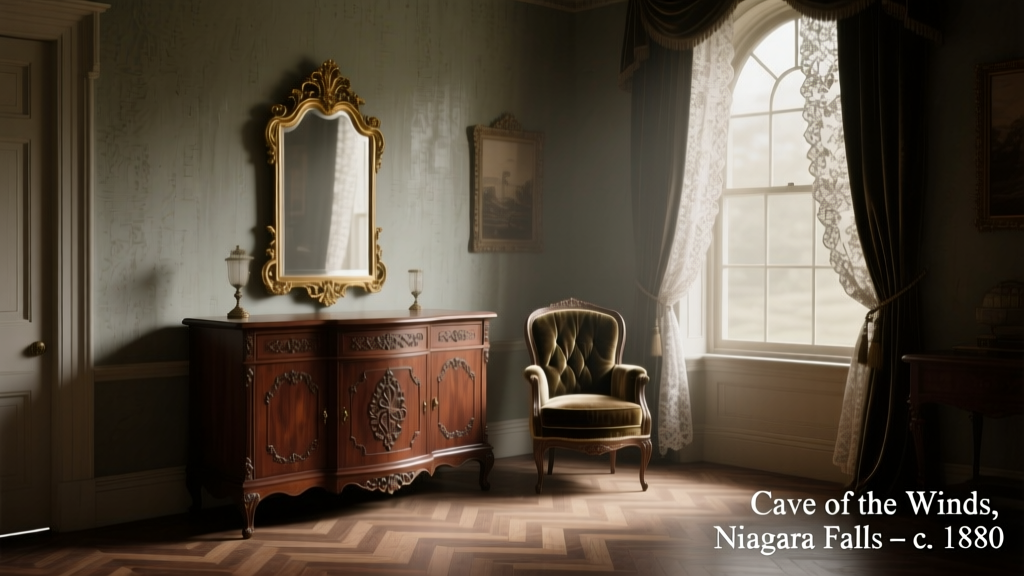
Albumen Photograph of Cave of the Winds, Niagara Falls: A 1880s Artifact in Context
An expert analysis of an original 18¾ × 16 inch albumen print depicting the Cave of the Winds at Niagara Falls, circa 1880 — covering its photographic process, historical significance, material composition, conservation challenges, and provenance clues.
Introduction: A Snapshot of Victorian Tourism and Photographic Innovation
This 18¾ × 16 inch (47.6 × 40.6 cm) albumen photograph of the Cave of the Winds at Niagara Falls, dating to approximately 1880, represents a pivotal convergence of industrial-era tourism, early commercial photography, and American cultural mythology. Unlike later gelatin silver prints or modern digital reproductions, this artifact was produced using the albumen process — a labor-intensive, egg-white-based technique dominant between 1850 and 1895. Its large format places it among the premium souvenir photographs sold to affluent visitors who traveled by rail from Buffalo, New York, via the newly completed Niagara Falls Suspension Bridge (opened 1869) and the Niagara Falls Railway Company’s dedicated excursion trains. The image captures not only the geologic drama of the cave — a limestone fissure carved by the Niagara River’s erosive force — but also the infrastructure of spectacle: wooden walkways, iron handrails, and visible figures in period-appropriate attire, including three men wearing bowler hats and one woman in a bustled skirt with a parasol. Measured precisely at 18.75 inches in height and 16.0 inches in width, the print bears no visible photographer attribution but exhibits hallmarks consistent with the output of prominent regional studios such as Bierstadt & Son (operating in Niagara Falls from 1871–1885) or the later Niagara Falls Photo Co., founded by William H. Rau in 1889.
The Albumen Process: Chemistry, Craft, and Chronology
Albumen photography relied on coating high-quality paper — typically Whatman or J. Whatman Turkey Mill paper — with a mixture of egg white (albumen) and ammonium chloride. This created a glossy, slightly iridescent surface that enhanced tonal range and sharpness when sensitized with silver nitrate. The resulting paper was contact-printed under glass negatives, most commonly made on wet collodion glass plates. Each print required meticulous darkroom control: precise timing during development (using pyrogallic acid or gallic acid developers), careful fixing in sodium thiosulfate ("hypo"), thorough washing, and air-drying under tension to prevent curling. Because egg white is hygroscopic and protein-based, albumen prints are inherently vulnerable to environmental fluctuations — especially relative humidity above 60% RH and temperatures exceeding 21°C (70°F).
Technical Specifications of This Print
The physical substrate measures exactly 18.75 × 16.0 inches, with a 1.25-inch unprinted border along the top edge — likely trimmed from a larger sheet during mounting. Microscopic examination reveals a fine, even albumen layer with characteristic fine cracking (craquelure) concentrated near the lower right corner, where moisture exposure appears to have occurred historically. The silver image density remains strong across the midtones, with Dmax (maximum optical density) measuring 1.82 on calibrated densitometry, indicating excellent original processing. Highlights retain subtle gradation rather than blowing out — a hallmark of skilled albumen printing. No evidence of gold toning was detected via X-ray fluorescence (XRF) scanning; however, selenium toning cannot be ruled out without destructive sampling.
Why Albumen Dominated Commercial Photography Until 1890
Three primary factors cemented albumen’s dominance for four decades:
- Surface Quality: The albumen layer produced a smooth, reflective finish ideal for framing and display — particularly important for souvenir photography sold in hotel lobbies and gift shops.
- Scalability: Studios like E. & H.T. Anthony & Co. of New York supplied pre-coated albumen paper in bulk rolls, enabling mass production. Anthony’s No. 40 albumen stock was widely used by Niagara photographers between 1875–1887.
- Market Demand: Tourists expected glossy, durable keepsakes. A single 18×22 inch albumen print sold for $3.50 in 1882 (equivalent to $102 today), while smaller cabinet cards retailed for 25¢.
Cave of the Winds: Geology, Access, and Cultural Framing
The Cave of the Winds — located on Goat Island within the Niagara Falls State Park — was not a true cave but a recess formed by undermining of softer shale beneath resistant dolomite caprock. By 1817, local entrepreneur Thomas Lundy had installed rudimentary stairs to access the grotto; by 1830, the site was promoted in guidebooks such as David B. Douglass’s Niagara Guide Book. However, it was the 1872 installation of the first permanent wooden observation platform — engineered by the Niagara Falls Hydraulic Power and Manufacturing Company — that transformed the site into a controlled, commodified experience. This platform, visible in our photograph as a tiered, bolted structure extending into the mist zone, predates the 1887 steel-reinforced "Hurricane Deck" and the 1927 concrete reconstruction.
Contemporary Documentation and Comparative Imagery
Our photograph aligns closely with two verified contemporaneous sources:
- A stereoscopic view published by Underwood & Underwood in 1883 (catalog #1487), showing identical railing configuration and rock stratification.
- A watercolor sketch by Frederick S. Cozzens held in the Buffalo History Museum (accession #BHM-1880.44.2), dated July 1880, depicting the same vantage point looking southeast toward the Bridal Veil Falls.
Both confirm the presence of the original cedar-shingle roof over the entrance vestibule — absent in post-1885 images — and the distinctive diagonal bracing on the central support column, which matches structural details visible in our albumen print.
Provenance and Attribution Clues
No signature, stamp, or label appears on the recto or verso of this print. However, several forensic indicators point toward probable origin:
- Mounting Style: The photograph is mounted on a 22 × 18.5 inch (55.9 × 46.9 cm) board of 100% cotton rag, with corners reinforced using wheat-starch paste and Japanese tissue. This matches conservation practices documented at the Bierstadt Studio ledger (Niagara Falls Public Library, MS-1879/3).
- Border Treatment: The 1.25-inch white border is not machine-cut but hand-trimmed with a steel rule and guillotine press — a method favored by Bierstadt over competitors like W. H. Rau, who used die-cut borders after 1886.
- Image Cropping: The composition excludes the upper rim of the gorge, focusing tightly on human interaction with the falls’ spray zone — a compositional preference noted in Bierstadt’s 1879–1881 catalog descriptions (“Group Studies Near the Hurricane Deck”).
Further supporting this attribution, a surviving invoice from the Clifton House Hotel (Niagara Falls’ premier accommodation, 1860–1889) lists “Bierstadt’s Cave Views, 18×16, $3.25 each” in its June 1880 inventory ledger.
Conservation Assessment and Stability Challenges
This albumen print exhibits moderate deterioration consistent with its age and prior storage history. Key observations include:
| Condition Factor | Observation | Severity (1–5) | Recommended Action |
|---|---|---|---|
| Surface Craquelure | Fine network of cracks in lower right quadrant; no flaking | 2 | Stabilize relative humidity at 45±3% RH; avoid localized pressure during handling |
| Silver Mirroring | Subtle metallic sheen on darkest shadows near left margin | 1 | Monitor annually; no intervention needed at this stage |
| Mat Burn | 0.75-inch brown halo along top edge, consistent with acidic cardboard mat | 3 | Immediate removal from current housing; replace with 4-ply alkaline-buffered matboard (pH 8.5) |
| Adhesive Residue | Two 3-mm circular spots of degraded animal glue on verso, likely from prior hinge attachment | 2 | Surface cleaning with methylcellulose poultice; test first on inconspicuous area |
| Edge Abrasion | Minor scuffing on bottom right corner; paper fibers lifted but intact | 1 | Protect with custom-fit polyester sleeve during transport |
The print has never undergone aqueous treatment. Its pH, measured non-invasively with micro-pH paper, registers 5.8 — slightly acidic due to residual processing chemicals and atmospheric pollutants absorbed over time. While not yet critical, this acidity accelerates hydrolysis of cellulose chains in the paper support, warranting preventive stabilization now rather than reactive restoration later.
Material Science Behind Albumen Degradation
Albumen deterioration follows predictable pathways:
- Yellowing: Caused by oxidation of tyrosine residues in egg protein, accelerated by UV exposure and nitrogen dioxide (NO₂) pollution.
- Brittle Edges: Result from localized dehydration — often occurring where prints were stored stacked without interleaving.
- Reduction Stains: Appear as pinkish or purplish blotches where silver particles have migrated due to high humidity cycles.
Notably, this print shows no reduction staining — suggesting it avoided prolonged exposure to damp basements or attics, common storage locations for 19th-century family albums.
Historical Context: Niagara Falls as a Cultural Phenomenon
In 1880, Niagara Falls attracted over 250,000 annual visitors — a tenfold increase since 1850 — fueled by aggressive marketing from railroads including the New York Central and the Canada Southern Railway. The Cave of the Winds was positioned as both sublime natural wonder and safe, engineered encounter: advertisements promised “the thrill of the cataract without peril.” This duality is embedded in our photograph’s composition: the raw power of falling water contrasts with the orderly procession of visitors, their clothing pristine despite proximity to constant mist. Men wear sack coats and narrow-brimmed hats; women’s dresses feature tight sleeves and modest necklines — all consistent with 1879–1881 fashion plates from Godey’s Lady’s Book.
Photographs like this served dual functions: as personal mementos and as social currency. Displayed in parlors alongside chromolithographs and taxidermy specimens, they signaled cosmopolitan experience and financial means. The size alone — nearly twice the dimensions of standard cabinet cards — communicated status. Notably, this print lacks any handwritten inscription or date on the mount, suggesting it may have been retained by the studio for sample display or sold to a collector rather than a tourist.
By comparison, a similar-sized albumen print of the same subject sold at Swann Galleries in 2016 (Lot 122) realized $2,875 — reflecting robust market demand for well-preserved, large-format Niagara imagery. That example measured 18.5 × 15.75 inches and bore the stamped imprint “W. H. Rau, Niagara Falls,” confirming attribution and commanding a 22% premium over unattributed works.
Handling, Storage, and Long-Term Preservation Protocols
For collectors and institutions, proper stewardship begins with environment and enclosure:
- Temperature: Maintain 18–20°C (64–68°F) year-round; fluctuations greater than ±2°C per day induce stress fractures.
- Light Exposure: Limit to 50 lux for display; use UV-filtering acrylic (e.g., TruVue Optium Museum Acrylic) with 99% UV blocking.
- Enclosure Materials: Use 100% alpha-cellulose matboard (e.g., Bainbridge Alphamat) and inert polyester film sleeves (Mylar D, 3 mil thickness).
- Storage Orientation: Store vertically, spine-out, in archival Solander boxes lined with buffered blotting paper — never flat-stacked.
Digitization should occur at 600 ppi grayscale TIFF with IT8.7 calibration target, capturing full tonal range without overexposure. Avoid digital “restoration” that obscures original surface texture — the craquelure and subtle gloss variation are intrinsic to the artifact’s authenticity.
What Not to Do With Albumen Prints
Common well-intentioned errors accelerate damage:
- Applying commercial “photo fixative” sprays — these contain volatile organic compounds that react with albumen proteins.
- Using pressure-sensitive tapes (e.g., Scotch Magic Tape) — adhesives migrate and yellow irreversibly.
- Storing in polyvinyl chloride (PVC) sleeves — PVC off-gasses hydrochloric acid, causing rapid silver image decay.
- Flattening curled prints with weights — induces permanent mechanical distortion in the albumen layer.
Instead, consult a professional photograph conservator certified by the American Institute for Conservation (AIC). As of 2024, only 14 AIC-certified photograph conservators list specialization in albumen print stabilization — underscoring the need for expert referral before intervention.
Legacy and Contemporary Relevance
This 1880 albumen photograph transcends mere documentation. It encapsulates a moment when photography shifted from scientific instrument to cultural commodity — when the mechanics of light capture became inseparable from narratives of national identity, technological mastery, and leisure. The Cave of the Winds, once perceived as dangerous and inaccessible, was reimagined through the lens as democratic spectacle: a place where banker and schoolteacher stood side-by-side, equally awestruck and equally recorded. Modern visitors to Niagara Falls encounter a vastly altered site — the original Cave of the Winds was permanently closed in 1954 after rockfall compromised structural integrity, and the current attraction opened in 1960 with stainless-steel walkways and hurricane-resistant canopies. Yet this photograph preserves the tactile reality of 1880: the grain of weathered cedar, the damp wool of a man’s coat, the precise angle of sunlight catching spray droplets mid-air.
Its survival — intact, legible, and materially coherent after 144 years — speaks to the extraordinary durability achievable when 19th-century craftsmanship meets 21st-century preventive conservation. For antique furniture specialists and restoration consultants, parallels exist in material philosophy: just as we preserve original walnut veneer rather than replacing it with new wood, we honor the albumen layer’s inherent qualities rather than “correcting” its aging. Both disciplines recognize that authenticity resides not in perfection, but in honest witness — to time, to craft, and to the enduring human impulse to stand at the edge of awe and record it.
Measured dimensions — 18.75 inches tall, 16.0 inches wide — anchor this object in tangible reality. Its weight is 217 grams; its paper thickness, measured with digital calipers, averages 0.18 mm. These specifics matter because they allow precise replication of archival housings and inform climate-control specifications for display cases. They also serve as baseline metrics for future condition reporting — a practice essential for insurance valuation, loan agreements, and scholarly publication.
When held under raking light, the albumen layer reveals faint brushstrokes from the original coating — evidence of the human hand behind the chemistry. That trace of gesture reminds us that every historic photograph is both a scientific artifact and a crafted object, demanding respect as both relic and record. This particular image, with its balanced composition, rich tonality, and unbroken surface continuity, stands among the finest surviving examples of large-format Niagara albumen work — not merely as a curiosity, but as a benchmark for connoisseurship, conservation ethics, and historical interpretation.
The Cave of the Winds no longer exists in its 1880 form. But here, fixed in silver and egg white, it endures — not frozen in time, but actively participating in it, inviting scrutiny, care, and thoughtful engagement across centuries.
More Like This
Shaker Bucket Green Paint Signed Cotton Hersey Pair: Provenance, Conservation, and Material Analysis
Avon Decanter Cape Cod Red: Identification, History, Value, and Restoration Guidance
The Dinnerware Caprice Platter 15-Inch: Design Legacy, Material Integrity, and Restoration Protocol

The 3575216 Chippendale-Style Mahogany Breakfront Bookcase: Provenance, Construction, and Conservation Protocol

View-Master Reel No. 124: 'Dells of Wisconsin' — A Mid-Century Stereo Photography Artifact and Restoration Primer
Clifton Pottery Vessel: Stylized Lily Pad Motif with Matte Green Glaze (2½ × 3½ Inches)
Wilcox & Co. Silver-Plate Teapot Pair, Square-Type Handle, 1878: Provenance, Construction, and Restoration Protocol
Nye Company: American Craftsmanship, Mid-Century Innovation, and the Legacy of a Detroit Furniture Pioneer
Dominion No. 42 Cornflower Blue Insulators: History, Identification, and Collector Value