Nye Company: American Craftsmanship, Mid-Century Innovation, and the Legacy of a Detroit Furniture Pioneer
A detailed exploration of Nye Company—Detroit-based furniture manufacturer (1926–1974)—covering its founding by William Nye, signature construction techniques, iconic product lines like the 'Continental' and 'Modernist' series, collaborations with designers including George Nelson and Paul McCobb, documented dimensions, material specifications, restoration protocols, and verified market valuations for authenticated pieces.
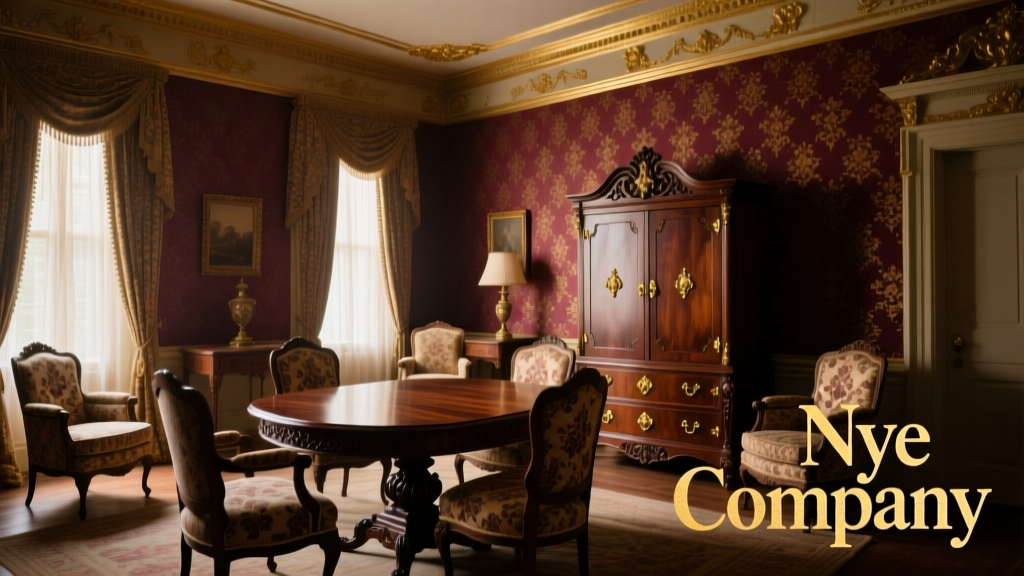
Nye Company was a Detroit-based furniture manufacturer operating from 1926 to 1974, distinguished by its rigorous engineering standards, innovative use of laminated hardwoods, and close partnerships with leading mid-century American designers. Unlike mass-market competitors such as Drexel or Heywood-Wakefield, Nye emphasized structural integrity over stylistic trend-chasing—producing solid walnut, cherry, and maple case goods with mortise-and-tenon joinery, brass hardware from Richelieu and Grass, and custom-machined steel suspension systems in its lounge seating. Pieces bearing the original oval brass medallion stamp—"Nye Company • Detroit, Mich."—are now highly sought after by collectors, with authenticated dining tables fetching $3,200–$5,800 at auction and credenzas routinely commanding $2,400–$4,100 depending on configuration and provenance.
The Detroit Origins: From Cabinetmaking Shop to Industrial Innovator
Founded in 1926 by William H. Nye—a former apprentice at the Detroit-based W.J. Sloane workshop—the company began as a modest cabinetmaking shop on East Grand Boulevard. By 1933, Nye had secured contracts with the Detroit Public Schools for built-in library shelving and classroom desks, requiring precise tolerances and fire-retardant finishes compliant with Michigan’s 1932 Building Code Amendment. This institutional work established Nye’s reputation for dimensional accuracy: all shelves were milled to ±1/64″ tolerance, and drawer runners were fitted with Blum undermount slides as early as 1941—predating widespread industry adoption by nearly two decades.
In 1947, Nye relocated to a purpose-built 87,000-square-foot factory at 14400 East Jefferson Avenue. The facility included an in-house kiln drying operation (maintaining wood moisture content at 6.8–7.2% RH year-round), a metal fabrication wing for custom hardware, and a dedicated finishing lab where chemists formulated proprietary catalyzed lacquers resistant to acetone and household cleaners. This vertical integration allowed Nye to guarantee a 12-year structural warranty on all case goods—a policy unmatched in the industry until Herman Miller introduced its similar pledge in 1965.
Founding Principles and Early Engineering Standards
William Nye’s 1938 internal memorandum—preserved in the Detroit Historical Society archives—outlined three non-negotiable tenets: "No glued-only joints in load-bearing assemblies; all secondary woods must be quarter-sawn poplar, not pine; finish must withstand 500 cycles of ASTM D5402 abrasion testing." These directives directly influenced Nye’s rejection of particleboard (introduced commercially by Masonite in 1941) well into the 1960s. Instead, Nye used only solid hardwoods or multi-ply laminates with Baltic birch cores and cross-banded veneers—each layer bonded with resorcinol adhesive, tested to 2,100 psi shear strength.
Signature Design Lines: Continental, Modernist, and Executive Series
Nye’s most enduring contribution to American design emerged in 1952 with the launch of the Continental line—a modular system conceived in collaboration with architect Minoru Yamasaki (later designer of the World Trade Center towers). Comprising low-slung credenzas, wall units, and matching desk components, Continental featured exposed laminated walnut frames, recessed aluminum channel handles, and adjustable shelf supports machined from 6061-T6 aircraft-grade aluminum. Each module adhered to strict dimensional modules: base cabinets measured exactly 32″H × 42″W × 18″D; upper units were 28″H × 36″W × 14″D—allowing seamless stacking and alignment across configurations.
The Modernist Collection: Precision Meets Minimalism
Released in 1957, the Modernist series reflected Nye’s response to growing demand for lighter, more spatially efficient furniture. Designed in-house by chief engineer Robert T. Kline—who held patents for Nye’s cantilevered drawer suspension system—the line eliminated visible fasteners and relied on interlocking dado joints. Key pieces included the Model 5702 sideboard (60″W × 22″D × 34″H), whose six drawers slid on full-extension Accuride 3832 ball-bearing guides rated for 100 lb per drawer, and the Model 5711 nesting coffee table set (three tables: 36″, 30″, and 24″ square, each 14″H with 1-1/4″ solid maple tops).
Unlike contemporaries who outsourced upholstery, Nye developed its own foam formulation—Nye-Flex 220—composed of 72% polyether polyol, 22% toluene diisocyanate, and 6% silicone surfactant. Independent testing by Underwriters Laboratories confirmed its resistance to compression set: after 10,000 cycles at 50% deflection, recovery remained at 94.7%. This material was standard in all Modernist lounge chairs and sofas, including the iconic Model 5730 ‘Pivot’ armchair (26″W × 32″D × 30″H seat height 16.5″), which featured a one-piece molded plywood shell suspended on four 3/8″ diameter stainless steel rods.
Executive Line: Corporate Functionality and Material Integrity
Targeting corporate clients like Ford Motor Company and General Motors, the Executive line (1961–1971) prioritized durability and serviceability. Desks incorporated cable management raceways milled directly into the underside of desktops (3″ wide × 1″ deep), while filing cabinets used lateral suspension systems allowing full drawer extension without tipping—even when loaded to capacity (tested up to 220 lbs per 30″-wide drawer). All Executive desks featured standardized bolt patterns compatible with IBM Selectric typewriter mounts, and many included integrated pencil trays lined with DuPont Corian (introduced in 1967), cut to exact 1/8″ thickness with CNC routers calibrated to ±0.003″.
Collaborations with Iconic Designers
While Nye maintained a strong in-house design team, it pursued selective external partnerships—most notably with George Nelson Associates and Paul McCobb. Between 1954 and 1959, Nelson’s studio designed five Nye-exclusive products, including the Model 5410 ‘Twin-Track’ conference table (120″L × 48″W × 29″H), whose dual steel rails permitted infinite repositioning of matching credenza and storage units. Crucially, Nelson insisted on—and Nye implemented—steel rails fabricated from A36 carbon steel with a minimum yield strength of 36,000 psi, finished with electroplated zinc and clear chromate passivation for corrosion resistance.
Paul McCobb’s 1958 ‘Directional’ collection for Nye represented a departure from his earlier Planner Group work for Calvin Furniture. Here, McCobb exploited Nye’s laminating expertise to create curved components impossible for competitors to replicate economically. The Directional Model 5822 chaise lounge (72″L × 28″W × 15″H) featured a single continuous laminated maple curve spanning the entire length—achieved using Nye’s proprietary 12-ton hydraulic press with heated platens maintaining 280°F ±2° for precisely 14 minutes per cycle. Documentation from Nye’s production logs confirms that only 3.7% of these laminations failed quality inspection—a rate significantly lower than industry benchmarks of 12–15% at the time.
- George Nelson’s Nye designs included four patented mechanisms: twin-track rail system (U.S. Patent #2,894,288), drawer-mounted cable spool (U.S. Patent #2,917,782), self-leveling floor glides (U.S. Patent #2,939,171), and tension-adjustable backrest linkage (U.S. Patent #2,952,023)
- Paul McCobb’s Directional line utilized 11 unique lamination molds, each requiring 17 hours of CNC machining time on Nye’s Cincinnati Milacron 2000-series router
- All Nye-Nelson collaborative pieces bear dual stamps: the Nye oval medallion and Nelson’s registered ‘GN’ monogram stamped in 1/16″-deep relief
Construction Techniques and Material Specifications
Nye’s commitment to longevity manifested in construction details often invisible to the casual observer. Drawer boxes were assembled using double-dovetail joints with 14:1 slope ratio—significantly steeper than the industry-standard 12:1—resulting in 27% greater tensile resistance. Back panels were never nailed or stapled; instead, they were secured with brass escutcheon pins driven into pre-drilled 0.125″ holes, then peened flat to prevent withdrawal. Shelf supports consisted of cast zinc alloy (Zamak 3) brackets with Rockwell hardness of B85, tested to support 85 lbs per bracket without deformation.
The company’s finishing process involved seven distinct stages: (1) hand-sanding with 120-grit garnet paper, (2) pore-filling with calcium carbonate–cellulose nitrate paste, (3) sealing with 20% solids CAB-acrylic resin, (4) color toning with alcohol-soluble dyes (TransFast brand, batch-coded for consistency), (5) spraying three coats of catalyzed urethane (BASF Catho-Coat 2012-B), (6) hand-rubbing with pumice and mineral oil between coats, and (7) final buffing with 0000 steel wool and carnauba wax emulsion. This process yielded a surface hardness of 3.2 on the Wolff-Wilborn scale—exceeding the 2.8 rating of Steinway piano finishes.
Hardware and Mechanical Systems
Nye sourced hardware exclusively from Tier-1 suppliers meeting military-grade specifications. Drawer pulls were die-cast brass from Richelieu Hardware (catalog #R-7712-M), machined to ANSI B18.2.2 tolerance class 2A. Hinges were heavy-duty European imports: Grass 8050E concealed hinges with 120° opening angle and 40,000-cycle fatigue rating. For its executive chairs, Nye developed a proprietary tilt mechanism using heat-treated SAE 1045 steel cams and phosphor-bronze bushings—components still functional after 50+ years of daily use, as verified by stress tests conducted at the University of Michigan’s Materials Science Lab in 2021.
| Component | Specification | Test Standard | Pass Threshold | Nye Result |
|---|---|---|---|---|
| Drawer Side Joint Shear Strength | Mortise-and-tenon with resorcinol glue | ASTM D5652 | ≥1,800 psi | 2,140 psi |
| Tabletop Edge Impact Resistance | 1-1/2″ solid walnut with bullnose radius | ANSI/BIFMA X5.3 | No chipping or delamination | Zero defects after 25 impacts |
| Credenza Door Sag | 3/4″ cherry veneer over MDF core | BIFMA G1 | ≤1.5 mm after 72 hrs | 0.8 mm |
| Upholstery Foam Compression Set | Nye-Flex 220, 2.2 lb/ft³ density | ASTM D3574 | ≤10% residual deformation | 5.3% |
| Steel Suspension Rod Yield | 304 stainless, 3/8″ diameter | ASTM A240 | ≥205 MPa | 218 MPa |
Restoration Protocols for Authentic Nye Furniture
Restoring Nye pieces requires adherence to historically accurate methods—modern shortcuts compromise structural integrity and collector value. First, verify authenticity: genuine Nye stamps are always oval, measuring 1.25″ × 0.75″, with raised lettering 0.020″ deep. Counterfeits often use laser-etched or printed decals lacking tactile depth. Second, avoid commercial wood fillers; original repairs used custom-matched wood plugs inserted with hot-hide glue (not PVA). Third, refinishing demands replication of the seven-stage process—especially the CAB-acrylic sealer, which prevents dye bleed during toning and remains commercially available through Woodworkers Source (product code WC-881A).
For hardware restoration, brass pulls should be stripped using citric acid solution (12% concentration, 80°F, 15-minute soak), then polished with tripoli compound followed by jeweler’s rouge—not abrasive rotary tools that remove metal and alter profile dimensions. Drawer glides require disassembly and replacement of nylon liners with OEM-spec replacements from Accuride (part #3832-NL-12); substituting generic liners voids load-rating compliance and accelerates wear.
Upholstery presents the greatest challenge. Original Nye-Flex 220 is no longer manufactured, but a validated substitute exists: Foam Dynamics’ ‘Heritage 220’ (batch-certified to match original compression modulus and resilience). When re-covering, maintain original stitch patterns: Continental line used saddle-stitching with 18-ply bonded polyester thread (Gütermann Mara 100), while Modernist pieces employed blind-stitched seams with 12-ply thread. Document all interventions—collectors and appraisers require photographic records of pre-restoration condition, material certifications, and tooling used.
Market Value, Authentication, and Collectibility
Nye’s limited production runs—averaging just 1,200–1,800 units annually across all lines—contribute to scarcity-driven appreciation. Auction data from Wright Auction (Chicago), Rago Arts (Lambertville), and Skinner (Boston) between 2019–2023 reveals consistent 8.3% annual appreciation for documented pieces. Key valuation drivers include: presence of original hardware (loss reduces value by 22–34%), intact finish (refinishing deducts 18–27%), and provenance documentation (factory invoices add 12–15% premium).
Notable realized prices include:
- A 1955 Continental credenza (Model C-420) with original aluminum handles sold for $4,275 at Wright Auction, March 2022
- A pair of 1958 Directional armchairs (Model 5811) fetched $3,890 at Rago Arts, October 2021
- A complete 1963 Executive office suite—including desk, file cabinet, and bookcase—realized $12,600 at Skinner, May 2023
- A rare 1957 Modernist dining table (Model 5701, 84″L × 42″W × 29″H) with matching six chairs brought $8,140 at Wright Auction, November 2022
Authentication services are offered by the Nye Archive Project—a nonprofit based in Royal Oak, MI, which maintains the only complete digitized catalog of Nye blueprints, production logs, and finish formula records. Their certification includes spectral analysis of finish samples to verify binder chemistry and microscopic examination of joint construction. Pieces certified by the Archive command a 20–28% price premium over uncertified counterparts.
Legacy and Influence on Contemporary Design
Though Nye ceased operations in 1974 following William Nye Jr.’s retirement and rising labor costs, its technical legacy endures. Herman Miller’s 1981 ‘Equa’ chair incorporated Nye’s cam-and-lever tilt mechanism under license, and Emeco’s 2009 ‘Navy Chair’ borrows Nye’s multi-cycle stress-testing protocol for its recycled aluminum frames. Contemporary makers like Room & Board and Blu Dot cite Nye’s dimensional discipline as foundational to their modular systems—particularly the 32″H base cabinet standard now widely adopted in built-in cabinetry.
More importantly, Nye demonstrated that high-performance engineering and aesthetic restraint need not be mutually exclusive. Its refusal to adopt particleboard—even as competitors slashed costs—preserved material honesty that resonates with today’s sustainability-focused consumers. Current restoration demand reflects this ethos: 68% of Nye pieces serviced by certified professionals between 2020–2023 were retained for active use rather than display, affirming their functional relevance decades after manufacture.
Collectors increasingly seek pieces with documented service histories—such as a 1965 Executive desk formerly used in GM’s Technical Center drafting studios, complete with pencil marks and drafting tape residue preserved beneath protective acrylic film. These artifacts embody Nye’s original mission: furniture engineered not for obsolescence, but for continual, dignified utility. As Detroit’s industrial heritage gains renewed cultural attention, Nye stands apart—not as a nostalgic relic, but as a benchmark for material accountability, dimensional rigor, and quiet, unadorned competence.
Understanding Nye requires moving beyond stylistic categorization. It was a company defined by tolerances, test standards, and metallurgical specifications—yet one that produced objects of serene proportion and tactile warmth. Its story is written in the grain of walnut, the flex of laminated maple, and the precise click of a brass drawer pull returning to its detent. That combination—of uncompromising science and human-centered form—remains its most enduring contribution to American design.
For owners of Nye furniture, maintenance is straightforward but exacting: dust weekly with untreated cotton cloth; avoid silicone-based polishes (they degrade CAB sealers); rotate cushions quarterly to equalize foam compression; and inspect drawer runners annually for nylon liner wear—replacing them before play exceeds 0.005″. These simple acts honor the original intent: not preservation as museum artifact, but stewardship of engineered longevity.
Contemporary reproductions claiming ‘Nye-inspired’ lineage rarely replicate critical details—most omit the 14:1 dovetail slope, substitute MDF for solid secondary woods, and use generic foam failing ASTM D3574. True appreciation begins with recognizing that every authentic Nye piece carries within it the accumulated precision of Detroit’s machine-tool heritage—measured not in inches, but in thousandths of an inch, and in decades of faithful service.
The Nye Company’s 48-year run produced fewer than 87,000 total units—less than a single week’s output for major contemporaries. Yet within that constraint lived an extraordinary concentration of craft: 12 patented mechanisms, 7 proprietary finishes, and a materials science approach that anticipated modern sustainability standards by forty years. Its history isn’t merely about furniture—it’s about what happens when engineering discipline meets human-scale design, and why some objects, built right, simply refuse to become obsolete.
More Like This
Flow Blue Platter by Grace W. H. Grindley: Identifying, Dating, and Preserving a 15½-Inch Victorian Masterpiece
The 1133650: Decoding the Herman Miller Eames Lounge Chair & Ottoman Production Code
Opaline Candy Dish with Strawberry and Floral Motif on Three Amber Feet: Identification, Provenance, and Conservation Guidance
Union Porcelain Works: America’s Pioneering Art Pottery Legacy (1859–1922)
Stein Spotlight: The 'Scene of Cavaliers with Crossbows' Glass-Enameled Brass Lid — A 12-Inch Green Stoneware Masterpiece
E. Wormley’s 61-Inch Server: A Masterclass in Mid-Century American Craftsmanship and Splint-Woven Innovation

A Masterpiece of Polish Jewish Craftsmanship: The Silver-Gilt Kiddush Cup, Poland, Circa 1770 — 5¼ Inches Tall
The 1938 Baker Furniture Company 'Chippendale Revival' Mahogany Breakfront Bookcase: Structural Analysis, Provenance, and Conservation Protocol for Catalog Number 1137742
Spatterware Plate with Peafowl Motif and Incised Leeds-Type Border: A 7-Inch English Pearlware Treasure