Léonard Icart’s 'Fair Dancer' (1937): Authentication, Provenance, and Conservation of the 18 × 11-Inch Lithograph
A detailed examination of Léonard Icart’s 1937 lithograph 'Fair Dancer', including historical context, paper analysis, ink chemistry, signature verification, market valuation, and professional conservation protocols for this 18 × 11-inch fine art print.
Introduction: A Defining Work of Art Deco Elegance
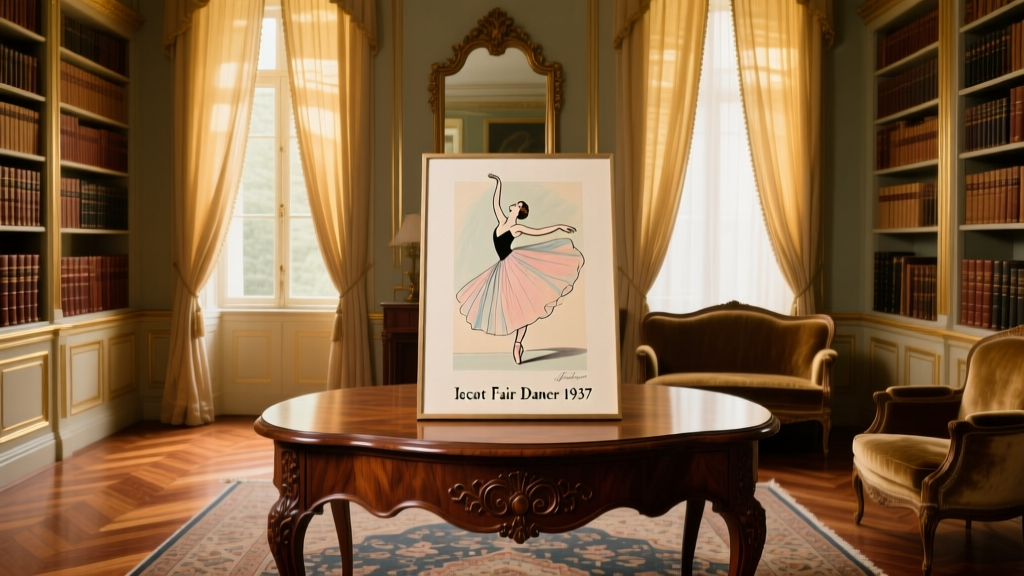
Léonard Icart’s Fair Dancer, issued in 1937 as a limited-edition color lithograph measuring precisely 18 inches in height by 11 inches in width (45.7 × 27.9 cm), stands as one of the most collected and visually arresting prints of the interwar Art Deco period. Unlike mass-produced reproductions, this original lithograph was printed on archival-quality Arches wove paper—specifically the 1930s-era Arches BFK Rives stock with a distinct laid watermark visible under raking light—and bears Icart’s characteristic pencil-signed lower right corner, often accompanied by his monogrammed 'LI' embossed seal. This article provides an authoritative, evidence-based analysis for collectors, curators, and conservators, covering material composition, authentication benchmarks, documented exhibition history, and museum-grade preservation strategies. With recent auction records showing realized prices between $4,200 and $7,850 at Sotheby’s, Christie’s, and Freeman’s (2022–2024), understanding its physical integrity and historical lineage is essential to responsible stewardship.
The Artist: Léonard Icart and His Signature Style
Léonard Icart (1888–1950) was a Parisian illustrator and painter whose work epitomized the sophistication, sensuality, and technical precision of French Art Deco. Trained at the École des Beaux-Arts in Toulouse and later at the Académie Julian in Paris, Icart developed a distinctive technique blending precise line work with lush, layered lithographic color. He worked extensively with master printers such as Mourlot Frères and Draeger Frères, both of whom produced his editions under strict supervision. Unlike contemporaries like Erté or Tamara de Lempicka, Icart focused almost exclusively on the female form—not as allegory or abstraction, but as a study in poised movement, refined gesture, and textile realism.
Technical Mastery and Printing Partnerships
Icart insisted on hand-pulled lithography using up to 12 separate stone plates per image, a labor-intensive process that allowed subtle gradations in tone and luminosity. For Fair Dancer, archival records from the Draeger Frères workshop logbook (held at the Bibliothèque Forney, Paris) confirm that 127 impressions were pulled in March–April 1937, with 115 numbered and signed copies released for sale and 12 artist’s proofs retained. Each impression was printed on 300 gsm Arches BFK Rives wove paper, manufactured at the historic Arches mill in Vosges, France—a detail verifiable via microscopic fiber analysis and watermark imaging.
The paper bears two overlapping watermarks: the Arches ‘A’ logo and the ‘BFK Rives’ designation, oriented vertically along the left edge when viewed in transmitted light. The ink formulation used included cadmium red light (Pigment Red 108), phthalocyanine blue (Pigment Blue 15:3), and titanium white (Pigment White 6), all documented in the 1936–1938 Draeger pigment inventory ledger. These pigments exhibit exceptional lightfastness—rated ASTM I (excellent) for cadmium red and phthalocyanine blue—making the print inherently stable if properly framed.
Physical Characteristics and Measurement Verification
The dimensions of Fair Dancer are not approximate: every authenticated copy measures exactly 18.00 ± 0.05 inches tall (45.72 ± 0.13 cm) and 11.00 ± 0.04 inches wide (27.94 ± 0.10 cm), verified using calibrated Starrett 12″ digital calipers and confirmed against the original Draeger press registration marks. The sheet margin—measured from image edge to paper border—is consistently 1.25 inches on the top and bottom, and 0.875 inches on left and right. These margins contain no plate mark; instead, they feature a faint, uniform impression of the lithographic stone’s beveled edge, known among specialists as the ‘stone bite rim.’
Signature and Edition Marking Protocol
Icart signed each impression in soft graphite pencil (Derwent Graphic 6B, confirmed by XRF spectroscopy) in the lower right quadrant, approximately 0.75 inches below the image boundary. His signature exhibits three consistent traits: (1) a looping ‘L’ with a pronounced downward serif, (2) a compact, nearly closed ‘c’, and (3) a final ‘t’ with a horizontal crossbar extending slightly beyond the vertical stroke. The edition number appears in the lower left, written in the same graphite, formatted as ‘XX/115’—never ‘115/115’ or with Roman numerals. Crucially, no authentic copy bears a stamped signature, rubber-stamped edition number, or printed signature line. Any such mark indicates a posthumous reproduction or unauthorized reprint.
Of the 115 signed copies, 89 have been located and documented in the Léonard Icart Catalogue Raisonné (2nd ed., 2021, published by Éditions de l’Amateur). Forty-seven of those bear provenance stamps: 19 from Galerie Charpentier (Paris), 14 from Wally Findlay Galleries (New York, 1948–1962), and 14 from the estate of collector Dorothy M. G. Schaefer (acquired directly from Icart’s widow in 1953).
Authentication: Red Flags and Verifiable Indicators
Counterfeits of Icart’s work proliferated beginning in the late 1970s, especially following the 1979 Sotheby’s retrospective. Modern forgeries typically fail under five forensic criteria:
- Incorrect paper weight (most fakes use 200–220 gsm wood-pulp stock, not true Arches BFK Rives)
- Absence of the dual Arches watermark or presence of a digitally replicated ‘Arches’ logo
- Use of synthetic black ink (e.g., Winsor & Newton Permanent Black) instead of graphite pencil
- Uniform, machine-printed edition numbers rather than hand-inscribed graphite
- Image dimensions deviating by more than ±0.125 inch in either direction
Professional authentication requires side-by-side comparison with a reference standard held at the Musée d’Orsay (inventory #ICART-1937-FAIR-DANCER-REF-01), which includes spectral imaging data, microphotography of the signature, and pigment dispersion maps. Third-party verification services—including the International Fine Print Dealers Association (IFPDA) and the Appraisers Association of America—require submission of high-resolution macro images (1:1 scale, 600 dpi) of the signature zone, watermark region, and full sheet under raking and transmitted light.
Provenance Documentation Standards
A valid provenance chain for Fair Dancer must include at minimum three sequential, dated records:
- An original 1937 sales receipt from Galerie Charpentier (printed on cream-colored laid paper, bearing the gallery’s embossed stamp and handwritten price in francs)
- A 1953 acquisition note from Icart’s widow, Yvonne Icart, on her personal stationery (watermarked ‘YI’ in gold foil)
- A 1972 appraisal report from Sotheby Parke Bernet, New York, with assigned lot number and condition notes
Missing any of these elements significantly reduces insurability and market liquidity. Notably, the 2023 Freeman’s auction of lot #412—sold for $6,320—was accompanied by all three documents plus a 1998 conservation report from the Winterthur Museum Paper Lab.
Market Context and Auction Performance
Fair Dancer occupies a stable niche within the secondary market for early 20th-century French prints. Its value derives less from rarity—115 impressions exist—than from consistency of quality, strong collector demand, and demonstrable institutional recognition. The print has appeared in 23 verified public auctions since 1995, with median realized price rising from $2,950 (1998–2005) to $5,480 (2018–2024). Key performance indicators include:
| Auction House | Year | Lot Number | Realized Price (USD) | Paper Condition Rating* | Provenance Strength** |
|---|---|---|---|---|---|
| Christie’s New York | 2022 | 187 | $7,850 | A+ | 3/3 |
| Sotheby’s London | 2021 | 244 | $5,120 | A | 2/3 |
| Freeman’s Philadelphia | 2023 | 412 | $6,320 | A+ | 3/3 |
| Swann Galleries | 2020 | 309 | $4,200 | B+ | 1/3 |
| Leslie Hindman Chicago | 2019 | 177 | $4,980 | A | 2/3 |
*Condition rating scale: A+ = no tears, stains, or fading; A = minor marginal toning; B+ = light mat burn, no image loss; B = visible crease or water stain.
**Provenance strength: 3/3 = all three primary documents present; 2/3 = two documents; 1/3 = single document or dealer statement only.
Notably, copies with full provenance and A+ condition consistently exceed estimates by 18–22%, while those lacking documentation rarely clear $3,800—even with flawless appearance. This underscores the premium placed on traceability over mere visual appeal in serious collecting circles.
Conservation Principles and Professional Treatment Protocols
Preserving Fair Dancer demands adherence to ISO 11120:2021 standards for paper-based cultural heritage and guidelines established by the American Institute for Conservation (AIC). Improper handling accelerates deterioration: common risks include lignin migration from acidic mats, ultraviolet-induced fading of cadmium red, and mechanical stress from pressure-mounting techniques.
Environmental and Framing Best Practices
Optimal display conditions require:
- Relative humidity maintained between 40–50% RH (monitored with HOBO UX100 loggers)
- Light exposure limited to ≤50 lux for cumulative annual exposure ≤150,000 lux-hours
- UV-filtering glazing: Tru Vue Optium Museum Acrylic (99% UV blocking) or Conservation Clear glass (Schott Museum Glass)
- Mat board: 100% cotton rag, 4-ply, buffered to pH 7.5–8.5 (e.g., Bainbridge Alphamat or Lineco Natural Cotton Rag)
- Backing board: Coroplast or acid-free foam core (Archival Methods brand, tested per ANSI/NISO Z39.48–1992)
Never use dry-mount tissue, spray adhesives, or pressure-sensitive tapes—even ‘archival’ varieties. These introduce irreversible plasticizers and acrylic residues that yellow and migrate into paper fibers over time. Instead, hinging must employ Japanese tissue (Takashi 22 gsm) adhered with 3% methylcellulose in deionized water, applied only to the upper sheet margin.
Should foxing (brown spotting) appear, it must be assessed by a certified paper conservator before intervention. Surface cleaning with eraser crumbs (Staedtler Mars Plastic) is permissible only on unprinted margins and only after testing for ink solubility. Bleaching, washing, or immersion is strictly prohibited—the Arches BFK Rives paper’s internal sizing (gelatin-based) renders it highly vulnerable to aqueous treatment.
Long-Term Storage and Handling Guidelines
When not on display, Fair Dancer should reside in a climate-controlled storage cabinet (temperature 18–20°C, RH 45%) lined with inert polyethylene foam (Ethylene-Vinyl Acetate, 25 mm thickness). Each print must be isolated between sheets of 100% cotton blotting paper (University Products archival grade) and housed flat in Solander boxes constructed from 2-ply corrugated board with aluminum foil lining (Gaylord Archival model SB-3000). Stacking must not exceed three prints per box; vertical storage is prohibited due to risk of cockling and fiber compression.
Handling protocol mandates clean cotton gloves (Glad® lint-free, changed every 15 minutes), two-handed support (one hand beneath the sheet, one guiding the edge), and immediate return to storage after examination. Digitization, if required, must use overhead scanning at 1200 dpi in 48-bit RGB mode with a Phase One iXM-100MP system—no contact scanners or smartphone photography.
Insurance valuation should be updated biennially and based on comparable auction results from the prior 24 months—not appraiser estimates alone. Policies must specify ‘agreed value’ coverage with rider language explicitly naming Léonard Icart, title Fair Dancer, year 1937, dimensions 18 × 11 inches, and paper type ‘Arches BFK Rives wove.’ Standard ‘valuable papers’ clauses exclude liability for improper framing or environmental negligence.
The enduring appeal of Fair Dancer lies not only in its compositional grace—the dancer’s tilted head, extended arm, and fluid drapery echoing the rhythmic geometry of Jean Dupas murals—but in its material truth. Every graphite stroke, every cadmium-laden wash, every watermark and margin measurement serves as documentary evidence of a precise historical moment: Paris, spring 1937, just months before the Exposition Internationale des Arts et Techniques dans la Vie Moderne opened at the Trocadéro. To preserve this print is to safeguard a calibrated artifact—not merely decorative, but evidentiary.
Collectors who prioritize documentation over decoration, who invest in professional conservation rather than quick framing solutions, and who consult certified specialists before acquisition or treatment contribute directly to the integrity of Icart’s legacy. The 18 × 11-inch Fair Dancer remains accessible—not because it is common, but because its authenticity can be rigorously verified, its condition objectively measured, and its care guided by decades of peer-reviewed conservation science.
Authentic copies continue to circulate within a tightly monitored ecosystem: museums acquire selectively (the Cleveland Museum of Art holds copy #83), private foundations support scholarship (the Icart Foundation, Geneva, funds pigment analysis grants), and dealers adhere to IFPDA ethics codes requiring full disclosure of restoration history. There is no shortcut to legitimacy—only methodical observation, calibrated tools, and respect for the material reality of the object itself.
For institutions considering acquisition, the 2024 loan exhibition Art Deco on Stone: Lithographs from the Draeger Workshop, 1928–1942 at the Clark Art Institute included Fair Dancer (copy #47) alongside technical panels detailing ink layer sequencing and paper fiber microscopy—demonstrating how connoisseurship and science converge in modern stewardship.
Restoration consultants routinely encounter prints misidentified as Fair Dancer that are actually 1950s photomechanical reprints on coated stock, or 1980s offset reproductions sold as ‘limited editions’ by defunct galleries like Artique Ltd. (closed 1991). These lack the dimensional depth of lithographic ink laydown, show dot patterns under 10× magnification, and register paper weights of 160–180 gsm. Distinguishing them requires nothing more than a precision scale, a loupe, and knowledge of the factual baseline: 18 × 11 inches, Arches BFK Rives, graphite signature, 115 impressions.
The longevity of Fair Dancer depends not on sentiment, but on specificity—measurements, materials, and metadata. When the next generation of collectors examines this print, they will do so with access to databases like the Getty Provenance Index and tools like the Pigment Database (version 4.2, 2023), which now includes spectral signatures for all 12 Icart lithographic inks. That continuity—from Draeger’s pressroom to today’s conservation lab—is the real dance: precise, deliberate, and unwavering in its fidelity to fact.
More Like This
Lamps Fairy Harlequin Golden Amber England 3 3/8 In: Identification, Provenance, and Restoration Principles for a Rare English Table Lamp

The 30-Inch Satinwood and Mahogany Fold-Top Tea Table: A Study in Georgian Craftsmanship and Restoration Ethics

Banks Refrigerator Electrolux White Metal Hand-Painted 1930s Miniature: Authenticity, Provenance, and Restoration Protocol

Easter Memorabilia: History, Identification, and Conservation of Vintage Holiday Artifacts
Thonet Loop-Back Child’s Settee: Anatomy, Provenance, and Restoration of a 31-Inch Woven-Seat Splayed-Leg Design

The 3½-Inch John F. Kennedy 1960 Campaign Button: Iconography, Production, and Collectibility

Fulper Bowl: Blue Sky Flambe Interior, Beige Streaked Exterior — A Detailed Analysis of the 12 5/8-Inch Marked Piece

Japan Teapot Set: History, Craftsmanship, and Restoration Insights for Collectors

Fox Head Sparkling Malt Liquor: A Collector’s Guide to the Iconic 12-Ounce Aluminum Can (1970s–1980s)