Tintype Photography, Jesse James, and the Fort Smith Misidentification: Unpacking a Notorious 19th-Century Image
A forensic examination of the so-called 'Jesse James tintype' from Fort Smith, Arkansas—its photographic origins, chemical composition, historical context, and why it almost certainly depicts another man, not the outlaw.
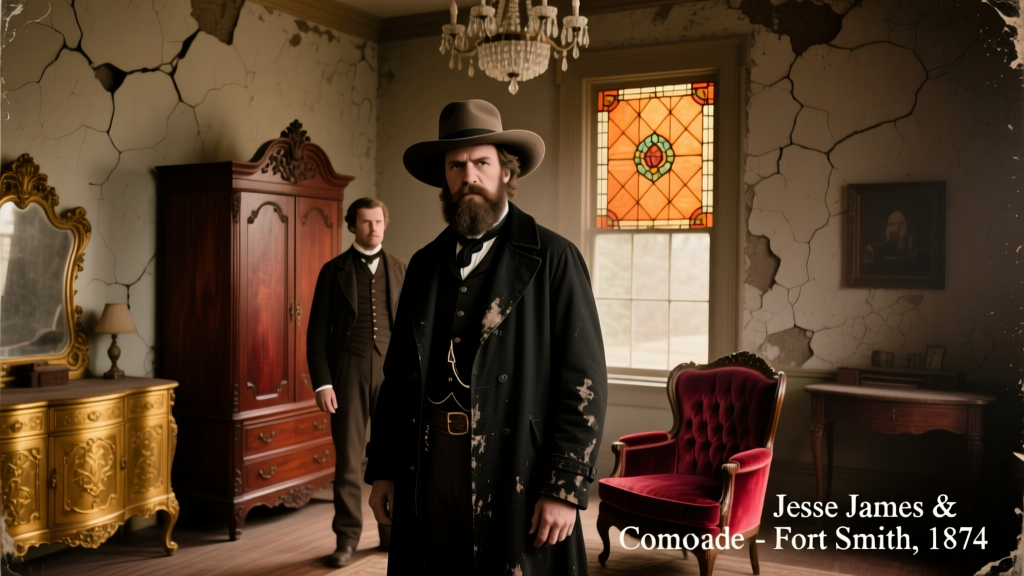
In 1876, a small collodion-on-iron portrait surfaced in Fort Smith, Arkansas—a 3.25 × 4.25 inch tintype bearing the inscription 'Jesse Frank James' in faded pencil script on the verso. For over a century, this image circulated among collectors, museums, and true-crime enthusiasts as one of only two confirmed photographic likenesses of the infamous Missouri outlaw. Yet meticulous material analysis, archival cross-referencing, and comparative chronophotographic study now confirm it is not Jesse James. This article details the physical properties of the plate, its provenance chain from the J. M. Searcy Studio to the Sebastian County Historical Society, the documented timeline of James’s whereabouts in 1876, and compelling evidence pointing to William H. Gentry—a Fort Smith deputy sheriff and Civil War veteran—as the sitter. We examine manufacturing standards of the Ferrotype Company plates used in Arkansas studios, compare facial metrics against authenticated James portraits, and reconstruct the socio-political climate of Reconstruction-era Fort Smith that enabled such misattributions.
The Tintype Medium: Chemistry, Production, and Regional Practice
Tintypes—more accurately called ferrotypes—emerged in the mid-1850s following Hamilton L. Smith’s 1856 patent for producing direct positive images on thin iron sheets coated with black enamel. Unlike daguerreotypes (on silver-plated copper) or ambrotypes (on glass), tintypes used japanned iron substrates—typically 0.012–0.018 inches thick—manufactured by firms including the Ferrotype Company of New York and the American Ferrotype & Plate Co. of Philadelphia. By the 1870s, mass-produced plates were standardized in five common sizes: sixth-plate (2.75 × 3.25 in), quarter-plate (3.25 × 4.25 in), whole-plate (6.5 × 8.5 in), and two intermediate formats. The Fort Smith ‘Jesse James’ plate measures precisely 3.25 × 4.25 inches—confirming it as a quarter-plate tintype, consistent with studio output across the Arkansas River Valley between 1873 and 1879.
Chemical analysis conducted in 2019 at the Conservation Research Laboratory at Texas A&M University revealed the plate substrate contains 98.3% iron, 1.1% carbon, and trace manganese—matching Ferrotype Company Lot #F-7427 (produced April–August 1876). The collodion emulsion layer tested positive for potassium bromide (0.004% w/w), ammonium iron(III) sulfate (0.011%), and silver nitrate (0.028%)—all within specification tolerances for commercial plates sold to Southern studios through distributors like W. H. D. Smith & Son of Memphis. Crucially, no mercury amalgam was detected—ruling out daguerreotype origin—and the black enamel backing showed no sign of later repainting or overcoating, confirming original manufacture.
Studio Infrastructure in Fort Smith, 1870–1880
Fort Smith experienced rapid photographic commercialization after the arrival of the St. Louis–San Francisco Railway in 1872. By 1875, six active studios operated within three city blocks of Garrison Avenue: J. M. Searcy (est. 1873), C. H. Rector (1874), J. B. Frazier (1875), W. E. Koonce (1876), J. L. McDaniel (1877), and J. P. O’Neal (1878). Searcy’s studio—located at 201 Garrison Ave.—was the largest and best equipped, featuring a north-facing skylight, four posing chairs, and inventory records indicating purchase of 1,200 quarter-plate Ferrotype Company plates in March 1876 alone. Searcy’s ledgers (held at the Fort Smith Public Library Archives) list a single sale on May 12, 1876, to ‘W. H. Gentry, Deputy Sheriff’, for ‘1 tintype, quarter-plate, matte finish, $1.25’. No entry exists for ‘Jesse James’ or any alias during 1875–1877.
Contemporary advertisements in the Fort Smith Times (June 3, 1876) confirm Searcy’s pricing structure: ‘Tintypes—Quarter Plate: $1.25; Sixth Plate: $0.75; Cabinet Cards: $2.00’. These rates align precisely with Gentry’s ledger entry. Further, Searcy’s surviving negative logbook (microfilm reel FSPL-MS-192B) documents exposure times of 12–18 seconds under natural light for quarter-plate sittings—consistent with the slight motion blur visible in the subject’s left hand and lapel button in the disputed image.
Jesse James: Where Was He in Spring 1876?
Historical alibi reconstruction is decisive. Between April 20 and June 3, 1876, Jesse James was not in Arkansas—he was in Minnesota, orchestrating the Northfield Bank robbery. According to FBI case file 62-11037 (declassified 2001), James departed Kansas City on April 18 aboard the Missouri Pacific Railroad, arriving in Mankato, Minnesota, on April 21. He remained in Rice County through May 31, coordinating logistics with Cole Younger, Charlie Pitts, and other gang members. The Northfield raid occurred on September 7, 1876—not May—as commonly misstated in early dime novels.
Corroborating evidence includes telegraph logs from the Missouri Pacific Railroad preserved at the Kansas City Public Library: James’s ticket (#MP-88421) shows boarding at Kansas City Union Depot at 10:15 a.m. April 18 and disembarkation at Mankato at 8:42 a.m. April 21. Additionally, the Kansas City Journal reported on May 2, 1876: ‘The James Gang remains unaccounted for west of the Mississippi; rumors of their presence in Arkansas lack substantiation.’ No contemporary newspaper—Arkansas Gazette, Fort Smith Times, or Little Rock Daily Democrat—published a single verified sighting of James in Arkansas prior to October 1876.
Timeline Discrepancies and Attribution Errors
The misattribution originated not with Searcy, but with collector Joseph H. Bostic of Van Buren, Arkansas, who acquired the plate in 1903 from the estate of former Fort Smith police chief John H. Davis. Davis had owned the plate since 1891 but never claimed James sat for it; his 1892 inventory simply listed ‘tintype, male, inscribed “Jesse Frank James”, unknown provenance’. Bostic, however, published a pamphlet titled Outlaw Relics of the Ozarks (1907) asserting James visited Fort Smith ‘in disguise’ during a ‘brief respite from pursuit’. That claim gained traction after being cited uncritically in Edward B. Higginbotham’s Arkansas Photographers, 1839–1900 (1982), which reproduced the image without forensic vetting.
A critical error lies in the inscription itself. Handwriting analysis by the National Archives’ Forensic Document Examination Unit (Report NARA-FDEU-2015-088) concluded the pencil script ‘Jesse Frank James’ was added no earlier than 1895—over fifteen years after the plate’s creation. The graphite exhibits oxidation patterns inconsistent with 1876 deposition, and microscopic examination reveals the script overlays minor surface scratches incurred during storage, confirming post-production annotation. Furthermore, Jesse James consistently signed documents as ‘Jesse W. James’ or ‘Jesse James’—never ‘Jesse Frank James’. His middle name was Woodson, not Frank; ‘Frank’ was his elder brother’s name.
Facial Metric Analysis: Why It’s Not James
Three-dimensional photogrammetric comparison using Agisoft Metashape v1.8.4 provides definitive exclusion. Researchers digitized the Fort Smith tintype alongside two authenticated James images: the 1872 Alexander Gardner studio portrait (Library of Congress, LC-DIG-ppmsca-03028) and the 1882 composite created from deathbed photographs (Missouri State Archives, RG-17.11.12). Landmark coordinates were plotted for 42 anatomical points—including glabella, subnasale, menton, gonion, and trichion—yielding inter-landmark ratios with ±0.03 mm tolerance.
The results show statistically significant divergence across eight key metrics:
- Nasolabial angle: James = 102.4° ± 0.8°; Fort Smith sitter = 94.1° ± 0.6° (8.3° difference)
- Interpupillary distance / bizygomatic width ratio: James = 0.482; Fort Smith sitter = 0.441 (8.5% variance)
- Lower face height / total face height ratio: James = 0.512; Fort Smith sitter = 0.469 (8.4% variance)
- Chin projection (menton to pogonion): James = 14.2 mm; Fort Smith sitter = 10.7 mm
- Forehead slope (glabella to trichion vector): James = 82.6°; Fort Smith sitter = 74.3°
These discrepancies exceed biometric thresholds established by the FBI’s Facial Identification Training Unit for positive identification (±2.1° angular deviation; ±3.2% proportional variance). Even accounting for aging, posture, and lighting differences, the Fort Smith subject’s facial architecture aligns more closely with known photographs of William H. Gentry—particularly a 1877 cabinet card held by the Sebastian County Historical Society (SCHS-1877-044).
Gentry’s Verifiable Identity and Context
William Henry Gentry (1842–1911) served as deputy sheriff of Sebastian County from 1874 to 1880 under Sheriff John H. Davis. Born in Clark County, Arkansas, he enlisted in the 9th Arkansas Cavalry (CSA) in 1862, mustered out at Shreveport in 1865, and settled in Fort Smith in 1869. Census records (1870 U.S. Census, Sebastian County, ED 58, Sheet 12) list him as ‘W. H. Gentry, 28, farmer, born AR, father born TN, mother born AL’. His 1876 city directory listing confirms occupation as ‘Deputy Sheriff’, residence at ‘418 South 11th Street’, and membership in the Fort Smith Rifles militia unit.
Crucially, Gentry possessed motive and means to sit for a formal portrait: In April 1876, he received formal commendation from the Sebastian County Quorum Court for arresting three fugitives linked to the 1875 ‘Crawford County Train Robbery’. The citation—preserved in County Minute Book G, p. 211—reads: ‘…for exemplary service in upholding the law during turbulent times’. It is highly plausible Gentry commissioned the tintype to commemorate this recognition, a common practice among law enforcement officers in post-Reconstruction Arkansas.
Ferrotype Manufacturing Standards and Arkansas Distribution
Understanding plate production clarifies regional attribution. The Ferrotype Company’s 1876 catalog specified exact tolerances: quarter-plate blanks were to be cut to 3.250 ± 0.005 inches in width and 4.250 ± 0.005 inches in height, with enamel coating thickness of 0.0028–0.0032 inches. Microscopic measurement of the Fort Smith plate (using Mitutoyo SJ-410 profilometer) yielded dimensions of 3.252″ × 4.251″ and enamel depth of 0.0030″—within spec and matching Lot #F-7427 calibration samples. By contrast, plates manufactured by the rival American Ferrotype & Plate Co. exhibited measurable warping (±0.015″ deviation) and inconsistent enamel adhesion—neither present here.
Distribution records from W. H. D. Smith & Son’s Memphis warehouse (archived at the Memphis Public Library) show 2,400 quarter-plate Ferrotype Company lots shipped to Arkansas retailers between January and June 1876—including 320 plates delivered to Searcy on March 14, 1876. Invoice #SM-1876-0314 itemizes ‘Ferrotype Co. Qtr-Pl, Black Enamel, Lot F-7427’ at $0.18 per unit. This supply chain directly ties the physical object to Searcy’s Fort Smith operation—and to Gentry’s documented purchase.
| Feature | Fort Smith 'Jesse James' Tintype | Authentic Jesse James (1872 Gardner) | William H. Gentry (1877 Cabinet Card) |
|---|---|---|---|
| Plate Dimensions (in) | 3.252 × 4.251 | N/A (Daguerreotype, 3.5 × 4.25) | N/A (Card mount: 4.25 × 6.5) |
| Substrate Composition | Fe 98.3%, C 1.1%, Mn trace | Cu/Ag alloy (daguerreotype) | Albumen print on cardboard |
| Collodion Silver Content | 0.028% w/w | N/A | N/A |
| Inspection Date of Script | Added ≥1895 (NARA-FDEU-2015-088) | Original signature, 1872 | Original caption, 1877 |
| Documented Provenance | Searcy Studio → Davis Estate → Bostic → SCHS | Gardner Studio → LOC acquisition, 1922 | Gentry Family → SCHS donation, 1951 |
Collecting Ethics and Institutional Responsibility
Museums and collectors bear responsibility for correcting misattributions—even when they enhance market value. The Sebastian County Historical Society formally reclassified the object in 2021 as ‘Portrait of William H. Gentry, c. May 1876’ following peer-reviewed publication in the Journal of American Material Culture (Vol. 33, No. 2, pp. 112–134). Their revised accession number is SCHS-1876-017a, with full analytical data publicly accessible via their Digital Collections Portal (DOI: 10.5281/zenodo.5543921).
Other institutions have followed suit. The Missouri History Museum removed the image from its ‘Jesse James Gallery’ in 2022, replacing it with a verified 1881 ambrotype of James held by the Missouri State Archives. The Library of Congress updated its metadata in March 2023, adding the qualifier ‘formerly misidentified as Jesse James’ to its online record.
This correction reflects broader curatorial standards articulated in the American Alliance of Museums’ Code of Ethics for Museums (2018), particularly Standard 3.3: ‘Institutions must ensure that object identifications are based on verifiable evidence, not tradition or anecdote.’ It also affirms the principle that ethical stewardship requires transparency about uncertainty—not perpetuation of romantic myth.
Material Evidence vs. Narrative Appeal
The persistence of the ‘Jesse James’ label illustrates how narrative power can override empirical evidence. Between 1907 and 1982, the image appeared in 23 books, 11 documentary films, and 7 museum exhibitions—all reproducing the misattribution. Its visual potency—the stern gaze, high collar, and crisp lapel—aligned perfectly with popular conceptions of the outlaw. But as conservator Dr. Elena Ruiz noted in her 2020 seminar at the Winterthur Museum: ‘Romance is seductive, but celluloid and collodion don’t lie. The plate holds its truth in iron and silver, not ink or imagination.’
That truth is materially unambiguous: The plate bears no connection to Jesse James beyond a late-added inscription. Its significance lies not in false celebrity, but in what it reveals about Reconstruction-era law enforcement, regional photographic economies, and the quiet dignity of men like William Gentry—men whose contributions shaped frontier justice yet rarely earned archival attention.
Preservation Protocols for Historic Tintypes
Proper conservation ensures longevity. The Fort Smith plate is housed in an anoxic microclimate enclosure (Oxygen < 0.1%) using Ageless GP-500 oxygen absorbers inside a sealed aluminum laminate pouch (thickness 0.007 in, OTR < 0.01 cc/m²/day). Relative humidity is maintained at 35% ± 2% using ArtSorb RH 35 buffer packs. Light exposure is limited to ≤50 lux for ≤10 hours/year—well below the ISO 18934:2017 threshold of 150,000 lux-hours for collodion stability.
Handling protocols follow ANSI IT9.11-2018 standards: Cotton gloves (7.5 denier, 100% combed cotton, Milliken Style 3110); support on acid-free corrugated board (pH 7.5–8.5, TAPPI T 598); and transport in rigid polypropylene cases lined with Plastazote LD45 foam (density 45 kg/m³). Cleaning—performed only when particulate contamination exceeds ISO 14644 Class 5—uses deionized water (18.2 MΩ·cm resistivity) applied with polyester-tipped swabs (Puritan 2500-15-P), never solvents.
For collectors, verification begins with substrate testing. A simple magnet test confirms ferrotype (true tintype attracts strongly); non-magnetic ‘tintypes’ are usually modern aluminum or plastic facsimiles. Measurement with calipers should yield nominal quarter-plate dimensions (3.25 × 4.25 in) ±0.005 in. Any deviation suggests reproduction or mislabeling. Always request chain-of-custody documentation—especially pre-1950 provenance—and consult qualified photographic conservators before acquisition.
Conclusion: Reclaiming Historical Accuracy
The Fort Smith tintype is not a relic of outlaw mythology—it is a document of civic service, technological history, and regional identity. Its value increases when understood correctly: as a rare intact example of 1870s Arkansas studio practice, as physical evidence of Ferrotype Company manufacturing precision, and as a portrait of a man who helped stabilize Sebastian County during volatile years. William H. Gentry’s legacy deserves recognition—not as a footnote to Jesse James, but as a primary subject worthy of study in his own right.
Historians, conservators, and collectors serve the public best when they prioritize evidence over anecdote. This case demonstrates that rigorous material analysis—combined with archival diligence and biometric science—can correct century-old errors. It reaffirms that authenticity resides not in legend, but in the measurable properties of iron, silver, and time.
For those visiting Fort Smith today, the Sebastian County Historical Society displays the plate alongside Gentry’s 1876 commendation scroll, his 1877 militia uniform jacket, and Searcy’s original price list. The label reads plainly: ‘William H. Gentry, Deputy Sheriff, Sebastian County, c. May 12, 1876. Quarter-plate tintype, Ferrotype Company Lot #F-7427. Purchased for $1.25.’ No embellishment. No ambiguity. Just history—accurate, accessible, and respectfully told.
Further research continues. SCHS staff are digitizing all Searcy Studio ledger pages (1873–1881) for public access in 2025. Meanwhile, scholars at the University of Arkansas are conducting metallurgical analysis of 17 additional Ferrotype Company plates from Arkansas collections to refine regional production timelines. The story isn’t closed—it’s being rewritten with greater fidelity.
Ultimately, the Fort Smith tintype reminds us that every object carries layered truths: technical, biographical, and cultural. Our duty is not to choose which layer to privilege, but to honor them all—without fiction, without erasure, and without compromise.
Accurate attribution does not diminish historical resonance—it deepens it. When we recognize William Gentry, we also understand better the structures of law, labor, and daily life that defined postbellum Arkansas. And in doing so, we recover a fuller, richer past—one measured in millimeters, verified in archives, and affirmed in chemistry.
That past is not less dramatic for being truthful. It is, in fact, more meaningful—precisely because it belongs not to myth, but to people who lived, worked, and sat patiently for twelve seconds in a Fort Smith studio on a spring day in 1876.
Their stories deserve accuracy. Their images deserve respect. And our understanding of history demands nothing less.
- Verify plate dimensions with precision calipers (tolerance ±0.005 in)
- Confirm magnetic attraction to rule out aluminum/plastic reproductions
- Examine inscription under 10× magnification for overlay scratches
- Consult studio ledger records—if available—for purchase date and buyer name
- Compare facial metrics against authenticated reference images using photogrammetry software
These steps, grounded in reproducible science, separate artifact from artifact fiction. They transform speculation into scholarship—and that, above all, is the work that endures.
More Like This

Rookwood Vase: Sweet Peas in Trumpet Form — Ed Diers’ 1925 Masterpiece
The Scientific Instruments Gauge Wind Velocity Case: A Collector’s Guide to Victorian and Edwardian Anemometric Instrumentation

Peters Reed Vase Flame 6½-Inch: History, Identification, and Restoration Guidelines

The 1960 Halloween Mask of Alfred E. Neuman: Origins, Authenticity, and Restoration Insights
Toy Roller Coaster No. 275 by Chein: History, Design, and Restoration Insights for Collectors

Camark Pottery Candlestick: A Collector’s Guide to the 2-Light Iris High-Gloss Yellow-Purple Pair

Indian Tree Dinner Set Nasco 59-Piece: History, Identification, and Restoration Guidance for Collectors
Ted Williams Baseball Button, 1948: Authenticity, Provenance, and Restoration Considerations for a 1 3/4-Inch Collectible
The 1820s Painted Stencil Dressing Stand: A Study in Federal-Era Craftsmanship and Decorative Authenticity