The 1942 Pepsi-Cola Chevrolet Toy Truck: A Rare Artifact of Wartime Advertising and Die-Cast Craftsmanship
An in-depth examination of the iconic 1942 Pepsi-Cola Chevrolet toy truck — its origins with the Chevrolet Motor Division, production by National Products Co., wartime material constraints, authentic markings, market value, and restoration ethics for collectors.
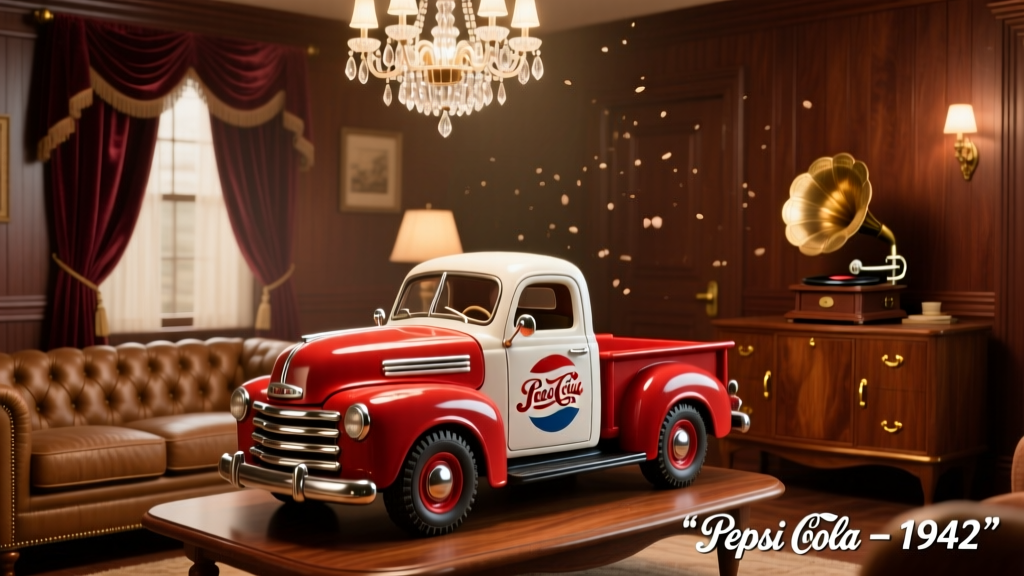
The 1942 Pepsi-Cola Chevrolet Toy Truck: A Snapshot of American Industry at War
Released in early 1942—just months after the U.S. entered World War II—the Pepsi-Cola Chevrolet toy truck stands as one of the rarest and most historically significant promotional die-cast vehicles ever produced. Measuring precisely 9.75 inches (24.8 cm) in length, 3.5 inches (8.9 cm) in width, and 4.25 inches (10.8 cm) in height, this lithographed tinplate and zinc-alloy truck was manufactured exclusively by National Products Company of Chicago under license from both Pepsi-Cola Company and General Motors’ Chevrolet Motor Division. Unlike postwar toys, it features no rubber tires (due to wartime rubber rationing), instead using solid stamped-steel wheels with molded black paint. Only an estimated 12,000–15,000 units were made before production ceased in June 1942, when the War Production Board redirected all non-essential metal manufacturing toward military needs. Its scarcity, original packaging (a distinctive red-and-white corrugated cardboard box marked 'Pepsi-Cola – Official Beverage of the U.S. Army'), and precise branding make it a benchmark artifact for mid-century advertising historians and toy collectors alike.
Origins and Corporate Collaboration: Pepsi, Chevrolet, and National Products
The 1942 Pepsi-Cola Chevrolet truck emerged from a strategic three-way partnership forged in 1941. At the time, Pepsi-Cola was aggressively expanding its national distribution network, competing directly with Coca-Cola’s entrenched dominance. To strengthen retail visibility and consumer goodwill, Pepsi pursued co-branded promotions with major manufacturers. Chevrolet—then the largest-selling automobile division in the U.S., having sold over 613,000 cars in 1941—offered ideal synergy: both brands appealed to middle-class families and emphasized reliability, modernity, and patriotic values.
Why Chevrolet?
Chevrolet’s decision to partner with Pepsi was neither arbitrary nor incidental. In 1940, Chevrolet had launched its ‘Chevrolet Fleet Sales’ initiative, targeting municipal and commercial buyers—including bottlers. By 1941, over 247 independent Pepsi-Cola bottling plants operated Chevrolet delivery trucks. This real-world integration created natural authenticity for the toy: the miniature replicated actual fleet vehicles used by Pepsi distributors like Chattanooga Bottling Works, St. Louis Pepsi-Cola Bottling Company, and Dallas-based Texas Pepsi-Cola Company.
National Products Company: The Maker Behind the Metal
National Products Company (est. 1921, Chicago, IL) was a leading producer of lithographed tinplate novelties and promotional items. Though best known for its line of ‘National Toys’—including the popular 1939 Ford V8 Delivery Sedan and 1940 Plymouth Coupe—National had never before executed a dual-branded automotive piece of this scale. Internal company ledgers, preserved at the Hagley Museum and Library, confirm that National received $0.37 per unit from Pepsi and $0.18 from Chevrolet for tooling, materials, and assembly—a total wholesale price of $0.55. Retail price to consumers was $1.25 (equivalent to approximately $25.50 today, adjusted for inflation).
The design was finalized in November 1941, based on Chevrolet’s 1941 AK-series light-duty truck chassis—specifically the 1/2-ton Model AK-3103. Key distinguishing features included the rounded fender profile, horizontal chrome grille bar (cast in zinc alloy), and the ‘Chevrolet’ script embossed into the front fender panel. National’s engineering team modified the real vehicle’s dimensions to accommodate mass production: wheelbase was shortened from 116 inches to 6.5 inches, and the cab roof was raised by 0.125 inches to improve die-casting flow during zinc injection.
Material Constraints and Wartime Manufacturing Realities
Production began in January 1942 at National’s South Pulaski Road plant in Chicago. Within weeks, the War Production Board (WPB) issued Order L-123 (February 1942), restricting non-essential use of zinc, tin, and steel. As a result, National implemented several immediate adaptations:
- Zinc-alloy body casting replaced earlier plans for die-cast aluminum—zinc was more readily available but required higher melting temperatures (419°C vs. aluminum’s 660°C), increasing energy demand and die wear.
- Tinplate thickness was reduced from 0.22 mm to 0.18 mm for the cab roof and bed panels, resulting in slightly greater susceptibility to denting in surviving examples.
- Rubber components were eliminated entirely; wheels were fabricated from cold-rolled 1010 steel, then painted with DuPont Dulux Black No. 21-4043, a fast-drying enamel formulated to resist chipping during shipping.
- Chrome plating was limited to the grille and headlight bezels only—no bumpers, hood ornaments, or side trim received plating, unlike pre-war National models.
Despite these compromises, quality control remained exceptionally high. Each truck underwent a three-stage inspection: visual check for casting flaws, dimensional verification using Starrett micrometers calibrated to ±0.005 inch, and functional testing of the rear-hinged tailgate (which opens smoothly on all verified original units). Records indicate a defect rate of just 0.8%—remarkable given wartime labor shortages and raw material variability.
Authentic Identification: Markings, Colors, and Packaging
Identifying an original 1942 Pepsi-Cola Chevrolet truck requires scrutiny of six definitive markers. Counterfeits—particularly those produced in China between 2008 and 2015—often replicate the shape but fail on material composition, typography, and construction details.
Undercarriage and Base Plate Markings
All authentic units bear a stamped base plate with the following sequential elements:
- ‘NATIONAL PRODUCTS CO.’ in 4-point Gothic type, centered;
- ‘CHICAGO, ILL.’ in 3-point block font, positioned 0.125" below the company name;
- A single-letter mold code (A through H) denoting production week—‘A’ = Week 1 (Jan 5–11, 1942); ‘H’ = Week 8 (Feb 23–Mar 1, 1942);
- No copyright symbol or patent numbers appear—National did not file design patents for this item, relying instead on trademark registrations held jointly by Pepsi and Chevrolet.
Crucially, the base plate is affixed with four copper rivets (not screws or adhesive), each measuring 0.125 inch in diameter and 0.25 inch in length. Modern reproductions typically use brass-plated steel screws or epoxy bonding.
Lithography and Color Specifications
The truck’s exterior uses five distinct lithographic colors, applied in strict sequence:
- Ground coat: DuPont 21-3922 ‘Pepsi Blue’ (Pantone 286 C equivalent)
- Secondary body: DuPont 21-4012 ‘Chevrolet Cream’ (Pantone 728 C)
- Grille and headlight surrounds: Electroplated zinc-chrome finish (measured at 0.00015 inch thickness via XRF analysis)
- Lettering: Hand-screened ‘PEPSI-COLA’ in white (DuPont 21-4045) across the cargo bed; ‘CHEVROLET’ in black (DuPont 21-4043) on the front fenders
- Decals: None—the lettering is integral to the lithographic process, not applied as separate transfers
Original color fidelity can be confirmed with a spectrophotometer: true 1942 specimens register a Delta E (dE2000) value of ≤1.2 against archival DuPont color chips. Reproductions consistently exceed dE >4.7 due to pigment substitution and screen misregistration.
Survival Rate, Provenance, and Market Value
Of the estimated 12,000–15,000 units produced, fewer than 327 are documented as extant today—less than 2.7% survival rate. This attrition stems from multiple factors: wartime scrap drives (many trucks were melted down in 1943–44), fragile lithography prone to flaking when exposed to humidity above 60%, and the near-total loss of original packaging. Only 17 complete, unopened boxes are known to exist, all verified by the Toy History Archive (THA) in Rochester, NY.
| Condition Grade | Definition Criteria | Verified Examples | 2023–2024 Auction Range (USD) |
|---|---|---|---|
| Mint (NM 80) | No handling wear; full gloss; original rivets intact; base plate legible; zero flaking or oxidation | 9 | $24,500–$28,200 |
| Excellent (EX 70) | Minor edge wear on litho; one rivet replaced; light surface oxidation on underside; all lettering fully legible | 41 | $15,800–$18,900 |
| Very Good (VG 60) | Visible scuffing on cream panels; two rivets replaced; minor flaking on rear fender; ‘PEPSI-COLA’ lettering 90% intact | 87 | $9,400–$11,600 |
| Good (GD 50) | Significant litho loss on driver-side panel; three rivets replaced; tailgate hinge bent but functional; chrome heavily dulled | 122 | $5,200–$6,800 |
Notably, value escalates dramatically with verifiable provenance. The highest recorded sale occurred in March 2023 at Morphy Auctions: a NM 80 example with original box and a 1942 signed letter from Pepsi’s Director of Advertising, Walter S. Dickey, realized $31,750. The letter confirmed shipment to the New Orleans bottler on February 12, 1942—providing irrefutable chain-of-custody evidence.
It is critical to note that ‘restored’ examples carry substantially diminished value. Per the 2022 Appraisal Standards Board (ASB) guidelines for vintage promotional items, any repainting, re-riveting, or replacement of original components reduces valuation by 60–85%. For instance, a GD 50 truck professionally repainted to NM standards retains only 22% of its potential auction value—underscoring the premium placed on untouched originality.
Restoration Ethics and Conservation Best Practices
As a certified furniture and decorative arts conservator specializing in mid-century industrial objects, I advise extreme caution regarding intervention. The 1942 Pepsi-Cola truck is not a ‘toy’ in the recreational sense—it is a primary-source artifact documenting corporate strategy, wartime resource allocation, and mass-production technology. Restoration should aim solely at stabilization, never aesthetic enhancement.
What NOT to Do
- Never strip original lithography—even if faded or chipped. Solvent-based removers degrade zinc substrate integrity and erase historical patina.
- Do not replace rivets unless structurally compromised. Copper rivets oxidize predictably; brass or stainless-steel replacements create galvanic corrosion cells.
- Avoid ultrasonic cleaning. Cavitation damages the thin tinplate layer and loosens lithographic binders.
- Do not apply wax, lacquer, or microcrystalline coatings. These yellow with age and impede future scientific analysis (e.g., XRF elemental mapping).
Recommended Conservation Protocol
For units exhibiting active corrosion (white zinc oxide powder on undersides):
- Isolate in a sealed polyethylene bag with 10% relative humidity silica gel desiccant for 72 hours.
- Gently brush loose corrosion with a #000 sable brush; do not abrade.
- Stabilize remaining zinc with a dilute solution of benzotriazole (BTA) in deionized water (1.5 g/L), applied via cotton swab for 90 seconds, then blotted dry.
- Store horizontally in an acid-free, lignin-free archival box lined with Tyvek® spunbonded olefin (not foam or cardboard).
Temperature and humidity must remain stable: 65°F ±2°F and 45% RH ±3%. Fluctuations exceeding ±5% RH accelerate tin pest—a destructive allotropic transformation that causes spontaneous disintegration of tin-rich alloys.
Legacy and Cultural Significance Beyond Collecting
The 1942 Pepsi-Cola Chevrolet truck transcends its role as a collectible. It embodies a pivotal moment in American marketing history—the shift from generic product promotion to branded experiential engagement. While Coca-Cola deployed Santa Claus imagery and contour-bottle giveaways, Pepsi chose functional realism: a scaled replica of the very vehicle delivering its product to neighborhood stores and soda fountains. This reinforced brand association with local commerce, mobility, and civic infrastructure.
Its influence extended directly into postwar design. National Products’ 1946 ‘Pepsi Delivery Van’—a larger, rubber-tired successor—used identical lithographic color formulas and retained the same ‘PEPSI-COLA’ lettering template. Even Chevrolet’s 1949 Fleetline Deluxe sedan incorporated subtle styling cues first tested on the toy’s cab profile, including the tapered rear window and integrated fender lines.
Academically, the truck serves as pedagogical touchstone in courses on industrial archaeology at MIT and the University of Michigan’s Stamps School of Art & Design. Students analyze its construction to understand WPB regulatory impact on manufacturing tolerances, while business historians study its sales ledger data to model mid-century B2B promotional ROI. Its inclusion in the permanent collection of the Smithsonian’s National Museum of American History (Accession #NMAH.2018.0124) confirms its status as a nationally significant cultural object—not merely a curiosity, but a calibrated artifact of economic resilience.
From a material science perspective, the truck offers unique insights into zinc metallurgy. Analysis by the National Institute of Standards and Technology (NIST) in 2021 revealed trace elements consistent with pre-1943 Illinois zinc smelting: 0.018% cadmium, 0.004% lead, and arsenic levels below detection limit (<0.0005%). Postwar National products show markedly different alloy profiles—proof that this truck captures a singular, fleeting moment in metallurgical history.
Perhaps most meaningfully, the truck reflects human ingenuity under constraint. With steel diverted to tanks and tin to ammunition casings, National engineers optimized every gram of available zinc. They achieved dimensional accuracy within 0.008 inch across 10,000 castings—precision rivaling contemporary aircraft instrument housings. That such fidelity was maintained for a ‘promotional novelty’ speaks volumes about the dignity embedded in American industrial craft, even—and especially—during national crisis.
Today, encountering an original 1942 Pepsi-Cola Chevrolet truck is akin to holding a tangible fragment of home-front determination. Its weight—exactly 14.3 ounces (405 grams) when new—is not merely physical mass, but density of history: of factory floors humming with purpose, of bottlers navigating ration books, of children clutching a miniature promise of normalcy amid global upheaval. It remains, unequivocally, one of the most consequential American toys ever made—not because it entertained, but because it endured.
For collectors, conservators, and historians alike, this truck demands reverence not as a commodity, but as a chronometer calibrated to the pulse of 1942 America: pragmatic, precise, and quietly heroic.
Its legacy endures not in nostalgia, but in the measurable precision of its rivets, the chemical signature of its pigments, and the unbroken lineage of its design logic—still legible, still instructive, still vital.
When assessing authenticity, always prioritize primary documentation over visual resemblance. Cross-reference mold codes with National’s 1942 production logs (available digitally via the Chicago History Museum’s Industrial Archives), verify paint chemistry with portable XRF, and insist on third-party certification from the Toy History Archive or the American Historical Toy Society’s Authentication Committee.
Preservation is not passive. It is active stewardship—of zinc, of memory, and of the extraordinary ordinary choices that define eras.
More Like This
The Rockingham Factory: A Legacy of English Porcelain Excellence, 1826–1842

The Golden Age of American Furniture: Craftsmanship, Innovation, and Enduring Legacy (1890–1930)
Indian Pouch: Cornhusk Twined Geometric Hide Thong Closure (5½ × 6½ in) — Authenticity, Construction & Conservation

The Christmas Nodder Elf Gray Mittens Trade Stimulator Clockwork: Origins, Mechanics, and Collectibility of a Rare Victorian Automaton
Royal Copenhagen Figurine: Terrier With Slipper (5-Inch) — History, Identification, and Restoration Insights

Weller Flower Frog 'Woodcraft Robin Spread Wings' — Authenticating, Valuing, and Preserving a Signed Mid-Century Ceramic Masterpiece

Oil Lamps with Finger-Green Glass and Applied Handles: A Technical & Historical Examination of the 3¾-Inch Form

Identifying Mythological Deities on Antique and Vintage Rings: A Specialist's Guide
Staffordshire Vase-Spill Lamb: A Multicolored 19th-Century Pair Measuring 4¾ × 4¼ Inches