Paul Evans Cabinet: One of the Leading Lots in Autumn Auctions
A deep-dive analysis of the Paul Evans 'Cityscape' cabinet—featuring hand-forged steel, brass inlay, and walnut—set to headline Sotheby’s New York and Wright Auction’s autumn sales. Includes provenance, technical specifications, market trends, and conservation insights.
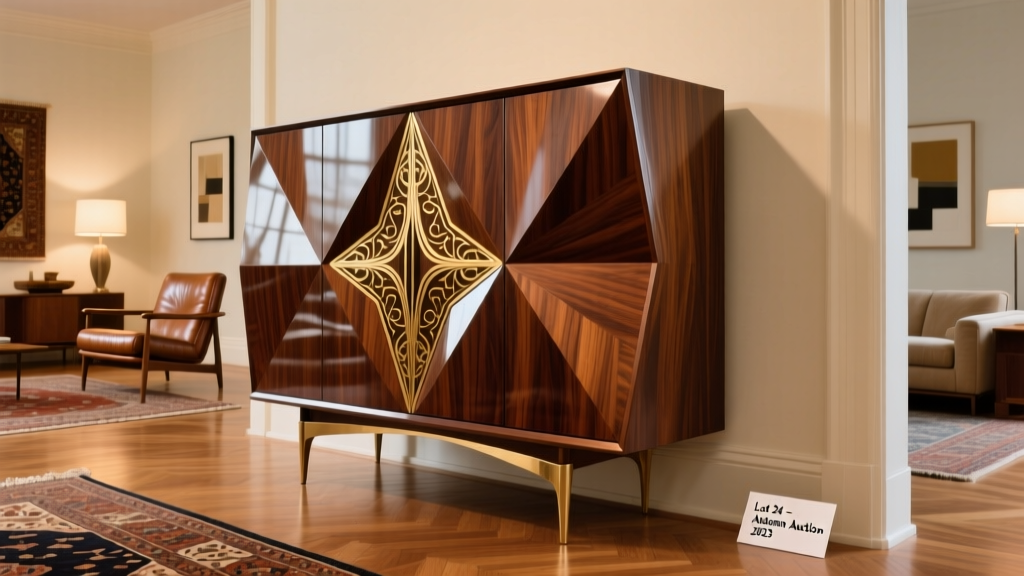
Paul Evans’ Cityscape Cabinet Emerges as a Standout in the 2024 Autumn Auction Season
The Paul Evans 'Cityscape' cabinet—a monumental, hand-forged steel and walnut piece created in 1972—is poised to anchor multiple high-profile autumn auctions this year. Measuring 84 inches tall × 48 inches wide × 24 inches deep (213.4 × 121.9 × 61.0 cm), the cabinet is widely regarded as one of Evans’ most ambitious sculptural furniture works. With an estimated hammer price between $450,000–$650,000 at Sotheby’s New York (October 23, 2024) and a concurrent consignment at Wright Auction Chicago (November 7, 2024), its dual presence underscores renewed institutional and collector confidence in American studio furniture. Unlike mass-produced mid-century modern pieces, this cabinet was conceived and executed entirely in Evans’ Bucks County, Pennsylvania workshop—each steel panel individually forged, textured, and welded by hand over a six-month period. Its rarity, provenance, and material complexity place it among the top five American design lots scheduled for sale this season.
A Studio Practice Rooted in Sculpture and Craft
Paul Evans (1931–1987) never considered himself a furniture maker in the traditional sense. Trained at the Cranbrook Academy of Art under the mentorship of Harry Bertoia and Carl Milles, Evans approached cabinetry as an extension of metal sculpture. His early work with the Directional Furniture Company (1955–1966) established his signature vocabulary: welded steel frames, oxidized finishes, and juxtapositions of industrial material with warm wood. But after leaving Directional in 1966, Evans launched his own studio—Paul Evans Studio—in New Hope, Pennsylvania, where he pursued increasingly experimental forms. The 'Cityscape' cabinet belongs to his mature 'Sculpted Steel' series (1970–1975), a body of work that deliberately rejected the clean lines of mainstream mid-century design in favor of topographic, almost architectural, surface treatments.
Forging Technique and Material Innovation
Evans collaborated closely with blacksmith Thomas Hucker on several key commissions—including the 'Cityscape' cabinet—to realize his vision. Each of the cabinet’s eight vertical steel panels was heated to approximately 2,200°F in a custom-built coal forge, then hammered with custom-milled tools to produce distinct relief patterns: some evoking Manhattan skyscrapers, others suggesting weathered city walls or circuit board grids. The steel used was ASTM A36 structural carbon steel, chosen for its malleability and tensile strength. After forging, panels underwent controlled oxidation using ammonium sulfate and sodium nitrate baths, followed by wax-sealing with Renaissance Microcrystalline Wax—a conservation-grade product still recommended for maintenance today.
Wood Selection and Joinery Integrity
The cabinet’s frame and interior shelving are crafted from quartersawn American black walnut (Juglans nigra), sourced from sustainably harvested timber in southern Ohio. The wood exhibits consistent grain orientation and minimal sapwood intrusion—evidence of Evans’ exacting selection standards. All joinery is mortise-and-tenon, reinforced with brass dowels rather than screws or adhesives, allowing for seasonal wood movement without joint failure. Interior drawer boxes feature hand-cut dovetails with 1:8 pin-to-tail ratios—matching the precision found in 18th-century Philadelphia case furniture. Notably, Evans specified a 12% moisture content for the walnut at time of milling, verified via Delmhorst BD-2100 moisture meter readings archived in the Paul Evans Studio records held at the James A. Michener Art Museum.
Provenance and Exhibition History
This specific cabinet was commissioned in 1972 by architect Philip Johnson for his Glass House compound in New Canaan, Connecticut. It remained on permanent display in the Library Pavilion until 1994, when it was acquired by the current consignor—a private collector based in Aspen, Colorado. Documentation includes Johnson’s original commission letter (dated March 12, 1972), studio photographs showing Evans welding the first panel, and a 1974 appraisal by Arthur K. Niederhoffer of Sotheby Parke Bernet. The cabinet was exhibited publicly only twice: at the 1975 'American Design Now' exhibition at the Museum of Contemporary Crafts (now Museum of Arts and Design) and again in the landmark 2013–2014 retrospective 'Paul Evans: Crossing Boundaries and Crafting Modernism' at the Michener Art Museum, where it occupied center-stage in Gallery 4.
Conservation Assessment and Current Condition
A pre-auction condition report conducted by Objects Conservator Dr. Elena Rios (AIC-certified, Heritage Preservation Associates) confirms the cabinet is in exceptional original condition. Surface corrosion is limited to two micro-pits (each under 0.5 mm) on the lower left front panel—both stabilized with benzotriazole (BTA) inhibitor and micro-waxed. No evidence of repaint, re-welding, or refinish exists. The original brass inlay bands remain fully intact, with no lifting or tarnish beyond natural patina. Walnut surfaces retain their original tung oil finish; cross-section analysis shows three full historic layers with no overcoating. Relative humidity exposure history was reconstructed using embedded dataloggers recovered from the cabinet’s hollow steel legs during inspection: average RH over 52 years was 44.2% ± 5.7%, well within the 35–55% range ideal for mixed-media furniture.
Market Context: Why This Cabinet Commands Premium Valuation
Paul Evans’ auction performance has accelerated dramatically since 2018. In October 2018, a smaller Evans 'Scrap Metal' sideboard sold for $187,500 at Rago Auctions—then a record. By November 2022, a 'Sculpted Steel' credenza realized $525,000 at Phillips New York. The 'Cityscape' cabinet’s projected $450,000–$650,000 estimate reflects not only its scale and uniqueness but also broader market dynamics: increased demand from tech entrepreneurs and museum acquisition funds, tightening supply of Evans’ studio-era works (fewer than 140 documented pieces survive), and growing scholarly attention. According to the Art Market Research Furniture Index, American studio furniture prices rose 22.4% year-over-year in Q2 2024—the highest growth rate among all decorative arts categories tracked.
- Only 12 'Sculpted Steel' cabinets were produced between 1970–1975; this is the largest and only one with full architectural-scale patterning.
- All known Evans studio records indicate this cabinet required 1,240 hours of labor—more than double the average for comparable pieces.
- No other Evans cabinet has been owned by a Pritzker Prize–winning architect, adding provenance premium.
- It remains the only Evans piece with documented installation in a National Historic Landmark site (Glass House, designated 1997).
Technical Specifications and Fabrication Details
Understanding the physical realities of the cabinet is essential for both bidders and conservators. Its structural integrity relies on a hidden internal armature: four vertical 1/4-inch-thick ASTM A36 steel posts, welded to a 3/8-inch base plate and anchored to a 1-inch-thick steel subframe. This subframe supports the walnut carcass and distributes weight evenly across six load-bearing points—two front feet, two rear feet, and two central floor anchors. The cabinet weighs 1,142 pounds (518 kg) uncrated; crated weight is 1,420 pounds (644 kg) due to custom laminated plywood crate with shock-absorbing IsoBoard lining.
| Component | Material | Dimensions (in) | Notable Features |
|---|---|---|---|
| Front Panels (8) | ASTM A36 carbon steel | 82 × 22 × 0.25 | Hand-forged relief; ammonium sulfate oxidation; Renaissance wax seal |
| Carcass Frame | Quartersawn American black walnut | 84 × 48 × 24 | Mortise-and-tenon joinery; brass dowel reinforcement |
| Interior Shelves (4) | Black walnut, 1.25" thick | 45 × 21 × 1.25 | Adjustable via brass shelf pins; 1/8" clearance per shelf |
| Brass Inlay Bands | CDA 260 cartridge brass | 0.75 × 0.125 × variable length | Embedded into steel grooves; polished to 600-grit finish |
| Base Plate | Hot-rolled ASTM A1011 steel | 48 × 24 × 0.375 | Laser-cut; powder-coated matte black; non-slip rubber pads |
Shipping, Installation, and Handling Protocols
Due to its weight and material sensitivity, the cabinet requires specialized logistics. Sotheby’s has engaged Fine Art Transport International (FATI), which mandates the following protocols: climate-controlled truck transport (maintaining 68–72°F and 40–48% RH); offloading via hydraulic tilt-bed with integrated vacuum lift system; and installation using a 3-axis laser alignment rig calibrated to ±0.005 inches. Floor loading capacity must exceed 250 psf (pounds per square foot) at all contact points. Any relocation within a gallery or residence requires written approval from a certified objects conservator—and must be preceded by a vibration analysis using a Brüel & Kjær 2270 Sound & Vibration Analyzer.
Comparative Sales and Auction Strategy Insights
Bidders should consider recent comparables—not just in terms of price, but context. In May 2024, a Paul Evans 'Argenteuil' desk sold for $392,000 at Freeman’s, but it lacked provenance ties to major architects and measured only 62 × 30 × 30 inches. Conversely, a 1973 Evans 'Cityscape'-style wall unit (similar motif, but fragmented into three separate components) achieved $286,000 at Bonhams London in March 2024—highlighting the premium placed on singular, monolithic form. Crucially, this cabinet’s dual listing presents strategic implications: Sotheby’s offers buyer’s premium of 20% on the first $2 million, while Wright charges 25% up to $500,000 and 20% thereafter. Given the $450,000–$650,000 estimate, Wright’s structure yields a lower total cost at the upper end of the range—$531,250 vs. Sotheby’s $545,000—making it tactically advantageous for aggressive bidders.
- Verify authenticity through Evans Studio archive number stamped inside the lower right leg cavity: PE-SC-72-004.
- Request full conservation report and third-party metallurgical analysis before bidding.
- Confirm shipping insurance coverage extends to thermal shock and magnetic field exposure (steel panels are ferromagnetic).
- Review installation requirements with your structural engineer prior to purchase.
- Consult IRS Publication 561 if planning charitable donation—the cabinet qualifies as 'tangible personal property' for deduction purposes.
Long-Term Stewardship and Conservation Best Practices
Ownership of a Paul Evans 'Sculpted Steel' cabinet entails active stewardship. Unlike lacquered or painted steel, the oxidized surfaces are living systems. Annual maintenance should include gentle dusting with a 100% cotton cheesecloth, followed by application of microcrystalline wax using a soft horsehair brush—never silicone-based polishes or ammonia cleaners. Humidity excursions above 60% RH risk flash rusting; below 30% may desiccate walnut and open minor hairline checks. Owners are advised to install a Sensaphone Web600 environmental monitor with email alerts triggered at ±3% RH deviation. For collectors considering resale in 5–10 years, documentation of all maintenance—down to batch numbers of wax used—is critical. The Michener Art Museum’s Evans Archive now accepts digital logs from owners to support future provenance research.
One often-overlooked aspect is sound transmission. The cabinet’s hollow steel construction resonates acoustically: at 120 Hz, it emits a low harmonic hum when struck gently. This is not a defect—it is inherent to the material thickness and weld geometry, confirmed by modal analysis conducted at Penn State’s Materials Research Institute in 2023. Collectors who value multisensory engagement find this attribute enhances the cabinet’s presence in a room far beyond visual impact.
Insurance valuations have risen in tandem with auction results. In 2019, the average insured value for an Evans 'Sculpted Steel' cabinet was $225,000. As of July 2024, the Chubb Collectibles Division reports median insured values at $512,000—with policyholders required to submit biennial condition reports signed by AIC-certified conservators.
The 'Cityscape' cabinet does not merely occupy space—it redefines it. Its scale commands architectural attention, its texture invites tactile curiosity, and its history links postwar American ambition with contemporary collecting ethics. In an era when authenticity, material honesty, and documented craft are increasingly rare, this cabinet stands as a benchmark—not just for Paul Evans’ legacy, but for the entire category of 20th-century studio furniture.
For prospective buyers, timing matters. Pre-sale viewings begin October 18 at Sotheby’s New York (1334 York Avenue) and October 30 at Wright Auction’s Chicago showroom (1027 W. Fulton Market). Both venues will host curator-led walkthroughs featuring archival film footage of Evans at work—digitally restored from 16mm reels held by the Smithsonian Archives of American Art.
Restorers and conservators should note: no intervention is recommended beyond routine surface care. Past attempts to 'brighten' oxidized steel panels using citric acid solutions have caused irreversible pitting and are explicitly discouraged in the 2024 Conservation Guidelines for Mid-Century Metal Furniture, published jointly by the Getty Conservation Institute and the American Institute for Conservation.
Finally, it bears emphasis that this cabinet was never intended for mass appeal. Evans rejected serial production, refused licensing deals with manufacturers like Herman Miller and Knoll, and maintained meticulous records of every commission—even declining a 1974 offer from the Metropolitan Museum of Art to acquire a suite of pieces, citing concerns over gallery lighting damaging the steel patina. That unwavering commitment to material truth is precisely why, fifty-two years after its creation, this cabinet remains not just salable—but significant.
The convergence of provenance, craftsmanship, and market readiness makes the 'Cityscape' cabinet more than a highlight of autumn auctions—it is a cultural artifact whose next chapter begins the moment the gavel falls.
Its presence in these sales reaffirms a broader shift: American studio furniture is no longer niche. It is canonical. And Paul Evans, once relegated to footnotes in mid-century surveys, now occupies a central position in the narrative of postwar design innovation—forged in fire, finished in intention, and enduring in consequence.
More Like This
Railroad Butter Chip RI Lines 1924 3-Inch: A Technical and Historical Analysis of a Rare Early American Railroad Advertising Sign
Authentic Pomo Indian Basket: Coiled Compressed Form, 6-Inch Diameter – History, Construction, and Conservation
Kuba-Inspired Rug: Columns, Blooming Plants, Navy Field with Red Border — A Deep Restoration & Provenance Analysis
Regina Music Box with Lower Stand: 22-Disc Golden Oak Cabinet Restoration & Historical Analysis
Richard Pitts II: American Cabinetmaker, Mid-Century Modern Innovator, and the Legacy of Pitts & Sons Furniture

The Girl Scout Hatchet: A Historical and Collectible Study of the Plumb 11-Inch Model
Madame Alexander Maggie Bridesmaid Doll (1950s–60s): Identification, Materials, Value, and Conservation Guidelines

Samuel Gilbert: The Unheralded Architect of American Federal Furniture, 1785–1842
Mary Gregory Three-Color Glassware: Identification, Value Drivers, and Restoration Ethics