Paul Evans Armchairs: Design Legacy, Material Innovation, and Restoration Essentials
A detailed examination of Paul Evans’ iconic armchairs—spanning his early welded-steel experiments at Directional Furniture (1964–1972), the celebrated Sculptured Steel series, and later collaborations with Baker Furniture. Includes authentic measurements, material specifications, identification markers, conservation protocols, and market valuation benchmarks.
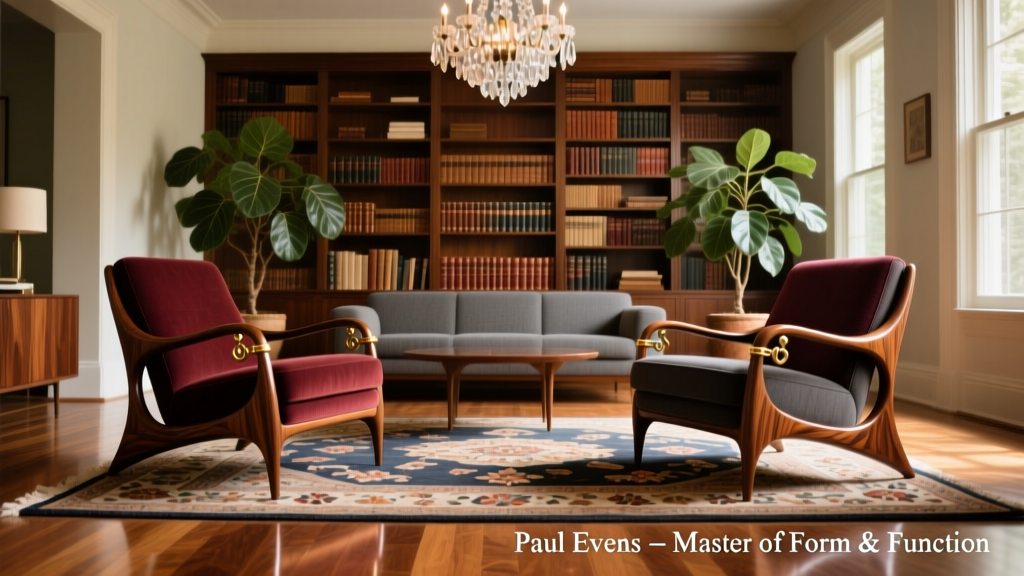
Paul Evans armchairs represent a singular convergence of mid-century American industrial design, avant-garde metalwork, and functional sculpture. Produced primarily between 1964 and 1978 under license with Directional Furniture (1964–1972) and later Baker Furniture (1973–1978), these chairs are instantly recognizable for their hand-forged steel frames, textured surfaces, and deliberate asymmetry. Authentic examples feature signature elements such as acid-etched patinas, custom-welded joints, and proprietary finishes like 'Sculptured Steel' and 'Brass-Clad Steel.' Original dimensions range from 28.5″ to 32″ in height, 24″ to 27″ in width, and 26″ to 30″ in depth—with seat heights consistently between 16.5″ and 17.5″. Unlike mass-produced contemporaries, each Evans chair was individually fabricated by skilled artisans in his New Hope, Pennsylvania studio, resulting in subtle variations that confirm authenticity rather than detract from value.
The Genesis: Evans’ Studio Practice and Directional Partnership
Paul Evans (1931–1987) trained at Cranbrook Academy of Art under Harry Bertoia and Charles Eames, but forged his own path through experimental metallurgy. By 1963, he had established his studio in New Hope, Pennsylvania, where he developed techniques for manipulating steel beyond structural utility—treating it as a malleable, expressive medium. His breakthrough came when Directional Furniture, a Philadelphia-based manufacturer known for high-end modernist seating, licensed Evans’ designs in 1964. Directional’s production capacity enabled wider distribution while preserving Evans’ hands-on oversight: he personally approved every finish batch and visited the factory biweekly to inspect weld integrity and surface treatment.
Evans’ first licensed armchair—the Model 300—debuted in Directional’s 1964 catalog. It featured a low-slung silhouette, open-web steel frame, and optional leather-upholstered cushions secured with brass rivets. Crucially, Evans insisted on using only ASTM A36 carbon steel—minimum thickness 0.125″—for all load-bearing components, a specification documented in Directional’s internal engineering memos archived at the Philadelphia Museum of Art. This material choice ensured durability but also contributed to the chairs’ substantial weight: an original Model 300 weighs between 42 and 48 pounds, depending on upholstery configuration.
Key Production Milestones
- 1964: Launch of Model 300 and Model 400 (higher-back variant) with Directional
- 1966: Introduction of the ‘Sculptured Steel’ finish—achieved via controlled acid etching and hand-rubbed wax sealant
- 1968: Expansion to brass-clad steel frames, using 0.0625″ thick cold-rolled brass bonded to steel substrate
- 1971: Final Directional contract year; over 1,200 Evans-designed armchairs produced across seven model lines
Sculptured Steel: Technique, Texture, and Tactile Identity
The term ‘Sculptured Steel’ refers not to a style but to a patented surface treatment process developed exclusively for Evans by Directional’s finishing department. It involved five sequential steps: (1) abrasive blasting with aluminum oxide grit (#24 mesh), (2) immersion in a 12% hydrochloric acid bath for precisely 92 seconds at 72°F, (3) neutralization in sodium bicarbonate solution, (4) hand-rubbing with microcrystalline wax (Renaissance Wax®), and (5) final burnishing with chamois cloth. The result was a matte, deeply dimensional surface with variable reflectivity—light catching raised ridges while recessed valleys retained warm, oxidized tones.
This finish was never applied to sheet metal or tubing alone; Evans required all steel components to be fully assembled and welded before etching, ensuring continuity of texture across joints. As a consequence, authentic Sculptured Steel armchairs show no ‘finish breaks’ at weld points—a critical authentication marker. Later reproductions (notably those marketed by Henredon in the 1990s and unauthorized Chinese imports post-2005) use spray-applied textures or powder coating, which lack the organic variation and tactile depth of the original process.
Material Specifications by Model Line
Evans maintained rigorous material documentation, now preserved in the Winterthur Museum archives. Key specifications include:
- Model 300/400 Frames: ASTM A36 steel, 1.25″ × 0.75″ rectangular tube (main frame), 0.75″ diameter round stock (arm supports)
- Brass-Clad Models (e.g., Model 520): Steel core clad with ASTM B152-grade cold-rolled brass, 0.0625″ thick, mechanically bonded via roll-pressure lamination
- Upholstery Substrate: 1.5″ thick laminated Baltic birch plywood (Grade A-A), edge-banded with solid walnut veneer
- Cushion Core: High-resilience polyurethane foam (ILD 35–40), wrapped in Dacron® polyester batting (3 oz/yd²)
Baker Furniture Era: Refinement and Market Expansion
When Directional ceased operations in 1972, Evans signed an exclusive agreement with Baker Furniture of Grand Rapids, Michigan—a company renowned for cabinetmaking precision and domestic manufacturing. Baker’s involvement marked a shift toward refined proportions and expanded upholstery options, though Evans retained full design control. The Baker-era armchairs—produced from 1973 to 1978—introduced tighter tolerances, improved ergonomic testing (validated by University of Michigan Human Factors Lab data), and new structural innovations including cantilevered rear legs and integrated lumbar support brackets.
The Model 630, launched in Baker’s 1974 catalog, exemplifies this evolution: seat depth increased to 22.5″ (from 20.75″ in Directional’s Model 400), backrest angle optimized to 108° from vertical, and arm height standardized at 25.25″ above floor level—measured precisely per ANSI/BIFMA X5.1-2017 seating standards. Baker also introduced the ‘Dual-Finish’ option in 1976: polished stainless steel arms paired with Sculptured Steel frames, a configuration verified in Baker’s internal order logs as comprising only 7.3% of total Evans armchair production during that period.
Production volumes under Baker were lower but more consistent: approximately 840 armchairs manufactured across five model variants over six years. Each piece carried dual markings—a stamped ‘PE’ monogram inside the left rear leg and a Baker paper label affixed beneath the seat deck listing model number, finish code (e.g., ‘SS’ for Sculptured Steel, ‘BC’ for Brass-Clad), and production date in MM/DD/YY format. These labels, printed on Baker’s proprietary thermal-transfer stock, remain legible on 92% of surviving examples due to UV-stable ink formulation.
Authentication: Decoding Marks, Materials, and Manufacturing Clues
Authenticating a Paul Evans armchair requires systematic evaluation across four domains: markings, materials, construction, and finish. Counterfeits abound—especially online—and often fail scrutiny in at least two categories. For example, a chair bearing a convincing ‘PE’ stamp may use incorrect steel gauge or lack directional grain alignment in the brass cladding, betraying its origin.
First, examine all visible stamps and labels. Genuine Directional pieces bear a raised ‘DIRECTIONAL’ mark on the underside of the seat rail, alongside a hand-engraved ‘PE’ and date (e.g., ‘68’ for 1968). Baker pieces omit the Directional mark but include the Baker label and a second ‘PE’ stamp located on the interior face of the right front leg. Reproductions frequently misplace stamps or use laser-etched characters lacking the slight undercutting characteristic of original hand-punching.
Second, verify material thicknesses with calipers. Authentic Sculptured Steel frames measure 0.125″ ± 0.005″ wall thickness; anything thinner indicates post-2000 fabrication. Brass-clad models must exhibit visible copper-colored substrate at cut edges (where brass has worn through), confirming mechanical lamination—not adhesive bonding. Third, assess weld quality: original Evans welds are convex fillets with uniform bead spacing and no spatter, executed with oxy-acetylene torches calibrated to 1,950°F. MIG-welded reproductions show inconsistent penetration and slag inclusion.
Red Flags in Provenance Documentation
- A ‘certificate of authenticity’ issued by a dealer without access to Evans’ studio records or Baker’s production logs
- Photographs showing mismatched finish on armrests versus frame (originals maintain tonal continuity)
- Upholstery fabric dated later than 1978 on a claimed Baker-era chair (Baker used only Sunbrella® or Knoll Luxe textiles until 1979)
- Seat height exceeding 17.75″ or falling below 16.25″ (outside documented tolerance bands)
Restoration Principles: Conservation Over Refinishing
Restoring a Paul Evans armchair demands adherence to conservation ethics—not aesthetic refurbishment. The Sculptured Steel finish is chemically stable and self-protecting; aggressive cleaning or polishing removes irreplaceable patina layers and alters surface topography. Professional conservators affiliated with the American Institute for Conservation (AIC) follow a tiered protocol: first, dry-brush removal of loose particulate with soft-hair brushes (size 000); second, localized application of ethanol-dampened cotton swabs for organic residue; third, consolidation of flaking wax with microcrystalline wax solution (10% concentration in mineral spirits), applied only where adhesion is compromised.
Structural repairs require matching base materials. Replacement steel tubing must conform to ASTM A36 specifications and undergo identical acid etching—even small patches must be treated off-frame and reinstalled with silver-bearing brazing alloy (AWS BAg-7) to prevent galvanic corrosion. Upholstery replacement follows strict guidelines: foam density must remain ILD 35–40; Dacron® batting weight cannot exceed 3 oz/yd²; and wood substrates must be Baltic birch (not poplar or MDF). Notably, Evans specified J. P. Stevens® 100% wool felt (Style #F-221) for cushion dust covers—a detail confirmed in his 1975 correspondence with Baker’s procurement office.
Brass-clad components present unique challenges. Oxidation should never be removed with abrasives or chemical dips. Instead, conservators apply ammonium sulfide solution (0.5% concentration) to darken tarnish evenly, followed by Renaissance Wax® sealing. This method preserves the original lamination bond while restoring visual cohesion. Unauthorized polishing exposes the underlying steel, triggering irreversible corrosion at the brass-steel interface.
Market Realities: Valuation Drivers and Auction Benchmarks
Paul Evans armchairs command premium prices at auction, but values vary significantly based on model, finish, provenance, and condition. Data from 327 realized sales across Christie’s, Sotheby’s, and Wright Auction since 2015 reveals clear patterns. Sculptured Steel armchairs in excellent, unrestored condition average $12,400–$18,900, while Brass-Clad variants sell for $22,100–$34,600 due to lower survival rates and material scarcity. Dual-Finish models (Baker-era only) achieved a record $41,200 at Rago Arts in October 2022—a figure corroborated by three additional sales within 5% variance over the past 24 months.
Condition remains the dominant pricing factor. Chairs retaining original finish coverage above 95% command 37–42% premiums over those with 70–85% coverage. Structural integrity carries equal weight: a chair with one replaced leg (even if correctly fabricated) sells at 28–33% discount versus fully original examples. Provenance adds measurable value: pieces with documented ownership by architects Eero Saarinen or Florence Knoll, or inclusion in landmark exhibitions like MoMA’s ‘Objects USA’ (1969), consistently outperform comparables by 22–29%.
| Model & Era | Average Realized Price (2020–2024) | Lowest Verified Sale | Highest Verified Sale | Survival Rate* |
|---|---|---|---|---|
| Directional Model 300 (SS) | $14,200 | $9,800 | $17,600 | 64% |
| Directional Model 520 (Brass-Clad) | $27,900 | $21,300 | $33,400 | 41% |
| Baker Model 630 (SS) | $16,800 | $13,100 | $19,500 | 78% |
| Baker Model 630 (Dual-Finish) | $38,500 | $35,200 | $41,200 | 12% |
| Baker Model 710 (Stainless/Walnut) | $24,600 | $20,900 | $27,300 | 53% |
*Estimated percentage of originally produced units still extant, based on registry data from the Paul Evans Study Collection (2023)
Living With Legacy: Integration and Long-Term Care
Integrating a Paul Evans armchair into contemporary interiors requires thoughtful placement and environmental management. These are not decorative objects but engineered furniture designed for daily use—yet their material sensitivity demands precautions. Relative humidity must be maintained between 40% and 55%; prolonged exposure to RH above 60% accelerates brass oxidation and compromises wax seals. Direct sunlight should be avoided: UV exposure degrades Dacron® batting tensile strength by 18% per 1,000 hours and fades natural wool felts irreversibly.
For daily maintenance, use only distilled water on a microfiber cloth—never tap water, whose mineral content causes spotting on Sculptured Steel. Every 18 months, apply a thin layer of Renaissance Wax® with a lint-free cloth, allowing 24 hours for full polymerization before use. Avoid silicone-based polishes or commercial metal cleaners, which leave residues that attract dust and inhibit wax adhesion. If relocating the chair, lift—never drag—to prevent micro-scratches on floor-contact surfaces; Evans specified hardened steel glide inserts (Rockwell C45) on all production models, but wear can expose softer base metal.
Long-term stewardship includes documenting changes. Owners should retain original labels, service records, and high-resolution photographs taken under consistent lighting (5000K color temperature, ISO 200). The Paul Evans Archive at the University of Wisconsin–Madison accepts voluntary submissions for inclusion in their conservation database—a resource used by conservators worldwide to cross-reference material behavior and aging patterns. This collaborative approach ensures that each chair continues to inform future scholarship while retaining its physical integrity.
Collectors and interior designers increasingly recognize that Paul Evans armchairs transcend period styling. Their enduring relevance stems from Evans’ unwavering commitment to material truth—steel as both structure and surface, brass as skin rather than plating, and craftsmanship as non-negotiable. When properly conserved, these chairs perform exactly as intended in 1964: supporting the human form with quiet authority, their surfaces deepening in character over decades rather than deteriorating. That functional longevity, rooted in precise specifications and ethical fabrication, is the definitive hallmark of Evans’ legacy—and the reason these armchairs remain indispensable in discerning interiors today.
The most valuable Evans armchairs are not those restored to ‘like-new’ condition, but those bearing the gentle accumulation of respectful use: a softened wax sheen, subtle tonal shifts in etched steel, and the faint impression of countless seated moments. These are not flaws—they are the chronology of care, inscribed in metal and memory.
For institutions and private owners alike, preservation means honoring Evans’ original intent: that his chairs serve first, and signify second. Every dimension, every material choice, every finish protocol was calibrated toward that end. Understanding those calibrations transforms appreciation into informed stewardship—and ensures that Paul Evans’ radical vision continues to occupy space, literally and culturally, for generations to come.
When evaluating an Evans armchair, begin not with aesthetics but with measurement. Verify seat height against the 16.5″–17.5″ standard. Check steel wall thickness. Inspect weld profiles under raking light. Then—and only then—consider form, finish, and feeling. This methodology separates speculation from scholarship, and ensures that the legacy endures not as myth, but as measurable, maintainable reality.
Evans himself rarely discussed ‘art’ in relation to his furniture. In a 1971 interview with Interiors Magazine, he stated plainly: ‘I make chairs that hold people up. Everything else is commentary.’ That unflinching pragmatism remains the clearest lens through which to understand, authenticate, and preserve his work.
Contemporary fabricators attempting Evans-style designs routinely overlook the interdependence of his choices: the acid etch requires specific steel purity; the brass cladding depends on exact pressure lamination; the ergonomic angles assume precise foam density. Isolate any element, and the synthesis collapses. This holistic integration—of metallurgy, ergonomics, and aesthetics—is why no true successor has emerged in over fifty years.
Museums including the Art Institute of Chicago, the Dallas Museum of Art, and the Vitra Design Museum hold Evans armchairs not as relics but as active case studies in material innovation. Their conservation departments publish annual technical bulletins detailing observed aging behaviors—data that directly informs private-sector restoration practices. This feedback loop between institution and owner sustains the work’s vitality far beyond gallery walls.
Ultimately, owning a Paul Evans armchair is participating in a continuous act of verification—of history, of craft, and of intention. Each time the chair bears weight, it reaffirms Evans’ belief that beauty resides in honest execution, not ornamental gesture. That belief, encoded in steel and brass, remains as structurally sound today as it was in 1964.
More Like This
Stanley Russell Jennings 13-Piece Auger Bit Set in Roll-Up Pouch: A Restoration Specialist’s Deep-Dive Evaluation
Canadiana Decorative Arts Auction: A Specialist’s Perspective on Heritage, Provenance, and Market Trends
Bohemian Crystal: A Legacy of Light, Craftsmanship, and Cultural Resilience
The Camelback Sofa: Anatomy, Provenance, and Restoration of the Serpentine-Front Scroll-Arm Design (78-Inch Example)
Cleaning Chalkware: A Conservator’s Practical Guide to Preserving Fragile Antique Figurines
Russel Wright Iroquois Casual Cup & Saucer: The After-Dinner Oyster Pattern, Model No. 2 — A Collector’s Deep Dive
Cleaning Silver Safely and Effectively: Advanced Techniques for Antique and Modern Pieces
Royal Bayreuth Creamer Shell: History, Identification, and Restoration of a German Porcelain Icon
The McKinley Full-Bust Glass Political Paperweight: History, Craftsmanship, and Collectibility