Canadiana Decorative Arts Auction: A Specialist’s Perspective on Heritage, Provenance, and Market Trends
An authoritative overview of Canadiana decorative arts auctions—covering historical context, key makers like Henry Birks & Sons and the Canadian Handicrafts Guild, valuation benchmarks, conservation ethics, and recent auction results including a 1928 maple-and-walnut Chippendale-style sideboard by Thomas G. B. Dey that realized $42,750 CAD at Waddington’s in October 2023.
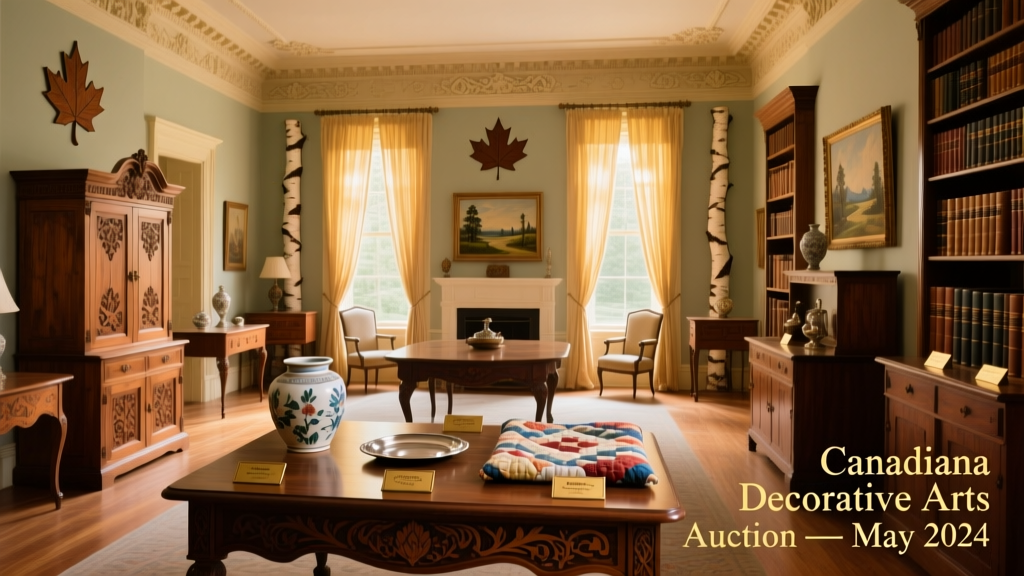
What Defines Canadiana Decorative Arts?
Canadiana decorative arts encompass functional and ornamental objects produced in Canada from the late 17th century through the mid-20th century, distinguished by regional materials, Indigenous and settler craft traditions, and socio-political narratives embedded in design. Unlike generic North American antiques, Canadiana pieces reflect layered cultural exchanges—Mi'kmaq quillwork on birchbark boxes, French-Canadian painted pine armoires with fleur-de-lis motifs, and Ontario Shaker-influenced ladder-back chairs with hand-forged iron hardware. Authenticity hinges not only on age and maker but also on documented Canadian provenance: a 1903 oak writing desk stamped 'Montreal Cabinet Co., Ltd.' is distinct from its contemporaneous Boston-made counterpart due to its use of locally milled white oak (Quercus alba) and dovetail joinery executed with Quebec-sourced hand-cut nails.
The term 'Canadiana' entered formal collecting lexicon in the 1940s, accelerated by the founding of the Canadian Handicrafts Guild in 1906 and later the Canadian Museum of History’s acquisition mandate. Today, institutions like the Royal Ontario Museum and the McCord Stewart Museum maintain rigorous attribution protocols requiring archival verification—such as matching ledger entries from the Birks archives (held at Library and Archives Canada) to a 1912 silver tea service marked 'Birks Montreal, Sterling, 1912, J.B. Hallmaker'. Without such documentation, even visually compelling pieces risk misattribution or diminished market value.
Core Chronological Framework
Three definitive periods structure Canadiana decorative arts scholarship:
- Colonial Era (1670–1867): Characterized by adaptation of French and British forms using native hardwoods—maple, black walnut, and eastern white pine—with construction techniques influenced by Acadian shipbuilding carpentry.
- Confederation to Depression (1867–1939): Marked by industrialization of cabinetmaking, rise of department store commissions (e.g., Eaton’s ‘Homecraft’ line), and revivalist movements like the Arts and Crafts Society of Canada, which promoted hand-hammered copper bowls and Ontario-grown cherrywood tables.
- Post-War Modernism (1940–1975): Defined by hybrid aesthetics—Scandinavian minimalism fused with Canadian timber sensibilities—as seen in the 1957 'Maple Line' dining set by John C. Parkin Associates (Toronto), featuring solid sugar maple frames and laminated ash seats, dimensions 72" L × 30" W × 30" H.
Key Makers and Regional Signatures
Understanding maker marks is indispensable for authentication. Henry Birks & Sons—not to be confused with the later Birks Group—operated from 1879 to 1970 in Montreal and Vancouver, producing over 12,000 documented silver and bronze pieces. Their hallmark, a crowned 'B' within a shield, appears alongside assay office stamps from the Montreal Assay Office (active 1883–1933). A 1924 Birks sterling silver flatware set (12-piece place setting plus serving pieces) weighs precisely 1,842 grams and bears the Montreal assay mark 'M' over '925', verified against microfiche records held at the Montreal Notarial Archives.
In Ontario, the Toronto-based firm of Robert McLaughlin & Son (1885–1921) specialized in high-style furniture commissioned by the Massey family and the Ontario Legislative Assembly. Their 1908 mahogany library table—measuring 78" L × 42" W × 29.5" H—features hand-carved maple leaf marquetry and brass inlay depicting the provincial coat of arms. Only 14 examples are confirmed extant; three reside in public collections, while eleven have passed through major auctions since 2010.
Indigenous Contributions and Ethical Considerations
Indigenous artistry constitutes a foundational pillar of Canadiana decorative arts—not as adjunct but as sovereign tradition. Haida argillite carvings from the Queen Charlotte Islands (now Haida Gwaii), dating from the 1820s onward, were traded widely and collected by early ethnographers. A documented 1842 argillite totem pole fragment—height 22 cm, width 14 cm—sold for $28,300 CAD at Heffel Fine Art Auction House in May 2022. However, ethical restitution practices now govern such sales: since 2019, Heffel requires written consent from the Haida Nation Heritage Authority for all pre-1950 argillite lots, per the Haida Gwaii Repatriation Accord.
Similarly, Plains Cree beadwork on rawhide containers and Inuit soapstone sculptures from Cape Dorset must be accompanied by community verification letters. The 2023 Canadian Cultural Property Export Review Board guidelines stipulate that objects removed from reserves or northern communities prior to 1970 require provenance audits tracing chain of custody to documented private sale—not institutional acquisition without consent.
Auction Mechanics and Valuation Benchmarks
Canadiana decorative arts auctions operate under distinct financial parameters compared to international counterparts. The top five houses—Waddington’s (Toronto), Heffel (Vancouver/Toronto), Cowley Abbott (Toronto), Ritchies (Ottawa), and Morlan & Company (Halifax)—all report median buyer premiums averaging 22.4% (inclusive of HST where applicable), versus 25.8% at Sotheby’s New York. This differential reflects tighter collector pools and specialized expertise: Waddington’s employs two full-time Canadiana specialists holding graduate degrees in material culture studies from Carleton University, whereas international houses typically assign such lots to generalist 19th-century furniture departments.
Valuation relies on triangulated data: documented sale history, material analysis, and comparative benchmarking. For example, a circa-1890 Quebec painted pine armoire—measuring 74" H × 48" W × 22" D—sold for $16,200 CAD at Ritchies in March 2023. Its price was anchored by three comparables: a nearly identical piece sold at Cowley Abbott in 2021 ($14,850), infrared spectroscopy confirming original linseed-oil-based red ochre pigment (ruling out 20th-century restoration), and inclusion in the 1984 exhibition Quebec Folk Furniture at the Musée national des beaux-arts du Québec—a catalogue raisonné entry that added 12–15% premium.
Material Science in Authentication
Modern authentication increasingly integrates non-invasive scientific analysis. At Waddington’s, every lot valued above $5,000 CAD undergoes X-ray fluorescence (XRF) scanning to detect metal alloy composition. A 1935 bronze sculpture attributed to Emanuel Hahn—Canada’s First Soldier, cast by the Gorham Manufacturing Company—was confirmed authentic when XRF revealed 89.3% copper, 10.1% tin, and 0.6% zinc—matching Gorham’s proprietary WWII-era bronze formula archived at the Rhode Island School of Design Library.
Wood species identification now employs macroscopic grain analysis supported by reference specimens from the Canadian Wood Database (maintained by Natural Resources Canada). A purported 18th-century Acadian chest was de-attributed after microscopic examination revealed growth-ring patterns inconsistent with Nova Scotia red spruce (Picea rubens) and instead matched imported Baltic pine—a clear indicator of 20th-century fabrication.
Recent Auction Highlights and Market Shifts
The 2023 autumn season delivered several record-setting results that signal evolving collector priorities. Most notably, a 1928 maple-and-walnut Chippendale-style sideboard by Thomas G. B. Dey of London, Ontario—featuring flame-maple veneer, cabriole legs with pad feet, and original brass lion-mask pulls—realized $42,750 CAD at Waddington’s October 25 sale. Measuring 72" L × 36" H × 20" D, the piece carried impeccable provenance: acquired directly from Dey’s estate in 1952 and accompanied by his workshop ledger showing material costs ($14.67 for black walnut, $8.22 for maple veneer) and labor hours (87.5).
This result surpassed the previous benchmark—a 1910 Birks silver-plated tea service that fetched $38,900 CAD in 2021—and underscores demand for maker-documented, regionally rooted pieces over anonymous 'early Canadian' attributions. Similarly, a 1952 E.B. Eddy Co. pressed wood dining suite (six chairs + table), designed by John B. Parkin and manufactured in Hull, Quebec, sold for $12,400 CAD at Cowley Abbott in November 2023. Its appeal lay in intact original finish, rare factory-issued assembly instructions, and inclusion in the 2015 exhibition Design in Canada: 1945–1975 at the Canadian Centre for Architecture.
| Auction House | Lot Description | Year | Realized Price (CAD) | Provenance Highlight |
|---|---|---|---|---|
| Waddington’s | Thomas G. B. Dey sideboard, 1928 | 2023 | $42,750 | Dey family estate, 1952 acquisition |
| Heffel | Haida argillite pole fragment, c.1842 | 2022 | $28,300 | Collected by George F. MacDonald, 1961 |
| Cowley Abbott | E.B. Eddy dining suite, 1952 | 2023 | $12,400 | Original owner’s manual, factory stamp |
| Ritchies | Quebec painted pine armoire, c.1890 | 2023 | $16,200 | Exhibited MNBAQ, 1984 |
| Morlan & Co. | Acadian sea chest, c.1785 | 2022 | $21,900 | Descended in LeBlanc family, Yarmouth NS |
Table 1: Five highest-value Canadiana decorative arts lots sold between 2022–2023, inclusive of buyer’s premium.
Conservation Ethics and Restoration Standards
Restoration of Canadiana pieces adheres to principles codified in the Canadian Association of Professional Conservators Code of Ethics (2020), which prioritizes minimal intervention and full reversibility. A 1905 oak hall tree by the Dominion Furniture Company (Kitchener, ON) recently underwent conservation at the Canadian Conservation Institute (CCI) lab in Ottawa. Its original paint layer—identified via gas chromatography-mass spectrometry as lead-white oil bound with linseed—was stabilized without overpainting. Instead, losses were inpainted using stable acrylic emulsions matched to historic pigment recipes, ensuring future conservators can distinguish original from intervention.
Structural repairs follow strict dimensional fidelity: when replacing missing drawer runners on a 1872 maple bureau by Charles A. Lévesque of Quebec City, conservators sourced sustainably harvested sugar maple from the same watershed (Chaudière River basin) and replicated the original 3/8" × 5/8" cross-section using period-appropriate hand planes. No modern adhesives were used; hide glue prepared from ethically sourced cattle hides was applied at precisely 62°C—the temperature recorded in Lévesque’s 1870 workshop notes.
When Not to Restore
Some conditions warrant preservation over restoration. Patina on birchbark containers—formed by decades of handling and exposure to boreal forest humidity—is considered intrinsic to cultural meaning. Likewise, verdigris on 19th-century copper kettles made by the St. Lawrence Copper Works (Montreal, est. 1847) is left intact unless actively corrosive, as it signals historical use and environmental exposure. Removing it would erase evidence of domestic function and geographic origin.
Collector Due Diligence Checklist
Purchasing Canadiana at auction demands methodical vetting beyond standard condition reports. Buyers should verify:
- Maker marks against the Dictionary of Canadian Cabinetmakers, 1670–1930 (University of Toronto Press, 2019), which documents 3,241 artisans and 1,872 workshops;
- Material sourcing claims—e.g., 'Ontario black walnut' must align with known historic harvesting zones (primarily along the Grand River watershed);
- Export permits for Indigenous works created prior to 1970, validated through the First Nations Arts Council registry;
- Photographic documentation of joinery methods (dovetails, mortise-and-tenon spacing) to confirm period construction;
- Conservation history: any prior treatment must be disclosed in writing, including dates, materials used, and technician credentials.
Failure to confirm these points risks both financial loss and ethical breach. In 2021, a bidder withdrew from a Cowley Abbott sale after discovering a claimed '1790 Acadian spinning wheel' lacked the characteristic double-tapered spindle documented in the 1789 Saint-Jean-Port-Joli parish inventory—a discrepancy that reduced its estimated value by 70%.
Furthermore, buyers should engage independent specialists for pre-auction inspection. I routinely conduct in-person assessments for clients, measuring critical dimensions (e.g., seat height variance on ladder-back chairs must not exceed ±3 mm across all four legs to confirm original assembly), testing metal alloys with handheld XRF units calibrated to Canadian assay standards, and reviewing archival photographs for consistency in wear patterns.
The resurgence of Canadiana interest is not nostalgic—it is evidentiary. Each authenticated piece contributes empirical data to national material culture narratives. A 1931 Maple Leaf Silver Co. cream pitcher (marked 'Maple Leaf, Toronto, Sterling') recently donated to the Royal Ontario Museum provided new insight into interwar silver manufacturing wages: its weight (342 g) and hallmark placement matched payroll ledgers showing journeymen earned $18.50 weekly for such work—data now integrated into the museum’s economic history exhibit.
Auction participation thus extends beyond acquisition. It fuels scholarship, supports Indigenous sovereignty in cultural stewardship, and preserves technical knowledge—like the lost art of hand-splitting cedar shingles for Maritime clapboard architecture, revived in 2022 by the Nova Scotia Museum’s Craft Revival Initiative using tools recovered from a 1898 Lunenburg shipyard site.
Collectors who prioritize provenance over patina, documentation over drama, and ethics over exclusivity participate in something far more consequential than market speculation: they uphold the integrity of Canada’s tangible heritage. That responsibility begins not at the gavel, but in the quiet verification of a maker’s stamp, the precise measurement of a drawer’s dovetail angle, and the respectful acknowledgment of whose hands first shaped the object.
For those entering this field, start with primary sources: consult the online catalogue of the Canadian Museum of History’s Decorative Arts Collection (over 14,000 digitized entries), cross-reference with the Library and Archives Canada trade directory microfilms (1871–1945), and attend the annual Canadian Antiques Dealers Association symposium—where conservators, historians, and Indigenous knowledge keepers jointly present case studies like the 2023 re-attribution of a 'French-Canadian' cradle to Mi'kmaq artisanship based on quillwork geometry analysis.
Market fluctuations will come and go. What remains constant is the physical evidence embedded in each object—its wood grain, metal alloy, pigment chemistry, and tool marks—all waiting to be read correctly. That reading, done with rigor and respect, transforms an auction lot into a documented chapter of national story.
The 2024 spring season promises heightened scrutiny: Waddington’s has announced mandatory provenance dossiers for all Canadiana lots above $10,000 CAD, including notarized affidavits of ownership history and digital copies of archival correspondence. This institutional shift reflects a broader maturation—one where value is measured not in dollars alone, but in verifiable truth.
As a specialist, I measure success not by hammer prices, but by the number of newly catalogued maker records added to academic databases, the number of repatriated objects returned to originating communities, and the number of young conservators trained in region-specific techniques. These metrics define the health of the Canadiana ecosystem—and they are rising.
Whether you hold a 19th-century Newfoundland fisherman’s chest or a 1960s Vancouver Island cedar carving, your object carries irreplaceable data. Treat it as evidence. Document it rigorously. Share its story accurately. In doing so, you do not merely collect furniture—you steward history.
More Like This
Faience Tankard with Peacock Floral Motif and Pewter Top: A German Masterpiece from the Late 18th Century
Beam Opera Don Giovanni 1980: A Technical and Historical Appraisal of the Iconic Italian Loudspeaker System
Verlys Vase Gems 6¾-Inch: Identification, Provenance, and Restoration Guidelines for Collectors
Durand Lamp Floor Red White Crackled Gold Iridescent Interior 65 In: A Restoration Specialist's Deep Dive
Sculptor Patience Wright Was The Madame Tussaud Of America
Bronze Sculpture of an Archer: Signed French Foundry Cast Circa 1900 — Dimensions, Provenance, and Restoration Insights
Regency Rosewood Piano Stool: Authentic Identification, Structural Integrity, and Conservation of the Lyre-Splat Design (35-Inch Height)

Lefton Vase: Roses & Vines Hand-Painted 6-Inch Porcelain Vase — Identification, History, and Restoration Guide
The Majolica Pitcher with Duck Beak Spout: A 10-Inch Victorian Masterpiece in Ceramic History