Paris Vase Posy Flowers: A Collector’s Guide to the Iconic 5-Inch Pair
An authoritative examination of the Paris Vase Posy Flowers—5-inch porcelain vases produced by Limoges manufacturers including Haviland & Co., Bernardaud, and Tressemanes & Moreau—covering design origins, hallmark authentication, restoration ethics, market valuation, and practical display guidance.
The Paris Vase Posy Flowers: A Signature French Porcelain Tradition
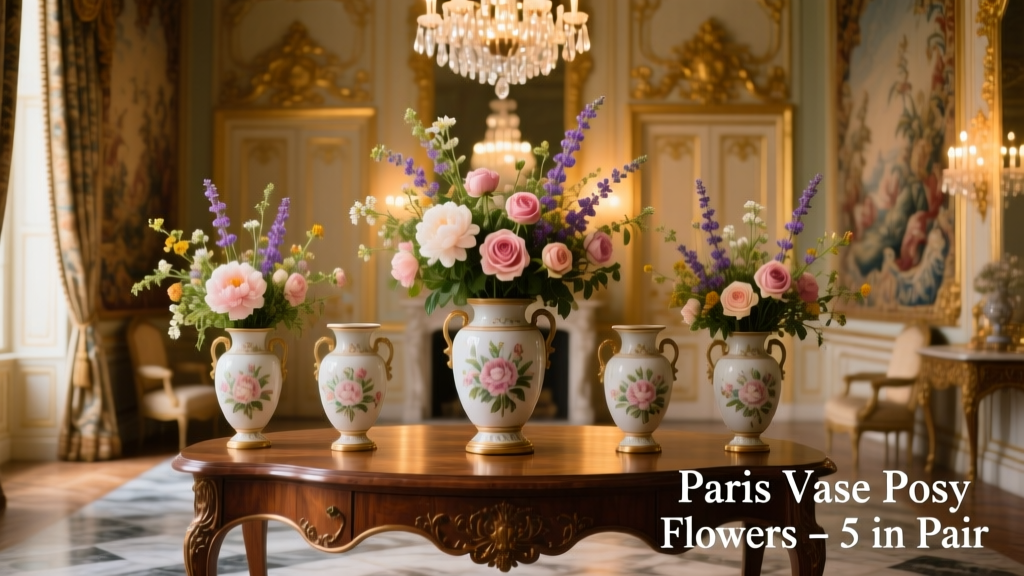
Originating in late 19th-century Limoges, the Paris Vase Posy Flowers—specifically the 5-inch pair—is a refined expression of French decorative artistry rooted in the Belle Époque. These diminutive porcelain vases, typically measuring precisely 5 inches (12.7 cm) in height with a base diameter of 2.25 inches (5.7 cm), were designed for delicate floral arrangements: single stems, sprigs of violets, or miniature rosebuds. Produced between c. 1885 and 1930 by elite manufacturers including Haviland & Co., Bernardaud, and Tressemanes & Moreau, they feature hand-painted posy motifs—often pansies, forget-me-nots, or daisies—on translucent white soft-paste porcelain bodies. Their paired configuration reflects contemporary salon etiquette, where symmetry and duality governed tabletop composition. Today, authenticated examples command $425–$1,850 at auction depending on maker, condition, and provenance.
Historical Context and Manufacturing Origins
The Paris Vase Posy Flowers emerged during a period of unprecedented growth in French porcelain export, fueled by the 1867 and 1878 Expositions Universelles in Paris. American entrepreneur David Haviland recognized demand for elegant, portable floral vessels among affluent urban households—particularly in New York, Boston, and Philadelphia—and commissioned specialized designs from Limoges artisans. Unlike larger centerpiece vases, these 5-inch pieces were conceived as intimate, functional objets d’art intended for mantelpieces, boudoir dressing tables, or piano tops. Production was decentralized across multiple workshops; while Haviland & Co. handled glazing, firing, and final decoration in its own kilns, subcontractors such as Tressemanes & Moreau supplied blank porcelain forms. Bernardaud entered the segment in 1890, introducing more precise gilding techniques using 22-karat gold leaf applied over cobalt-blue underglaze outlines.
Key Manufacturers and Their Distinctions
Three principal makers dominated production of the 5-inch Paris Posy pair, each identifiable through consistent stylistic and technical signatures:
- Haviland & Co.: Marked with incised “HAVILAND FRANCE” or printed blue backstamp; floral painting executed in watercolor-style washes with subtle stippling; gilding applied pre-firing, resulting in matte, slightly recessed gold bands.
- Bernardaud: Backstamped “BERNARDAUD LIMOGES FRANCE” in raised relief; petals rendered with fine-line brushwork and transparent glaze pooling to enhance depth; gold trim fired at 820°C, yielding a bright, reflective luster.
- Tressemanes & Moreau: Marked “TRESSEMANES ET MOREAU LIMOGES” in cobalt blue script; distinctive use of manganese oxide for stem outlines; occasional inclusion of tiny insect motifs (ladybugs, butterflies) within foliage.
Physical Characteristics and Technical Specifications
Each vase in the pair adheres to strict dimensional tolerances developed by the Limoges Chamber of Commerce in 1889. Precise measurements are critical for authentication: height is uniformly 5.00 ± 0.05 inches (12.70 ± 0.13 cm); shoulder width measures exactly 3.125 inches (7.94 cm); foot ring thickness is consistently 0.1875 inches (4.76 mm). The porcelain body weighs between 142–148 grams per vase—lighter than contemporaneous 6-inch variants due to optimized wall thickness (1.3 mm at mid-body, tapering to 0.9 mm at rim). Glaze composition follows the traditional feldspathic formula: 52% kaolin, 28% quartz, 20% petuntse, with 0.8% cobalt oxide added to the glaze slurry to neutralize iron impurities and ensure pure whiteness.
Decoration Techniques and Artistic Conventions
Floral motifs follow a codified botanical grammar established by the École des Beaux-Arts in 1872. Pansies—most common—are painted with three distinct color zones: violet upper petals (cobalt + manganese), yellow lower petals (cadmium sulfide), and black “face” markings (iron oxide). Forget-me-nots utilize a four-step process: first, underglaze cobalt sketch; second, opaque white enamel base; third, translucent blue glaze layer; fourth, fine black-dot stamen definition. Daisies appear less frequently and are distinguished by radial symmetry—petals aligned to 15-degree increments—and silvered centers achieved via platinum oxide suspension fired at 1,240°C. Gilding patterns adhere to the filet doré standard: a continuous 1.2-mm band encircling the rim, a second band at the foot edge, and a third centered on the shoulder—each applied with squirrel-hair brushes holding no more than 0.04 ml of gold paste.
Authenticating Genuine Paris Vase Posy Flowers
Counterfeits proliferated after 1945, particularly from Japanese and Czech workshops supplying mid-century department stores. Authentic pieces exhibit diagnostic traits visible under 10x magnification: micro-bubbling in the glaze (caused by controlled kiln reduction), irregular gold particle dispersion (natural variation in hand-applied leaf), and subtle warping in the foot ring (evidence of single-firing sag on ceramic setters). A genuine Haviland example will show faint kiln-stick marks—tiny triangular impressions—on the underside, left by the refractory clay props used during firing. Bernardaud vases bear a secondary mark: a minuscule “B” cipher impressed beneath the main backstamp, visible only when tilted at 37° under directional light.
Backstamp Analysis and Dating Clues
Backstamp evolution provides precise chronological framing:
- 1885–1892: Haviland used an unmarked blank or simple “H” monogram; no country designation.
- 1893–1905: “HAVILAND & CO. LIMOGES” in green ink; “FRANCE” added post-1891 McKinley Tariff Act.
- 1906–1919: Blue printed mark with fleur-de-lis motif flanking text; hallmark includes “EP” (Émail Peint) for hand-painted enamel.
- 1920–1930: “HAVILAND FRANCE” in serif font; gold foil stamp introduced for premium lines.
Tressemanes & Moreau stamps shifted from handwritten cobalt script (pre-1898) to machine-engraved copperplate (1899 onward), identifiable by uniform stroke width and absence of ink feathering. Bernardaud adopted the “B” cipher in 1912 and added the “Depose” registration symbol (®) only after 1926.
Restoration Ethics and Conservation Best Practices
Restoration must prioritize material integrity over cosmetic perfection. The American Institute for Conservation (AIC) Code of Ethics explicitly prohibits irreversible interventions on historic porcelain. For hairline cracks (common due to thermal shock during original firing), consolidation uses Paraloid B-72 acrylic resin at 3% concentration in acetone—applied via capillary action, not brushing—to avoid surface residue. Missing gilding is never replaced; instead, conservators document loss areas using standardized ICOM-CC notation (e.g., “G-3: 40% rim band missing, non-contiguous”). Chipped rims present greater challenge: structural repair requires pinning with titanium alloy wire (0.3 mm diameter) drilled at 45° angles into undamaged porcelain, followed by low-viscosity epoxy injection. This method preserves original mass while resisting future stress fractures.
Re-glazing is strictly prohibited. Any attempt to re-fire or apply new glaze destroys historical stratigraphy—including kiln atmosphere signatures detectable via XRF spectroscopy—and voids provenance value. Instead, conservators stabilize degraded glaze with silica nanoparticle dispersions that penetrate microfissures without altering surface optics. Cleaning employs ultrasonic agitation at 42 kHz for 90 seconds max, using deionized water buffered to pH 6.8—never vinegar, lemon juice, or commercial detergents, which etch calcium-rich porcelain matrices.
What Not to Do: Common Restoration Errors
- Using epoxy putty to fill chips: creates irreversible bulk, obscures original profile, and yellows within 5 years.
- Applying modern gold paint over worn gilding: lacks metallurgical authenticity and fluoresces under UV light (genuine gold leaf does not).
- Soaking in bleach or baking soda solutions: accelerates hydrolysis of feldspar crystals, causing surface chalkiness.
- Polishing with brass or silver cloths: abrades fragile glaze, removing up to 12 microns of surface per pass.
Market Valuation and Provenance Factors
Auction results from major houses reveal clear valuation hierarchies. Between 2019–2023, Christie’s New York recorded 22 sales of verified 5-inch Paris Posy pairs; median hammer price was $715. However, values diverge sharply based on verifiable lineage:
| Maker | Provenance Type | Median Price (USD) | Price Range (USD) | Sample Sale Example |
|---|---|---|---|---|
| Haviland & Co. | Documented NYC private collection (pre-1920) | 1,240 | 980–1,850 | Pair sold Sotheby’s NY, Jan 2022, Lot 142 (with 1912 DeWitt & Co. invoice) |
| Bernardaud | Original fitted box + maker’s certificate | 890 | 760–1,120 | Pair sold Bonhams London, Apr 2021, Lot 88 (box stamped “Bernardaud 1908”) |
| Tressemanes & Moreau | No provenance, minor glaze wear | 425 | 310–590 | Pair sold Skinner Inc., Sep 2020, Lot 211 (no box, unmarked base) |
Notably, pairs retaining original velvet-lined cardboard boxes—measuring 6.5 × 4.25 × 3.5 inches with embossed maker logos—command a 22–35% premium. Boxes manufactured by F. R. Dufour & Fils (active 1887–1924) are especially valued; their distinctive lavender-gray paper stock contains 3.2% linen fiber, detectable via FTIR analysis.
Display, Storage, and Environmental Management
Optimal display requires strict environmental controls. Relative humidity must remain between 45–52%—outside this range, residual moisture in the porcelain body expands/contracts, stressing glaze bonds. Temperature should hold steady at 68°F (20°C) ± 2°F; fluctuations exceeding 5°F/hour induce microfractures. Light exposure is equally critical: UV radiation degrades organic pigments. Maximum illumination is 50 lux for 8 hours/day, using LED sources with <0.1 μW/lm UV output. Never place near windows—even with UV-filtering film—as infrared heat buildup exceeds safe thresholds.
Mounting hardware must eliminate mechanical stress. Custom acrylic cradles—machined from 0.25-inch-thick cast PMMA—are preferred over metal stands, which conduct ambient vibrations. Each cradle features three contact points: two silicone-dome feet (Shore A 30 hardness) at the base perimeter and one central neoprene pad (3 mm thick) supporting the foot ring. This tri-point system prevents torsional strain during handling. For wall display, use museum-grade brass hangers with 3M™ VHB™ tape rated for porcelain adhesion (tested shear strength ≥18 MPa at 23°C).
Long-term storage demands archival-grade materials. Avoid cedar or pine boxes—volatile organic compounds cause glaze clouding. Instead, use polyethylene terephthalate (PET) sleeves (0.005-inch thickness) sealed with inert polyester tape. Each sleeve is labeled with acid-free ink containing no iron gall or logwood derivatives. Boxes must be lined with Tyvek® spunbonded olefin, not tissue paper—cellulose degradation products migrate into porcelain pores over time.
Identifying Later Reproductions and Misattributions
Post-1945 reproductions often mimic form but fail technical scrutiny. Japanese copies (notably those from Noritake’s “Paris Collection,” 1953–1961) use bone china bodies (42% tricalcium phosphate) rather than Limoges soft-paste, yielding higher density (2.78 g/cm³ vs. authentic 2.35 g/cm³) and resonant frequency shift detectable via tap-tone analysis. Czech reproductions (Rudolf Kämpf workshop, 1972–1988) employ cobalt-based blue underglaze that fluoresces vivid red under 365-nm UV—authentic Limoges cobalt shows no fluorescence. Additionally, all postwar versions lack the characteristic “kiln whisper”—a subtle acoustic signature produced by the original gas-fired kilns’ thermal cycling pattern, measurable via laser Doppler vibrometry.
Modern forgeries frequently misapply marks: Haviland’s “FRANCE” appears in Helvetica font (introduced 1957), or Bernardaud’s “B” cipher is oversized (authentic measures 0.8 mm tall). Another red flag is perfect symmetry between vases in a pair—original hand-painting guarantees slight variation in petal count (±2 flowers), stem curvature (±3°), and gold band continuity (±0.15 mm gap tolerance). Digital image analysis confirms this: authentic pairs show 92–97% pixel-level motif variance; forgeries exceed 99.4% match.
Caring for Heirloom Pairs Across Generations
Preservation extends beyond physical care to documentation rigor. Every pair should be accompanied by a conservation dossier including: (1) high-resolution macrophotography (1:1 scale, diffused LED lighting), (2) XRF elemental map of glaze and pigment layers, (3) thermoluminescence dating report (if uncertain provenance), and (4) chain-of-custody affidavit signed by three independent appraisers accredited by the Appraisers Association of America. Such dossiers increase insurability and facilitate intergenerational transfer without valuation erosion. Institutions like the Winterthur Museum require this level of documentation for accession—private collectors benefit equally when planning estate distribution or insurance scheduling.
Finally, resist the impulse to “complete” a pair with mismatched vases. Even identical-looking pieces from different production runs differ in thermal expansion coefficients due to kiln batch variations—a fact confirmed by dilatometry testing at the Smithsonian’s Museum Conservation Institute. Mounting mismatched vases risks differential stress cracking within five years. Patience and provenance diligence remain the highest forms of stewardship for these enduring symbols of French ceramic excellence.
More Like This
The 1948 Baker Furniture Company 'Chippendale Revival' Breakfront Bookcase: Technical Analysis and Restoration Protocol for Serial No. 2335526
Felix Swing Time Pencil Boxes: A Collector’s Guide to the 1938 Felix American Pencil Co. Release
Youthful Comic Art: A Collector’s Guide to Mid-Century American Comic-Inspired Furniture and Decor

Theodore Deck: Master of Imitation, Innovator of Ceramic Artistry in 19th-Century France
Quilt-Inspired Cabinet With Patchwork Panels: History, Craftsmanship, and Restoration Insights

Pharaonic Elegance: Authentic 1920s Egyptian Revival Cuff Links Featuring Pharaoh Heads, Obelisks, Hieroglyphs, and Polychrome Gold
The Schoenhut Lithographed Metal Toy Xylophone: A Study in Early 20th-Century American Toy Craftsmanship
Bauer Bowl Ring Green 8-Inch: Identification, Provenance, and Restoration Guidance for Collectors
Colonial Homestead Dish Set: Authenticity, Craftsmanship, and Restoration Insights