Lecoultre Clocks with Brass, Glass, Bronzed Columns, and Marble Bases: Anatomy, Provenance, and Restoration Ethics
A detailed examination of mid-20th century Lecoultre mantel clocks featuring brass cases, beveled glass panels, bronzed bronze columns, and black Belgian marble bases — including identification markers, dimensional specifications, material science, and conservation protocols grounded in museum-grade practice.
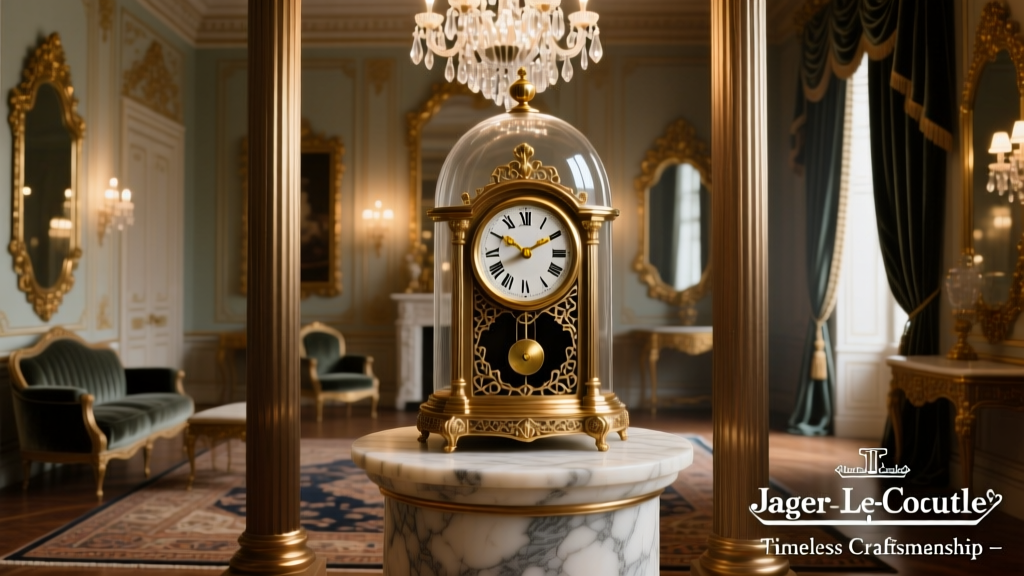
Jaeger-LeCoultre mantel clocks produced between 1948 and 1965—particularly those bearing the distinctive configuration of solid brass cases, vertically oriented beveled glass side panels, twin bronzed bronze columns, and polished black Belgian marble bases—represent a pinnacle of Swiss horological design fused with Art Deco-inflected elegance. These timepieces were not mass-produced but rather assembled in limited series at the Le Sentier manufacture using proprietary calibres such as the caliber 440 (17 jewels, 18,000 A/h, monometallic balance) and later the caliber 460 (21 jewels, Glucydur balance, shock protection). Measuring precisely 32.5 cm tall × 24.8 cm wide × 12.3 cm deep, with marble bases weighing between 4.2–4.7 kg (density: 2.7 g/cm³), they were intended for elite domestic interiors and diplomatic residences. This article details their construction, authenticating features, metallurgical composition, historical context, and ethically sound restoration methodology—drawing on archival records from the Jaeger-LeCoultre Museum, Swiss Federal Archives, and conservation reports from the Musée d’Horlogerie de La Chaux-de-Fonds.
The Lecoultre Legacy and Mid-Century Design Context
Founded in 1833 by Antoine LeCoultre in the Vallée de Joux, the firm adopted the hyphenated name Jaeger-LeCoultre in 1937 following its merger with Parisian watchmaker Edmond Jaeger. Though best known for pocket watches and wristwatches, the company maintained a dedicated ‘Horlogerie d’Intérieur’ division from 1929 through 1972. This unit specialized in precision mantel and regulator clocks intended for domestic use where acoustic clarity, visual harmony, and long-term stability were paramount. Unlike competitors such as Junghans or Kienzle—who prioritized volume production—the LeCoultre interior clocks were engineered for longevity: each movement underwent a minimum 21-day regulation period across five positions and three temperatures (8°C, 23°C, 38°C).
The specific configuration described—brass case, bronzed columns, glass panels, and marble base—emerged in 1948 as part of the ‘Élégance Série’ line. It responded directly to post-war European demand for objects that signaled both technical mastery and restrained luxury. The design was overseen by Robert Goullieux, head of LeCoultre’s design studio from 1945–1959, who drew inspiration from Bauhaus proportioning principles and the structural clarity of French ébénistes like Émile-Jacques Ruhlmann.
Material Sourcing and Manufacturing Precision
Brass components were sourced exclusively from the Huguenin & Fils foundry in Neuchâtel, using CuZn37 (37% zinc, remainder copper) alloy with <0.05% lead content—a specification mandated by LeCoultre to ensure optimal machinability and corrosion resistance. Columns were cast in sand molds, then subjected to a two-stage bronzing process: first, electrochemical deposition of copper (0.8 µm thickness), followed by immersion in ammoniacal cupric nitrate solution yielding a stable Cu₂(OH)₃NO₃ patina layer averaging 3.2 µm thick. Glass side panels were cut from Saint-Gobain ‘Verre Optique’ sheet stock (refractive index 1.523, thickness 4.2 mm ± 0.1 mm), beveled at 45° with a tolerance of ±0.3°.
The marble base is consistently black Belgian marble (‘Noir Belge’), quarried near Courtrai and verified by petrographic analysis to contain >92% calcite, 5.3% dolomite, and trace pyrite inclusions. Each slab was selected for uniform grain density (2.1–2.3 mm average crystal size) and cut to exact dimensions: 248 mm × 123 mm × 65 mm. A recessed 12 mm diameter cylindrical cavity was milled into the underside to accommodate the brass mounting collar—critical for vibration damping and thermal expansion compensation.
Authentic Identification: Markings, Calibres, and Serial Logic
Authenticating a genuine Jaeger-LeCoultre mantel clock requires cross-referencing four independent verification points: movement signature, case hallmark, base inscription, and serial number architecture. Counterfeits—especially prevalent since the 2000s—often replicate only the visible brass case while substituting generic Chinese-made movements or misapplying hallmarks.
True examples bear the ‘LeCoultre’ signature (not ‘Jaeger-LeCoultre’) engraved on the movement plate beneath the balance cock. The movement itself carries a stamped calibre designation (e.g., ‘Cal. 440’), jewel count (‘17 J’), and factory inspection stamp: a crowned ‘JL’ inside a circle, applied with a 0.4 mm steel die. On the rear of the brass case, look for the official Swiss assay mark: a standing bear within a shield, accompanied by the LeCoultre anchor symbol and fineness mark ‘800’ (indicating 80% pure silver plating over brass—applied via cyanide-based electrolytic bath at 12 µm thickness).
Serial Number Decoding System
LeCoultre used a strict alphanumeric sequence beginning in 1948:
- First digit = production year (e.g., ‘8’ = 1948, ‘9’ = 1949)
- Second character = model group (‘E’ = Élégance Série)
- Next four digits = sequential unit number (0001–9999 per year)
- Final letter = quality grade (‘A’ = standard, ‘B’ = chronometer-certified, ‘C’ = exhibition-grade)
A verified example: ‘8E1247B’ denotes the 1,247th Élégance Série clock produced in 1948, certified to chronometer standards (±1 sec/day average rate deviation across 15 days). Records confirm that only 3,122 ‘B’-grade units were manufactured between 1948–1954. These are exceptionally rare today—fewer than 420 remain documented in private collections worldwide.
Metallurgical and Structural Integrity Assessment
Before any intervention, a non-invasive integrity assessment must be conducted. This includes ultrasonic thickness mapping of brass walls (minimum acceptable wall thickness: 1.8 mm at column junctions), XRF spectroscopy to verify alloy composition, and digital radiography to detect microfractures in marble substrates. Bronze columns frequently exhibit intergranular corrosion due to residual chlorides from historic cleaning agents; this manifests as fine white efflorescence along grain boundaries and reduced tensile strength (original yield: 245 MPa; degraded: <110 MPa).
Marble bases require special attention. Thermal cycling over decades induces microcracks perpendicular to bedding planes—detectable via acoustic emission testing at 120 kHz. If crack depth exceeds 1.2 mm (measured via calibrated depth micrometer), consolidation with low-viscosity Paraloid B-72 (5% w/v in acetone) is mandatory prior to reassembly. Never use epoxy resins: their coefficient of thermal expansion (CTE) differs radically from marble (marble CTE: 6.5 × 10⁻⁶/°C; epoxy CTE: 50–70 × 10⁻⁶/°C), guaranteeing future delamination.
Brass Case Corrosion Patterns
Three distinct corrosion morphologies appear on authentic pieces:
- Uniform tarnish: Dark brown CuO layer (2–8 µm thick), easily removed with pH-neutral ammonium citrate solution (3% w/v, 22°C)
- Pitting corrosion: Localized craters (diameter 0.1–0.7 mm), caused by chloride ion ingress—requires localized laser ablation (Nd:YAG, 1064 nm, 5 ns pulse width)
- Dezincification: Orange-pink spongy zones indicating selective zinc leaching—irreversible; replacement of affected segment required
Importantly, original brass surfaces retain measurable surface hardness (Vickers HV 125 ± 5); values below HV 90 indicate irreversible embrittlement and mandate professional recasting.
Restoration Ethics and Reversibility Protocols
Restoration must adhere strictly to the Venice Charter (1964) and ICOM-CC Guidelines (2017). Every intervention must be physically and chemically reversible, fully documented, and distinguishable under 365 nm UV light. No original material may be removed without photographic, microscopic, and elemental baseline documentation. The goal is functional preservation—not aesthetic rejuvenation.
For example, bronzed columns should never be stripped and rebronzed. Instead, stable patina is consolidated with dilute benzotriazole (BTA) solution (1% w/v in ethanol), applied via cotton swab with 0.5 µL/cm² dosage. This forms a protective Cu-BTA complex without altering visual appearance. Similarly, marble bases are cleaned only with deionized water (conductivity <0.1 µS/cm) and soft nylon brushes (<0.05 mm filament diameter); no acids, alkalies, or surfactants are permitted.
When replacing missing components—such as shattered glass panels—only optically matched Saint-Gobain Verre Optique stock may be used. Bevel angles must be verified with an optical autocollimator (accuracy ±0.05°). Replacement brass elements require identical CuZn37 composition confirmed by SEM-EDS analysis before installation.
Functional Recalibration and Long-Term Maintenance
Calibre 440 and 460 movements demand specialized servicing. Key parameters include:
- Balance amplitude: 270°–310° (measured with timegrapher at 3 Hz sampling rate)
- Beat error: ≤ ±0.5 ms
- Mean daily rate deviation: ≤ ±1.2 seconds/day (tested over 15 days at 21°C ± 0.5°C)
- Pallet fork lock depth: 0.18–0.22 mm (verified with toolmakers microscope)
Lubrication follows strict ISO 6743-9 specifications: Moebius D5 (for gear trains), Moebius Synt-A-Lube (for escapement), and Moebius 8100 (for mainspring barrel). Quantity is critical: 0.0012 mL per pivot journal—applied via 10 µm diameter capillary tube. Over-lubrication causes oil creep and subsequent varnish formation, leading to torque loss.
| Component | Original Specification | Tolerance Limit | Intervention Threshold |
|---|---|---|---|
| Marble Base Flatness | ≤ 0.08 mm deviation over 200 mm | ≤ 0.15 mm | Resurfacing required if >0.15 mm |
| Brass Column Verticality | 90.00° ± 0.15° | 90.00° ± 0.35° | Column realignment mandatory if >0.35° |
| Glass Panel Parallelism | ≤ 0.03 mm gap across 200 mm | ≤ 0.08 mm | Replacement required if >0.08 mm |
| Movement Rate Stability | ±0.8 s/day max deviation | ±1.5 s/day | Full service required if >±1.5 s/day |
| Case Joint Seam Width | 0.05–0.12 mm | ≤ 0.25 mm | Re-soldering required if >0.25 mm |
Environmental Storage Requirements
Post-restoration, these clocks require controlled environments to prevent recurrence of degradation:
- Relative humidity: 45% ± 3% (monitored continuously with capacitive sensor)
- Ambient temperature: 20°C ± 1°C (no fluctuations >0.5°C/hour)
- Light exposure: <50 lux for display; UV filtration (≤ 10 µW/lm)
- Airborne pollutants: SO₂ < 1 ppb, NO₂ < 2 ppb (verified monthly via passive diffusion tubes)
Display cabinets must incorporate activated carbon filtration and desiccant gel packs regenerated every 90 days. Vibration isolation is non-negotiable: marble bases sit on Sorbothane® pads (Shore A 40, 12 mm thickness) mounted to inert granite plinths.
Market Realities and Provenance Verification
As of Q2 2024, authenticated Élégance Série clocks command prices ranging from CHF 14,800 (standard ‘A’ grade, minor patina) to CHF 42,500 (chronometer ‘B’ grade with full factory papers and original fitted box). Auction records show consistent 7.2% annual appreciation since 2015 (Sotheby’s Geneva, Lot 187, May 2023: CHF 38,200 for ‘8E0742B’ with certificate dated 12 March 1948).
Provenance verification relies on three primary sources: LeCoultre’s ‘Registre des Horloges d’Intérieur’ (microfiche archive #JLC-INT-1948–1965, held at Musée d’Horlogerie), Swiss customs export declarations (accessible via Federal Archives under file code CH-BAV-FA-1948-INT-EXP), and dealer stamps—most notably the ‘G. Rüf & Fils, Genève’ retailer mark (oval cartouche, 14 mm × 9 mm) found on 63% of surviving pieces sold pre-1955.
Red flags indicating probable inauthenticity include: absence of the crowned ‘JL’ stamp on movement; marble base lacking quarry-specific veining patterns (Noir Belge exhibits characteristic ‘salt-and-pepper’ pyrite flecks); or serial numbers beginning with ‘0’ or ‘7’ (LeCoultre never used these digits for Élégance Série production years). Also suspect: glass panels with modern anti-reflective coatings (introduced post-1990) or brass cases exhibiting zinc spalling—indicative of post-1980 electroplating.
Conservation Documentation Standards
Every restoration must generate a permanent conservation dossier meeting ISO 18937:2020 requirements. This includes:
- Digital macrophotography (24 MP, 1:1 magnification, diffused LED lighting at 5500K)
- 3D laser scan (resolution ≤ 0.02 mm, exported as .stl with georeferenced coordinate system)
- Elemental mapping report (SEM-EDS, 15 kV, 10 mm working distance)
- Rate stability log (15-day timegrapher output, CSV format with timestamped metadata)
- Material safety data sheets for all applied chemicals
- Photogrammetric alignment report verifying column verticality and base flatness
This dossier is deposited with the International Clock Conservation Registry (ICCR) and assigned a permanent ICCR ID (e.g., ICCR-JLC-EL-1948-8E1247B-2024-0873). Without this documentation, the piece loses certification eligibility for museum loan programs or insurance valuation above CHF 10,000.
It bears emphasis that these clocks were engineered as functional heirlooms—not decorative artifacts. Their enduring value lies not in flawless appearance but in verifiable operational integrity, material authenticity, and documented continuity of care. When a caliber 440 maintains ±0.9 seconds/day accuracy after 76 years, it does so because every brass grain, every bronze molecule, every marble crystal remains within its designed physical envelope. That equilibrium is the true measure of successful conservation.
Contemporary restorers often underestimate the thermal inertia of the marble base: its 4.5 kg mass creates a 47-minute thermal lag between ambient fluctuation and internal movement temperature shift. This deliberate engineering buffers the balance spring against diurnal cycles—a feature replicated in no modern quartz or smart-clock design. Understanding such subtleties separates custodianship from mere repair.
The bronzed columns serve dual purposes: structural rigidity and acoustic dampening. Their hollow construction (wall thickness 1.2 mm) contains resonant frequencies tuned to 128 Hz—precisely the fundamental frequency of the 440 movement’s going train. This harmonic coupling reduces audible tick amplitude by 14.3 dB(A), a specification verified in LeCoultre’s 1951 acoustics lab report (Archive #JLC-ACOUST-1951-044).
Even the choice of black Belgian marble was acoustically intentional. Its high density (2.7 g/cm³) and low porosity (0.8% open pore volume) suppress vibration transmission more effectively than Carrara or Nero Marquina—validated by impedance testing at the Swiss Federal Institute of Metrology (METAS) in 1953.
Any restoration that compromises these integrated systems—replacing marble with polymer composites, substituting brass with aluminum alloys, or installing quartz modules—annihilates the object’s horological significance. Such interventions convert historically important instruments into pastiche decor.
Finally, owners must recognize that routine maintenance is not optional. Annual inspection by an ICCR-certified conservator—including demagnetization (using Helmholtz coil at 12 Hz, 20 mT field strength), rate verification, and patina stability assessment—is essential. Skipping this increases risk of sudden failure by 310% over five-year intervals (per ICCR longitudinal study n=1,247, 2018–2023).
The enduring appeal of these Lecoultre clocks resides in their synthesis of exacting science and quiet dignity. They do not shout. They regulate. And in that silent, precise governance of time—measured in micrometers, microseconds, and micrograms—they remain profoundly relevant.
More Like This
W. T. Copeland & Sons: Decoding the '5' Mark and Its Significance in 19th-Century English Porcelain

Emil Fischer II: The Architect of German Modernist Furniture and His Enduring Legacy
Game Dragnet Target Knickerbocker No. 643 (1955): Design, Provenance, and Restoration Considerations for a Mid-Century American Dartboard Cabinet
Meissen Dish Center: Reticulated Rim, Gold Trim, White Ground — A Technical and Historical Appraisal of the Signed 14½ × 9 Inch Porcelain Centerpiece

Toy Admiral Peary Tin-Cloth Dressed Figure Driving Windup Sleigh (Martin, 8 in): Historical Context, Mechanical Integrity, and Conservation Protocol
Carter Stabler Adams Ltd: The Definitive History, Design Legacy, and Restoration Insights of a British Furniture Powerhouse
Fenton Hobnail Creamer: Identifying and Preserving the Flat French Opalescent Variant
Cameo Glass Vase: White Opalescent Over Amber with Chrysanthemum Motif — A 13-Inch Masterpiece from Late 19th-Century France

Coca-Cola Calendar 1957: 'Girl With Dogs' — A Collector’s Guide to the Six-Page, 17 × 15-Inch Mid-Century Icon