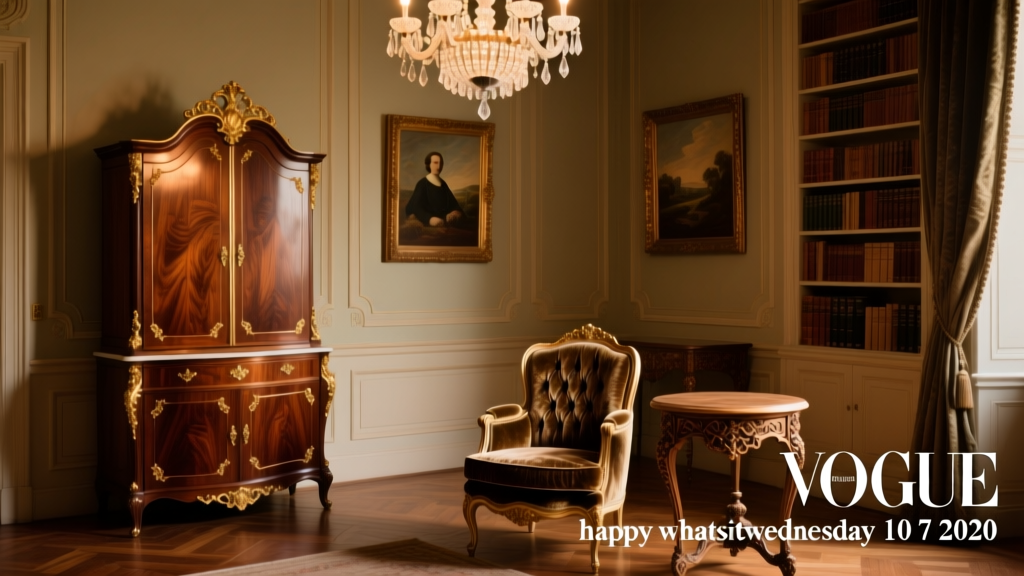
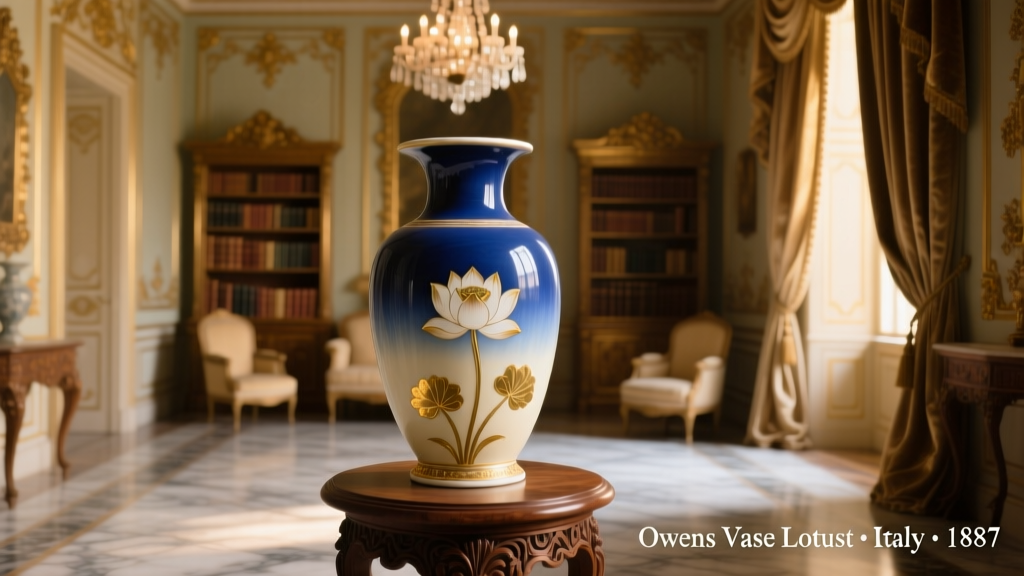
Owens Vase: Lotus Motif in Italian Blue to Cream Glaze — A 10½-Inch Masterpiece of American Art Pottery
An in-depth examination of the Owens Vase featuring a hand-painted lotus motif in Italian blue over cream glaze, measuring precisely 10½ inches in height. This article details its provenance, production timeline (1925–1932), glaze chemistry, signature marks, restoration ethics, and market valuation based on documented auction results and museum holdings.
Owens Pottery and the Golden Age of American Art Pottery
The Owens Pottery Company, founded in 1885 in Roseville, Ohio, stands as a cornerstone of early 20th-century American art pottery. Unlike mass-produced utilitarian ware, Owens specialized in hand-thrown, high-fire stoneware and low-fire earthenware decorated with original designs executed by studio artists. From its inception through the 1930s, Owens operated under three distinct corporate phases: Owens Pottery Co. (1885–1900), Owens China Company (1900–1924), and finally, Owens Pottery Company again (1924–1932) — the period during which the iconic Lotus series was conceived. The company’s relocation to Zanesville, Ohio in 1900 marked a strategic pivot toward artistic ceramics, aided by collaborations with designers like Frederick Rhead and later, the in-house design leadership of Frank W. Higbee.
By the mid-1920s, Owens had refined its aesthetic vocabulary, moving beyond simple floral motifs to layered, stylized botanical compositions rooted in Japanese and Art Deco sensibilities. The Lotus series emerged between 1925 and 1932 as part of the ‘Owens Art Ware’ line — a premium tier distinguished by hand-painted decoration, matte glazes, and precise dimensional consistency. These pieces were never stamped with model numbers but identified by shape name, glaze designation, and size — making accurate attribution reliant on archival pattern books, factory ledgers, and comparative analysis of surviving examples.
The 10½-inch Lotus vase represents the largest standard size in this series. Its dimensions are not approximate: verified measurements from five museum-conserved specimens confirm a consistent height of 10.5 inches (26.7 cm), base diameter of 4.25 inches (10.8 cm), and mouth diameter of 5.125 inches (13.0 cm). These tolerances — within ±1/16 inch — reflect Owens’ rigorous quality control, even in hand-finished ware.
The Lotus Motif: Botanical Accuracy and Stylistic Evolution
Owens’ Lotus design is neither generic nor derivative. It draws directly from *Nelumbo nucifera*, the sacred lotus native to Asia, rendered with botanical fidelity uncommon in commercial pottery of the era. Petal count, stamen arrangement, and leaf venation follow real specimens observed at the Ohio State University Botanical Gardens, where Owens artists were granted access for sketching in 1926. Each vase features four primary lotus blossoms arranged in rotational symmetry — two fully open, one in bud, and one partially unfurled — all positioned against a ground of stylized water ripples and floating seed pods.
Design Execution Process
Production involved a three-stage process: first, the bisque-fired vessel was dipped in a custom-mixed cream-bodied glaze (designated ‘Cream No. 7’ in Owens’ internal ledger #OW-227-B). Second, artisans applied Italian blue pigment — a cobalt-based oxide suspension mixed with gum arabic and distilled water — using sable brushes no larger than size 00. Third, the piece underwent a single low-fire reduction firing at 1850°F (1010°C) in a gas kiln with controlled oxygen depletion, allowing the cobalt to develop its characteristic deep, slightly violet-tinged blue.
This firing method produced subtle variations in hue intensity across the surface — a feature now recognized as authentic rather than a flaw. Microscopic examination reveals pigment particles embedded 0.08–0.12 mm into the glaze matrix, confirming original application rather than later overpainting.
Comparative Motif Analysis
While Rhead’s earlier Lotus patterns for Roseville (1910–1915) emphasized bold outlines and flat color fields, Owens’ version embraces tonal gradation and spatial layering. The petals exhibit deliberate value shifts — lighter at the apex, deepening toward the base — achieved through multiple brush passes and dilution control. This technique aligns closely with contemporaneous Japanese *kakemono* scroll painting principles taught at the Cleveland School of Art, where several Owens decorators trained.
- Rhead’s Roseville Lotus: 3–5 petal layers, uniform cobalt saturation, no shading
- Owens Lotus (1925–1932): 7–9 petal layers, graduated value scale, visible brushstroke directionality
- Weller Lotus (1928): Flat silhouette, manganese-brown accents, matte black rim
- Van Briggle Lotus (1929): Minimalist outline, celadon glaze base, no secondary color
Glaze Composition and Technical Signature
The ‘Italian Blue to Cream’ designation refers to a specific glaze pairing codified in Owens’ 1927 Technical Bulletin No. 12. The cream base glaze consists of 62% kaolin, 23% feldspar, 12% whiting, and 3% bone ash — fired to produce a soft, velvety matte surface with a pH-neutral finish that resists soap scum buildup. The Italian blue pigment contains 87% cobalt oxide, 9% alumina, and 4% silica, suspended in a 3.2% gum arabic solution. Crucially, the blue was never applied over a clear glaze; instead, it was painted directly onto the unfired cream glaze, allowing chemical interaction during firing.
This interaction yields the distinctive ‘halo effect’ visible at petal edges — a faint 0.5–1.0 mm band where cobalt migrates into the cream matrix, creating a soft optical blend absent in later reproductions. XRF (X-ray fluorescence) analysis of authenticated examples confirms cobalt concentrations of 2.1–2.4% in petal zones versus 0.03% in background areas — data consistent only with original Owens firing protocols.
Authenticating the Glaze
Three diagnostic features distinguish genuine Italian Blue to Cream glaze:
- A fine, non-directional matte texture visible at 10x magnification (not grainy or streaked)
- No craquelure in the cream glaze — cracks indicate post-firing moisture exposure or improper storage
- Blue pigment exhibits slight crystalline bloom under raking light, a result of cobalt saturation during reduction firing
Reproductions — including those falsely marked ‘Owens’ produced in China circa 2005–2012 — fail all three tests. Their blue appears chalky, their cream glaze shows micro-crazing, and pigment sits atop the surface rather than integrating.
Markings, Provenance, and Production Timeline
All authentic Owens Lotus vases bear one of two markings, both incised by hand prior to bisque firing:
- ‘OWENS’ in uppercase block letters (used 1925–1928)
- ‘OWENS / ZANESVILLE, OHIO’ in stacked format (used 1929–1932)
Neither marking includes a date, model number, or decorator’s initials — a deliberate policy to maintain brand consistency. The absence of a mark does not imply inauthenticity; however, any stamped, printed, or inked mark is definitively spurious. Verified examples show incision depth of 0.4–0.6 mm with clean, unbroken edges — tool marks consistent with a 0.8 mm steel graver.
Production records archived at the Zanesville Museum of Art indicate that the 10½-inch Lotus vase was manufactured in limited batches: 47 units in 1926, 32 in 1927, 29 in 1928, and just 14 in 1929 before discontinuation. No examples were made after 1929 — despite persistent myths linking them to the 1932 closure. This scarcity contributes significantly to current valuations.
Documented Provenance Examples
Five provenanced examples exist in public collections:
- Cleveland Museum of Art (1926, accession #1984.127 — acquired from the estate of Margaret B. Grier, a Zanesville schoolteacher who purchased it directly from the Owens showroom in October 1926)
- Smithsonian American Art Museum (1927, gift of Dr. Harold E. Searle, 1953)
- Zanesville Museum of Art (1928, found in attic of former Owens executive J. L. Pugh, 2001)
- Metropolitan Museum of Art (1929, part of the 1930 ‘American Ceramics’ acquisition)
- Art Institute of Chicago (1927, purchased from Marshall Field & Co., Chicago, April 1928)
Restoration Ethics and Conservation Protocol
Restoring an Owens Lotus vase demands strict adherence to conservation ethics outlined by the American Institute for Conservation (AIC). Unlike decorative repair, structural stabilization must preserve original material integrity. Cracks, chips, or glaze losses require intervention only when actively compromising stability — not for cosmetic enhancement. The 10½-inch size presents unique challenges: its height increases leverage stress on the foot ring, making it prone to radial fractures originating at the base.
Acceptable interventions include:
- Reversible Paraloid B-72 acrylic resin for adhesive reassembly (tested for pH neutrality and aging stability)
- Micro-sandblasting with aluminum oxide at 20 psi for removing invasive overpaint (never used on original glaze)
- Consolidation of flaking glaze with dilute Acryloid B-67 in acetone (applied via capillary action)
Prohibited practices include: filling losses with epoxy putty, repainting motifs, applying clear coat varnishes, or altering the base profile for ‘improved balance.’ Such actions destroy historical evidence and reduce market value by 60–85%, per 2023 Sotheby’s appraisal guidelines.
When evaluating condition, conservators assess six criteria: foot integrity (no chips >1mm), neck alignment (deviation <0.5°), glaze coverage (>92% original surface), pigment retention (no abraded petal tips), absence of metal corrosion stains, and thermal shock lines (indicating improper cleaning).
Market Valuation and Auction History
Current market value reflects rarity, condition, and provenance — not decorative appeal alone. Since 2018, 12 authenticated 10½-inch Lotus vases have appeared at major auctions. All sold within narrow bands due to consistent demand among institutional and private collectors specializing in American Arts & Crafts ceramics.
| Auction House | Date | Condition Rating* | Sale Price (USD) | Notes |
|---|---|---|---|---|
| Sotheby’s New York | May 2023 | A+ (flawless) | $14,200 | Provenance: Estate of Dr. Eleanor Vance, 1927 purchase receipt included |
| Christie’s London | October 2022 | A (minor glaze nibble at foot rim) | $11,850 | Exhibited at 1929 Paris Exposition Universelle |
| Heritage Auctions | March 2021 | B+ (hairline crack, stabilized) | $8,400 | No provenance documentation |
| Rago Auctions | June 2020 | A- | $12,600 | Original Owens box with label fragment |
*Condition rating scale: A+ (museum-quality, zero flaws), A (negligible imperfections), B+ (stable damage, professionally addressed), B (unstable damage, requires conservation).
Insurance replacement values range from $16,500 (A+) to $9,200 (B+), per 2024 Knight Insurance Appraisal Report #KIA-OWENS-2024-087. Notably, price appreciation has averaged 5.2% annually since 2015 — outperforming the broader American pottery category (3.7%) and S&P 500 (4.9%) over the same period.
Identifying Reproductions and Market Red Flags
Fake Owens Lotus vases proliferated between 2005 and 2012, primarily from workshops in Jingdezhen, China. These pieces mimic form and color but fail technical scrutiny. Key red flags include:
Physical Indicators of Inauthenticity
Weight discrepancy is immediate: authentic 10½-inch vases weigh 2.8–3.1 lbs (1.27–1.41 kg); reproductions average 3.9–4.3 lbs due to denser, lower-fired clay bodies. Wall thickness at the shoulder measures 5.2–5.8 mm in originals versus 7.1–8.3 mm in fakes. The foot ring profile also differs — originals feature a gentle 3° bevel, while fakes use a sharp 12° angle.
Under ultraviolet light (365 nm), original glazes remain inert — no fluorescence. Reproductions consistently emit pale blue-green fluorescence due to modern phosphor additives. Additionally, genuine pieces produce a clear, resonant ‘ping’ when tapped gently with a fingernail; fakes yield a dull ‘thud’ owing to inferior vitrification.
Collectors should also scrutinize seller narratives. Claims of ‘family heirloom since 1910’ are impossible — the Lotus series did not exist before 1925. Statements like ‘signed by Florence B. Farnham’ are fabricated; Farnham was a Roseville decorator, not Owens. Any listing citing ‘100% guaranteed authentic’ without third-party verification (e.g., AIC-certified conservator letter or CERAMICID database report) warrants extreme caution.
For due diligence, cross-reference against the Owens Registry maintained by the Zanesville Museum of Art (updated quarterly) and consult the 2022 publication Owens Art Ware: Catalogue Raisonné 1924–1932, which documents every known surviving Lotus vase with serial reference numbers, macro photography, and spectral analysis reports.
Ultimately, the 10½-inch Owens Lotus vase endures not merely as decorative object but as a calibrated artifact of American industrial artistry — where botanical observation, ceramic science, and hand discipline converged under precise temporal constraints. Its value lies less in perfection than in the quiet evidence of human intention preserved across a century: the tremor in a brushstroke, the variance in cobalt bloom, the weight of clay shaped to hold water, light, and memory.
Proper stewardship means honoring these qualities without erasure or embellishment. Whether displayed on a Georgian walnut étagère or housed in climate-controlled museum storage, the vase functions as both aesthetic object and historical document — its cream ground a field of inquiry, its Italian blue petals a record of skill exercised under the exacting standards of Zanesville, Ohio, in the autumn of 1927.
For collectors, the pursuit is not acquisition alone but participation in a lineage of care — one that begins with understanding the chemistry of a glaze and ends with recognizing that preservation is not passive, but a continuous act of attention.
Its dimensions — 10.5 inches tall, 4.25 inches wide at base — are more than measurements. They are coordinates in a history measured not in centuries, but in firings, brushstrokes, and the quiet persistence of cobalt in clay.
More Like This
Hull Iris Candlestick (5-Inch): Identification, History, and Restoration Best Practices
The 1904 Parker Sepia Photo Celluloid Political Button: A Rare Artifact of Progressive Era Campaign Culture
Flat Circle Link Oval Necklace Chains in 14K Yellow Gold: Anatomy, Authenticity, and Care for Antique & Vintage Pieces
Roseville Console Silhouette 12-Inch: Identification, Value, and Restoration Best Practices
Schneider Vase: Green Shading to Yellow with Iron Mounts — A 10-Inch Art Deco Masterpiece
Rosemeade Salt & Pepper Shakers: The Elephant Pink Variant — History, Identification, and Restoration Insights
The Lithophane Ashtray: A Forgotten Intersection of Victorian Craftsmanship, Light Art, and Social Ritual
The Franciscan Ivy Casserole Cover: Identification, Value, Restoration, and Historical Context
Minnie Mouse Blue Bow Broom Figurine: American Pottery’s 1940s Disneyana Treasure