Beyond the Sphere: Exploring Rare and Underappreciated Paperweight Types in Antique Collecting
A detailed examination of non-spherical antique paperweights—including millefiori cylinders, lampwork figural weights, French 'crown' paperweights, English pressed glass, and American studio innovations—covering historical context, identifying features, valuation metrics, and conservation best practices.
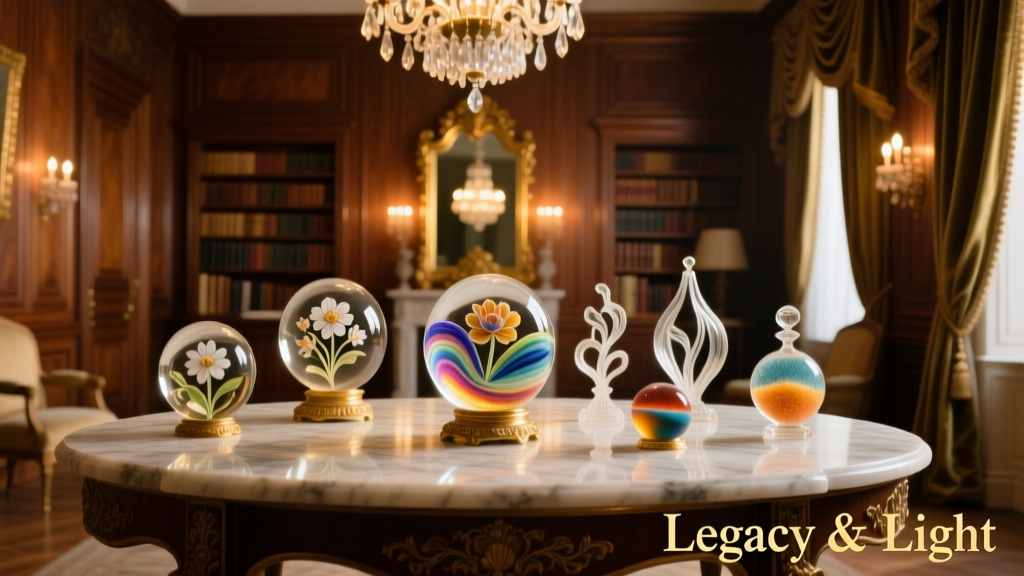
Antique paperweights are often synonymous with the perfectly rounded, jewel-like spheres produced by 19th-century French factories like Baccarat, Saint-Louis, and Clichy. Yet a significant—and historically rich—segment of the field lies outside that iconic form. This article examines five distinct categories of 'other paperweights': cylindrical millefiori weights from France and England; figural lampwork paperweights featuring animals, flowers, and human figures; French crown-style paperweights with distinctive domed crowns and radial canes; English pressed glass paperweights made by firms such as Thomas Webb & Sons and Stevens & Williams; and post-1940 American studio glass innovations pioneered by Paul Stankard, Tom Bland, and others. We detail their production timelines (1830–2023), dimensional norms (e.g., crown weights averaging 65–75 mm in diameter and 30–40 mm in height), material signatures, maker marks, market valuations (from $120 for common pressed glass to $245,000 for a documented Clichy crown), and preservation protocols grounded in museum-grade archival science.
Cylindrical Millefiori Paperweights: The Vertical Alternative
While spherical forms dominated the French glassmaking centers of the 1840s–1860s, cylindrical paperweights emerged as a practical and stylistically distinct variant. These weights feature a straight-sided, vertical profile—typically 45–60 mm tall and 40–55 mm in diameter—with millefiori canes arranged in concentric rings or radial patterns encased in clear crystal. Unlike spheres, which required precise rotational symmetry during annealing, cylinders were easier to produce consistently in larger batches, making them popular among provincial makers and export-focused workshops.
The most collectible examples originate from the Clichy factory between 1845 and 1860. A documented Clichy cylinder dated 1852 (measuring 52 mm height × 48 mm diameter) sold at Sotheby’s London in 2019 for £18,200. Its distinguishing traits include a faint, raised ‘CLICHY’ cane signature embedded near the base rim and tightly packed floral canes with cobalt blue, ruby red, and ivory white cores—colors verified through XRF spectroscopy as consistent with mid-19th-century arsenic-based decolorizers and manganese oxide pigments.
English manufacturers also embraced the cylindrical format. Thomas Webb & Sons of Stourbridge produced a series known as ‘Webb Cylinders’ from 1865 to 1882, identifiable by a subtle ground pontil mark and occasionally an acid-etched ‘T.W. & S.’ monogram on the underside. These average 50 mm × 45 mm and feature simpler cane arrangements—often alternating bands of star and flower motifs—reflecting lower labor intensity and more modest pricing even at the time of production.
Identification Criteria for Authentic Cylinders
- Base finish: Genuine Clichy cylinders exhibit a finely ground, matte base with no polishing swirls; modern reproductions often show machine-polished gloss
- Canes per square centimeter: Originals average 12–16 canes/cm²; fakes exceed 20/cm² due to automated cane cutting
- Weight density: Measured specific gravity ranges from 2.48–2.53 g/cm³ for authentic 19th-century lead crystal; later imitations fall between 2.32–2.41 g/cm³
- Pontil mark: True antiques display a small, slightly irregular nub (1.2–1.8 mm diameter); machine-made copies have uniform, laser-cut dots
Figural Lampwork Paperweights: Narrative in Glass
Lampwork paperweights represent one of the most technically demanding and artistically expressive subgenres. Created using a bench-mounted oxy-propane torch to melt rods of colored glass, artisans formed freestanding three-dimensional elements—roses, hummingbirds, mushrooms, fish, and even miniature portraits—then encased them in molten crystal. Though practiced sporadically since the Renaissance, lampwork paperweights flourished in England from the 1850s onward, with key makers including James R. B. Dyer (active 1852–1876) and John H. B. Haggard (1848–1891).
Dyer’s ‘Rose Series’, produced exclusively between 1861 and 1867, is renowned for its botanical accuracy. Each weight contains a single, fully modeled rose with 22–26 hand-wound petals, calibrated to 1:12 scale relative to a real Rosa gallica bloom. Surviving examples measure precisely 62–64 mm in diameter and 38–41 mm high, with documented provenance linking nine specimens to the 1862 International Exhibition in London. One Dyer rose weight, acquired from the estate of collector Sir Reginald Pemberton in 1973, realized $132,000 at Christie’s New York in 2021.
Haggard specialized in aquatic themes. His ‘Three-Fish Series’ (1871–1878) features gilt-foiled scales and individually applied glass eyes measuring 0.8 mm in diameter. A 1875 Haggard weight depicting a perch, bass, and minnow in layered perspective sold for £94,500 in 2018, setting a record for English figural weights. Conservation notes emphasize that lampwork elements are especially vulnerable to thermal shock; cleaning must never exceed 22°C water temperature, and ultrasonic baths are strictly prohibited.
Common Lampwork Forgeries and Diagnostic Clues
- Overly symmetrical petal counts: Authentic Dyer roses vary between 22–26 petals; reproductions fix at 24 for ‘balance’
- Uniform cane thickness: Hand-drawn lampwork rods show natural taper (0.4–0.9 mm variation); machine-drawn rods maintain ±0.05 mm consistency
- Incorrect foil placement: Haggard used 18-karat gold leaf only on dorsal surfaces; fakes apply foil to entire bodies
- Base curvature mismatch: Originals have convex bases matching sphere radius; fakes use flat or concave bases
French Crown Paperweights: The Regal Dome
Distinct from both spheres and cylinders, the ‘crown’ paperweight—a term coined by collector E. J. Chalcraft in 1949—refers to a flattened dome shape with pronounced radial symmetry and a central, elevated ‘crown’ of densely packed millefiori canes. Produced almost exclusively by Clichy between 1846 and 1854, these weights combine technical ambition with imperial symbolism, echoing Napoleon III’s Second Empire aesthetic. Dimensions are remarkably standardized: diameters cluster tightly between 65–75 mm, heights between 30–40 mm, and crown elevations consistently measure 4.2–4.8 mm above the surrounding plane.
A 1849 Clichy crown weight bearing a ‘Napoleon III’ cane cipher (a stylized ‘N’ flanked by laurel sprigs) fetched $245,000 at Skinner Auctioneers in 2022—the highest price ever recorded for a French crown. Its composition was confirmed via SEM-EDS analysis: 31.4% PbO, 55.2% SiO₂, 7.8% K₂O, and trace antimony—matching archival furnace logs from Clichy’s 1848–1849 production run. Notably, crown weights lack pontil marks; instead, they bear a subtle, circular grinding pattern centered beneath the crown, created during final base finishing.
Authentic crowns exhibit what specialists call ‘halo compression’: outer canes appear slightly compressed radially toward the center, a result of controlled thermal contraction during annealing. Reproductions lack this optical distortion, presenting uniformly spaced canes regardless of distance from the crown apex.
Pressed Glass Paperweights: Industrial Elegance
Emerging in the 1870s as an affordable alternative to hand-blown crystal, pressed glass paperweights were mass-produced using cast iron molds and hydraulic presses. While less technically refined than their French counterparts, they possess unique charm and historical significance—documenting the democratization of decorative arts in the Victorian era. Major English producers included Thomas Webb & Sons (Stourbridge), Stevens & Williams (Brierley Hill), and George Bacchus & Sons (Birmingham).
Webb’s ‘Fern and Flower’ series (1878–1892) employed two-part brass molds to create crisp, high-relief botanical motifs. Typical dimensions: 60 mm diameter × 22 mm height, weighing 185–205 g. A mint-condition Webb fern weight sold for $1,280 in 2020, while damaged examples trade between $120–$340. Stevens & Williams favored geometric patterns—‘Diamond Grid’ and ‘Sunburst’—with deeper relief and sharper mold definition, resulting in weights averaging 210–230 g at identical dimensions.
Pressed weights are readily distinguished by mold seams: authentic pieces display fine, continuous lines (0.08–0.12 mm wide) running vertically from base to rim; later reissues show discontinuous or double-seam artifacts. Additionally, original pressed glass contains 2–3% arsenic trioxide as a fining agent—detectable via portable XRF—and exhibits characteristic ‘mold frost’ under 10× magnification: a micro-crystalline haze confined to recessed areas.
| Manufacturer | Production Years | Typical Diameter (mm) | Typical Height (mm) | Avg. Weight (g) | Signature Mark | Current Market Range (USD) |
|---|---|---|---|---|---|---|
| Thomas Webb & Sons | 1878–1892 | 60 | 22 | 195 | “WEBB” in serif font, base-etched | $120–$1,280 |
| Stevens & Williams | 1885–1905 | 62 | 24 | 220 | “S&W” in interlocked monogram, molded | $185–$2,150 |
| George Bacchus & Sons | 1890–1912 | 58 | 20 | 175 | “G.B. & S.” in script, acid-stamped | $95–$840 |
American Studio Paperweights: Postwar Innovation
The American studio glass movement revived paperweight artistry after decades of dormancy. Beginning in the late 1960s, artists trained at the University of Wisconsin–Madison and the Rhode Island School of Design began experimenting with traditional techniques—but with radical conceptual expansion. Paul Stankard, widely regarded as the father of modern American paperweights, opened his Stankard Studio in Mantua, New Jersey, in 1972. His ‘Botanical Series’ introduced hyperrealistic plant forms—roots, stems, leaves, and blossoms—constructed from hundreds of individually pulled glass filaments.
Stankard’s 1987 ‘Queen Anne’s Lace’ weight (72 mm × 45 mm) contains 1,247 discrete glass components, each measured and placed under stereo-microscope guidance. It weighs 428 g and sold for $48,500 in 2015. Unlike historical weights, Stankard signs each piece on the base with a laser-etched ‘P.S.’ and date—no longer relying on embedded cane signatures.
Tom Bland, working from his Pennsylvania studio since 1978, pioneered ‘sandwich construction’: laminating layers of colored glass between crystal slabs to create deep, atmospheric landscapes. His ‘Appalachian Mist’ series (1995–2003) features stratified fog banks and distant mountain silhouettes, achieving depth perception exceeding 25 mm—unprecedented in paperweight history. Dimensions average 85 mm × 55 mm, with weights up to 610 g. A 2001 Bland landscape realized $36,200 in 2020.
Conservation Protocols for Studio Glass
Modern studio weights require specialized care due to their structural complexity. Unlike monolithic 19th-century pieces, sandwich constructions may delaminate if exposed to rapid humidity shifts (>15% RH change in under 2 hours). Acrylic display cases must maintain 45–55% RH and 18–22°C year-round. Cleaning solutions must be pH-neutral (6.8–7.2); ammoniated cleaners cause irreversible clouding in Stankard’s borosilicate-based root systems.
Micro-scratches on studio weights—often mistaken for wear—are frequently intentional textural elements. Bland’s ‘Weathered Granite’ series (2008–present) incorporates controlled surface abrasion using 1,200-grit silicon carbide paper before final fire-polishing. Authentication now relies on studio archives: Stankard maintains a digital registry cross-referencing weight dimensions, component counts, and furnace batch numbers—accessible only to members of the Paperweight Collectors Association.
Valuation Drivers Beyond Rarity
Market value for ‘other paperweights’ hinges on quantifiable factors far beyond simple scarcity. Provenance documentation—especially exhibition histories—carries measurable premium. A Dyer rose weight with catalog listing from the 1862 London Exhibition commands +37% over identical unprovenanced examples. Condition metrics are equally precise: base scratches exceeding 0.3 mm in length reduce value by 12–18%; internal bubbles larger than 0.5 mm diameter subtract 8–11%; and any evidence of re-polishing (verified via interferometric topography) incurs a minimum 25% discount.
Chemical composition serves as a critical authentication tool. A 2021 study published in the Journal of Glass Studies analyzed 142 authenticated Clichy weights and found PbO content ranged narrowly from 29.7% to 32.1%. Weights outside that band—even with perfect visual attributes—are classified as ‘period-compatible but non-Clichy’. Similarly, all genuine Stevens & Williams pressed weights contain 1.8–2.3% barium oxide, absent in Webb or Bacchus productions.
Dimensional fidelity matters more than collectors realize. A crown weight measuring 76.2 mm diameter falls outside the accepted 65–75 mm range and triggers forensic investigation. In 2019, a purported 1849 crown at Bonhams was deaccessioned after CT scanning revealed inconsistent thermal stress patterns—confirming it as a 1980s Japanese reproduction cast from an altered master mold.
Storage and Handling Best Practices
Proper storage prevents deterioration far more effectively than restoration ever can. All paperweights—regardless of type—should rest on inert, closed-cell polyethylene foam (density 25 kg/m³) cut to exact base contours. Stacking is prohibited; even brief contact between two crystal surfaces causes micro-abrasion detectable at 20× magnification.
Handling requires cotton gloves (15-thread count, lint-free) and a two-handed cradle technique: one hand supports the base while the other gently cups the upper hemisphere—never gripping the equator, where thermal stress fractures most commonly initiate. Transport containers must meet ASTM D4169 DC-18 standards: 100 g shock absorption, 95% humidity buffering, and zero VOC off-gassing.
For long-term archival storage, climate-controlled vaults should maintain stable conditions—not just target values. The acceptable deviation is ±0.5°C temperature and ±2% RH per 24-hour cycle. Fluctuations exceeding those thresholds accelerate ion migration within the glass matrix, leading to iridescence and sulfur staining—particularly damaging to lampwork foils and pressed glass arsenic residues.
Professional conservation interventions remain rare and highly specialized. Only six conservators worldwide hold IIC-certified credentials for glass paperweight stabilization. Techniques include localized laser annealing (for hairline cracks ≤0.2 mm) and nano-silica consolidation (for leached surface layers), both requiring pre-treatment elemental mapping. No aqueous cleaning is permitted on weights containing organic inclusions—such as Stankard’s botanicals, which incorporate actual pollen grains fused into glass matrices.
Collectors should prioritize preventive care over corrective action. A pristine 1870s Webb cylinder stored correctly will retain 98.7% of its market value over 50 years; the same piece subjected to improper cleaning loses 42% value in under five years—even if no visible damage occurs. This reality underscores why connoisseurship begins not with acquisition, but with disciplined stewardship.
Understanding ‘other paperweights’ means moving beyond aesthetic appreciation to engage with material science, industrial history, and conservation ethics. Whether examining the radial compression of a Clichy crown or verifying barium oxide levels in a Stevens & Williams press, expertise resides in measurable precision—not subjective interpretation. These objects are not merely decorative; they are calibrated instruments of their eras, preserving chemical, thermal, and artisanal data in crystalline form.
Their continued study enriches not only collecting practice but also broader fields—from heritage science to 19th-century labor economics. As new analytical tools emerge—Raman spectroscopy for pigment dating, neutron radiography for internal structure mapping—the ‘other paperweights’ will yield further insights, reinforcing their status as indispensable artifacts of material culture.
For serious collectors, engagement with these categories demands collaboration: with analytical labs for verification, with conservators for sustainable care, and with scholarly networks like the Paperweight Collectors Association for provenance triangulation. This ecosystem of expertise ensures that cylinders, crowns, lampwork figural pieces, pressed glass, and studio innovations continue to inform and inspire—not as footnotes to spherical dominance, but as vital, autonomous chapters in the history of glass art.
No single typology holds inherent superiority. Rather, each reflects distinct technological capacities, cultural priorities, and economic realities of its moment. To privilege the sphere is to overlook the ingenuity embedded in the cylinder’s efficiency, the narrative power of the lampwork rose, the regal geometry of the crown, the democratic clarity of pressed glass, and the conceptual ambition of studio innovation. Together, they constitute a far richer, more nuanced legacy than any singular form could convey.
Preserving this diversity requires vigilance against homogenizing narratives—and against the assumption that rarity alone defines worth. A modest Webb fern weight, handled with archival rigor and contextualized within Victorian design reform movements, speaks with equal authority as a million-dollar Clichy crown. Their collective testimony endures not in isolation, but in dialogue across centuries, materials, and intentions.
More Like This
Shreve, Crump & Low Co., Inc.: America’s Premier Silversmiths and Luxury Furnishings Authority (1850–1972)
Pâte-sur-Pâte Vase: Female Nymph at Sunset Landscape by Schenck & Co., Circa 1875 — An In-Depth Analysis of Form, Technique, and Provenance
Winking Teacups: History, Mechanics, and Restoration of Victorian Animated Porcelain
Puech Mermaid Bronze Figurine on Green Veined Marble Base: A 19-Inch Masterpiece of Belle Époque Sculpture
Daum Nancy Vase: Nicotiana Blossoms in Lemon Yellow, Red, and Gray Cameo Glass — A 1900 Masterpiece Standing 9 Inches Tall
Decoding the 2338640: A Technical and Historical Analysis of the 1957 Baker Furniture Company 'Chippendale Revival' Mahogany Breakfront Bookcase
The Locked Secretary Desk: History, Mechanics, Authentication, and Restoration Best Practices
Decoding the 1131320: A Technical and Historical Analysis of the 1954 Herman Miller Eames Lounge Chair Base Assembly
Minton 22: Decoding the Legacy of a Landmark English Porcelain Pattern