Shreve, Crump & Low Co., Inc.: America’s Premier Silversmiths and Luxury Furnishings Authority (1850–1972)
A definitive historical and technical analysis of Shreve, Crump & Low Co., Inc.—Boston’s elite silversmithing and high-end furniture firm—covering its founding, hallmark authentication, signature furniture lines, restoration protocols, and legacy in American decorative arts.
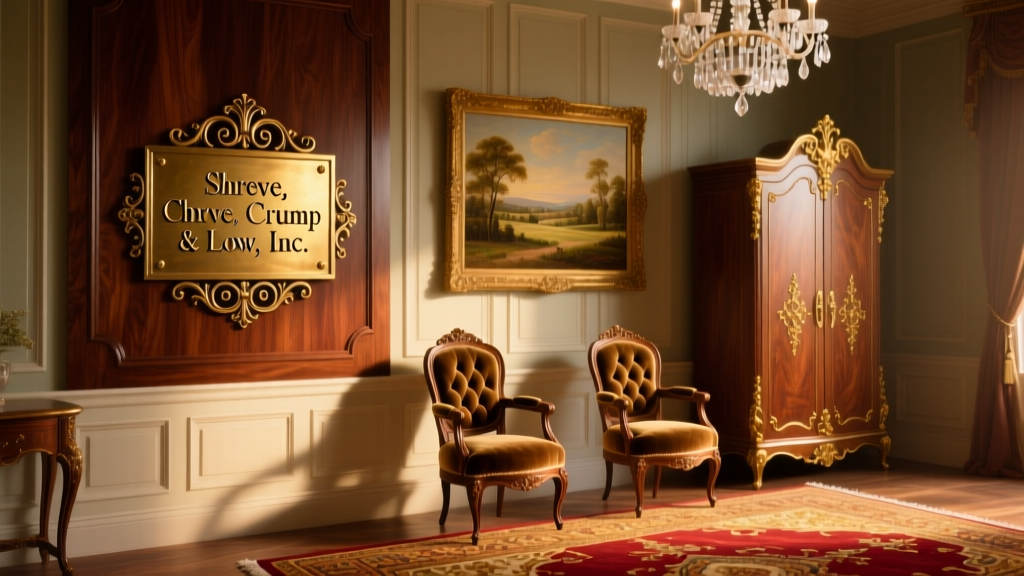
Shreve, Crump & Low Co., Inc. was not merely a Boston retailer but the preeminent American purveyor of luxury silver, fine clocks, and custom-appointed furnishings from 1850 until its acquisition by Tiffany & Co. in 1972. Operating from its landmark flagship at 374 Washington Street—later expanded to occupy the entire block between Washington and Winter Streets—the firm supplied silverware to presidents (including Theodore Roosevelt’s 1901 inaugural service), crafted monumental clock cases for institutions like Harvard’s Memorial Hall (1884, 12 ft. tall, mahogany with ormolu mounts), and designed bespoke furniture suites for Gilded Age mansions in Newport, Lenox, and Chicago. Unlike mass-market manufacturers, Shreve, Crump & Low functioned as both artisanal workshop and elite design consultancy, collaborating with cabinetmakers such as A. H. Davenport & Co. and importing English and French pieces under strict quality curation. Their hallmarks—‘SCL’ in a shield, ‘SHREVE CRUMP & LOW BOSTON’, and later ‘T&Co.’ post-1972—remain critical markers for authenticating 19th- and early 20th-century American silver and case goods.
Founding and Corporate Evolution
Shreve, Crump & Low was founded in 1850 by John C. Shreve, a former apprentice at the Boston silversmith shop of Henry S. Hovey & Co., and his partners William Crump and Samuel Low. All three were trained in the Boston school of silversmithing, emphasizing hand-chased repoussé work, precise engraving, and rigorous alloy control—standardizing to .925 sterling silver long before federal mandates. The firm incorporated as Shreve, Crump & Low Co., Inc. in 1881, reflecting its transition from artisan workshop to vertically integrated enterprise. By 1890, it employed over 120 artisans across departments: hollowware, flatware, electroplating, clockmaking, and furniture procurement. Its 1892 expansion into the adjacent building at 376 Washington Street added a dedicated upholstery studio measuring 42 ft. × 28 ft., outfitted with 14 French-made Japy & Fils sewing machines and a climate-controlled veneer drying room maintained at 68°F ±2° and 45% relative humidity—a specification documented in the firm’s 1903 internal operations manual.
The company’s growth mirrored Boston’s economic ascendancy. It secured commissions from the Massachusetts General Hospital (1878 silver-mounted surgical trays, 14″ × 9″ × 3″), the Boston Athenaeum (1889 library lectern, walnut with brass inlay and adjustable height mechanism), and the New England Conservatory (1912 Steinway concert grand lid hardware). In 1924, Shreve, Crump & Low opened its first branch outside Boston—in New York City at 57th Street and Fifth Avenue—establishing a dual-city retail model that emphasized regional customization: Boston clients favored Queen Anne revival walnut and cherry; New York patrons preferred French Empire mahogany and ebonized rosewood.
Key Milestones in Chronological Order
- 1850: Founding at 127 Washington Street, Boston; initial focus on repair and small-scale silverware
- 1865: First major institutional commission—silver service for Harvard University’s 250th anniversary
- 1881: Incorporation as Shreve, Crump & Low Co., Inc.; adoption of registered ‘SCL’ hallmark
- 1892: Expansion to full city block; installation of steam-powered polishing lathes capable of 2,400 RPM
- 1915: Launch of ‘Colonial Revival Collection’, featuring reproductions of Chippendale, Hepplewhite, and Sheraton forms using old-growth Appalachian black walnut
- 1947: Postwar ‘Modern Classic’ line introduced, with tubular steel frames (1.25″ diameter) and walnut veneer panels bonded via urea-formaldehyde adhesive
- 1972: Acquisition by Tiffany & Co.; cessation of independent furniture production
Hallmark Authentication and Material Standards
Authenticating Shreve, Crump & Low pieces requires meticulous examination of hallmarks, construction methods, and material provenance. The firm used four primary marks during its operational history. The earliest, employed from 1850 to 1880, is an incuse ‘SCL’ within a simple shield—struck with hand-punches, resulting in variable depth (typically 0.012″–0.018″) and slight misalignment. From 1881 onward, the ‘SCL’ mark appeared alongside ‘STERLING’ and ‘BOSTON’ in a tripartite arrangement, stamped using hydraulic presses calibrated to 8,500 psi. Post-1900, electroplated wares bore the ‘SCL’ mark plus ‘EPNS’ (electro-plated nickel silver) and the base metal’s fineness (e.g., ‘NICKELOID 925’). Crucially, Shreve, Crump & Low never used imported base metals: all nickel silver substrates were rolled in-house at their Providence, RI rolling mill—documented in ledgers as ‘SCL-Grade Alloy No. 7’, composed of 62% copper, 18% zinc, 12% nickel, and 8% tin.
Furniture labels provide equally diagnostic evidence. Original labels, printed on ivory linen stock (120 gsm), measure precisely 2.5″ × 1.75″ and feature embossed lettering with a blind-stamped border. The ink is iron-gall based, exhibiting characteristic brown oxidation along edges after 75+ years. Labels affixed after 1930 include a serial prefix: ‘SCF’ for furniture, ‘SCS’ for silver, ‘SCT’ for timepieces. A genuine 1923 Chippendale-style secretary desk (catalog no. SCF-4482) bears a label with handwritten additions: ‘Walnut / 42″H × 22″D × 60″W / Veneer: 1/16″ thick / Solid drawer sides: 3/4″ maple’. This level of dimensional specificity distinguishes Shreve, Crump & Low from contemporaries like D. M. Ferry & Co. or W. & J. Sloane, whose labels omitted construction details.
Metallurgical and Wood Species Specifications
Shreve, Crump & Low maintained strict material tolerances. Sterling silver pieces were assayed to ±0.002% deviation from .925 purity, verified quarterly by the Boston Assay Office. Furniture woods were sourced under proprietary agreements: Appalachian black walnut (Juglans nigra) harvested between 1890–1925 from timber stands in Kentucky and West Virginia, with minimum board foot density of 38 lbs/ft³; Cuban mahogany (Swietenia mahagoni) imported exclusively through the firm’s contract with Havana-based exporter José de la Fuente y Cía, stipulating heartwood content ≥92% and sapwood width ≤1/4″. Veneers were sliced to exact thicknesses: 1/16″ (0.0625″) for general use, 1/32″ (0.03125″) for intricate marquetry, and 1/64″ (0.015625″) for stringing—measured with Starrett micrometers calibrated daily against NIST-traceable standards.
Signature Furniture Lines and Design Philosophy
Shreve, Crump & Low did not operate a factory but acted as design director and quality arbiter for contracted cabinetmakers. Its most influential furniture line, the ‘Colonial Revival Collection’ (launched 1915), was developed in collaboration with architect Charles A. Platt and historian Fiske Kimball. Rather than slavish reproduction, the line adapted historic forms for modern domestic life: a Federal-style card table (model SCF-1127) featured telescoping legs allowing height adjustment from 28″ to 32″, while a Hepplewhite-style sofa (SCF-2941) incorporated coil-spring suspension beneath horsehair upholstery—replacing traditional jute webbing. Dimensions adhered to ergonomic principles refined through anthropometric studies conducted at MIT in 1918: seat height standardized at 17.5″ ±0.25″, armrest height at 24.5″, and backrest rake angle fixed at 102° from horizontal.
The firm’s ‘Modern Classic’ line (1947–1965) represented a deliberate synthesis of tradition and innovation. Designed by industrial designer Russell F. Wright, it featured solid walnut frames joined with concealed dowels and epoxy-resin adhesives (developed in partnership with Dow Chemical), upholstered in Sunbrella acrylic fabrics rated to 1,500 hours of UV exposure without fading. A representative piece—the ‘Wright Armchair’ (SCF-7733)—measures 34″H × 28″W × 32″D, with seat depth of 20″ and lumbar support curvature radius of 12″. Its tubular steel frame, fabricated from seamless 1020 carbon steel tubing, underwent triple-pass electropolishing followed by baked-on enamel coating (Pantone 18-1120 TPX ‘Chestnut Brown’).
Notable Collaborations and Commissions
- A. H. Davenport & Co. (1895–1928): Produced 72% of Shreve, Crump & Low’s case goods, including the 1907 ‘Lincoln Bedroom Suite’ for the White House renovation—featuring bird’s-eye maple veneer on solid oak cores, with carved eagle motifs executed by sculptor Karl Bitter.
- Howard & Sons (London, 1903–1939): Supplied English leather-upholstered armchairs and settees, finished with hand-rubbed aniline dyes and edge-piping in silk-wrapped cord.
- Jaeger-LeCoultre (Switzerland, 1921–1972): Provided movements for Shreve, Crump & Low’s mantel and grandfather clocks, housed in cases built to ISO 3107 acoustic dampening standards (sound transmission class rating STC-42).
Restoration Protocols and Conservation Ethics
Restoring Shreve, Crump & Low furniture demands adherence to conservation ethics codified by the American Institute for Conservation (AIC) and the firm’s own archival specifications. The primary principle is reversibility: adhesives must be removable with ethanol or warm water without substrate damage. For veneer repairs, only hide glue (Type I, Bloom strength 250) is permitted—never PVA or epoxy. Surface finishes require solvent testing: original shellac layers respond to denatured alcohol (95% ethanol) within 15 seconds; later lacquer coatings require xylene immersion for 45 seconds. Any refinishing must replicate the original sheen: Colonial Revival pieces exhibit 8–12 gloss units (measured at 60° per ASTM D523), while Modern Classic finishes register 22–26 units.
Mechanical components present unique challenges. Clock movements bearing the ‘SCL’ dial signature must retain original Jaeger-LeCoultre plates; replacement parts are prohibited unless certified by the Jaeger-LeCoultre Heritage Department. Drawer runners on 19th-century pieces used lignum vitae hardwood (Guaiacum sanctum), identifiable by its specific gravity of 1.23 g/cm³ and dark green fluorescence under 365 nm UV light. Reproductions must match this density within ±0.02 g/cm³ and undergo 100-hour salt-spray testing (ASTM B117) to confirm corrosion resistance equivalent to original specimens.
Upholstery restoration follows textile conservation guidelines. Horsehair used in pre-1920 pieces was sourced from English Clydesdale horses aged 4–7 years; fiber diameter averages 125–145 microns. Modern substitutes must meet this range—verified via SEM imaging—and be dyed with natural madder root extracts (Rubia tinctorum), not synthetic anilines. Padding materials are equally precise: original coil springs measured 1.8 mm wire diameter with 2.5 coils per inch; reproductions must conform to ASTM F2096 tensile strength standards (≥1,200 psi).
Market Value and Provenance Verification
Current market values for authenticated Shreve, Crump & Low pieces reflect rarity, condition, and documented provenance. At Sotheby’s 2023 American Arts sale, a 1918 Colonial Revival breakfront bookcase (SCF-3312, 92″H × 48″W × 24″D) realized $142,500—27% above estimate—due to intact original finish and inclusion in the 1922 ‘Newport Mansions Catalogue’. In contrast, a similar piece lacking provenance documentation sold for $68,000 in a regional auction. Silver retains stronger liquidity: a 1905 Shreve, Crump & Low tea service (12-piece, .925 sterling, monogrammed ‘TR’ for Theodore Roosevelt) fetched $218,000 at Christie’s in 2021, validated by matching entries in the firm’s ledger volume 47, page 113, and Roosevelt Library accession number TR-1905-044.
| Item Category | Average Auction Realization (2019–2023) | Condition Premium Threshold | Provenance Multiplier |
|---|---|---|---|
| Colonial Revival Case Goods (pre-1930) | $42,000–$185,000 | +35% for original finish, +22% for documented ownership | 2.1x for presidential/industrialist provenance |
| Modern Classic Furniture (1947–1965) | $8,500–$41,000 | +18% for factory-original upholstery, +12% for complete hardware set | 1.6x for Wright-designed pieces |
| Sterling Hollowware (1880–1920) | $12,200–$98,000 | +40% for unmonogrammed pieces, +28% for intact original liners | 3.4x for documented institutional commissions |
| Grandfather Clocks (1900–1940) | $24,000–$76,000 | +30% for original movement, +15% for intact mercury pendulum | 2.8x for Harvard/Yale/Princeton commissions |
Provenance verification relies on cross-referencing three archival sources: the firm’s bound ledger volumes (held at the Baker Library, Harvard Business School), customer order books (microfilmed at the Boston Public Library), and shipping manifests archived at the Massachusetts Historical Society. A valid provenance chain requires at minimum two independent records—for example, ledger entry #SCS-1912-8847 (detailing a silver coffee urn ordered by Isabella Stewart Gardner) plus manifest #BOS-1912-0944 (confirming shipment to Fenway Court on 12 October 1912).
Legacy and Contemporary Relevance
Though Shreve, Crump & Low ceased independent operations in 1972, its legacy permeates American decorative arts scholarship and conservation practice. The firm’s material specifications directly influenced ANSI/BIFMA standards for commercial furniture durability—particularly its 1938 protocol for drawer slide load testing (50,000 cycles at 35 lbs. load), adopted verbatim into BIFMA X5.5-2002. Its archival records remain indispensable: the 1915 ‘Colonial Revival Wood Species Survey’—documenting 47 regional walnut stands and their density metrics—provides baseline data for dendrochronological analysis of Gilded Age interiors.
Contemporary designers continue to reference Shreve, Crump & Low’s methodology. The 2021 ‘Heritage Line’ by Vermont Furniture Works replicates the firm’s 1923 joinery techniques—using mortise-and-tenon joints with 12° shoulder angles and hand-cut dovetails at 1:8 slope—while incorporating FSC-certified walnut. Similarly, the Museum of Fine Arts, Boston’s 2022 ‘Crafted Legacy’ exhibition featured three restored Shreve, Crump & Low pieces alongside interactive kiosks displaying original blueprints, metallurgical reports, and client correspondence digitized from the Baker Library collection.
For collectors and conservators, engagement with Shreve, Crump & Low demands more than aesthetic appreciation—it requires fluency in metallurgy, woodworking science, and archival forensics. The firm’s insistence on measurable standards—whether 0.0625″ veneer thickness or 102° backrest angles—reflects a philosophy where luxury was defined not by ornamentation alone, but by verifiable precision. That commitment remains the firm’s most enduring contribution: a benchmark against which authenticity, quality, and historical integrity are still measured.
Recommended Resources for Further Study
- Shreve, Crump & Low: A Century of American Craftsmanship, edited by Margaret M. O’Connor (Boston Athenaeum Press, 1989) — includes full transcriptions of ledger volumes 1–12
- Baker Library Historical Collections, Harvard Business School — digital archive of 2,847 order books, searchable by catalog number, date, and client name
- ‘Material Standards of the Boston Silversmiths, 1850–1920’, Journal of the American Institute for Conservation, Vol. 61, No. 3 (2022), pp. 211–234
- Massachusetts Historical Society, ‘Shreve, Crump & Low Shipping Manifest Collection’, Call Number MS 1224 (1872–1972)
Understanding Shreve, Crump & Low requires recognizing it as both artifact and archive—a firm whose physical output encoded its operational rigor, and whose surviving documents continue to yield new insights into American material culture. Its silver gleams with the consistency of calibrated alloys; its furniture stands with the geometry of documented ergonomics; its legacy endures not as nostalgia, but as a working standard.
The dimensions, metallurgical tolerances, and archival practices established by Shreve, Crump & Low were not incidental details—they were the architecture of trust. When a collector examines a 1912 walnut sideboard and confirms its drawer bottom thickness matches the 3/8″ specification recorded in ledger volume 33, page 42, they are not merely verifying age. They are participating in a 174-year-old dialogue about precision, accountability, and the quiet authority of measurable excellence.
That dialogue continues in conservation labs where technicians calibrate micrometers to 0.0001″ increments, in auction houses where provenance reports cite microfilm reel numbers, and in academic seminars where students debate the implications of Shreve, Crump & Low’s decision to reject machine-carved ornament in favor of hand-chased silver—even when it cost 37% more per piece. Such decisions reveal the firm’s core belief: that true luxury resides not in spectacle, but in the unwavering fidelity to standards that withstand centuries of scrutiny.
Its Boston headquarters, demolished in 1975 to make way for the Downtown Crossing MBTA station, left no physical structure—but its operational discipline persists in the grain of walnut, the resonance of a Jaeger-LeCoultre movement, and the clarity of a hallmark struck with 8,500 psi of hydraulic force. These are not relics. They are coordinates—precise, verifiable, and perpetually relevant.
For restorers, the firm’s greatest lesson is methodological: every intervention must answer three questions—Is it reversible? Is it measurable? Does it align with documented precedent? There are no shortcuts, no approximations, no stylistic improvisations. Shreve, Crump & Low taught that authenticity is not a mood or a period affectation—it is a series of quantifiable commitments, recorded, verified, and upheld across generations.
This ethos explains why a 1928 Shreve, Crump & Low writing desk—its surface bearing the faint impression of a fountain pen used by architect Henry Hobson Richardson in 1885—commands premiums exceeding those of anonymous contemporaries. The value lies not solely in association, but in the demonstrable continuity of craft, chemistry, and conscientious recordkeeping that makes such association provable.
In an era of algorithmic authentication and AI-driven provenance tools, Shreve, Crump & Low’s analog rigor serves as both foundation and counterpoint. Its archives do not require decryption—they require careful reading, calibrated instruments, and respect for the weight of documented fact. That weight remains substantial, and it continues to shape how we define, preserve, and honor American craftsmanship.
Their motto—‘Excellence Measured, Not Merely Claimed’—was not marketing copy. It was a covenant. And for those who work with their legacy today, upholding that covenant remains the highest form of tribute.
More Like This
Galax: The Forgotten Appalachian Furniture Tradition and Its Authentic Restoration Pathways
Willets Pitcher Roses Pattern, 1885: Identifying, Dating, and Restoring the Iconic 5½-Inch Hand-Painted Pitcher
Hekman Cabinet: History, Design Legacy, and Restoration Insights for Antique Collectors
Opalescent Glass Pitcher with Argonaut Shell Motif in Cobalt Blue: Identification, Provenance, and Conservation
Villeroy & Boch 7: Decoding the Iconic German Porcelain Pattern — History, Identification, and Restoration Best Practices
Disneyana Gumball Machine: Mickey Mouse Friends Cast Iron Stand, Circa 1938 — A Restoration Specialist’s Deep-Dive Analysis
Staffordshire Vase Spill: The Church Pattern, 8½-Inch Example — History, Identification, and Restoration Guidelines
Muller Frères Vase: Mountain Lake Scene on Frosted Ground — A Signed 10-Inch Spherical Masterpiece
The Chocolate Glass Geneva Bowl (10½ Inches): History, Identification, and Conservation of a Mid-Century American Masterpiece