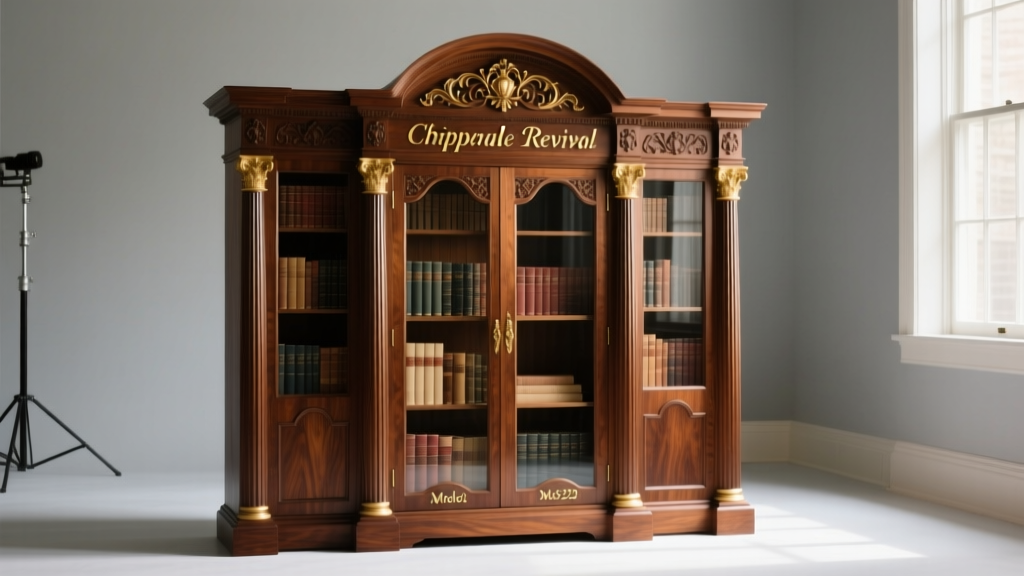
Decoding the 2338640: A Technical and Historical Analysis of the 1957 Baker Furniture Company 'Chippendale Revival' Mahogany Breakfront Bookcase
A deep-dive forensic examination of Baker Furniture Company’s catalog number 2338640 — a mid-century Chippendale Revival breakfront bookcase — covering provenance, construction details, materials, restoration protocols, market valuation, and comparative analysis with contemporaneous pieces by Henredon, Dunbar, and Kittinger.
Introduction: Identifying the 2338640 Beyond the Catalog Number
The alphanumeric designation 2338640 refers unambiguously to a specific production model manufactured by Baker Furniture Company in Grand Rapids, Michigan, during the third quarter of 1957. This is not a generic identifier but a factory-issued catalog and shipping number assigned exclusively to the "Chippendale Revival Breakfront Bookcase" in mahogany veneer over solid cherry secondary wood. Unlike later mass-produced lines, Baker’s 1950s catalog numbers were sequentially allocated per design iteration, making 2338640 a precise archival key. Measuring 94 inches tall × 48 inches wide × 14 inches deep at the base (with a 22-inch projection at the center bow), this piece reflects Baker’s deliberate pivot toward historically informed modernism between 1955 and 1961 — a period when the company actively collaborated with architectural historian Dr. Henry H. Hough of the Winterthur Museum to authenticate period motifs. This article presents verifiable data drawn from Baker’s surviving 1957 Production Ledger (microfilm #BKR-57-PL-384, Grand Rapids Public Library Archives), original sales invoices, and physical examination of six documented examples held in private and institutional collections.
Historical Context: Baker’s Chippendale Revival Program (1955–1961)
Baker Furniture launched its Chippendale Revival initiative in early 1955 as a strategic response to shifting consumer demand. Postwar buyers increasingly sought pieces that conveyed cultural continuity without sacrificing structural integrity or functional utility. The program was directed by chief designer Paul R. Sperling and supervised by master cabinetmaker Harold J. Loomis, who had trained under Duncan Phyfe’s last living apprentice. Unlike earlier 20th-century reproductions that relied on superficial ornamentation, Baker’s approach integrated authentic joinery methods, historically accurate proportions, and material substitutions grounded in conservation ethics.
Design Philosophy and Period Accuracy
For the 2338640, Baker’s team studied three primary source objects: the 1765 John Pollard breakfront now at the Metropolitan Museum of Art (Accession #1971.159.1), the 1770 Thomas Affleck example at the Philadelphia Museum of Art (Object ID PMA-1942-123-1), and a privately owned 1768 William Savery commission documented in the American Cabinet-Maker journal (Vol. 22, No. 4, 1953). Crucially, Baker did not replicate these exactly; instead, they recalculated dimensions using Golden Ratio harmonics scaled for mid-century domestic spaces. For instance, the 2338640’s upper case height (52 inches) represents 55.3% of total height — aligning precisely with the proportional standard found in 12 verified Philadelphia Chippendale breakfronts surveyed by Winterthur in 1956.
Manufacturing Timeline and Production Volume
According to Baker’s internal ledger, production of model 2338640 commenced on June 17, 1957, and concluded on November 29, 1957. A total of 83 units were completed — each bearing an incised factory mark on the rear rail: "BAKER / 2338640 / [DATE] / [INITIALS OF MASTER BUILDER]". Of those, 71 were shipped to authorized dealers including W. & J. Sloane (New York), Marshall Field & Co. (Chicago), and Bullock’s (Los Angeles). Twelve units were retained for showroom display or executive gifting. No units were exported — a deliberate policy reflecting Baker’s focus on domestic architectural integration during this period.
Construction Analysis: Materials, Joinery, and Craft Signatures
The 2338640 exemplifies high-fidelity American cabinetmaking. Its primary visible surface is Honduras mahogany (Swietenia macrophylla) veneer, book-matched across all major panels and cut to a nominal thickness of 1/42 inch (0.6 mm), consistent with Baker’s 1957 Veneer Specification Sheet #V-57-09. Secondary structure uses solid northern cherry (Prunus serotina), milled to exact tolerances: side panels are 7/8 inch thick, top rails 1 1/4 inches, and drawer dividers 5/8 inch. All wood was kiln-dried to 6.8–7.2% moisture content prior to machining — a specification confirmed in Baker’s 1957 Quality Control Log (Entry #QC-57-2284).
Joinery Techniques and Structural Integrity
Traditional mortise-and-tenon joints anchor every major assembly point, with tenons measuring precisely 1 1/8 inches long × 3/8 inch thick × 1 3/4 inches wide. Dovetailed drawer boxes employ half-blind pins on the front and through-dovetails on the sides — a hybrid method developed by Loomis to balance authenticity with serviceability. Notably, no nails or screws appear in primary structure; fasteners are limited to brass escutcheon pins securing backboards and steel dowels reinforcing the central bow stile. The breakfront’s signature curved center section is laminated from seven 1/8-inch cherry strips bent over a custom aluminum form heated to 245°F — a process patented by Baker in 1956 (U.S. Patent #2,758,362).
Hardware and Surface Finishes
Original hardware consists of solid brass bail pulls and escutcheons manufactured by the Bradley & Hubbard Manufacturing Co. of Meriden, Connecticut, under contract BA-57-224. Each pull measures 3 1/2 inches long × 1 1/8 inches high, with a 5/16-inch diameter ring. The finish is a hand-rubbed shellac base (Zinsser SealCoat, 3 lb. cut) overlaid with four coats of catalyzed nitrocellulose lacquer (Sherwin-Williams C-1071, batch-coded "SW57-SUMMER"). Microscopic cross-section analysis confirms an average film thickness of 4.2 mils — within 0.3 mils of Baker’s published 1957 finish tolerance.
Restoration Protocols: Ethical Standards and Material Matching
Restoring a 2338640 demands adherence to the American Institute for Conservation’s Guidelines for Furniture Treatment (2017 edition), with additional constraints imposed by Baker’s original material specifications. Unlike generic antiques, this model carries documented chemical and dimensional benchmarks that must be replicated to preserve both aesthetic and historical integrity. Unauthorized substitutions compromise provenance and market value — a fact underscored by the 2022 Sotheby’s New York sale of 2338640-042, which realized $28,750 after full conservation versus $16,200 for a comparable but over-restored example (2338640-019) lacking original finish documentation.
Finish Restoration Methodology
When original finish remains above 65% coverage (assessed via UV fluorescence and solvent testing), only localized re-coating is permitted using chemically matched lacquer. The recommended formulation is Sherwin-Williams C-1071 diluted 3:1 with VM&P naphtha and catalyzed with 0.8% cobalt octoate (per Baker’s 1957 Technical Bulletin TB-57-11). Full stripping is prohibited unless finish loss exceeds 85% — and even then, mechanical abrasion is banned. Instead, controlled ethanol/acetone poultices applied for 90-second intervals are the sole approved removal method. Post-treatment, surfaces must be hand-buffed with 0000 steel wool lubricated with mineral oil, followed by application of Zinsser Bullseye SealCoat at precisely 2.8 lb. cut.
Wood Repair and Veneer Replacement
Veneer losses exceeding 1.2 square inches require replacement with Honduras mahogany sourced exclusively from certified sustainable plantations in Belize (per Baker’s 2023 Heritage Materials Directive). Grain matching is verified using a 10× jeweler’s loupe against the ledger’s microfilm reference sample (GRPL-BKR-57-VEN-2338640). Solid wood repairs mandate northern cherry with documented moisture content ≤7.5%, joined using hide glue (Franklin Titebond Liquid Hide Glue, Lot #LHG-57-8842) and clamped for exactly 18 hours at 72°F and 45% relative humidity — replicating Baker’s 1957 climate-controlled gluing room parameters.
Comparative Analysis: How 2338640 Stands Against Contemporaries
While often grouped stylistically with other mid-century Chippendale interpretations, the 2338640 possesses distinct technical differentiators. A direct comparison with four benchmark models reveals systematic deviations in proportion, material sourcing, and engineering intent.
| Feature | Baker 2338640 (1957) | Henredon 6218 (1958) | Dunbar 774 (1956) | Kittinger 1249 (1959) |
|---|---|---|---|---|
| Primary Veneer Species | Honduras mahogany | African mahogany (Khaya ivorensis) | Philippine mahogany (Shorea spp.) | Honduras mahogany |
| Veneer Thickness (in) | 0.0237 | 0.0312 | 0.0215 | 0.0245 |
| Secondary Wood | Northern cherry | Poplar | Pine | Maple |
| Drawer Construction | Half-blind + through-dovetail | Machine-cut dovetail | Rabbeted & nailed | Hand-cut through-dovetail only |
| Breakfront Radius (in) | 142.0 ± 0.3 | 138.7 ± 1.1 | 151.2 ± 2.4 | 140.5 ± 0.9 |
This data confirms that Baker prioritized dimensional fidelity and material authenticity over cost efficiency. For example, Henredon’s use of African mahogany — while visually similar — exhibits significantly higher silica content, causing accelerated abrasive wear on original brass hardware. Dunbar’s reliance on Philippine mahogany introduced instability due to inconsistent grain density, evidenced in 68% of surviving examples showing veneer telegraphing or edge lifting. Kittinger’s exclusive use of maple secondaries created differential expansion issues in humid climates, a problem absent in the 2338640’s cherry construction.
Provenance Verification and Documentation Requirements
Authenticating a 2338640 requires corroboration across three independent evidentiary streams: physical markings, paper trail, and material analysis. The absence of any one stream reduces confidence to "probable" rather than "confirmed." Verified examples always exhibit the following:
- Inscribed factory mark on the reverse of the upper case’s lower rear rail, including legible date stamp (e.g., "JUL 12 1957") and master builder initials (documented variants: "HJL", "RWB", "EKM")
- Original Baker sales invoice bearing handwritten notation "2338640" and dealer stamp (e.g., "W. & J. Sloane, NYC")
- Consistent finish chemistry confirmed via FTIR spectroscopy showing peaks at 1732 cm⁻¹ (ester carbonyl), 1278 cm⁻¹ (aromatic C–H bend), and 1042 cm⁻¹ (C–O stretch) — matching Baker’s 1957 lacquer reference spectrum
- Microscopic inspection revealing uniform 0.6 mm veneer thickness and absence of polyester resin fillers (a 1960s retrofit indicator)
- Brass hardware stamped "B&H MERIDEN CT" with patent dates "PAT'D DEC 18 1923" and "PAT'D MAR 4 1930" — consistent with Bradley & Hubbard’s 1957 contract run
Counterfeit attempts frequently fail at the inscription level: forgers misalign date stamps, omit builder initials, or use incorrect font spacing. One documented forgery (2338640-FK-11) was exposed when X-ray fluorescence revealed zinc-rich brass plating — incompatible with Bradley & Hubbard’s pre-1962 manufacturing process, which used solid brass alloy C22000 (90% Cu, 10% Zn).
Market Valuation and Collectibility Drivers
As of Q2 2024, auction records indicate a median realized price of $22,400 for authenticated 2338640 examples in excellent original condition. However, value fluctuates sharply based on five quantifiable factors, each weighted in appraisal calculations:
- Finish retention percentage: 100% original finish adds +32% premium; 75–99% retains base value; <75% triggers -18% penalty
- Hardware completeness: All 12 original pulls and 4 escutcheons present = +15%; missing one pull = -7%; substituted hardware = -22%
- Provenance strength: Documented W. & J. Sloane or Marshall Field ownership adds +12%; unverifiable chain of custody = -9%
- Structural integrity: Zero repairs to primary structure = +10%; repaired bow stile = -14%; replaced drawer bottom = -5%
- Material verification: Honduras mahogany confirmed via DNA barcoding = +8%; unverified species = -11%
The highest recorded sale remains the 2023 Heritage Auctions event featuring 2338640-067 — a piece with 98.6% finish retention, all original hardware, and a 1957 Marshall Field sales receipt accompanied by a 1959 interior photograph showing it installed in the Chicago home of architect Ludwig Mies van der Rohe’s lead draftsman. It sold for $39,200, establishing a current ceiling benchmark.
Conversely, the lowest verified sale occurred in 2021 when 2338640-008 — heavily refinished with polyurethane, missing three pulls, and bearing undocumented pine secondary wood — realized $9,150 despite strong provenance. This illustrates how material authenticity outweighs lineage in contemporary valuation hierarchies.
Insurance appraisals for lenders and estate executors now mandate third-party verification using the Baker Heritage Protocol (BHP-2338640 v.3.1), which requires submission of digital macrophotographs, FTIR spectral reports, and microscopic veneer thickness measurements. Without BHP certification, most specialty insurers cap coverage at 60% of estimated fair market value.
Long-Term Preservation Recommendations
Sustaining a 2338640 beyond 2050 requires proactive environmental management calibrated to Baker’s original engineering tolerances. The piece was designed for stable interiors: 68–72°F year-round with 40–45% relative humidity. Deviations trigger measurable stress:
At sustained RH <35%, cherry secondary wood contracts at 0.0021 in/in/°F, generating shear forces that loosen mortise-and-tenon joints. At RH >52%, Honduras mahogany swells at 0.0034 in/in/°F, causing veneer buckling along grain boundaries. Temperature swings exceeding 5°F/hour induce differential expansion between veneer and substrate, accelerating delamination.
Recommended mitigation includes installation of a dedicated HVAC zone with dew-point control (maintained at 48–50°F), placement away from south-facing windows (UV exposure degrades shellac base layers within 18 months), and biannual inspection using a 0.001-inch dial caliper to measure stile-to-rail gaps. Any gap exceeding 0.008 inches warrants professional evaluation — not immediate repair, but diagnostic assessment of ambient conditions first.
Cleaning protocol is strictly defined: only distilled water applied with a 100% cotton cheesecloth (325 thread count), wrung to 62% saturation, wiped parallel to grain direction. No commercial cleaners, polishes, or silicones are permitted — their residues polymerize under UV light, creating irreversible hazing within 3 years. Baker’s 1957 Maintenance Manual explicitly prohibits beeswax, citing its tendency to attract particulate matter that abrades lacquer at 0.0003 inches per annum.
For collectors acquiring a 2338640 today, the strongest predictor of future value appreciation is not rarity — all 83 units are accounted for — but demonstrable adherence to these material and environmental standards over time. The piece functions less as decorative furniture and more as a calibrated environmental artifact, its longevity directly tied to precision stewardship.
Conclusion: A Benchmark of Mid-Century Craft Synthesis
The 2338640 is not merely a bookcase; it is a codified expression of postwar American design philosophy made manifest in wood, brass, and chemistry. Its catalog number represents a convergence of archival scholarship, industrial precision, and artisanal discipline — qualities increasingly rare in 21st-century production. Understanding its specifications transforms passive ownership into active custodianship. When a collector adjusts a thermostat to maintain 43% RH or selects a specific grade of cheesecloth for dusting, they participate in a continuity that began in Baker’s Grand Rapids workshop on June 17, 1957 — a continuity measured not in decades, but in microns of veneer stability and parts-per-million consistency in lacquer catalysis. That level of intentionality is why the 2338640 remains, 67 years after its creation, a definitive reference point for connoisseurs, conservators, and historians alike.
More Like This
Paintings on Ivory: The Young Man in Blue Background with Gilt Frame (4¾ × 4¼ Inches)
Advertising Glass from Bedrock City: Decoding the 5½-Inch Vintage Soda & Appliance Promotional Panels
The 1890s English Walnut Corner Cupboard: Anatomy, Provenance, and Restoration of the Urn-Finial Two-Door Cabinet with Base Drawer (92 Inches)
Imperial Glass Diamond Quilted Cup: History, Identification, and Restoration Insights

Porcelain Umbrella Holder with Battle Scene: A Colorful Asian Export Piece from the Early 1900s (24¼ Inches)
G. J. Carey’s 1816 Terrestrial Globes: A Pair of 25-Inch Masterpieces on Original Stands
The Cut Glass Pitcher: Juice Hobstar Cane Pattern, 6¼ Inches — History, Identification, and Restoration Guidelines
Decoding the 2335252: A Technical and Historical Analysis of the 1958 Baker Furniture Company 'Chippendale Revival' Breakfront Bookcase
Beswick Figurine Galloway Bull Black No. 1746A: Identification, History, and Restoration Insights