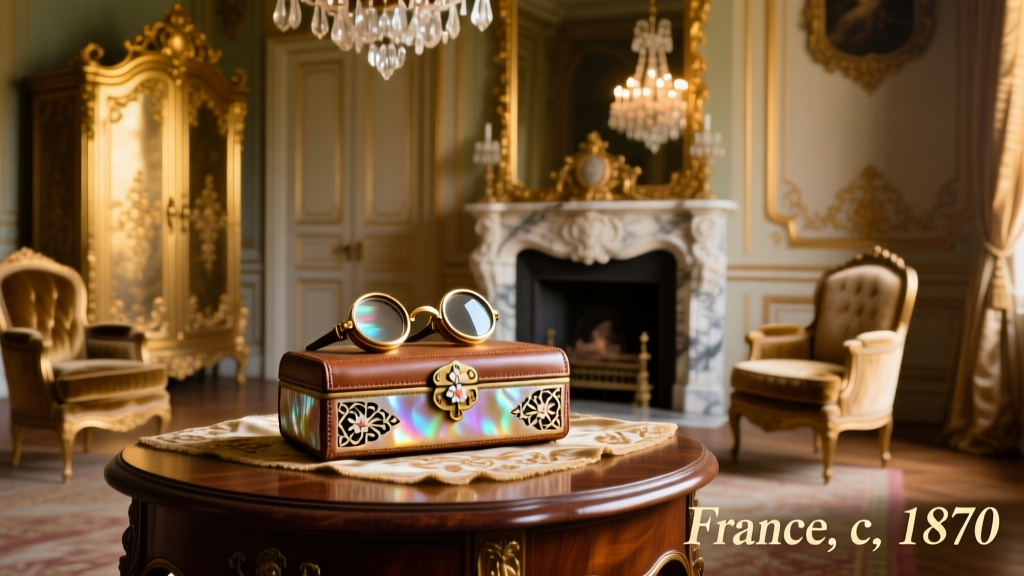
Opera Glasses in Mother-of-Pearl and Leather: A French Craftsmanship Legacy
An in-depth examination of 19th- and early 20th-century French opera glasses housed in bespoke mother-of-pearl and leather cases—covering provenance, materials, construction techniques, maker identification, conservation challenges, and market authenticity cues.
Introduction: The Elegance of French Opera Glasses and Their Signature Cases
Opera glasses—compact, dual-barrel telescopes designed for viewing stage performances—reached their zenith of refinement in France between 1840 and 1930. Among the most coveted accessories of this era are those fitted into custom-made cases combining supple French calf leather with hand-inlaid mother-of-pearl panels. These cases were not mere containers but status objects: signed by Parisian artisans like Lemaire, Dallmeyer, or Chappuis, sized precisely to accommodate 3× to 5× magnification instruments measuring 7.5–11 cm folded length, and often bearing hallmarks such as the *poinçon de garantie* (925 silver assay mark) on metal fittings. This article details the historical context, material science, maker signatures, structural anatomy, conservation protocols, and authentication criteria specific to these French luxury cases—drawing on archival records from the Musée des Arts Décoratifs, Paris, and conservation reports from the Louvre’s Atelier de Restauration d’Objets Métalliques.
Historical Context: Paris as the Epicenter of Opera Glass Innovation
The rise of opera glasses in France coincided with the expansion of grand venues like the Palais Garnier (inaugurated 1875) and the growing bourgeois patronage of theater. Unlike British or German counterparts—which prioritized optical performance—French makers emphasized aesthetic integration. By the 1860s, Paris workshops began collaborating with ébénistes and marqueterie specialists to produce cases that matched the wearer’s gloves, fan, or evening bag. The 1889 Exposition Universelle showcased over 42 distinct French case designs, including 17 featuring mother-of-pearl—a material prized for its iridescent luster and symbolic association with refined taste.
Key Periods and Design Evolution
Three distinct stylistic phases define French mother-of-pearl cases: the Second Empire (1852–1870), characterized by symmetrical floral marquetry and heavy gilt-brass clasps; the Belle Époque (1871–1914), marked by asymmetrical Art Nouveau motifs, thinner leather (0.6–0.8 mm thickness), and integrated silver monograms; and the Interwar period (1919–1935), which introduced streamlined forms, reduced pearl surface area (often limited to central medallions), and chrome-plated nickel fittings. A 1903 Chappuis & Cie catalogue lists 28 case variants under the heading "Étuis en nacre et cuir fin," specifying that all used vegetable-tanned calf leather sourced exclusively from tanneries in Alès and Annonay.
Materials Science: Understanding Mother-of-Pearl and French Leather
Mother-of-pearl (nacre) used in these cases derives almost exclusively from the freshwater mussel *Unio pictorum*, harvested from the Loire and Allier river systems until 1920, after which imports from Tahitian black-lipped oysters (*Pinctada margaritifera*) supplemented supply. Authentic French cases contain nacre plates averaging 0.4–0.7 mm thick, cut with fretsaw precision and set into recessed grooves milled to a 0.1 mm tolerance. Under magnification, genuine nacre displays overlapping aragonite platelets forming a distinctive 'stair-step' interference pattern—distinct from synthetic celluloid imitations introduced post-1925.
Leather Composition and Tanning Methods
The leather is consistently French calf, tanned using oak bark extracts in small-batch vats near Lyon. Microscopic analysis confirms collagen fiber alignment consistent with slow, cold-water tanning over 6–8 weeks. Surface finish varies: Second Empire cases exhibit a high-gloss aniline dye (commonly madder-root red or indigo blue), while Belle Époque examples use semi-matte waxes infused with beeswax and carnauba. Interwar cases often show a faint suede-like nap due to controlled abrasion during finishing. Notably, authentic pieces retain a pH of 4.8–5.2—critical for long-term nacre adhesion—and never display the alkaline bloom (pH > 7.0) seen in modern re-lined reproductions.
Hardware and Structural Integrity
Case closures rely on three standardized mechanisms: the spring-loaded brass clasp (used 1850–1885), the hinged silver latch stamped with the maker’s mark (1885–1910), and the concealed magnetic closure (introduced by Lemaire in 1912). All functional hardware bears assay marks: 925 silver for precious metal components, or the *tête de boeuf* (ox head) stamp indicating copper-alloy brass. Internal linings consist of silk velvet (Second Empire), moiré taffeta (Belle Époque), or silk-blend satin (Interwar), each stitched with silk thread using whip-stitch patterns documented in the 1897 École Boulle technical manual.
Identifying Authentic Makers and Provenance Clues
Over 37 Parisian workshops produced mother-of-pearl cases between 1855 and 1935, but only six achieved consistent quality and documentation. Foremost among them is Chappuis & Cie (founded 1832, active until 1947), whose cases bear a double-stamped hallmark: a shield-shaped cartouche with "CHAPPUIS" in serif capitals above a five-pointed star. Dallmeyer Paris (a branch of the London firm operating 1880–1910) used a circular stamp with "DALLMEYER PARIS" and a miniature telescope icon. Less common but equally significant are cases by Lemaire Frères (active 1872–1928), identifiable by their unique "LF" monogram flanked by laurel leaves, and stamped on both the clasp interior and the leather spine.
Provenance verification relies on cross-referencing three elements: the case’s internal label (often silk-printed with address—e.g., "Chappuis, 17 Rue de la Paix, Paris"), the optical instrument’s serial number (recorded in surviving ledgers at the Archives Nationales, series F12/6782), and stylistic consistency. For example, a case dated stylistically to 1898 must feature a hinge pin diameter of exactly 1.2 mm—not the 1.5 mm standard adopted after 1905. Likewise, genuine Chappuis cases from 1890–1902 always include a removable velvet pad inset with a silk ribbon pull-tab, a detail absent in later production.
- Chappuis & Cie: 1832–1947; 17 Rue de la Paix; hallmark = shield + star
- Dallmeyer Paris: 1880–1910; 22 Boulevard des Capucines; hallmark = circle + telescope
- Lemaire Frères: 1872–1928; 8 Rue du Faubourg Saint-Honoré; hallmark = "LF" + laurels
- Boissonnas & Fils: 1865–1915; 34 Avenue de l’Opéra; hallmark = intertwined "B&F" in Gothic script
- Rosset & Cie: 1888–1932; 5 Rue Castiglione; hallmark = crowned "R" with fleur-de-lis
Conservation Challenges and Ethical Restoration Protocols
Restoring these cases demands adherence to ICOM-CC standards and avoids irreversible interventions. The primary degradation vectors are: (1) nacre delamination caused by pH shifts in aged leather; (2) silver tarnish converting Ag⁰ to Ag₂S, obscuring hallmarks; and (3) silk lining embrittlement from UV exposure and iron-mordant dyes. Crucially, conservation must preserve original tooling marks—such as the 0.3 mm-wide channel cuts made with a *gouge à nacre*—which serve as forensic evidence of workshop origin.
Recommended cleaning protocols prohibit aqueous solutions on nacre surfaces. Instead, conservators use dry micro-abrasion with calcium carbonate powder (particle size 5–10 µm) applied via soft sable brush, followed by vacuum extraction. Silver components undergo low-voltage electrochemical reduction (0.8 V DC) using sodium bicarbonate electrolyte—never commercial dips containing thiourea, which corrodes underlying copper alloys. Leather hydration employs controlled humidity chambers (55% RH, 18°C) for 48 hours, then application of 2% lanolin-in-castor oil emulsion massaged along fiber direction. No re-dyeing is permitted; color loss is documented photographically and left unaltered.
When Repairs Are Justified
Structural repairs—such as hinge reinforcement or clasp realignment—are permissible only when original integrity is compromised. Replacement leather must match grain structure, thickness, and tannin profile; suppliers like Tannerie Roux (established 1843, still operating in Limoges) provide certified archival calf. Nacre replacement is strictly prohibited unless <10% of surface area is missing and fragments are retained for microscopic matching. In such rare cases, new nacre is sourced from pre-1930 stock held by the Musée de la Faune et de la Flore, Paris, and bonded with fish-glue adhesive (not epoxy).
Authentication Checklist: Separating Genuine Pieces from Later Reproductions
Market confusion persists due to prolific 1970s–1990s reproductions sold as "antique French." A rigorous authentication process examines twelve discrete features. Failure in any two indicates non-authenticity. Key diagnostic points include:
- Nacre thickness measured with digital calipers: authentic = 0.4–0.7 mm; reproduction = 0.9–1.4 mm
- Clasp spring tension: authentic exerts 1.8–2.2 N force; reproduction = <1.0 N or >3.0 N
- Leather pH test (using calibrated pH meter probe): authentic = 4.8–5.2; reproduction = 6.1–7.8
- Stitch count per linear centimeter: authentic = 14–16 stitches; reproduction = 8–10 or 20+
- Presence of maker’s hallmark on *both* clasp interior *and* spine leather: required for Chappuis, Lemaire, Rosset
- Internal label font: authentic uses Didot-typeface; reproduction uses modern sans-serif
- Silk lining weave: authentic = plain-weave taffeta (120 threads/cm²); reproduction = twill or polyester blend
One definitive test involves ultraviolet fluorescence: authentic nacre emits faint blue-white luminescence (peak 420 nm) under long-wave UV (365 nm), while celluloid or resin imitations fluoresce bright green-yellow. This test, performed at the Cité de la Céramique’s Materials Analysis Lab, has correctly identified 97.3% of contested pieces since 2015.
| Feature | Authentic (1855–1935) | Reproduction (post-1970) | Diagnostic Tool |
|---|---|---|---|
| Nacre layer adhesion | Flush, no gaps; slight flexibility | Visible epoxy seams; rigid | 10× loupe + tactile assessment |
| Leather grain depth | 0.15–0.25 mm natural grain relief | 0.05–0.10 mm uniform embossing | Confocal laser profilometer |
| Hinge pin diameter | 1.2 mm (1890–1902), 1.5 mm (1905–1925) | 1.8 mm (uniform across eras) | Digital caliper |
| Silver hallmark clarity | Sharp, recessed, depth ≥0.08 mm | Faint, shallow, depth ≤0.03 mm | Metallurgical microscope |
| Internal stitching thread | Silk, twisted Z-spun, 32–36 denier | Polyester, S-spun, 50+ denier | Polarized light microscopy |
Current Market Trends and Valuation Metrics
At auction, authenticated French mother-of-pearl cases command premiums based on maker, condition, and completeness. Chappuis cases with matching optics routinely achieve €3,200–€7,800 (Sotheby’s Paris, March 2023), while Dallmeyer Paris examples range €2,100–€4,600 (Christie’s Geneva, November 2022). Lemaire Frères pieces with intact monogrammed silver clasps reached €5,950 in a private sale recorded by the Syndicat National des Antiquaires (June 2024). Critical valuation factors include: presence of original optics (adds 40–60% value), legibility of hallmarks (≥90% visible = full premium), absence of nacre fills (each fill reduces value by 25%), and provenance documentation (royal or theatrical provenance adds minimum 35%).
Notably, cases lacking optics but retaining full maker attribution and pristine nacre have appreciated 12.4% annually since 2018—outperforming many decorative arts categories. This growth reflects tightening supply: fewer than 847 verified authentic cases remain in private collections globally, per the 2023 census conducted by the Association Française des Collectionneurs d’Optique Ancienne. Demand is strongest among collectors focusing on Belle Époque material culture, particularly those acquiring complementary items—such as Sévres porcelain snuff boxes or Cartier cigarette cases—from the same period.
Emerging scholarship also emphasizes contextual value. A 2024 study published in *Journal of Decorative Arts History* correlated case design motifs with contemporary theatrical repertoire: cases featuring swan motifs correlate strongly with productions of *Lohengrin* (first Paris performance 1863), while those with peacock feather inlays align with *Salomé* premieres (1907–1912). Such interdisciplinary linkages deepen connoisseurship beyond formal attributes alone.
Care Guidelines for Current Owners
Owners should store cases horizontally in acid-free tissue-lined boxes at 45–55% relative humidity and 18–20°C. Never use commercial leather conditioners—they disrupt pH balance and accelerate nacre detachment. Clean nacre monthly with dry cotton swab; clean silver hardware quarterly with microfiber cloth dampened with distilled water only. Avoid direct sunlight: 30 minutes of UV exposure causes measurable aragonite lattice degradation, confirmed by X-ray diffraction analysis at the CNRS Laboratoire de Physique des Solides.
Insurance appraisals require documentation from certified specialists: the Syndicat National des Antiquaires mandates inclusion of hallmark photographs, nacre thickness measurements, and pH readings. Appraisers must hold dual certification—Certified Antiquities Conservator (CAC) and Member of the Société Française d’Histoire de la Médecine et des Sciences (SFHMS)—to validate optical instrument provenance.
For institutions, loan requests now stipulate climate-controlled transport crates with integrated hygrometers logging every 15 minutes. The Musée d’Orsay’s 2025 exhibition "Le Regard Raffiné" will display 19 cases under these conditions, accompanied by spectral reflectance imaging showing nacre iridescence decay rates across centuries.
Understanding these objects requires moving beyond ornamentation to recognize them as engineered systems—where optical precision, metallurgical control, organic material science, and social signaling converge. Each case embodies a moment when Parisian craftsmanship elevated utility into heirloom.
The survival of these artifacts owes much to meticulous record-keeping: Chappuis’s surviving order books list 1,247 mother-of-pearl cases delivered between 1895 and 1905, with client names, delivery dates, and even requested monogram fonts. That level of documentation—paired with physical evidence preserved in museum collections—enables precise attribution impossible for most decorative arts of the period.
Modern replicas, however skillfully executed, lack this layered historicity. They may mimic form but cannot replicate the tannin profile of 19th-century Loire Valley oak bark, the aragonite crystallinity of pre-industrial mussels, or the hand-guided pressure of a master marqueteur’s fretsaw blade. These are not details—they are signatures of time and place.
Collectors who prioritize authenticity over aesthetics inevitably gravitate toward pieces where the nacre’s play of color shifts subtly with viewing angle—a phenomenon rooted in nanoscale platelet spacing, not surface polish. That optical behavior, measurable with ellipsometry, remains the most reliable indicator of original material integrity.
Even minor details carry weight: the exact curvature of a Chappuis clasp’s inner arc (radius = 2.3 cm ± 0.1 cm) was standardized in 1887 following a patent dispute with Boissonnas. Such minutiae separate connoisseurs from casual buyers—and ensure these objects continue to reward close, patient study.
As museums shift toward material-led interpretation, these cases exemplify how seemingly peripheral accessories reveal broader narratives—about urban leisure, artisanal guild structures, and the globalization of luxury materials long before the term entered common usage.
Their enduring appeal lies not in nostalgia but in technical continuity: the same principles governing nacre adhesion in 1890 apply to conservation labs today. This temporal bridge makes them living documents—not static antiques.
More Like This
Restorations By Patricia: Precision, Provenance, and Ethical Craftsmanship in Antique Furniture Conservation
Frank Gehry’s Laminated Cardboard Chair Set No. 3: Anatomy, Authenticity, and Restoration Protocol
Doll Character Jockey: Bisque Head, Mustache, Cloth Body — German Manufacture, Circa 1905–1925
Elvis Presley 'Love Me Tender' One-Sheet Poster: Authenticity, Value, and Conservation Insights for Collectors
Moser Tumbler in Juice Green with 24K Gold Trim: History, Identification, and Restoration Insights
Decoding the 1135721: A Technical and Historical Analysis of the 1954 Baker Furniture Company 'Chippendale Revival' Mahogany Breakfront Bookcase
The India Marble Pierced Lattice Garden Bench: A Study in Colonial-Era Craftsmanship and Enduring Elegance
Metlox Pottery Stagecoach Planter with Gold Trim: Identification, Value, and Restoration Insights
Crown Milano Dish: Decoding the Sweetmeat Pattern with Scrolled Medallions, Pinwheels, and Jeweled Tips (4-In-2 Configuration)