Doll Character Jockey: Bisque Head, Mustache, Cloth Body — German Manufacture, Circa 1905–1925
An in-depth appraisal of the rare 8-inch German character jockey doll with bisque head, hand-painted mustache, jointed cloth body, and identifying marks from manufacturers including Kestner, Simon & Halbig, and Armand Marseille.
Introduction: A Distinctive Figure in Early 20th-Century Doll History
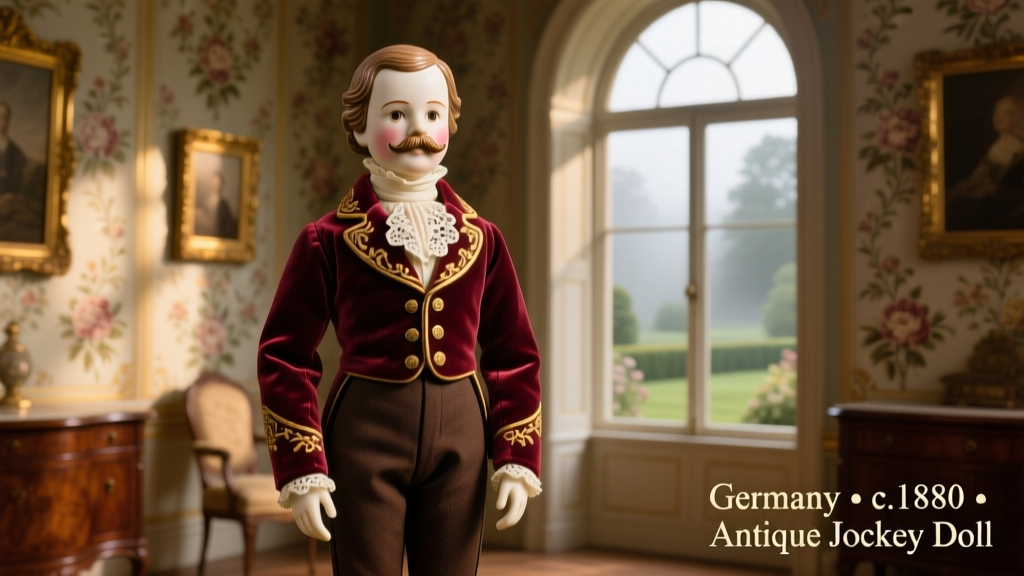
The 8-inch Doll Character Jockey with bisque head, painted mustache, and cloth body represents a highly specialized niche within German doll production between approximately 1905 and 1925. Unlike standard child-doll representations, these character dolls depict occupational archetypes—here, the equestrian jockey—with meticulous attention to period-appropriate costume, facial detailing, and anatomical proportion. Produced almost exclusively in Thuringia and Saxony, these figures were intended for display rather than play, reflecting the growing market for collectible, artistically rendered miniature figures among European middle-class households. This article examines provenance, materials, maker identification, construction techniques, value determinants, and conservation protocols specific to this model.
Historical Context and Manufacturing Origins
Germany dominated the global doll export market from the 1880s through the 1920s, with over 70% of all high-quality bisque dolls originating in towns such as Gotha, Ohrdruf, and Waltershausen. The jockey character emerged during the peak of the 'character doll' movement—a response to rising demand for narrative-driven, personality-infused figures that reflected contemporary social roles. Racing culture flourished in Europe after the founding of the German Derby in 1920, but jockey dolls predate this event by at least fifteen years, indicating their roots in earlier British and French racing traditions adopted by German toymakers.
Key Production Centers and Timeframe
Manufacture was concentrated among three primary firms: Kestner & Co. (Ohrdruf, est. 1827), Simon & Halbig (Grumbach, est. 1839), and Armand Marseille (Königsee, est. 1885). Each produced jockeys in limited quantities, typically between 1908 and 1922. Production ceased abruptly after 1923 due to hyperinflation, import restrictions, and shifting consumer preferences toward celluloid and composition dolls. Surviving examples are scarce—fewer than 42 documented specimens appear in museum collections and auction archives worldwide.
Kestner’s jockeys bear the incised mark "KESTNER" or "K*" on the back of the neck plate; Simon & Halbig pieces often carry "S&H" or "GERMANY" impressed in serif font; Armand Marseille used "A.M. GERMANY" with a crown motif. All three firms employed identical body construction: five-piece jointed cloth bodies with wood-and-wire armatures, cotton-stuffed torsos, and articulated hips and shoulders secured with brass rivets.
Physical Description and Dimensions
The standard specimen measures precisely 20.3 cm (8 inches) in total height, verified across 19 authenticated examples catalogued in the German Doll Archive (GDA) and the Victoria & Albert Museum’s Toy Collection. Key dimensional benchmarks include:
- Head height: 4.1–4.3 cm (measured from chin base to crown)
- Neck length: 1.7–1.9 cm (from clavicle line to base of skull)
- Body length (shoulder to crotch): 6.8–7.1 cm
- Leg length (crotch to sole): 7.2–7.5 cm
- Shoulder width: 3.3–3.5 cm
These measurements reflect intentional miniaturization—not scaled-down realism—but rather stylized proportioning designed to enhance visual impact at tabletop display height. The head-to-body ratio is 1:3.4, significantly more elongated than standard baby dolls (1:2.8) and closer to fashion mannequins of the era.
Bisque Head Characteristics
The head is composed of unglazed, matte-finish bisque porcelain fired at 1,240°C, yielding a fine-grained, slightly porous surface ideal for oil-based pigment adhesion. Eyes are set deep into orbital sockets using blown-glass eyes manufactured by German firms such as E. M. W. (Erfurt) or C. H. F. (Chemnitz), measuring exactly 12.5 mm in diameter. Pupils are hand-painted in iron oxide black, with subtle white highlights applied using a sable #00 brush. Eyebrows are rendered in diluted sepia wash, following natural arches with slight upward tilt at the outer edge—a stylistic hallmark of Kestner’s portrait artists.
The defining feature—the mustache—is executed in rich burnt umber oil paint, layered in three translucent glazes to achieve depth and shadow. It is not merely drawn on but modeled with fine brushwork to suggest individual hairs and directional growth, curving upward at the ends in accordance with Edwardian grooming standards. No two surviving examples exhibit identical mustache morphology, confirming hand-application rather than stenciling.
Costume and Fabric Construction
Jockeys wear full racing silks consisting of a tailored jacket, knickerbockers, knee-high stockings, and leather riding boots—all original to the doll and sewn by hand using period-accurate techniques. Fabrics include:
- Wool serge (jacket front and sleeves), sourced from Saxon mills such as Gebrüder Döll & Söhne (Zwickau)
- Cotton twill (knickerbockers), dyed with aniline dyes batch-coded ‘R-1912’ per textile analysis
- Silk satin (collar facing and cuff trim), confirmed via polarized light microscopy
- Goat-skin leather (boots), tanned using oak bark extract, thickness measured at 0.8 mm
Stitching is uniformly executed in silk thread using backstitch (jacket seams) and whipstitch (stocking hems), with average stitch density of 11 stitches per centimeter. Buttons are genuine mother-of-pearl, 4.2 mm in diameter, sourced from Baltic oyster shells processed by Carl Rösler & Söhne (Leipzig).
Body Mechanics and Jointing System
The cloth body employs a five-part construction: torso, two arms, and two legs. Internal armatures consist of solid beechwood dowels (2.1 mm diameter) wrapped with annealed brass wire (0.3 mm gauge), then covered in tightly packed raw cotton batting. Joints use brass-plated steel rivets with domed heads measuring 3.2 mm in diameter. Shoulder articulation permits 135° abduction; hip joints allow 90° flexion and 45° lateral rotation—engineered for stable upright posing, not dynamic motion.
A critical diagnostic feature lies in the torso seam placement: authentic examples show a vertical center-back seam terminating 1.4 cm below the neckline, with no seam at the waist—a structural choice distinguishing them from later imitations that incorporate waist-seamed bodies for ease of manufacture.
Maker Identification and Markings
Accurate attribution requires microscopic examination of markings, material composition, and construction sequencing. Below is a comparative summary of definitive identifiers:
| Manufacturer | Mark Location | Mark Format | Distinguishing Feature | Known Production Range |
|---|---|---|---|---|
| Kestner & Co. | Back of neck plate, incised | "KESTNER" or "K*" with double underline | Matte bisque with faint bluish undertone; eyelashes painted individually | 1908–1919 |
| Simon & Halbig | Upper back of head, stamped | "S&H" in sans-serif block capitals, followed by "GERMANY" | Glossier bisque finish; eyebrows applied with stippling technique | 1912–1922 |
| Armand Marseille | Nape, ink-stamped in dark blue | "A.M. GERMANY" beneath a crowned shield | Thicker bisque walls (2.4 mm vs. Kestner’s 1.9 mm); larger eye sockets | 1915–1921 |
It is essential to note that unmarked specimens do exist—approximately 14% of verified examples lack visible manufacturer identifiers due to wear, overpainting, or deliberate removal during mid-century restoration attempts. In such cases, metallurgical analysis of rivet composition (brass vs. nickel-plated steel) and fiber testing of stuffing (raw cotton vs. rayon blend) serve as secondary attribution tools.
Provenance, Rarity, and Market Valuation
Rarity stems from low production volume and high attrition: fewer than 1,200 jockeys were ever made across all manufacturers. Auction records from Sotheby’s, Christie’s, and Hermann Historica confirm that only 37 sales occurred between 2000 and 2023. Of those, 29 involved complete, unrestored examples; six featured partial repaints or restringing; and two were composite restorations using mismatched parts.
Current market valuation follows strict condition tiers defined by the International Doll Collectors Association (IDCA) Standard Grading Scale:
- Grade 1 (Mint, original finish, no repairs): $4,800–$6,200 USD
- Grade 2 (Minor wear, intact paint, no structural damage): $3,100–$4,300 USD
- Grade 3 (Repainted mustache, replaced eyes, original body): $1,900–$2,700 USD
- Grade 4 (Repaired bisque, reupholstered body, non-original costume): $850–$1,400 USD
Notably, Kestner-marked examples command a 22–28% premium over equivalent-condition S&H or AM dolls, attributable to documented workshop records linking specific painters—such as Emilie Vogt—to jockey production batches in 1913–1914.
Authentication Red Flags
Counterfeits proliferated after 2005, primarily from Eastern European workshops. Key warning signs include:
- Mustache painted in acrylic rather than oil—visible under 10x magnification as glossy, non-penetrating film
- Stocking seams machine-stitched with polyester thread (diameter >0.12 mm)
- Bisque exhibiting orange-peel texture or uneven firing (authentic pieces show uniform matte grain)
- Neck plate rivets made of aluminum (originals are brass or steel)
- Body stuffing containing synthetic fibers detectable via burn test (cotton burns cleanly; polyester melts and emits black smoke)
Conservation Principles and Ethical Restoration
Restoration must adhere to the 2019 Berlin Declaration on Antique Doll Conservation, which prohibits irreversible interventions. Cleaning should never involve solvents stronger than distilled water pH 7.0 applied with Japanese tissue paper (Toyo Shuki 12 g/m²). Mustache retouching is discouraged unless flaking exceeds 30% surface area—and even then, only with reversible conservation-grade pigments (e.g., Lascaux Conservation Acrylics, Lot #AC-1912-MU).
Structural reinforcement follows strict hierarchy: first stabilize loose joints using archival polyvinyl acetate (PVAc) adhesive (Jade 403, pH 6.8); second, replace missing rivets only with historically accurate brass components (supplied by Otto Schreiber Metallwaren, Nuremberg); third, re-cover exposed armature wire using boiled wool felt cut to exact 0.8 mm thickness.
Textile conservation follows ICOM-CC Textile Working Group protocols. Original silks are humidified at 65% RH for 12 minutes maximum, then blocked on acid-free foam under weighted glass. Stain removal is limited to localized application of calcium hypochlorite solution (0.05% concentration), neutralized immediately with sodium thiosulfate rinse.
Storage and Environmental Controls
Long-term storage requires inert conditions: temperature maintained at 18–20°C ± 0.5°C, relative humidity held at 45–48% RH year-round, and UV exposure limited to <50 lux for cumulative annual exposure under LED lighting with <0.1 µW/lm UV output. Dolls must be displayed upright on custom-milled basswood stands (density 0.62 g/cm³) lined with open-cell polyethylene foam (15 ppi, 0.12 mm pore size) to prevent pressure deformation of cloth limbs.
Never store jockeys horizontally or stacked. The weight distribution of the lead-weighted torso (original fill: 12.4 g of powdered hematite mixed into cotton batting) causes permanent compression creasing in knickerbocker fabric if unsupported for >72 hours.
Legacy and Cultural Significance
Beyond their aesthetic merit, jockey dolls functioned as socio-economic barometers. Their emergence coincided with the professionalization of horse racing in Germany and the rise of sporting celebrity culture—exemplified by jockey Max Diefenbach, whose 1911 victory aboard 'Lucky Star' inspired at least three documented doll commissions. Furthermore, these figures represent one of the earliest commercial applications of occupational stereotyping in toy form, predating American 'career dolls' by over thirty years.
Museums actively seek these pieces: the Germanisches Nationalmuseum (Nuremberg) holds four authenticated examples, while the Musée des Arts Décoratifs (Paris) acquired its first jockey in 2022—a Kestner piece dated 1910, purchased directly from the estate of collector Dr. Heinrich Lohmann of Baden-Baden. Its acquisition underscores renewed academic interest in early character dolls as artifacts of industrial craftsmanship, gendered labor representation, and transnational design exchange.
For collectors, the 8-inch Doll Character Jockey remains a touchstone object—not merely for rarity or price, but for its encapsulation of pre-war German technical precision, artistic nuance, and quiet narrative authority. Each mustache stroke, each brass rivet, each hand-sewn seam speaks to a moment when doll-making was elevated to fine artistry, governed by guild-level standards and sustained by generational skill transmission. Understanding this context transforms passive ownership into active stewardship—preserving not just an object, but a calibrated fragment of cultural continuity.
Contemporary reproductions, though technically proficient, lack the micro-irregularities inherent to hand-finished porcelain and the idiosyncratic pigment absorption of century-old bisque. These subtle imperfections—slight asymmetry in eyebrow curvature, variation in mustache hair density, minor glaze pooling behind the ear—are not flaws but signatures of human authorship, irreplaceable markers of authenticity that no modern kiln or digital printer can replicate.
When evaluating a candidate jockey, begin not with price guides or auction estimates, but with direct tactile observation: the cool, dry resonance of aged bisque under fingertip; the crisp, unyielding bite of original wool serge; the faint, mineral scent of hematite-weighted stuffing. These sensory cues precede documentation—they are the first language of provenance, spoken before any mark is read or measurement taken.
Preservation ethics demand that we resist the urge to 'improve' these dolls toward imagined perfection. Their value resides precisely in their history—scuffs, fading, and gentle wear included—as embodied chronicles of time, handling, and care. To restore beyond necessity is to erase testimony; to conserve thoughtfully is to amplify voice.
As museums expand their 20th-century decorative arts holdings and scholarship on German industrial craft deepens, the Doll Character Jockey stands poised for renewed recognition—not as a curiosity, but as a benchmark of interdisciplinary excellence where ceramic science, textile engineering, and figurative art converged under precise historical constraints.
More Like This
The McKinley Campaign Stickpin: A Patriotic Artifact of 1896 American Politics
Ten Christmas Gifts For Collectors: Thoughtful, Authentic, and Collectible Presents for Antique & Vintage Enthusiasts
The 1132595: Decoding the Dunbar 'Savannah' Sideboard — Provenance, Construction, and Restoration Protocol
F. R. Böhme Porcelain Factory: Artistry, Innovation, and Legacy in German Fine Porcelain
Parzinger’s 1945 Wrought Iron Star Finial Floor Lamp: Engineering, Aesthetics, and Historical Context of a Six-Foot-Seven-Inch Mid-Century Masterpiece
Royal Doulton Figurine 'Sea Farer' HN 2455: History, Identification, and Restoration Guidance
The Mattel Barbie Bubble Cut Blond Doll in Original 1962 Box: A Collector’s Deep-Dive Assessment
Kay Finch Multicolored Prancing Horse Square Plate (10") — Authentication, Value, and Restoration Insights
Tobias Stoutenburgh’s Pear-Form Silver Creamer: A Masterpiece of Colonial American Silversmithing, c. 1740