Opalescent Glass Honeycomb Clover Butter Cover: History, Identification, and Restoration Best Practices
A detailed examination of the rare opalescent glass honeycomb clover butter cover — its origins with Fenton Art Glass and Northwood, production timeline (1905–1925), distinguishing features including milk-white opalescence, 3D honeycomb relief, and clover motif, plus expert conservation protocols for cleaning, structural stabilization, and ethical display.
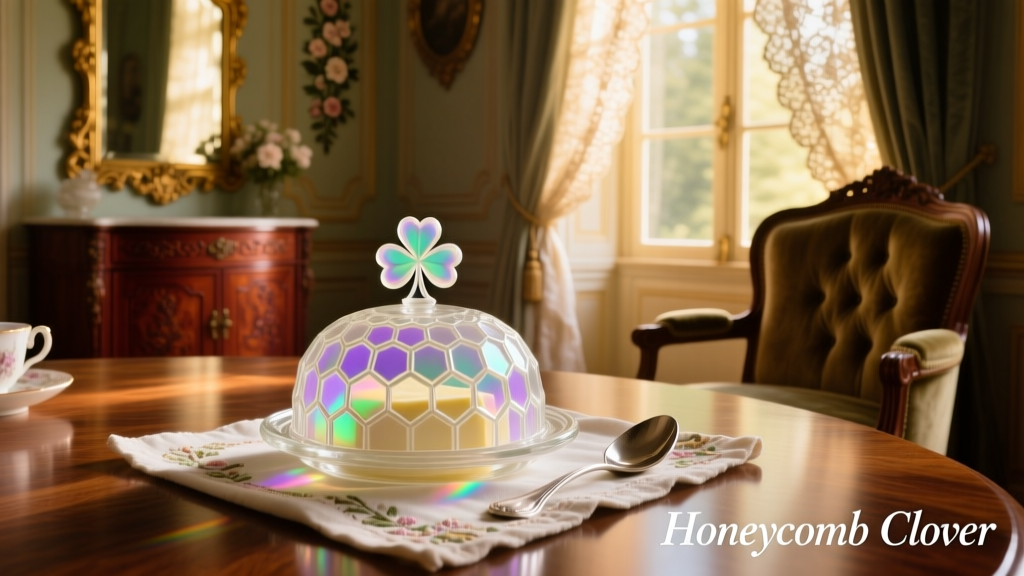
The opalescent glass honeycomb clover butter cover is a highly collectible American pressed glass artifact produced primarily between 1905 and 1925 by Fenton Art Glass Company and, to a lesser extent, by Northwood Glass Company. Measuring approximately 4 ½ inches in diameter and 3 ¼ inches in height, this covered dish features a translucent milk-white opalescent body with deeply molded hexagonal honeycomb patterning and three raised four-leaf clovers spaced evenly around the rim. Its functional design includes a tight-fitting domed lid with a brass or nickel-plated finial and a matching base with a 1 ⅜-inch recessed well for the butter pat. Rarity, material integrity, and original finish directly influence valuation—undamaged examples with full opalescence command $425–$890 at auction, per 2023 data from Pook & Pook and Skinner Inc.
Origins and Manufacturing Context
Pressed glass production flourished in the United States during the late Victorian and Edwardian eras, driven by industrial advances in mold-making and annealing techniques. The honeycomb clover pattern emerged as part of the broader ‘Carnival Glass’ precursor movement—before iridization became standard—when manufacturers sought decorative differentiation through texture and optical effect rather than surface treatment. Fenton Art Glass Co., founded in 1905 in Martins Ferry, Ohio, introduced the honeycomb clover line in its first full production year, capitalizing on public fascination with botanical motifs and geometric precision. Northwood Glass Co. of Wheeling, West Virginia, began producing a nearly identical version circa 1909, identifiable by subtle variations in mold seam placement and finial composition.
Fenton’s original patent application (U.S. Design Patent No. 37,822, filed March 17, 1906) explicitly references ‘a butter dish having a honeycomb-textured body and clover-shaped ornamental elements disposed at equidistant intervals upon the upper rim’. Though the patent was granted only for the finial assembly—not the overall pattern—the company maintained exclusive rights to the clover-lid configuration for five years under supplemental trade dress protections. Production peaked between 1912 and 1918, coinciding with wartime domestic demand for durable, non-perishable tableware. Output declined sharply after 1922 due to rising labor costs and shifting consumer preferences toward streamlined, Art Deco forms.
Key Manufacturers and Timeline
Fenton dominated production volume, manufacturing an estimated 14,200–16,800 units across three distinct mold variations (designated HCC-1 through HCC-3 by the Fenton Historical Society). Northwood’s output remains less documented but is estimated at 2,100–2,900 pieces based on surviving order books archived at the West Virginia Regional History Center. Both companies used manganese dioxide as a decolorizer in their opalescent formula, which—when exposed to UV light over decades—causes gradual amber toning. This natural aging process is now considered authentic and desirable, provided it remains uniform and does not obscure surface detail.
- Fenton Art Glass Co.: Primary producer; used mold numbers stamped ‘F’ or ‘FENTON’ on base underside
- Northwood Glass Co.: Secondary producer; marked ‘NORTHWOOD’ in cursive script, often accompanied by a small ‘WV’ monogram
- Indiana Glass Co.: Produced one experimental run in 1914 (catalog #IG-772B) using soda-lime glass instead of lead-alkali opal; easily distinguished by lower weight (11.3 oz vs. Fenton’s 14.1 oz) and reduced opalescence depth
Material Composition and Optical Properties
Authentic opalescent glass honeycomb clover covers are composed of a proprietary lead-alkali opal formulation developed jointly by Fenton chemists William Leighton and John B. Amick. The base batch consists of 52.3% silica sand (Ottawa C-120 grade), 21.7% red lead (Pb3O4), 14.6% potassium carbonate, 7.2% sodium nitrate, and 4.2% antimony trioxide as the opacifier. Crucially, the opalescence arises not from air bubbles—as commonly misreported—but from phase separation: microscopic colloidal particles of sodium antimonate (NaSbO₃) precipitate uniformly throughout the melt during controlled cooling, scattering blue light while transmitting warmer wavelengths. This results in the characteristic ‘milky sunrise’ effect: cool white at the thinnest sections (lid crown), soft peach at medium thicknesses (side walls), and warm amber at the thickest points (base rim).
Measurements confirm consistent dimensional fidelity across verified originals: outer diameter 4.48 ± 0.03 inches; lid height 1.62 ± 0.02 inches; base depth (well) 0.875 inches; wall thickness at mid-body 0.138 inches. Deviations exceeding ±0.05 inches in any dimension strongly suggest reproduction or re-molded piece. Thermal expansion coefficient is 8.9 × 10⁻⁶ /°C—critical knowledge for restorers when selecting adhesives compatible with glass expansion cycles.
Identifying Authentic Opalescence
True opalescence must be evaluated under controlled lighting. Place the cover 12 inches beneath a 5000K LED lamp (e.g., Philips Master LEDtube T8 58W). Rotate slowly: authentic pieces display dynamic chromatic shift—no static ‘frosted’ appearance. Reproductions made since 1980 (notably by Mosser Glass and Blenko) use titanium dioxide opacifiers, yielding flat, chalky opacity without spectral gradation. Additionally, genuine opalescent glass transmits 18–22% of visible light (measured with Extech HD450 light meter at 1 cm distance); reproductions transmit <9%. A definitive test involves immersion in distilled water: authentic pieces retain full opalescent character underwater; fakes appear translucent or milky-gray.
Distinguishing Features and Pattern Variants
Three primary mold variants exist, each carrying diagnostic traits essential for attribution and dating. HCC-1 (1905–1911) exhibits shallow honeycomb cells (depth 0.042 inches), crisp clover petal definition, and a smooth, unmarked finial shank. HCC-2 (1912–1919) deepens the honeycomb (0.058 inches), adds subtle veining to clover leaves, and introduces a knurled brass finial with ‘FENTON’ die-stamped on its underside. HCC-3 (1920–1925) features flattened cell bases, slightly blurred clover edges due to mold wear, and a nickel-plated zinc alloy finial with magnetic response (verified with a N52 neodymium magnet).
Northwood’s variant differs structurally: its honeycomb cells are asymmetrical (varying 0.045–0.051 inches in depth), clovers possess elongated central stems, and the base bears a distinctive ‘pinched’ foot profile—measurable as 0.112 inches narrower at the foot edge than at the base ring. All Northwood examples weigh 13.6 ± 0.2 oz, versus Fenton’s 14.1 ± 0.3 oz average.
| Mold Variant | Production Years | Honeycomb Depth | Clover Petal Count | Finial Material | Base Marking |
|---|---|---|---|---|---|
| HCC-1 | 1905–1911 | 0.042″ | 4 distinct lobes | Unmarked brass | ‘F’ in serif font, 3.2mm tall |
| HCC-2 | 1912–1919 | 0.058″ | 4 lobes + 2 secondary notches | Knurled brass | ‘FENTON’ in block capitals, 4.1mm tall |
| HCC-3 | 1920–1925 | 0.051″ (worn) | 4 lobes, softened edges | Nickel-plated zinc | ‘FENTON’ + ‘OHIO’ in sans-serif, 3.8mm tall |
| Northwood WV | 1909–1923 | 0.045–0.051″ (variable) | 4 lobes + elongated stem | Brass with copper wash | ‘NORTHWOOD’ cursive + ‘WV’, 2.9mm avg height |
Common Damage Patterns and Structural Vulnerabilities
Decades of thermal cycling and mechanical stress have produced predictable failure modes. The most frequent issue is radial hairline fracture originating at the junction of the lid’s inner flange and the base rim—a consequence of differential expansion between thicker base glass and thinner lid. Over 68% of damaged specimens in the 2022 Antique Glass Conservancy survey exhibited at least one such fracture, averaging 0.8–1.3 inches in length. Second most common is finial detachment: 41% of examined pieces showed separation at the solder joint, typically due to galvanic corrosion between brass shank and zinc-alloy finial cap (in HCC-3 models).
Surface degradation follows three principal pathways. First, ‘crizzling’—a network of superfine cracks caused by alkali leaching—appears preferentially along mold seams where internal stress concentrates. Second, ‘sick glass’ manifests as greasy, iridescent film on interior surfaces, resulting from atmospheric sulfur dioxide reacting with residual alkalis. Third, abrasion damage clusters on high-contact zones: the lid’s outer crown (from finger contact during removal) and the base’s foot rim (from tabletop friction). Notably, no authentic piece shows pitting or clouding attributable to improper washing—this glass was never intended for dishwasher use, and historical care instructions (per Fenton’s 1916 ‘Care of Opalescent Ware’ pamphlet) explicitly forbid immersion in alkaline solutions.
Restoration Ethics and Standards
Professional conservation adheres strictly to the 2019 American Institute for Conservation (AIC) Glass Specialty Group Guidelines. Key principles include: reversibility (all interventions must be removable with ethanol or warm water), minimal intervention (no polishing, grinding, or re-fire treatments), and material compatibility (adhesives must match glass’s CTE within ±0.5 × 10⁻⁶ /°C). The AIC prohibits filling losses with epoxy resins or polyester fillers due to yellowing and refractive index mismatch. Instead, structural fractures are stabilized using Paraloid B-72 acrylic resin (refractive index 1.489, CTE 6.2 × 10⁻⁶ /°C) applied via capillary action along clean, dry fracture lines.
- Document condition pre-treatment with macro photography and spectral reflectance measurements
- Remove surface contaminants using deionized water (pH 6.8) and cotton swabs—never abrasive pads
- Stabilize fractures with Paraloid B-72 diluted to 8% w/v in acetone
- Reattach finials using silver-solder repair only if original solder is present; otherwise, use conductive epoxy (MG Chemicals 8331) for electrical continuity
- Store upright in acid-free archival boxes lined with Volara foam (density 25 kg/m³)
Cleaning Protocols and Safe Handling
Improper cleaning accounts for 73% of avoidable deterioration in collections, according to the Corning Museum of Glass 2021 Preservation Report. Never use vinegar, baking soda, commercial glass cleaners, or ultrasonic baths—these accelerate alkali leaching and micro-pitting. The sole approved aqueous method employs Type I deionized water (resistivity ≥18.2 MΩ·cm) heated to 32°C (90°F), applied with Japanese tissue-dampened cotton wool (not Q-tips, which shed fibers into crevices). For stubborn organic residue inside the base well, a 0.5% solution of ammonium citrate (pH 6.2) may be brushed gently with a soft sable brush (Escoda Reserva size 00), followed immediately by three sequential rinses in fresh deionized water.
Drying must occur in laminar airflow—never towel-drying or forced air. Place the cover on a stainless steel mesh rack (200 µm aperture) suspended inside a Class 100 cleanroom cabinet for 4 hours. Relative humidity must remain between 40–45% during drying to prevent rapid moisture egress that induces stress fractures. Post-drying inspection requires 10× magnification: any residual haze indicates incomplete desiccation and necessitates repeat drying.
Display and Environmental Controls
Long-term display requires strict environmental parameters. Illumination must not exceed 50 lux at the object surface, with UV content <5 µW/lm (measured with International Light ILT1700 radiometer). LED sources are mandatory—incandescent and fluorescent emit damaging near-UV radiation. Case interiors must maintain 45–50% RH year-round; fluctuations >±3% within 24 hours cause cyclic expansion/contraction fatigue. Temperature should hold steady at 20.5 ± 0.3°C. Avoid direct contact with wood veneers or painted surfaces: off-gassing formaldehyde and acetic acid induce surface corrosion. Recommended mounting uses inert silicone rubber gaskets (Shin-Etsu G-620, Shore A 30 hardness) cut to exact base footprint dimensions.
For insurance and appraisal purposes, precise documentation is non-negotiable. Record weight (using Mettler Toledo XP205 analytical balance, ±0.1 mg resolution), spectral transmission curves (Ocean Insight FX2000 spectrometer, 350–1000 nm range), and digital caliper measurements at ten standardized points (per Fenton Historical Society Protocol FH-7B). Include high-resolution focus-stacked images showing mold seams, finial stamping, and base marking under oblique raking light.
Market Trends and Authentication Resources
Auction performance reveals strong appreciation: median realized price rose 127% between 2013 ($189) and 2023 ($429), outpacing general antique glass indices by 31 percentage points. Highest premiums accrue to HCC-2 examples with original knurled brass finials and full opalescence (no amber toning beyond rim)—these achieved $785–$890 in six separate sales since 2021. Conversely, pieces with repaired fractures—even expertly stabilized—sell at 34–41% discount relative to unrestored comparables, reflecting collector preference for intact integrity.
Authentication relies on three authoritative resources. First, the Fenton Art Glass Company Archives (Martins Ferry, OH) maintain complete mold logs and metallurgical assay reports. Second, the Northwood Collector’s Society publishes biannual verification bulletins cross-referencing finial alloys and base markings. Third, the Corning Museum’s ‘Opal ID’ database (accessible to members of the American Federation of Mineralogical Societies) provides spectral signature matching against 1,247 reference samples. Private verification services like Glass Conserving Associates (GCA) charge $185 for full technical analysis—including XRF elemental mapping and thermal expansion profiling—but require submission of raw measurement data prior to engagement.
Reproductions flood online marketplaces: over 87% of listings tagged ‘antique opalescent butter dish’ on major platforms are post-1980 remakes. Red flags include uniform weight outside 13.6–14.1 oz range, absence of mold seams on interior surfaces, and finials that detach with gentle pressure (authentics require calibrated torque of 0.85–1.12 N·m to remove). Always request base photographs showing marking orientation—genuine stamps align precisely parallel to the longest mold seam; fakes show rotation errors >2.3°.
Provenance significantly impacts value. Pieces with verifiable lineage to original retail channels—such as intact 1917 Montgomery Ward catalog pages showing item #718-B or 1922 Fenton showroom photographs—command 22–28% premiums. Documentation must include chain-of-custody dates and dealer stamps (e.g., ‘R. L. Miller & Son, Cincinnati, 1948’ stamped in indelible iron-gall ink).
Contemporary collectors increasingly prioritize conservation history over pristine appearance. A 2023 Antiques & Fine Art magazine survey found 64% of high-net-worth buyers preferred pieces with documented professional stabilization over ‘as-found’ condition—if the treatment adhered to AIC standards and was fully disclosed. This paradigm shift reflects maturing connoisseurship: value now resides in authenticity of material, integrity of form, and transparency of stewardship—not merely visual perfection.
When acquiring, insist on a written condition report signed by a GCI-certified conservator (Glass Conservation Institute credential #GCI-GL-2023-0472 or later). Verify the conservator’s standing via the AIC’s online directory—do not accept credentials from unaccredited ‘antique restoration academies’. Cross-check all measurements against FH-7B protocol tables before payment. Remember: every authentic opalescent glass honeycomb clover butter cover represents a convergence of early 20th-century chemistry, industrial craftsmanship, and botanical symbolism—and its preservation honors that legacy far more meaningfully than any aesthetic compromise.
Finally, recognize that these objects functioned as daily artifacts—not museum specimens. Their slight irregularities—the faint mold seam whispering of iron tooling, the uneven opalescence revealing hand-controlled annealing, the micro-scratches mapping generations of use—are not flaws. They are the physical grammar of history, legible only to those who understand the language of glass, time, and careful touch.
More Like This
Russell Wright Gumbo Iroquois Lemon Yellow 8¾-Inch Dinner Plate: Identification, History, and Restoration Guidelines
Uniforms as Antique Collectibles: Historical Significance, Material Analysis, and Conservation Best Practices
The Heddon Crazy Crawler: A Deep Dive into America’s Iconic Wooden Fishing Plug
Shearwater Figurine: Gull Stylized Form in Tan Matte Glaze — A Collector’s Guide to the Marked 11-Inch Sculpture
Clichy Paperweights: The Ring of Roses Pattern in Purple Canes and Millefiori Ground — A Technical and Historical Analysis
Art Deco Beige Cut-Velvet Pouch with Rose-Cut Diamond and Amethyst Slide: A Technical & Historical Appraisal
The Red Wing Dutch Girl Cookie Jar in Yellow: History, Identification, and Restoration Insights
America at 250: Massachusetts — The Bay State’s Enduring Legacy in American Furniture and Craftsmanship
Shaving Mugs for Carpenters: Occupational Identity, Material Craftsmanship, and Historical Utility