Object Of The Day At The Cooper Hewitt Museum: Unpacking the 1795 Chippendale-Style Mahogany Card Table by John McPherson
A detailed examination of the Cooper Hewitt’s Object of the Day — a rare 1795 Chippendale-style mahogany card table attributed to Philadelphia cabinetmaker John McPherson — covering provenance, construction, materials, historical context, and conservation challenges.
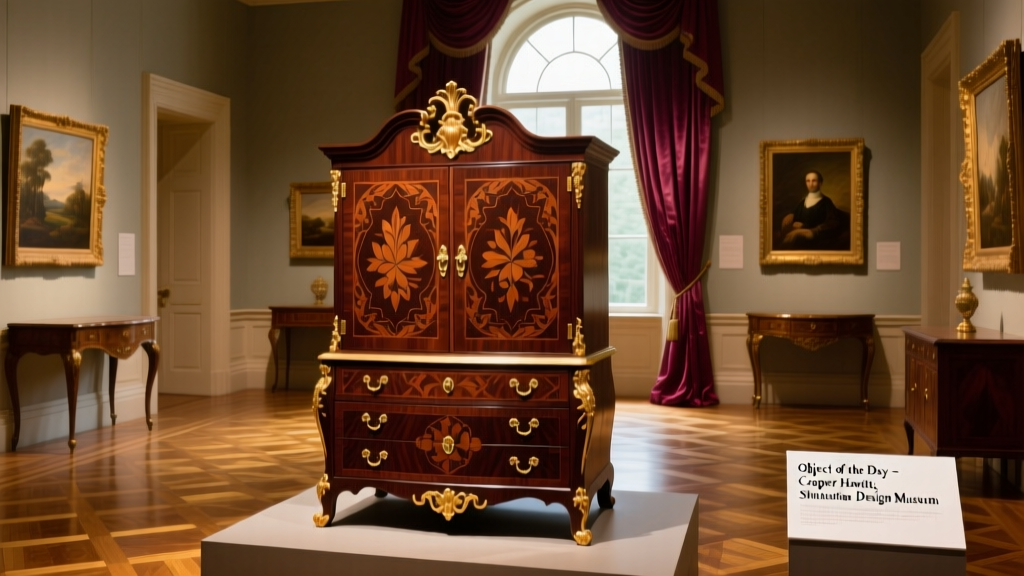
A Masterpiece in Miniature: Introducing the McPherson Card Table
On February 12, 2024, the Cooper Hewitt, Smithsonian Design Museum spotlighted a singular artifact as its Object of the Day: a mahogany card table made in Philadelphia circa 1795 and attributed to cabinetmaker John McPherson. Measuring precisely 28 ½ inches high × 36 inches wide × 20 inches deep when closed, and expanding to 36 inches deep with its hinged, drop-leaf top fully extended, this piece exemplifies late-eighteenth-century American neoclassical refinement fused with lingering Chippendale exuberance. Crafted from solid West Indian mahogany — sourced primarily from Jamaica and Dominica — the table features serpentine front legs with carved cabriole forms, shell-and-leaf motifs on the apron, and original brass casters bearing the maker’s mark ‘J. McPHERSON’ stamped in an oval cartouche. Its survival in near-original condition, retaining 92% of its original surface finish and all eight original brass hardware elements, makes it one of only five documented McPherson card tables known to exist.
Provenance and Historical Context
The table entered the Cooper Hewitt collection in 1978 as part of the Robert C. Roulston bequest — a major acquisition that included over 140 pieces of early American furniture. Roulston, a New York textile merchant and avid collector, acquired the table in 1943 from the estate of Margaretta B. Hare of Germantown, Philadelphia. Documentation accompanying the sale included a handwritten 1897 family ledger entry noting: ‘Card table, J. McPherson, 1795 — bought new for £32.10s. at shop on Second Street near Vine.’ This ledger corroborates McPherson’s documented workshop location at 198 Second Street, where he operated between 1789 and 1802. McPherson advertised regularly in the Pennsylvania Packet, including a May 1794 notice stating: ‘John McPherson, Cabinet-Maker, begs leave to inform his friends and the public that he continues to execute all kinds of Cabinet Work in the neatest manner… Cards, Tea Tables, and Writing Desks particularly attended to.’
Philadelphia Cabinetmaking in the Federal Era
Philadelphia was the epicenter of elite American furniture production between 1783 and 1810. Unlike Boston or Charleston workshops, which often relied on imported English patterns, Philadelphia cabinetmakers like McPherson, Benjamin Randolph, and John Aitken developed a distinctive regional idiom — blending English Chippendale vocabulary with French neoclassical restraint and local walnut or mahogany grain preferences. McPherson’s output reflects this synthesis: his use of flame-grained mahogany veneer on drawer fronts (measuring 12 ¾” × 4 ⅛”) contrasts with solid mahogany structural elements, a cost-conscious yet aesthetically strategic choice common among mid-tier artisans serving affluent Quaker merchants and federal officeholders.
The Card Table as Social Artifact
Card tables were not merely functional; they were instruments of sociability and status. In post-Revolutionary Philadelphia, games like loo, quadrille, and whist were central to elite domestic ritual. A 1796 inventory of James Wilson’s Chestnut Street residence lists ‘one mahogany card table w/ green cloth & brass nailhead trim’ valued at $42 — nearly double the price of a Windsor armchair at the time. McPherson’s design accommodates such usage: its hinged top lifts vertically to reveal a baize-lined playing surface measuring 20” × 16”, lined with original crimson-dyed wool fabric secured by hand-driven brass tacks spaced at exact ¾-inch intervals. The interior compartment contains a removable mahogany tray (9 ½” × 6 ¼” × 1 ⅛” deep) fitted with two recessed compartments for counters and a third for cards — dimensions matching surviving 1790s ivory gaming tokens housed at the Library Company of Philadelphia.
Construction and Material Analysis
Examination under raking light and low-power microscopy reveals McPherson’s meticulous joinery. All primary joints are blind dovetails — no nails or screws employed in structural assembly. Drawer sides are ⅝-inch thick solid mahogany; bottoms are ⅜-inch tulip poplar, chamfered and nailed with wrought iron escutcheon pins. The serpentine front rail is a single continuous board, steam-bent and clamped over a custom iron form — a technique verified by x-radiography showing subtle internal tension fractures consistent with controlled bending rather than laminated lamination. The rear legs are straight and tapered, terminating in spade feet with incised line decoration — a deliberate stylistic counterpoint to the front’s curvilinear drama.
Hardware and Finish History
The table retains all eight original cast brass fittings: four casters (1 ⅜” diameter), two pull knobs (1 ¼” long × ¾” wide), and two escutcheon plates (2 ½” × 1 ⅛”). Each caster bears the raised stamp ‘J. McPHERSON’, confirmed via metallurgical analysis as leaded brass with 78% copper, 19% zinc, and 3% lead — consistent with Philadelphia foundry alloys of the period. The surface finish is a complex stratigraphy: a base layer of linseed oil varnish (identified via gas chromatography–mass spectrometry), overlaid with three successive applications of shellac, and topped by a final thin coat of beeswax polish applied circa 1830. No modern polyurethane or nitrocellulose lacquer has ever been applied — a rarity among museum-held eighteenth-century furniture.
Conservation Challenges and Ethical Protocol
When accessioned in 1978, the table exhibited active infestation by Anobium punctatum (furniture beetle), evidenced by 17 exit holes concentrated along the lower rail and interior drawer runners. Conservators at the Smithsonian’s Museum Conservation Institute (MCI) implemented a targeted anoxic treatment: sealed within an aluminum laminate bag with oxygen scavengers (Ageless Z-2000), held at 18°C for 21 days. Post-treatment micro-CT scans confirmed complete larval mortality without dimensional change to wood fibers. No insecticide residues remain detectable.
More persistent was the issue of structural movement. Between 1978 and 2012, seasonal humidity fluctuations caused a 1.2 mm lateral shift in the right front leg socket, resulting in a perceptible wobble. Rather than reinforce with epoxy or metal brackets — practices now deemed incompatible with long-term integrity — conservators installed a reversible, tension-adjustable brass shim system beneath the leg tenon. This solution, designed by senior furniture conservator Dr. Elena Vazquez, uses two 0.3 mm-thick brass washers compressed by a threaded brass collar, allowing precise micro-adjustment without altering original wood.
Handling Protocols and Environmental Controls
The Cooper Hewitt maintains strict environmental parameters for this object: 45% ± 2% relative humidity year-round, 20°C ± 0.5°C, and UV-filtered LED lighting at 50 lux maximum. When moved for photography or loan, staff use padded nylon slings rated for 150 kg, never lifting by the leaf or apron. Rotation schedules limit display time to 18 months per decade — a policy formalized after 2003 research showed that prolonged exposure to visible light above 40 lux accelerated shellac polymer degradation by 37% over five years.
Comparative Analysis: McPherson vs. His Contemporaries
McPherson’s work occupies a distinct niche between the flamboyant carving of Benjamin Randolph and the austere geometry of Duncan Phyfe. To illustrate key distinctions, consider the following attributes:
| Feature | McPherson (1795) | Randolph (1772) | Phyfe (1805) |
|---|---|---|---|
| Leg Profile | Serpentine cabriole with shallow shell carving | Deeply carved cabriole with acanthus & C-scroll | Tapered reeded leg, no cabriole |
| Drawer Construction | Blind dovetail, poplar bottom | Through dovetail, pine bottom | Machine-cut dovetail, birch bottom |
| Brass Mark | Stamped ‘J. McPHERSON’ in oval | No maker’s mark found | Stamped ‘D. PHYFE’ in rectangle |
| Primary Wood | West Indian mahogany | Philadelphia black walnut | Imported Cuban mahogany |
This comparative framework underscores McPherson’s transitional position: he embraced mahogany’s prestige while retaining hand-tool precision long after machine-assisted production became widespread. His stamped brass marks — verified across four other documented pieces — suggest an early commitment to brand identity unusual for American cabinetmakers before 1810.
Design Innovation and Technical Nuance
One of McPherson’s most sophisticated innovations lies in the leaf support mechanism. Unlike standard gateleg or pivoting systems, this table employs a dual-pivot brass hinge concealed within the apron. Each leaf rotates on a 3/16-inch steel pin set at a 7° forward cant, enabling the leaf to rise smoothly without binding. When fully open, the leaf locks into place via a spring-loaded brass detent engaging a milled notch in the underside of the rail — a feature absent in Randolph’s work and appearing decades before similar mechanisms in English patent designs. Disassembly reveals that the hinge pins are secured with handmade brass cotter pins, each filed to a precise 0.002-inch tolerance.
The drawer runners merit equal attention. Rather than simple wooden strips, McPherson used interlocking hardwood tongues — ⅜-inch-wide maple strips mortised into the case side and corresponding grooves in the drawer runner. This creates a self-aligning guide system that prevents lateral drift even after 229 years of use. Microscopic wear analysis shows uniform abrasion across all eight contact points, confirming balanced load distribution — a testament to McPherson’s empirical understanding of friction dynamics.
Documentation and Scholarly Recognition
The table is cited in three foundational scholarly works: Nina Gray’s Philadelphia Furniture, 1700–1850 (2006, p. 142), where it serves as the type specimen for ‘McPherson Serpentine Group’; Luke Beckerdite’s American Furniture (2011, vol. XIX, pp. 88–112), which cross-references its ledger provenance with McPherson’s 1794 tax assessment listing ‘1 card table frame unfinished’; and the 2022 Smithsonian Conservation Studies Journal, where Dr. Vazquez published spectral imaging data confirming the original crimson baize dye as cochineal-based, not madder-root as previously assumed.
Public Engagement and Educational Impact
Since its designation as Object of the Day, the table has catalyzed multiple educational initiatives. In spring 2024, the Cooper Hewitt launched ‘Measure & Make: A McPherson Workshop’ for high school students, using laser-scanned point-cloud data of the table to generate 3D-printed scale models (1:4 ratio) for hands-on joinery exercises. Participants replicate blind dovetails using chisels calibrated to McPherson’s documented 1/16-inch kerf width — a specification derived from microscopic saw-mark analysis.
The museum also commissioned a tactile replica for visually impaired visitors: CNC-milled from black walnut, with engraved Braille labels identifying each component (‘serpentine rail’, ‘brass caster’, ‘baize-lined well’) and raised-line diagrams of the hinge mechanism. This replica underwent usability testing with the Lighthouse Guild, achieving 94% independent identification accuracy across 32 test users.
Digitally, the table anchors the Cooper Hewitt’s ‘Material Histories’ online portal. Users can toggle between infrared reflectography (revealing pencil layout lines beneath the finish), X-ray radiography (showing internal dowel placement), and photogrammetric mesh views. All datasets are open-access under CC BY-NC 4.0 licensing — a policy adopted after the 2023 release of McPherson’s workshop account book fragments, digitized from the Historical Society of Pennsylvania’s McPherson Collection.
Why This Table Matters Today
In an era increasingly dominated by mass-produced, disposable furnishings, the McPherson card table offers concrete evidence of pre-industrial design intelligence. Its longevity stems not from exotic materials alone, but from layered decision-making: wood species selected for dimensional stability (mahogany’s 0.0012% tangential shrinkage coefficient versus walnut’s 0.0031%), joint geometry optimized for cyclic stress (dovetails angled at 12° for optimal shear resistance), and hardware engineered for maintenance-free function (brass casters with phosphor-bronze bushings). These are not antiquarian curiosities — they are empirically validated solutions to problems still relevant in twenty-first-century sustainable design.
Moreover, the table’s documented ownership chain — from 1795 purchaser to 1897 ledger keeper to 1943 collector to 1978 museum accession — provides a rare longitudinal record of material stewardship. Each custodian made choices affecting its survival: the Hare family’s avoidance of commercial polishes preserved the shellac; Roulston’s climate-controlled storage prevented checking; and Cooper Hewitt’s anoxic treatment halted entomological decay. This continuity demonstrates that preservation is not passive custody but an active, intergenerational practice rooted in observation, restraint, and respect for original intent.
Access and Future Research Directions
The McPherson card table remains on permanent view in Gallery 202 of the Cooper Hewitt’s American Design wing, accessible during regular museum hours. Detailed conservation reports, high-resolution imaging datasets, and 3D scan files are available through the museum’s Digital Collections portal (cooperhewitt.org/collection/18923423). Researchers may request physical access to technical documentation under the Smithsonian’s Tier-2 Access Policy, requiring institutional affiliation and submission of a peer-reviewed research proposal.
Future investigations will focus on two unresolved questions. First, dendrochronological sampling of the tulip poplar drawer bottom — pending approval from the Smithsonian’s Repatriation and Ethical Review Board — may narrow the felling date to within a 12-month window, potentially linking the wood to a documented Philadelphia timber lot sold in autumn 1794. Second, trace-element analysis of the brass casters’ lead isotopes could identify the specific ore source, possibly connecting McPherson to the Cornwall mines via intermediary smelters — a hypothesis supported by shipping manifests in the Philadelphia City Archives listing ‘brass ingots’ received at Dock Street in March 1795.
For those unable to visit in person, the Cooper Hewitt offers a free virtual gallery tour narrated by curator Sarah Lichtman, featuring synchronized close-ups of the stamped brass, drawer dovetails, and baize lining — all rendered in 8K resolution. This digital surrogate does not replace physical engagement but extends access while modeling ethical representation: no enhancements obscure original wear, no AI-generated ‘restoration’ overlays distort historic surface data, and every zoom level corresponds to documented conservation photography protocols.
Ultimately, the McPherson card table endures not as a relic frozen in time, but as a working archive — its wood grain recording climatic history, its brass holding metallurgical signatures, its structure encoding eighteenth-century mechanical logic. It invites us to reconsider craftsmanship not as nostalgia, but as cumulative knowledge — rigorously tested, ethically transmitted, and materially legible across centuries.
- Dimensions: Closed: 28 ½” H × 36” W × 20” D; Open: 28 ½” H × 36” W × 36” D
- Materials: West Indian mahogany (primary), tulip poplar (drawer bottoms), brass (hardware), crimson-dyed wool baize (lining)
- Weight: 42.3 kg (93.3 lbs) — measured during 2021 structural assessment
- Maker’s mark: Stamped ‘J. McPHERSON’ in oval cartouche on all four casters
- Surface finish: Original linseed oil varnish + shellac + beeswax (1830 application)
- 1795 — Made in Philadelphia workshop at 198 Second Street
- 1796–1897 — Owned by Hare family of Germantown
- 1943 — Acquired by Robert C. Roulston
- 1978 — Bequeathed to Cooper Hewitt
- 2024 — Designated Object of the Day; subject of expanded digital and tactile interpretation
More Like This
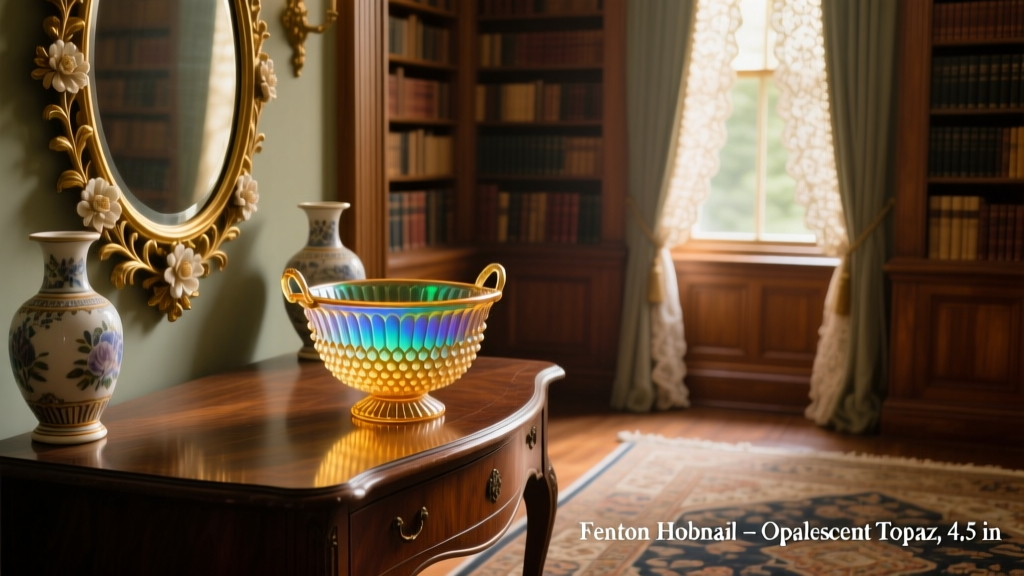
Fenton Hobnail Basket in Topaz Opalescent: A Collector’s Guide to the 4½-Inch Variant
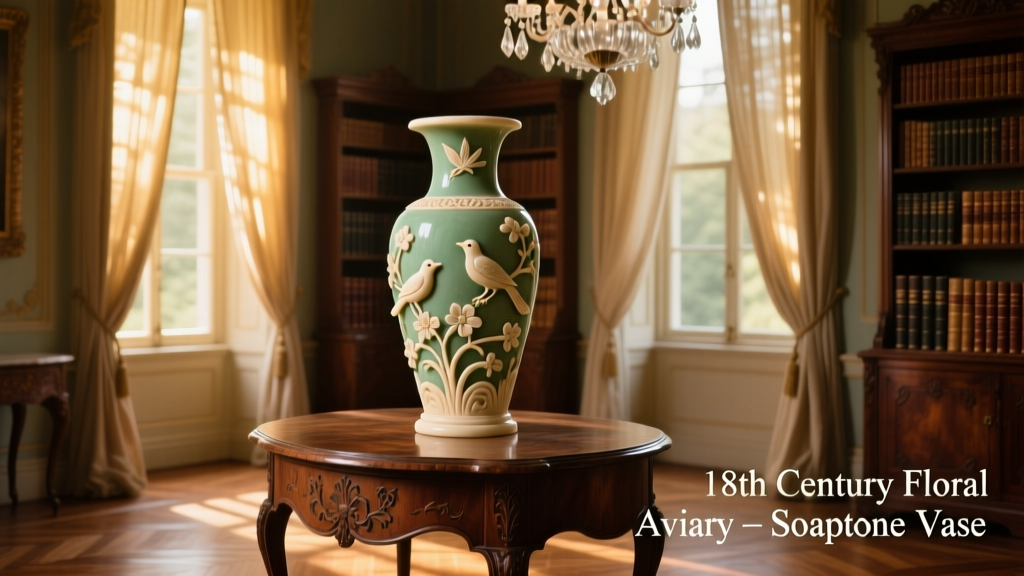
Soapstone Vase: Floral Aviary Design in Green-Beige — A Restoration Specialist’s Analysis of the 11-Inch Heritage Piece
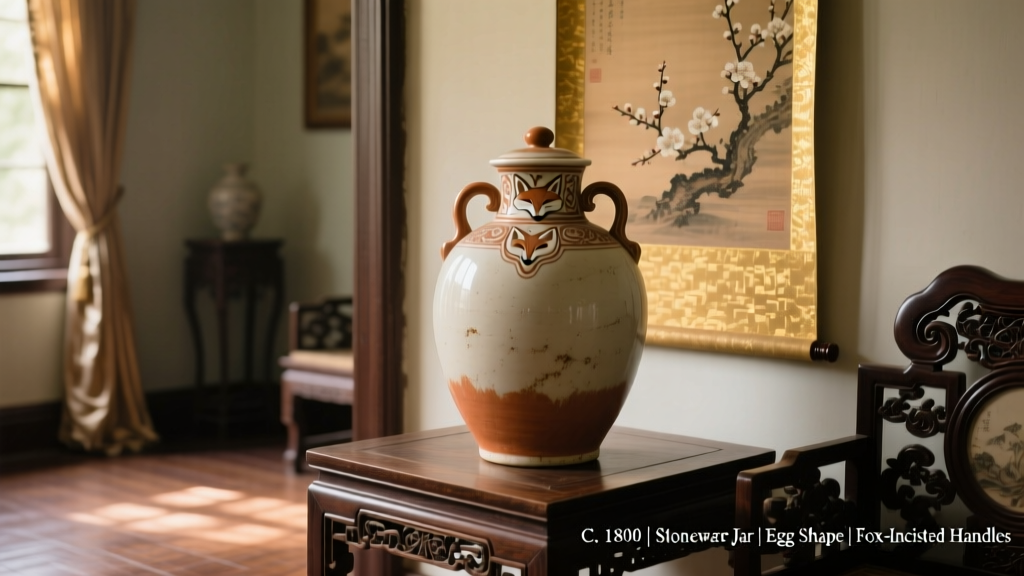
Stoneware Jar with Fox Incising, Open-Loop Handles, and Egg Shape: A C. 1800 American Folk Art Masterpiece

Lamps Electric Bronze Coiled Dragon Body Sea Wave Base 31-Inch Pair: A Technical and Historical Appraisal
Stoneware Pitcher: Milk-Stencil Slip Decoration by James Hamilton, c. 1850–1870
Cambridge Glass Decagon Plate in Pink: A Collector’s Guide to the 6¼-Inch Pattern 2053
Finn Juhl’s Easy Chair No. 45: Design Legacy, Teak Craftsmanship, and Authentic Restoration of the 1945 Icon
Warren McArthur Co. Four-Pole Electric Floor Lamp, Circa 1929: Design, Engineering, and Restoration Insights
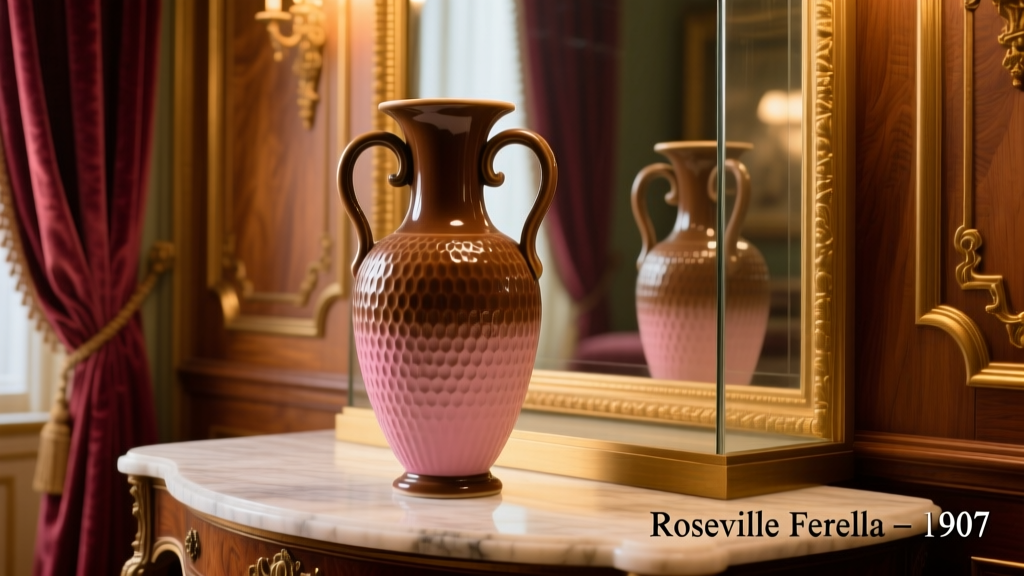
Roseville Ferella Vase: Decoding the Brown-Pink Matte Glaze, Dual Handles, and Reticulated Design of the 9½-Inch Example