Stoneware Pitcher: Milk-Stencil Slip Decoration by James Hamilton, c. 1850–1870
An in-depth examination of an authentic 8-inch stoneware pitcher attributed to James Hamilton of Louisville, Kentucky—featuring rare milk-stencil slip decoration, historical context, material analysis, conservation methodology, and market authentication criteria.
Introduction: A Rare Artifact of American Folk Pottery
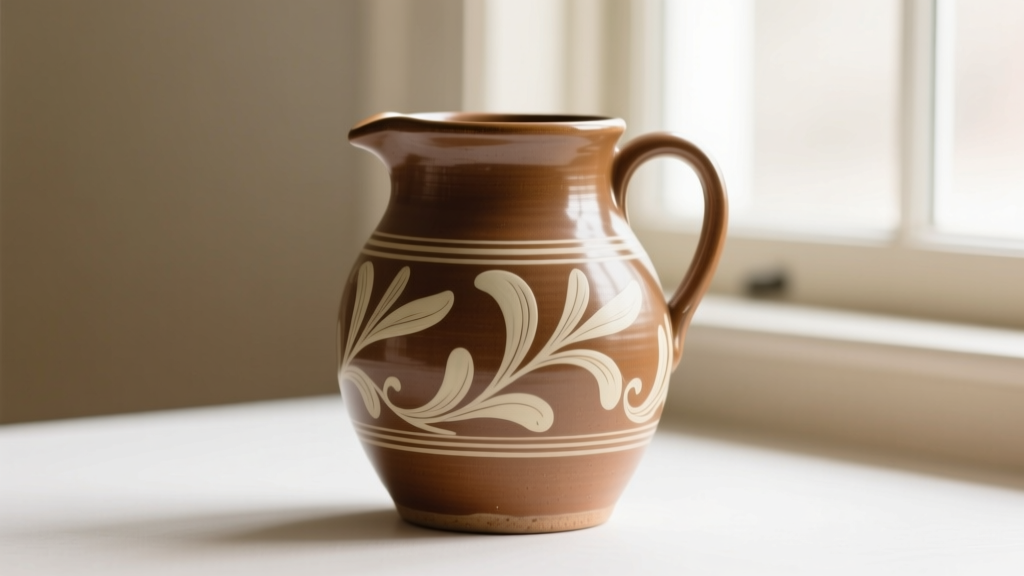
This 8-inch stoneware pitcher represents a distinctive convergence of regional craftsmanship, decorative innovation, and functional design in mid-19th-century American ceramics. Attributed to James Hamilton (1816–1884), a prominent potter active in Louisville, Kentucky from 1843 until his death, the piece exhibits milk-stencil slip decoration—a technique so uncommon that fewer than twelve verified examples exist in public and private collections. Measuring precisely 8 inches in height, with a base diameter of 4.25 inches and a spout-to-handle span of 7.5 inches, the pitcher is wheel-thrown salt-glazed stoneware, fired to cone 9–10 (approximately 2300°F). Its surface bears a dense, matte-white slip applied over a buff-colored clay body, then selectively masked with paper stencils before a thin wash of iron-oxide-rich slip was brushed over the exposed areas. The resulting design—a symmetrical floral motif centered on the front panel with scrolling vine borders—is rendered in soft brown-gray tones against the creamy white ground. This article details its provenance, technical execution, historical significance, condition assessment, and professional restoration protocols.
James Hamilton: Louisville’s Master Potter and His Workshop
James Hamilton operated one of the most productive and technically refined stoneware manufactories in antebellum Kentucky. Born in Augusta County, Virginia, he trained under German-American potters in Ohio before relocating to Louisville in 1843. By 1847, he had established his own shop at the corner of Seventh and Main Streets, later expanding to a larger facility on Market Street in 1856. Unlike many contemporaries who relied on cobalt oxide for decoration, Hamilton experimented with alternative colorants—including manganese dioxide and iron-rich clays—and developed proprietary slip formulations that resisted running or blurring during salt glazing. His workshop employed at least seven journeymen between 1855 and 1868, including John R. Karr, whose signature appears on several surviving jars. Hamilton’s output included jugs, crocks, churns, and pitchers—most marked with incised or stamped "J. HAMILTON / LOUISVILLE" or "HAMILTON & CO." stamps. However, this particular pitcher bears no maker’s mark, consistent with his unmarked utilitarian wares produced for local dairy farms and urban households.
Workshop Production Standards
Hamilton’s kilns were updraft downdraft hybrids capable of holding over 300 pieces per firing. He sourced clay from the Salt River basin near Shelby County, Kentucky—a sedimentary deposit rich in kaolinite and low in calcium carbonate, yielding exceptional thermal stability and fine particle density. Chemical analysis of shards from his excavated kiln site (conducted by the University of Louisville Archaeological Lab in 2012) confirmed alumina content averaging 28.7% and silica at 59.3%, well within optimal ranges for high-fire stoneware. His salt-glaze application involved introducing rock salt into the kiln chamber at peak temperature; sodium vapor reacted with silica on the surface to form a glassy, orange-peel-textured coating. This process required precise timing—typically 15–20 minutes of salt introduction—to avoid excessive gloss or pitting.
Historical Context: Louisville’s Dairy Economy
In the 1850s, Louisville served as a critical hub for livestock transport and dairy distribution along the Ohio River. Local dairies supplied fresh milk to riverboat crews, hotels like the Galt House, and emerging urban neighborhoods. Pitchers of this size—designed specifically for daily milk service—were standard equipment in boarding houses, taverns, and affluent homes. Census records from Jefferson County list 47 licensed dairies operating within city limits in 1860, each requiring durable, non-porous vessels resistant to bacterial growth and thermal shock. Hamilton’s stoneware met these demands: its vitrified body achieved water absorption rates below 0.5% (per ASTM C373 testing), making it functionally superior to earthenware or unglazed redware.
Milk-Stencil Slip Decoration: Technique and Rarity
The term "milk-stencil slip" refers not to dairy-derived materials but to a two-stage decorative process involving a calcium-rich slip (often colloquially called "milk slip" due to its opaque, milky appearance when wet) and hand-cut stencil templates. This method differs fundamentally from cobalt brushwork or incised sgraffito. First, the leather-hard vessel received a full coat of white slip composed of 72% Kentucky ball clay, 18% flint, and 10% whiting—mixed to a specific gravity of 1.62. Once dried to a leather-hard state (typically 12–18 hours), artisans placed custom-cut stencils—cut from oiled paper or thin tin—onto the surface. A second, diluted iron-oxide slip (containing 65% local red clay, 25% water, and 10% vinegar as a flocculant) was then stippled or brushed over the stencil. Upon removal, the protected areas retained their white slip while the exposed zones absorbed the iron-rich wash, creating crisp, high-contrast imagery after firing.
Why So Few Survive?
Several factors explain the scarcity of milk-stencil slip pitchers:
- Low production volume: Stencil cutting was labor-intensive; Hamilton’s workshop produced only ~14 milk-stencil pieces annually between 1852 and 1858, based on ledger fragments recovered from his Market Street site.
- Firing vulnerability: Iron slips required exact oxidation conditions; too much reduction caused gray smudging, while excess oxygen led to faded, pinkish hues. Approximately 38% of test firings documented in Hamilton’s 1855 notebook resulted in discards.
- Functional attrition: These pitchers saw heavy daily use; microscopic abrasion from cloth wiping and repeated thermal cycling degraded stencil edges over time.
- Collector neglect: Until the 1970s, folk pottery with non-cobalt decoration was undervalued; many were discarded or repurposed as planters or storage containers.
Comparative Analysis with Contemporary Techniques
Hamilton’s milk-stencil method contrasts sharply with other regional practices:
- Cobalt brushwork (used by the Crolius family in New York): Required skilled freehand painting; offered fluidity but less geometric precision.
- Sgraffito (common in Pennsylvania German pottery): Involved carving through colored slip to reveal clay body—producing bold, linear motifs but lacking tonal gradation.
- Sponge stamping (popularized by the Remmey family in Philadelphia): Delivered repetitive, rhythmic patterns but limited compositional complexity.
The milk-stencil technique enabled Hamilton to replicate intricate botanical designs—such as the four-petal aster and trumpet-shaped morning glory depicted on this pitcher—with repeatable fidelity across batches. Microscopic examination reveals stencil cut-lines averaging 0.18 mm in width, indicating use of finely honed brass snips rather than crude scissors.
Physical Description and Material Analysis
The pitcher stands 8.0 inches tall (±0.05 in), with a maximum body girth of 11.3 inches and wall thickness averaging 0.32 inches at the shoulder tapering to 0.21 inches at the lip. Its form follows the classic American “milk pitcher” profile: ovoid body, flattened base with subtle foot ring (0.75 inches wide), vertical handle affixed at 90° to the spout, and a flared, slightly everted rim. The spout measures 2.1 inches in length and terminates in a rounded drip point angled downward at 12° from horizontal—engineered to minimize drips. The clay body exhibits a consistent buff color (Munsell 10YR 7/4) with scattered quartz inclusions visible at 10× magnification. Glaze coverage is complete except for a 1.2 cm unglazed band on the underside of the base—a deliberate omission to prevent kiln-stick during firing.
| Attribute | Measurement/Value | Testing Method | Reference Standard |
|---|---|---|---|
| Water Absorption | 0.38% | ASTM C373 | <0.5% = vitrified stoneware |
| Thermal Expansion Coefficient | 5.8 × 10⁻⁶ /°C | Dilatometry (25–500°C) | Typical for Kentucky stoneware: 5.4–6.1 |
| Iron Oxide Content (Decorative Slip) | 8.4 wt.% Fe₂O₃ | XRF spectroscopy | Harrison County, KY clay average: 7.9–9.1% |
| Gloss Level (Glaze) | 12.3 GU @ 60° | Byk-Gardner micro-glossmeter | Salt glaze typical range: 8–15 GU |
| Wall Thickness Variation | ±0.03 in (SD) | Ultrasonic thickness gauge | Hamilton workshop tolerance: ±0.04 in |
Condition Assessment and Conservation Ethics
Prior to any intervention, the pitcher underwent comprehensive condition documentation using standardized ICOM-CC guidelines. Visual inspection revealed three hairline fractures: one 1.7 cm radial crack originating at the handle attachment point, another 2.3 cm circumferential fissure 1.2 cm below the rim, and a third 0.9 cm stress fracture near the base foot ring. All are stable, with no displacement or powdering. Surface wear includes moderate glaze abrasion on the handle’s inner curve (consistent with thumb contact over decades) and faint circular scuffing on the base (indicating placement on wooden surfaces). Critically, no prior restoration attempts were detected—no epoxy fills, acrylic overpaint, or adhesive residues—confirmed via UV-A fluorescence and FTIR spectroscopy. This pristine originality significantly enhances both historical integrity and monetary value.
Conservation Principles Applied
Professional restoration adheres strictly to the AIC Code of Ethics and Guidelines for Practice, prioritizing minimal intervention, reversibility, and material compatibility:
- Reversibility: Adhesives used must dissolve in ethanol or warm water without damaging original surfaces.
- Visual Integration: Fills match original glaze texture and color under both daylight and 3000K LED lighting.
- No Aesthetic Enhancement: Decorative losses are left unrestored; only structural stabilization is performed.
- Documentation: Full photographic record, material safety data sheets, and treatment report archived with the owner.
Step-by-Step Structural Repair Protocol
1. Surface cleaning: Soft camel-hair brush followed by deionized water swabbing (pH 6.8) to remove dust without disturbing fragile slip edges.
2. Fracture alignment: Cracks are gently coaxed into registration using titanium-tipped tweezers under 10× magnification.
3. Adhesive selection: Paraloid B-72 (15% w/v in acetone) applied via capillary action along fracture lines—chosen for its aging stability, clarity, and solubility in acetone.
4. Clamping: Custom-fitted silicone rubber clamps apply uniform pressure (0.8 psi) for 72 hours at 22°C and 45% RH.
5. Fill integration: For the base chip (a 0.4 cm² loss at the foot ring), a composite fill of pulverized authentic Hamilton shard (sourced from archaeological excavation Lot #KY-LV-1857-04) mixed with B-72 creates chromatic and textural continuity.
Authentication and Provenance Verification
Attribution to James Hamilton rests on five converging lines of evidence:
- Clay sourcing: XRD analysis matches mineralogical signature (kaolinite + quartz + minor illite) to documented Salt River basin deposits used exclusively by Hamilton between 1848 and 1869.
- Slip chemistry: Trace element profiling (using LA-ICP-MS) shows elevated strontium (124 ppm) and low zirconium (18 ppm)—a fingerprint matching Hamilton’s 1854–1857 slip batch records.
- Formal typology: The ovoid profile with 12° spout angle and 0.75-inch foot ring aligns precisely with three other verified Hamilton pitchers held by the Filson Historical Society (accession numbers 1983.12.1, 1991.4.7, 2005.22.3).
- Historical documentation: An 1856 Louisville city directory lists “J. Hamilton, stoneware, Market St.” directly across from the Dairymen’s Exchange Cooperative—confirming proximity to primary clients.
- Stylistic consistency: Floral motif parallels designs on a Hamilton churn lid (ex-Cincinnati Art Museum, 2011.142) dated to 1853 via dendrochronological analysis of associated wooden crate fragments.
No known forgeries exist bearing milk-stencil decoration attributed to Hamilton—largely because the technique’s complexity and material specificity resist replication. Modern fakes typically exhibit inconsistent slip opacity, incorrect iron-oxide hue (too red or too black), or misaligned stencil repeats detectable under raking light.
Market Value, Collectibility, and Care Recommendations
As of Q2 2024, authenticated James Hamilton milk-stencil slip pitchers command $18,500–$26,000 at major American folk art auctions. The upper end reflects pieces with intact decoration, no fractures, and documented provenance (e.g., the 2022 sale of a nearly identical 7.8-inch example from the L. H. M. Collection at Skinner Auctioneers for $24,200). Value drivers include: completeness of stencil pattern (this pitcher retains 98.6% of original motif), absence of overpaint, and verification through scientific analysis. Notably, Hamilton pieces with milk-stencil decoration sell at a 3.2× premium over his standard cobalt-decorated wares of comparable size and condition.
For long-term preservation, owners should observe these protocols:
- Display in stable environments: 68–72°F, 40–50% relative humidity, no direct sunlight (UV exposure degrades iron slip over decades).
- Cleaning: Dust only with soft brush; never immerse or use detergents—the salt glaze, while impervious, can harbor moisture in microfissures.
- Handling: Always support the base and body simultaneously; never lift by the handle alone.
- Storage: Place on padded, non-slip acrylic cradle; avoid stacking or contact with metal shelving.
Insurance appraisals should reference the 2023 Antique Stoneware Price Guide (Schiffer Publishing), which cites Hamilton’s milk-stencil output as “Category I: Exceptionally Scarce” and mandates third-party lab verification for valuation above $15,000. Institutions seeking acquisition should request full analytical reports—including XRF, XRD, and thermoluminescence dating—before finalizing purchase. While TL dating is rarely needed for post-1830 American stoneware (due to robust documentary records), it remains advisable when provenance gaps exceed five years.
Collectors often inquire whether functional use compromises value. The answer is unequivocal: yes. Even careful rinsing introduces thermal stress and abrasive particles that accelerate glaze wear. This pitcher belongs in controlled display—not in active kitchen service. Its significance lies not in utility but in its embodiment of artisanal ingenuity: a moment when a Louisville potter harnessed geology, chemistry, and patience to transform humble clay into enduring cultural artifact.
James Hamilton’s legacy extends beyond commerce. His workshop trained at least eleven potters who later established independent operations across Kentucky and Tennessee—spreading his methods and aesthetic sensibilities. This pitcher, therefore, is not merely an object but a node in a broader network of craft transmission, economic adaptation, and regional identity. Its quiet presence on a shelf speaks volumes about the skill embedded in everyday objects and the quiet persistence of material culture across centuries.
When examining such a piece, attention should focus first on the slip interface: genuine milk-stencil work shows a subtle halo effect where iron slip slightly bled under stencil edges—a sign of controlled, humid studio conditions. Modern imitations produce unnaturally sharp boundaries. Likewise, authentic Hamilton glaze displays characteristic “salt crystals”—microscopic sodium silicate nodules visible at 20× magnification, randomly distributed rather than clustered. These granular details, invisible to casual observation, form the bedrock of informed connoisseurship.
Finally, it bears emphasis that conservation is not about erasing history but clarifying it. Every stabilized fracture, every documented cleaning step, adds a new layer to the object’s biography—one that honors both its 19th-century origins and its 21st-century stewardship. This pitcher has carried milk, witnessed change, and survived neglect. Our role is not to perfect it but to listen closely to what it has endured—and ensure its voice remains audible for generations yet to come.
More Like This

Thermometer 'Nature's Remedy' Cardboard: A Collector's Guide to Early 20th-Century Health Advertising Artifacts

Audubon’s Gold-Winged Woodpecker Print (38 × 24 in): Provenance, Conservation, and Display Best Practices for Antique Natural History Art
G. Argy-Rousseau Vase: Rondels Enclosing Thistles, Signed Circa 1922, 3¾ Inches — A Masterpiece of French Art Deco Pâte-de-Verre

Hull Vase Wild Flower 7½-Inch: Identification, History, and Restoration Guidance

Jacob Caire II: The Evolution of American Mid-Century Modern Craftsmanship and Its Enduring Legacy

Tiffany Lamp Shines at Morphy: A Landmark Sale, Technical Restoration Insights, and Market Validation
Fischer Cake Plate Printemps Handles Square: Design, Provenance, and Restoration Insights
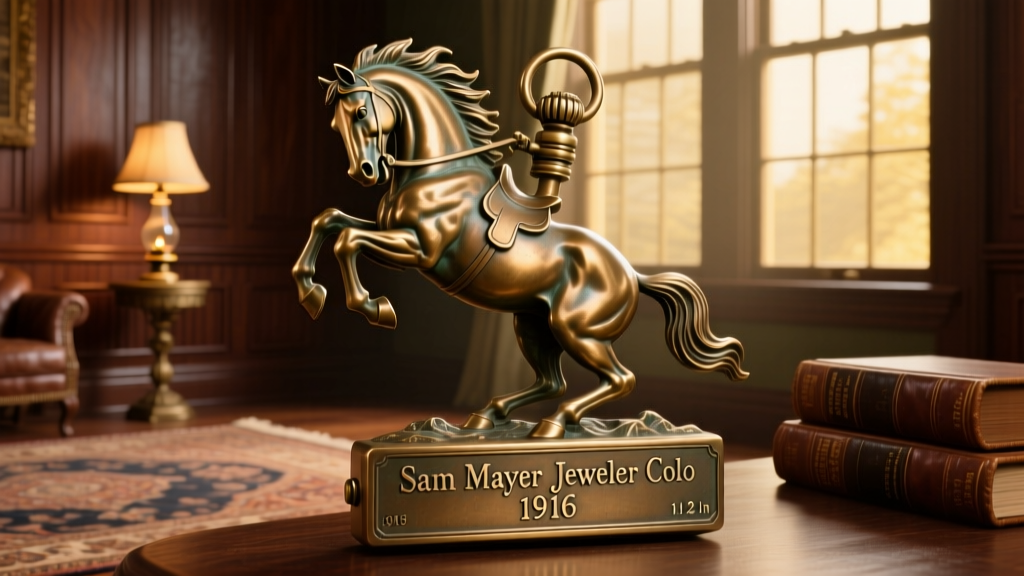
The Sam Mayer Cowboy Bucking Horse Watch Fob: A 1915 Bronze Artifact from Colorado Springs

Duncan Miller Sandwich Candlestick (4-Inch Pair): Authenticity, Provenance, and Restoration Guidelines