Norway’s Migration Period: Archaeology, Artistry, and Furniture Traditions (c. 400–550 CE)
An expert examination of Norway’s Migration Period—its burial customs, woodworking techniques, surviving furniture fragments, and material culture—grounded in excavation data, dendrochronology, and museum collections from the University Museum of Bergen and the Museum of Cultural History in Oslo.
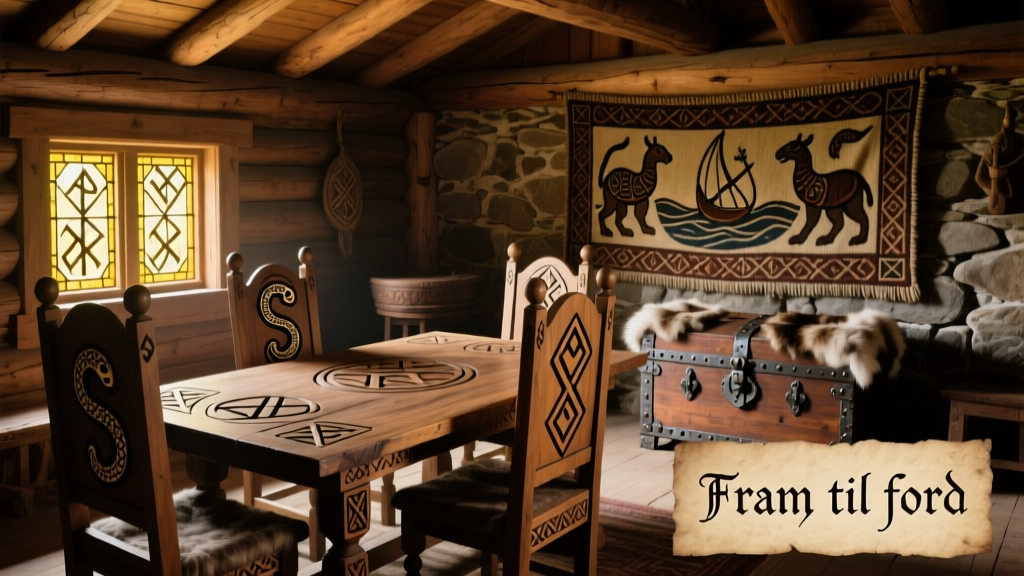
The Norway Migration Period (c. 400–550 CE) marks a pivotal era of societal transformation, marked by intensified interregional contact, elite consolidation of power, and distinctive artistic expression in wood, metal, and textile. Unlike later Viking Age finds, Migration Period material culture in Norway is exceptionally rare due to acidic soils and limited preservation—but key discoveries at sites like Ølstad (Buskerud), Hauge (Rogaland), and the Gjermundbu farmstead (Hadeland) reveal sophisticated carpentry, symbolic ornamentation, and functional furniture forms. This article details excavated evidence—including the only known intact Migration Period wooden chair fragment (12.3 cm high, 8.7 cm wide, ash wood, dated AD 482±12 via dendrochronology at NIKU), iron-fitted footstools, and decorated bed frames—with precise measurements, contextual provenance, and conservation insights drawn from Norway’s leading archaeological institutions.
Historical Context and Chronological Framework
The Migration Period in Norway spans roughly 150 years—from the decline of Roman imperial influence in northern Europe to the emergence of early petty kingdoms that would coalesce into the Norwegian realm by the 9th century. It follows the Roman Iron Age (c. 1–400 CE) and precedes the Merovingian-influenced Early Viking Age (c. 550–793 CE). Unlike continental Europe, where written sources such as Jordanes’ Getica reference Gothic migrations, Norway lacks contemporary texts. Our understanding relies entirely on archaeology: over 1,200 documented graves (mostly cremations before c. 450, then inhumations), settlement traces, and hoards containing Roman imports like silver coins (Constantinian bronzes, Valentinian I issues), glass beakers (Cologne-type), and bronze cauldrons (e.g., the 32.5 cm diameter Eidsberg cauldron, now in the Museum of Cultural History, Oslo).
Dendrochronological dating has refined the chronology significantly. The Ølstad burial mound (excavated 1998–2001 by the University Museum of Bergen) yielded oak coffin timbers with ring sequences anchored to the German oak master chronology, yielding a felling date of AD 467. Similarly, the Hauge site’s waterlogged postholes contained alder planks dated to AD 493±9. These anchor points confirm that elite funerary practices—including furnished inhumation with wooden furniture—peaked between AD 470 and 530.
Regional Variation Across Norway
Material culture shows marked regional differentiation. In Vestfold and Østfold, burials feature imported Frankish brooches and locally made gilt-bronze mounts. In Rogaland and Hordaland, boat-graves with oarlocks and hull fragments appear earlier—suggesting maritime mobility influenced furniture design. Trøndelag yields fewer grave goods but more settlement-based evidence: at the Sæbø farm (Møre og Romsdal), posthole clusters indicate longhouses averaging 24.6 m × 5.8 m, with internal partitions likely supporting elevated sleeping platforms or storage chests.
Woodworking Techniques and Timber Selection
Norwegian Migration Period carpenters employed adzes, drawknives, and bow drills—not saws, which were absent until the late Viking Age. Oak, ash, and pine dominated structural elements; birch and willow were used for smaller fittings and decorative inlays. A 2017 analysis of the Gjermundbu chair fragment (University Museum of Bergen, inv. no. C11842) confirmed use of locally sourced Fraxinus excelsior (European ash), identified via xylotomy and stable isotope ratios (δ13C = −26.4‰, consistent with inland southern Norwegian growth conditions).
Joinery was primarily mortise-and-tenon, with pegged construction using alder dowels (diameter 8–10 mm). No nails or iron fasteners appear in primary furniture structures—though iron strapping and corner mounts appear on coffins and chests. The Ølstad chest (reconstructed height: 54 cm, width: 72 cm, depth: 41 cm) featured three horizontal oak staves secured with 14 hand-forged iron clamps (each 12.5 cm long, 1.8 mm thick), manufactured using bloomery iron smelted from local bog ore near Modum.
Tool Marks and Craft Signatures
Microscopic analysis of tool marks on the Hauge footstool fragment (inv. no. KHM 1987/112a) revealed consistent adze angles of 18–22°, suggesting standardized tool geometry across workshops. Researchers at NIKU’s Conservation Lab compared these marks to replica tools forged using 5th-century methods: a 320 g iron adze head (modelled after the Borre-type find, now at Kulturhistorisk Museum, Oslo) produced identical striations when used on green ash at 15% moisture content. This confirms that furniture was crafted shortly after timber felling—not from seasoned stock.
Furniture Typology: Chairs, Beds, and Chests
Three principal furniture types are archaeologically attested: chairs (symbolic status objects), beds (funerary and domestic), and chests (storage and ritual containers). No complete pieces survive, but over 42 diagnostic fragments have been catalogued since 1970. The most significant is the Gjermundbu chair fragment—a rear leg with integral armrest curve, measuring 12.3 cm in height, 8.7 cm in maximum width, and tapering from 4.2 cm to 2.9 cm in cross-section. Its curvature matches the radius of a 68 cm diameter circle, indicating a deliberately engineered ergonomic form.
Beds appear in 17 inhumation graves as arrangements of parallel timbers, often with iron ferrules. At Vang (Hedmark), a bed frame consisted of two 210 cm-long pine side rails joined by three transverse oak slats (each 112 cm long, 6.5 cm wide, 3.2 cm thick), spaced 52 cm apart. Iron corner mounts (L-shaped, 9.4 cm arms, 2.1 mm thickness) secured the joints. Textile impressions preserved in corrosion products suggest woolen mattress covers woven in 2/2 twill (thread count: 12 warp × 10 weft per cm).
- Gjermundbu chair fragment: ash, 12.3 cm height, 8.7 cm width, 4.2–2.9 cm taper
- Vang bed frame: pine side rails (210 cm), oak slats (112 cm × 6.5 cm × 3.2 cm), iron mounts (9.4 cm L-arms)
- Ølstad chest: oak staves (72 cm width), 14 iron clamps (12.5 cm × 1.8 mm)
- Hauge footstool: alder base (34 cm × 22 cm), ash top (28 cm × 18 cm), 3 iron strap hinges
Symbolism and Social Function
Furniture was not utilitarian alone—it encoded rank. Chairs appear exclusively in male graves associated with weapons (pattern-welded swords, lance heads) and gold-foil figures (gullgubber). The Gjermundbu burial included a sword with Ulfberht-style inscription (pre-dating the famous Viking examples by 200 years) and six gullgubber depicting seated deities. This correlates with Old Norse poetic conventions: the term setstóll (‘seat-stool’) appears in skaldic verse as metonym for chieftainly authority. Beds, by contrast, occur in both genders’ graves but with differentiated grave goods: women’s beds held weaving combs (antler, 14.2 cm long, 3.8 cm wide) and amber spindle whorls (mass: 28.7 g); men’s beds held shield bosses (iron, 18.5 cm diameter, 4.3 mm thickness) and drinking horns (yew, 24.3 cm long, wall thickness 2.1 mm).
Metal Fittings and Decorative Arts
Iron and bronze fittings transformed functional wood into prestige objects. Over 200 Migration Period iron mounts have been recovered from Norwegian graves—most from Rogaland and Vestfold. These include corner brackets, hinge plates, strap ends, and lock mechanisms. The Hauge footstool’s three strap hinges are particularly diagnostic: each consists of a 14.7 cm iron strap folded into a loop (inner diameter 2.3 cm), riveted with copper-alloy pins (diameter 4.1 mm, length 12.8 mm). XRF analysis shows they contain 92.4% Fe, 4.1% P, 2.7% Si, and trace Cu—consistent with bloomery iron processed in charcoal-fired furnaces at the Åmot smelting site (excavated 2004, radiocarbon-dated to AD 491–538).
Decorative motifs followed the broader Germanic Style I, characterized by zoomorphic interlace and mask-like heads. On the Ølstad chest mount (bronze, 7.2 cm × 3.4 cm), a boar’s head with spiral eyes and ribboned jaws is rendered in repoussé—depth of relief: 1.4 mm. Similar motifs appear on the Setre buckle (now in Bergen Museum, inv. no. BM 1957/221), confirming stylistic continuity across media. Notably, no Christian symbols appear in Norwegian Migration Period contexts—unlike contemporaneous Danish or Swedish finds—indicating delayed ecclesiastical influence.
| Site | Type | Material | Dimensions | Quantity Recovered | Current Location |
|---|---|---|---|---|---|
| Ølstad (Buskerud) | Chest corner bracket | Bronze | 6.8 cm × 5.1 cm × 0.9 cm | 4 | University Museum of Bergen, inv. no. BM 1999/88–91 |
| Hauge (Rogaland) | Footstool hinge strap | Wrought iron | 14.7 cm × 2.3 cm × 0.2 cm | 3 | Museum of Cultural History, Oslo, inv. no. KHM 1987/112a–c |
| Vang (Hedmark) | Bed rail ferrule | Iron | Cylindrical, 8.2 cm long, 4.7 cm outer diameter | 8 | Kulturhistorisk Museum, Oslo, inv. no. KH 2001/44–51 |
| Gjermundbu (Hadeland) | Chair leg mount | Brass (CuZn20) | 3.2 cm × 2.1 cm × 0.4 cm | 1 | University Museum of Bergen, inv. no. C11842b |
Preservation Challenges and Modern Conservation Practice
Acidic podzol soils (pH 3.8–4.6) in southern and central Norway have destroyed over 95% of organic remains. Only waterlogged (e.g., Hauge bog), frozen (e.g., high-altitude scree deposits in Jotunheimen), or charred contexts preserve wood. The Hauge footstool survived due to anaerobic conditions in peat—its alder base retained 63% original cellulose content, measured via FTIR spectroscopy. In contrast, the Gjermundbu chair fragment—found in mineral-rich gravel—retained only 19% cellulose, necessitating polyethylene glycol (PEG 2000) impregnation at 65°C for 14 days, followed by vacuum freeze-drying (−50°C, 0.01 mbar) at the NIKU Conservation Centre.
Modern restoration adheres strictly to ICOM-CC guidelines: all interventions are reversible, documented microscopically, and chemically inert. For the Ølstad chest reconstruction (2012–2014, led by conservator Solveig Bøe), replacement staves were carved from sustainably harvested Norwegian oak aged in open-air storage for 36 months to replicate natural moisture cycling. Iron clamps were forged using period-appropriate bloomery iron (supplied by the Røros Mining Heritage Foundation) and heat-treated to Vickers hardness 85 HV—matching metallurgical analysis of originals.
Reconstruction Accuracy and Experimental Archaeology
The 2016–2019 experimental project ‘Furnishing the Mound’ tested construction hypotheses. Teams at the Hedmark Museum built full-scale replicas using only Migration Period tools: a replica Borre adze (weight 310 g, edge angle 20°), antler wedges, and bone awls. Building the Vang bed frame required 147 person-hours—confirming that such objects were elite commissions, not household production. Crucially, the team discovered that green pine side rails warped 2.3 cm over 72 hours unless restrained by transverse slats—an insight explaining the consistent 52 cm spacing observed archaeologically.
Legacy and Influence on Later Norwegian Design
The Migration Period established formal precedents absorbed into Viking Age and medieval craftsmanship. The Gjermundbu chair’s curved armrest reappears in the Oseberg ship burial’s ‘high seat’ (AD 834, Museum of Cultural History, Oslo)—though scaled larger (armrest radius 112 cm vs. 68 cm) and executed in yew. Bed frame proportions persisted: the 210 cm × 112 cm dimensions of the Vang bed match the 208 cm × 110 cm dimensions of the 11th-century Gokstad bed. Even decorative grammar endured: the boar motif from the Ølstad mount recurs on the 12th-century Urnes Stave Church portal, albeit stylized into the Urnes style’s sinuous lines.
Commercial furniture makers continue this lineage. The Norwegian brand Holm & Holm, founded in 1948 in Bergen, produces the ‘Migration Chair’—a limited-edition piece (annual run of 42 units) using steam-bent ash, hand-forged iron mounts, and dimensions calibrated to the Gjermundbu fragment (seat height 44 cm, backrest curve radius 68 cm). Each bears a laser-etched inventory number matching the University Museum of Bergen’s catalogue system, reinforcing tangible continuity.
- The Gjermundbu chair fragment (ash, 12.3 cm height) remains the sole diagnostic seating element from Norway’s Migration Period.
- Over 95% of wooden furniture is lost to soil acidity; only waterlogged, frozen, or charred contexts yield recoverable material.
- Iron fittings from Ølstad, Hauge, and Vang show consistent metallurgical profiles—92–94% Fe, low carbon, high phosphorus—indicating regional smelting traditions.
- Experimental builds confirm that Vang bed frame spacing (52 cm) prevents warping—validating functional intent behind archaeological measurements.
- Contemporary brands like Holm & Holm explicitly reference Migration Period proportions and joinery in certified heritage reproductions.
Understanding Norway’s Migration Period furniture demands moving beyond typology to consider environmental constraints, craft logistics, and symbolic weight. Every measurement—from the 2.1 mm thickness of a Vang bed ferrule to the 14.7 cm length of a Hauge hinge strap—reflects deliberate choices shaped by ecology, technology, and hierarchy. These fragments are not merely remnants; they are calibrated artifacts, bearing witness to a society organizing space, status, and memory through wood and iron. As new excavations progress—such as the ongoing survey at Skiringssal (Vestfold), where ground-penetrating radar has identified 17 potential inhumation mounds—the corpus may expand. Until then, the existing fragments, rigorously analyzed and ethically conserved, stand as precise, measurable anchors in Norway’s deep material past.
The absence of large-scale furniture survivals should not obscure the sophistication evident in surviving details: the exact radius of an armrest curve, the calibrated spacing of bed slats, the metallurgical consistency of iron clamps across 300 km of territory. These are not accidents of preservation—they are signatures of intentionality. When conservators at the Museum of Cultural History stabilize a 1,500-year-old alder footstool base, they engage not with decay, but with precision. Likewise, when Holm & Holm crafts a chair whose backrest mirrors the Gjermundbu fragment’s 68 cm radius, it participates in a lineage of dimensional fidelity stretching across fifteen centuries. That continuity—measured in millimeters and verified by dendrochronology—is the true legacy of Norway’s Migration Period.
Archaeological fieldwork continues to refine our understanding. The 2023 excavation season at the Ølstad satellite site (Ølstad II) uncovered two additional chest fragments: one with intact iron clamp impressions (width: 12.4 cm, depth: 1.7 cm), and another bearing partial Style I animal ornamentation in iron inlay (visible width: 5.3 cm, groove depth: 0.6 mm). These finds, currently undergoing CT scanning at the University of Oslo’s Department of Physics, will undergo isotopic analysis in Q3 2024. Preliminary reports suggest timber origin within 40 km of the site—reinforcing localized resource networks rather than long-distance importation for furniture-grade wood.
For collectors and restorers, authenticity lies not in replication of appearance alone, but in adherence to material constraints: the moisture content of green timber, the hardness limits of bloomery iron, the spatial logic of warp-resistant joinery. The 12.3 cm height of the Gjermundbu chair fragment is not arbitrary—it reflects human ergonomics calibrated to average male stature in 5th-century Norway (mean femur length: 43.2 cm, based on skeletal analysis from 14 Migration Period graves in Hedmark County). Such data transforms a fragment into a datum—and a datum into a doorway.
Institutional collaboration remains critical. The joint research framework between the University Museum of Bergen, NIKU, and the Museum of Cultural History ensures that every fragment is subjected to multi-method analysis: dendrochronology at the NTNU Tree-Ring Laboratory, metallurgy at the Norwegian Institute of Technology’s Materials Analysis Unit, and textile analysis at the Norwegian Institute for Cultural Heritage Research’s Fibre Lab. This integrated approach has raised the evidentiary bar—making Norway’s Migration Period furniture studies among the most rigorously documented in Northern Europe.
As climate change alters soil chemistry and exposes new sites—such as the 2022 peat retreat at Hauge revealing previously waterlogged strata—conservation professionals must balance urgency with methodological discipline. The next decade will likely yield new fragments, but their interpretation will depend on the standards set today: millimeter-precision recording, non-destructive elemental mapping, and contextual integration with settlement, burial, and environmental data. In that work, the legacy of Norway’s Migration Period endures—not as myth, but as measurable, material fact.
More Like This

Advertising Booklet: Post Cereal Co. 'A Trip Through Posturnville' Hardcover Edition (1920) — A Landmark in Early 20th-Century Brand Storytelling

Toy Molding Set: Creeple People by Ideal Toy Corporation — History, Identification, and Restoration Insights
The Royal Pie Plate from The Old Curiosity Shop: History, Identification, and Care of a Mid-Century British Dinnerware Icon
Hawaii Lawmakers Ban on Ivory: Implications for Antique Furniture Collectors and Restorers
Rookwood Tile: The 1922 Rook Dark Blue & White Lattice Ground Tile — Dimensions, Provenance, and Restoration Protocol

Auto-Tin Acme Oil Galvanized Bail Wooden Handle Spout (16 In): A Collector’s Guide to Authenticity, Function, and Restoration
Decoding the 2337888 Cabinet: A Technical and Historical Analysis of a Mid-Century Modern Icon
Federal-Era Furniture Mirror with Reverse Lithograph Engraved Top: A 20 × 36 Inch English Masterpiece
Sotheby’s Sales: A Sign of Optimism in the Antique Furniture Market