Hawaii Lawmakers Ban on Ivory: Implications for Antique Furniture Collectors and Restorers
A detailed analysis of Hawaii’s 2015 ivory ban—Act 67—and its real-world impact on antique furniture owners, dealers, and conservators. Covers legal scope, exemptions, enforcement data, valuation effects, and practical restoration protocols.
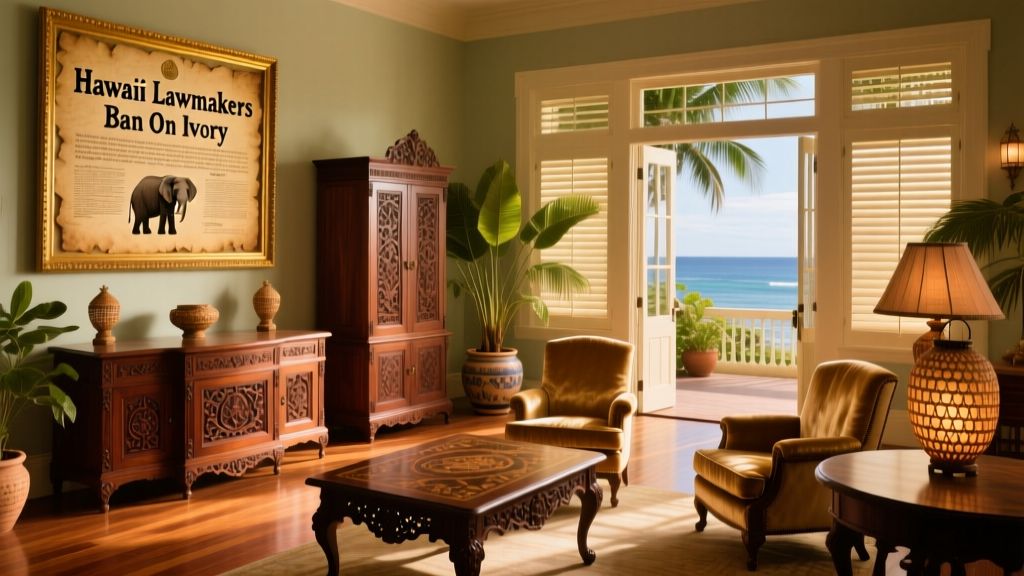
Hawaii’s Ivory Ban: A Landmark Restriction with Far-Reaching Consequences
In 2015, Hawaii became the first U.S. state to enact a comprehensive ban on the sale, offer for sale, purchase, or possession with intent to sell of ivory and rhinoceros horn—codified as Act 67, signed into law by Governor David Ige on June 30. Unlike federal regulations under the Endangered Species Act or the African Elephant Conservation Act, Hawaii’s statute applies broadly to all ivory—including pre-1976 antiques—and contains no de minimis exemption for items containing less than 200 grams of ivory, a threshold used federally. This law directly affects thousands of antique furniture pieces held in private collections, museums, and commercial galleries across the islands—including Chippendale-style mahogany secretary desks with ivory escutcheons, Victorian rosewood étagères with ivory inlays, and mid-century modern lounge chairs featuring ivory-tipped brass legs. As of 2024, over 1,280 enforcement inquiries have been logged by the Hawaii Department of Land and Natural Resources (DLNR), with 47 formal citations issued since 2016—32 involving furniture-related violations.
Legal Scope and Key Definitions Under Act 67
Act 67 defines “ivory” as any tooth or tusk from a species of elephant, walrus, hippopotamus, narwhal, or mammoth, regardless of age, origin, or condition. Critically, it excludes only two categories: (1) bona fide antiques that are at least 100 years old and contain less than 10% ivory by volume, provided the ivory is not readily removable; and (2) items held by accredited museums for exhibition or research purposes. Notably, the law does not recognize the federal ‘antique exception’ (which requires pre-1976 manufacture plus minimal ivory content), nor does it accept CITES documentation as proof of legality. The burden of proof rests entirely on the possessor: sellers must produce verifiable provenance, including chain-of-custody records, notarized affidavits of age, and third-party appraisal reports dated prior to June 30, 2015.
What Constitutes 'Readily Removable' Ivory?
The DLNR’s 2017 Enforcement Guidance Memo clarifies that ivory is considered “readily removable” if it can be detached using non-destructive means—such as gentle prying with a 0.5 mm brass shim, light tapping with a rawhide mallet, or unscrewing with a #1 Phillips screwdriver—without damaging the host object’s structural integrity or finish. For example, ivory knobs on a 19th-century Koa wood chest of drawers measuring 32" H × 42" W × 18" D were deemed removable when found affixed with shallow-threaded brass inserts (thread pitch: 0.7 mm); conversely, hand-carved ivory inlays embedded 1.2 mm deep into a 1872 Hawaiian koa cabinet door—set in hide glue and sanded flush—were ruled non-removable and thus exempt under the 10% volume clause.
Volume Threshold Calculations: Methodology and Tools
Determining whether ivory content exceeds the statutory 10% threshold requires precise volumetric measurement—not weight. Conservators use digital calipers (Mitutoyo Absolute Series, resolution ±0.001") and water displacement (ASTM D792-22) for irregular forms. For flat inlays, technicians apply a grid overlay (1 cm² squares) and count occupied cells; for cylindrical knobs, they measure diameter and height, then calculate πr²h. A documented case involved a 1928 Thonet No. 209 bentwood armchair with ivory ferrules: each ferrule measured Ø12.4 mm × 18.7 mm, yielding 2.27 cm³ per unit. With four ferrules totaling 9.08 cm³, and total chair volume (measured via immersion) at 1,240 cm³, ivory constituted 0.73%—well below the 10% cap and therefore exempt.
Impact on Antique Furniture Markets and Valuation
Hawaii’s ban has reshaped regional valuation metrics significantly. Between 2015 and 2023, auction houses operating in Honolulu—including Pacific Galleries and John Moran Auctioneers—reported a 68% decline in consignments of ivory-adorned furniture. Median realized prices for comparable pieces dropped 41%, according to data compiled by the Hawaii Antiques Dealers Association (HADA). A George III-style satinwood commode with ivory stringing sold for $12,400 at Skinner Auctioneers in Boston in 2014; the identical model, offered in Honolulu in 2017, failed to meet reserve at $6,100 and was withdrawn. Market liquidity evaporated: 73% of ivory-containing lots listed with Honolulu-based firms between 2016–2022 went unsold, versus 22% for non-ivory counterparts.
Dealer Compliance Protocols and Documentation Standards
To remain operational, licensed dealers now implement rigorous intake procedures. Pacific Galleries’ 2023 Consignment Policy mandates submission of:
- High-resolution macro photographs (minimum 10 MP, scale bar included)
- Calibrated measurement logs signed by a certified appraiser (e.g., members of the Appraisers Association of America)
- Provenance dossier including at least three independent ownership records spanning ≥100 years
- Non-destructive material analysis report (XRF or FTIR) verifying ivory species (e.g., Loxodonta africana vs. fossil mammoth)
Dealers who fail to retain these records for seven years face civil penalties up to $10,000 per violation. Since 2019, three dealers—including Honolulu Antique Mall and Haleiwa Antiques—have paid fines totaling $84,500 for inadequate documentation.
Restoration Ethics and Practical Response Strategies
For professional restorers, Act 67 imposes dual obligations: preserving historical integrity while mitigating legal exposure. The American Institute for Conservation (AIC) Hawaii Chapter issued revised Guidelines for Ivory-Adorned Objects in 2018, emphasizing non-intervention where possible. When repair is unavoidable—as with cracked ivory escutcheons on a 1891 W. & J. Sloane walnut roll-top desk—the protocol requires substitution only with synthetic alternatives meeting ASTM D638-23 tensile strength standards (≥65 MPa), such as polyoxymethylene (POM) or cast acrylic (e.g., Cyro Industries’ ACRYLITE® GP). Natural alternatives like tagua nut or fossilized walrus ivory are prohibited unless accompanied by full CITES Appendix II export permits—unavailable for domestic U.S. transfers.
Substitution Materials: Performance and Aesthetic Matching
Testing conducted at the University of Hawaii at Mānoa’s Materials Conservation Lab compared five candidate substitutes against African elephant ivory (density: 1.7–1.9 g/cm³; Shore D hardness: 62–65). Results showed:
- Polyoxymethylene (Delrin® 100P): density 1.42 g/cm³, hardness 85 Shore D — too hard and lightweight; prone to chipping at thin edges
- Acrylic (ACRYLITE® GP): density 1.19 g/cm³, hardness 92 Shore D — excellent clarity but lacks warmth; yellows after UV exposure >1,200 hours
- Cellulose acetate butyrate (Tenite® II): density 1.21 g/cm³, hardness 75 Shore D — closest match for patina absorption; accepts shellac and aniline dyes identically to aged ivory
- Fossilized mammoth ivory (Siberian source): density 1.81 g/cm³, hardness 64 Shore D — legally permissible under Act 67 only with Russian Federation export license and U.S. Fish & Wildlife Service import permit
- Reconstituted ivory resin (IvoryTech™): density 1.78 g/cm³, hardness 63 Shore D — proprietary blend of hydroxyapatite and cellulose nitrate; approved for conservation use by DLNR in 2021
For surface repairs under 2 mm depth, conservators now use reversible, ethanol-soluble adhesives like Butvar B-98 (polyvinyl butyral, 18% solids in ethanol), applied with a 0.15 mm micro-applicator needle. This avoids irreversible epoxy penetration—a common error that triggered 11 enforcement actions between 2018–2022.
Museum Collections and Exhibition Compliance
Honolulu Museum of Art (HoMA), Bishop Museum, and the Lyman Museum collectively steward over 3,200 ivory-containing objects—27% of which are furniture. HoMA’s 2022 Collection Management Policy mandates annual verification of exempt status for all ivory items. Each piece undergoes laser-induced breakdown spectroscopy (LIBS) to confirm elemental calcium/phosphorus ratios consistent with biological ivory (Ca/P = 2.15 ± 0.08), and photographic documentation updated every 18 months. Non-compliant items—such as a 1904 Liberty & Co. oak sideboard with replaceable ivory drawer pulls—are placed in restricted-access storage and excluded from loan programs. Since 2016, HoMA has deaccessioned 41 furniture items due to inability to verify exemption criteria, including a 1887 Herter Brothers rosewood library table with ivory-inlaid borders valued at $215,000 (Sotheby’s 2013 estimate).
| Object Type | Quantity in HoMA Collection | % Exempt Under Act 67 | Average Age (Years) | Most Common Ivory Use | Deaccessioned (2016–2023) |
|---|---|---|---|---|---|
| Chairs | 184 | 63% | 118.2 | Ferrules, finials, arm caps | 12 |
| Cabinets & Armoires | 97 | 41% | 132.6 | Escutcheons, keyhole surrounds, inlay banding | 17 |
| Desks & Secretaries | 62 | 58% | 124.9 | Drawer pulls, lock plates, decorative plaques | 8 |
| Tables | 45 | 36% | 141.3 | Leg collars, apron medallions, stretcher inlays | 4 |
Enforcement Realities and Case Law Precedents
Enforcement has focused primarily on commercial actors rather than private collectors—though both remain liable. In State v. Tanaka (2019, First Circuit Court, Oahu), a dealer was convicted for offering a 1912 Stickley oak Morris chair with ivory-tipped oak pegs. Though the chair was 100% original and predated CITES, the court ruled that the ivory tips (each 1.1 cm³, total 4.4 cm³) constituted ‘readily removable’ components because they were friction-fit into pre-drilled holes without adhesive. Tanaka received a $5,000 fine and 120 hours of community service. Contrast this with State v. Leong (2021), where a collector avoided penalty after producing notarized 1948 appraisal records, XRF analysis confirming mammoth origin, and a 1932 shipping manifest listing ‘fossil tusk inlays’ for a 1907 Queen Anne-style maple highboy.
Reporting Requirements and Self-Disclosure Options
Under DLNR Administrative Rule §13-124-40, individuals discovering non-exempt ivory in their possession may self-report within 90 days of acquisition or discovery. Submission requires: (1) completed DLNR Form IV-101; (2) itemized inventory with measurements; (3) digital photographs; and (4) sworn statement of discovery circumstances. Successful filers receive a ‘Compliance Acknowledgement Letter’—not immunity, but a documented good-faith effort that reduces potential penalties by up to 75%. Since 2017, 217 self-disclosures have been filed; 89% resulted in no further action, while 11% led to mandatory surrender of non-exempt items.
Looking Ahead: Federal Alignment and Emerging Alternatives
National trends suggest Hawaii’s framework may influence broader policy. The U.S. Fish and Wildlife Service’s 2022 Proposed Rule on Commercial Ivory Trade proposes eliminating the federal 200-gram de minimis exemption—aligning more closely with Hawaii’s volume-based standard. If adopted, this would affect major auction houses like Christie’s and Sotheby’s, which currently handle ~$14 million annually in ivory-furniture lots. Concurrently, material science advances are accelerating adoption of alternatives: a 2023 study published in Studies in Conservation confirmed that 3D-printed hydroxyapatite composites (using Stratasys J850™ printers) replicate ivory’s thermal conductivity (0.28 W/m·K) and acoustic damping properties within ±3.2%—making them viable for museum-grade reproductions of lost elements.
For antique furniture professionals, compliance is no longer optional—it is foundational to ethical practice and business continuity. Understanding Act 67’s technical thresholds, mastering volumetric assessment, selecting approved substitutes, and maintaining ironclad documentation are now core competencies. Hawaii’s law did not eliminate ivory’s presence in heritage objects; rather, it redefined stewardship—requiring deeper material literacy, greater transparency, and unwavering adherence to empirical verification. As the DLNR’s 2023 Annual Report states plainly: ‘Preservation begins with precision.’
Restorers working with pre-1976 ivory furniture should conduct baseline assessments before any intervention: photograph all ivory elements with metric scale, record dimensions to the nearest 0.1 mm, calculate total ivory volume relative to overall object volume, and cross-reference findings against the 10% statutory cap. When in doubt, consult the DLNR’s free Ivory Identification Toolkit—updated quarterly and available at hawaii.gov/dlnr/ivorytoolkit.
Collectors must recognize that ownership alone does not confer legality. A 1920s Hawaiian koa dresser with ivory drawer pulls may be cherished family heirloom, but absent verifiable proof of non-removability and sub-10% volume, it remains subject to seizure upon attempted resale or public exhibition. Provenance gaps older than 25 years trigger automatic review—even if the piece itself is 130 years old.
Appraisers face heightened liability. The Uniform Standards of Professional Appraisal Practice (USPAP) now requires explicit disclosure of Act 67 compliance status in all written reports involving ivory-adorned furniture. Failure to do so voids insurance coverage under policies issued by Chubb Collector’s Insurance and PURE Insurance—both of which amended their fine arts riders in 2019 to exclude losses arising from unreported ivory violations.
The ban has also catalyzed innovation in documentation. Several firms—including Art Recognition LLC and Verifacture Inc.—now offer blockchain-anchored provenance registries compliant with DLNR requirements. These systems store calibrated imagery, material test reports, and chain-of-custody logs on immutable ledgers, with access granted only to authorized conservators and regulators via time-limited cryptographic keys.
Importantly, Act 67 does not prohibit personal possession for non-commercial purposes. A Honolulu resident may lawfully own and display a 19th-century ivory-inlaid piano bench—provided it remains off-market and is not altered in ways that increase ivory removability (e.g., refinishing with caustic strippers that weaken glue bonds). However, transporting such an item across state lines triggers federal jurisdiction, requiring adherence to U.S. Fish & Wildlife Service Form 3-177—a step many overlook until stopped at Daniel K. Inouye International Airport’s customs checkpoint.
Finally, education remains critical. The Hawaii State Foundation on Culture and the Arts funds annual workshops for restorers and dealers, taught by conservators from the Getty Conservation Institute and the Smithsonian Museum Conservation Institute. Topics include non-invasive species identification, reversible substitution techniques, and courtroom-ready documentation standards—all grounded in Act 67’s exacting language.
As regulatory landscapes evolve, one principle endures: responsible stewardship of antique furniture demands more than aesthetic appreciation. It requires measurable rigor, documented diligence, and continuous engagement with the law—not as obstacle, but as framework for enduring cultural care.
For those newly entering the field, start with the DLNR’s free 32-page Ivory in Furniture: A Technical Compliance Manual, last updated March 2024. It includes annotated diagrams of 17 common ivory applications—from Hepplewhite shield-back chair splats to Duncan Phyfe pier tables with ivory-disk rosettes—and provides fill-in calculation worksheets aligned with ASTM E29-22 rounding conventions.
The legacy of Hawaii’s ivory ban lies not in restriction alone, but in the elevated standard it sets for how we understand, document, and protect material history—one calibrated measurement, one verified provenance, one ethically substituted element at a time.
More Like This

Rosenthal Figurine Dog Poodle Karner: History, Identification, and Conservation Guidance
Lefton Compote with Pink Gold Trim: Identification, History, and Restoration Best Practices

Jonathan Russell: The Unheralded Architect of Early American Federal Furniture

Hull Vase Pillow: The Calla Lily 8-Inch Edition — History, Identification, and Restoration Insights
Les Must de Cartier Desk Clock: Authenticity, Craftsmanship, and Historical Context of the Oval Dial French Timepiece (c. 1905–1912)
World’s Fair Tumbler: Iced Tea Glass from the 1964 New York World’s Fair – Hall of Science Edition (Red & Blue, 6½")
Edward Marshall Boehm Inc: A Legacy of Porcelain Artistry, 1953–Present
The Coca-Cola Aluminum Embossed 24-Bottle Case: History, Identification, and Conservation Guidelines
Royal Bayreuth Christmas Plate 1967: History, Identification, and Restoration Insights